
Step 5: Group representatives present their products, other groups listen and contribute ideas, can ask questions and add more.
Step 6: Teacher summarizes, comments, and makes general assessment. Implementation process:
Method 1: Guide students to exploit knowledge through historical propaganda posters
Method: Group discussion.
Group discussion is conducted through the participation of members in exchanging opinions based on the specific assignment of work to one or more small groups. It is the way teachers organize, guide and control the process of student groups discussing learning content to achieve teaching objectives.
To conduct group discussions, it is necessary to divide the class into different large and small groups, depending on the classroom conditions and the questions/topics being discussed.
Using group discussion method in class is very important in innovating current teaching and learning methods. Instead of the teacher giving lectures, students listening and taking notes, this method stimulates the cooperation of all members to solve learning tasks right in class.
Using posters for group discussion means that groups of students will work with historical posters that the teacher has prepared. The teacher will guide students to exploit historical knowledge from historical posters.
For example, when teaching lesson 18: The early years of the national resistance war against French colonialism (1946-1950). Part I. The national resistance war against French colonialism broke out.
Group activity: divide the class into 2 large groups, then the teacher uses the following propaganda poster:
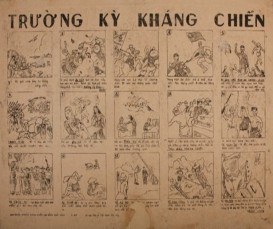
Picture No. 1 Picture No. 2
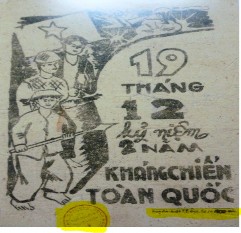
Vietnam Revolutionary Museum, p. 143)
Figure 2.1: Propaganda poster celebrating the anniversary of the national resistance war. (Source: Taken from the book 9 years of resistance war through propaganda posters –Figure 2.2: Propaganda poster promoting the Party's resistance line. (Source: Taken from the Propaganda Poster Collection - Military Museum. |
Maybe you are interested!
-
 Some Basic Requirements for Secondary School Teachers When Organizing Experiential Teaching of History
 -
 Organizing extracurricular activities in history teaching at Thanh Ha High School - Hai Duong on the occasion of the 90th anniversary of the founding of the Communist Party of Vietnam - 2
 -
 Current Status of Organizing Experiential Activities in Teaching History and Geography in Grades 4 and 5
 -
 Organizing extracurricular activities in history teaching at Thanh Ha High School - Hai Duong On the occasion of the 90th anniversary of the founding of the Communist Party of Vietnam - 15
 -
 Summary of Teachers' Opinion Survey Results on the Measure of "Organizing Students to Learn History Using the Problem-Solving Method"
The teacher introduces the lighting conditions of the two pictures.
After showing the poster, the teacher asked students to observe and work in groups.
Group 1 : Observe picture 1. What is your general idea of the national resistance day and what is the event shown in the picture? Why did that event take place and what is its significance?
Group 2 : Observe picture 2, please summarize the content of the picture according to your group's understanding. What events are the images in the picture related to? What do you think is the message the picture conveys? Why?
Students discuss in groups, then the groups present their discussion content. The groups listen and contribute their opinions.
Teacher comments and evaluation.
This way of working in groups will attract all students in the class to participate, through observing pictures and connecting knowledge in the textbook. With picture 1, students will deeply remember the event of December 19, 1946, the national resistance day, and explain why we issued a national call.
national resistance against French colonialism, then combine with textbooks and analyze the images of the painting to know the content of the call for national resistance. With painting 2. Students understand the message that the painting refers to, which is one of the basic contents of the Party's line of resistance against French colonialism: all-people, comprehensive, long- term , self-reliance and seeking international support. It is important that we must fight long-term because we must rely on our circumstances and power. And the manifestations of long-term resistance are illustrated by the actions of the Party and the people on that propaganda painting.
Method 2: Guide students to prepare and build a presentation about the knowledge content in the lesson and chapter, combined with the use of historical propaganda pictures for illustration.
Method: teamwork, game organization
Example 1 : Teachers can guide students to work in groups for Part II, section 2. The historical Dien Bien Phu campaign (1954), lesson 20: The nationwide resistance war against French colonialism ended (1953 - 1954). Teachers assign group tasks for students to prepare at home in advance as follows:
- Draw or collect propaganda paintings about our preparations to respond to the Dien Bien Phu campaign and present the content of the painting.
- Draw or collect propaganda paintings about the fighting spirit, determined to defend Dien Bien Phu and present the content of the painting.
- Draw or collect propaganda pictures about the anniversaries of Dien Bien Phu victory and present the meaning of those pictures.
Students divide themselves into groups and choose tasks that are appropriate to their abilities and interests. Teachers guide students on how to do it specifically, make plans for implementation, and answer students' questions. Regarding drawing, teachers suggest reference drawing samples and
encourage and promote student creativity
Example 2 : When teaching about the resistance war against French colonialism, teachers can guide students to collect, research and present products in the form of
is a reportage with illustrations, group activities and preparation at home with the following topics:
Group 1 : Topic: August Revolution 1945
Requirements : collect or draw historical propaganda paintings with content encouraging people to participate in movements to solve famine, the struggle movement of Hanoi people and the preparation work for the struggle and revolutionary spirit of the people in the South, Central region, the celebration of National Day September 2, 1945...
Group 2 : Topic: Work and activities of the Vietnamese Government one year after the success of the August Revolution.
Requirement : collect or draw historical propaganda paintings about the work of eliminating ignorance and hunger (specifically: the movement to eliminate illiteracy, the movement to donate, increase production, practice thrift...)
Group 3 : topic: national resistance
Requirements : collect or draw propaganda paintings about the preparation work and revolutionary spirit, the determination to fight of the people of the whole country, the fighting spirit of the national defense soldiers, guerrilla teams, logistics work serving combat, major campaigns...
Students can be grouped by themselves or by class list. The topics will be drawn by group representatives to receive the group's topics. After receiving the group's topics, the group leader assigns specific tasks to each member.
Teachers give specific instructions to students to present their products and guide them on how to write a reportage related to the topic of each group.
This way of working in groups will help students develop their creativity, proactively acquire knowledge, develop and practice subject practice skills, organization, cooperation, and presentation.
Example 3 : when teaching about the Viet Bac campaign in the fall and winter of 1947
To clearly see the fighting spirit of the soldiers on the front line and the support of women for the soldiers. Especially the spirit of encouraging the winter soldier movement. The teacher organized a contest to combine propaganda pictures with
topic “Winter Soldiers”. Teacher prepares 26 puzzle pieces corresponding to 6 pictures. Teacher divides the class into 3 groups, each group will receive 12 puzzle pieces corresponding to 2 different pictures.
In a short period of time, each group will have to quickly complete the product, which is to combine 12 pieces into 2 complete pictures and a short, concise presentation about the meaning of the group picture.
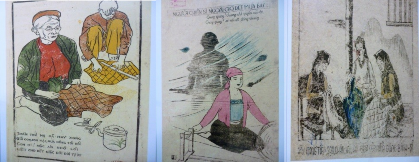
Figure 2.3: Propaganda poster encouraging people to support the winter soldiers movement. (Source: Taken from the book 9 years of resistance through propaganda posters - Vietnam Revolutionary Museum, pp. 20-27)
This way of working in groups will increase the interest in learning, mobilize the members of the class to participate and create a lively atmosphere in the class. Most importantly, students can receive a lot of knowledge quickly after completing their products. Maximize the ability to cooperate and present the group.
2.3.2 Using propaganda posters in organizing exchange and conversation activities
Discussion and dialogue in teaching History is the work in which teachers raise questions for students to answer in turn; at the same time, students can discuss with each other, under the guidance of the teacher. The form of discussion and exchange is very suitable for large historical contents and topics of a general nature. Teachers can conclude
structure one or more historical topics to form a common theme for discussion and exchange.
Using historical propaganda posters in exchange and dialogue activities means using propaganda posters as materials in the teaching process. It can be through exchange and dialogue between teachers and students or students with each other to achieve certain learning goals.
The use of historical propaganda posters for discussion and dialogue in teaching History is carried out in the following forms:
a) Observe the propaganda posters, discuss and talk to recreate historical events.
In history lectures, teachers mainly use pictures to illustrate the text channel, but this method is not effective and engaging. Regarding historical propaganda pictures, it is not simply to illustrate the content that does not attract a certain active student, but it also contains an important source of information to help students understand more deeply about historical events. Through observing the pictures, the imagination, especially the perception of the students and importantly the guidance and suggestions of the teacher help students find the content and historical meaning that the propaganda pictures show.
Using historical posters through the exchange process between teachers and students to recall the knowledge learned to acquire new knowledge to generalize and systematize knowledge or suggest knowledge to be learned in the new lesson. It helps students consolidate and understand more deeply the old knowledge, as a basis for acquiring new knowledge, without interruption in perception.
Using historical propaganda posters in exchange activities to recreate historical events can also be done at the beginning of class to introduce a new lesson or during the lecture to reinforce or affirm events. At that time, teachers need to review old knowledge so that students can perceive it continuously and systematically.
For example, when teaching lesson 18: The early years of the national resistance war against French colonialism (1946-1950). Lesson 2, Section IV. New historical circumstances and
Fall-Winter Border Campaign 1950. The teacher let students observe the propaganda picture encouraging the army and people to unite to kill the French invaders in Viet Bac.
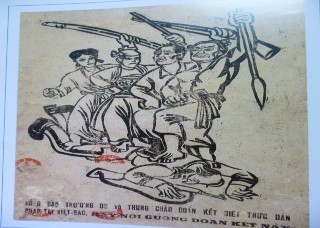
Figure 2.4: Propaganda posters to encourage the people's spirit of solidarity and fighting. (Source: Taken from the book 9 years of resistance through propaganda posters - Vietnam Revolutionary Museum, page 16)
The teacher uses the following re-enactment question: What event does the picture you are observing remind you of? What is the message of the picture? When observing the picture, students can easily see that it is the spirit of solidarity in the fight to kill the French invaders of our army and people and the heavy defeat of the French invaders. That is also the message that the picture shows (encouraging the army and people to unite to kill the French invaders under any circumstances). After the students recall and answer, the teacher continues to ask: Tell me: What plots and actions did the French colonialists have after the failure of the Viet Bac campaign?
That is a problematic situation where students are forced to recall knowledge and answer. The teacher continues: After the failure of the French in the first attack on Viet Bac, they planned to attack Viet Bac a second time with the expectation of winning to quickly end the war. In that situation, what policies and actions did we have?... By leading like this, students will grasp knowledge systematically and continuously.
Or the teacher asks students to observe the picture and answer the question: How do you imagine the results of the Viet Bac campaign? Through observing the picture, combining the images and the text, students can see the propaganda picture promoting the spirit of solidarity and struggle of the people in Vietnam.
North and the heavy defeat of the French army. Then the teacher can continue to lead, after the French failed in Viet Bac, they continued to plot to attack Viet Bac once again with the expectation of winning to quickly end the war. In that situation, what policies and actions did we have... let's learn about the content of the Autumn-Winter Border campaign. Thus, it will create a chain of events to help students grasp knowledge quickly and easily.
b) Use propaganda posters to discuss and discuss to research and analyze historical events.
Through exchange and discussion, teachers help students acquire knowledge, present and understand the logic and nature of historical events through historical posters. In this exchange, teachers guide students to exploit knowledge, explore, analyze and evaluate historical events from posters.
Example 1 : When teaching lesson 17, section II, you can use propaganda posters with the content: "Responding to the call of the Party, the government and President Ho Chi Minh" to destroy "famine" , "ignorance", "foreign invaders" for students to observe, the teacher asks the question:
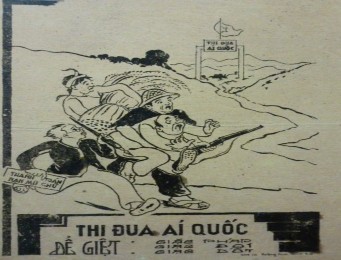
Figure 2.5. Propaganda poster calling on people to participate in the patriotic emulation movement. (Source: Taken from the book 9 years of resistance through propaganda posters - Vietnam Revolutionary Museum, page 43)
Analyze the content of the painting according to your understanding and tell us what the message of the painting is. When students observe, they can see that the painting calls on people to participate in the patriotic emulation movement to kill the French invaders.