a. Rubric-based assessment form
b. Checklist of report contents
c. Test with essay and multiple choice questions
d. Record students' daily events
Question 6. The teacher plans to apply the observation method to evaluate in teaching History and Geography. In your opinion, which of the following evaluation tools is most suitable?
a. Record students' daily events
b. Checklist of report contents
c. Test with essay and multiple choice questions
d. Rubric-based assessment form
Table 2. Lesson plan for teaching practical content
PRACTICAL LESSON PLAN
LESSON INFORMATION
1. Lesson name
Designing visual stories in geography teaching using video editing software | |
2. Course/module | Application of ICT in geography teaching |
3. Duration | 3 credit hours (50 minutes/1 hour) |
4. Object | 3rd year student |
Maybe you are interested!
-
 Measure 2: Tighten Management of the Development and Implementation of Program Content, Teaching Plans, Education and Training in Disaster Prevention
 -
 Objective Test Questions Used in Teaching the Lesson "Equation of a Straight Line"
 -
 Testing the Urgency and Feasibility of Measures to Manage Geography Teaching Activities
 -
 Teaching History - Geography in an Integrated Direction at Secondary School
 -
 Management Ensures the Requirements for Teaching Cultural Heritage Education Content in Social Science Subjects in Secondary Schools
LESSON OBJECTIVES
After completing this lesson, students will be able to:
Present the concept, benefits and steps of building visual stories in geography teaching.
Develop a script to edit a visual story with geographical content to serve the teaching of a specific lesson/topic.
Practice technical operations using Camtasia software to edit image stories for geography teaching
PREPARATION OF LECTURERS AND STUDENTS
Lecturer: Prepare lectures, reference image stories, edit software tutorial videos, evaluation criteria, computer practice room with enough computers for students
Students: Install software, download images related to a geographical topic from the Internet, personal computer (if available), study materials
TEACHING METHODS
Open dialogue method
Method of using visual aids
Sampling method
Practical method
LEARNING ACTIVITIES
Active name
dynamic
Teaching methods | Evaluation plan | Time (Minute) | |
Start | - Objective: Understand the effect of visual stories in teaching geography - Procedure: The teacher asks students to watch a picture story titled "living pearl" (environmental issue) to answer the following questions: 1. What message does the author of this picture story want to convey? 2. What is the main content of the story? 3. What created emotions for the viewer through the story being told? 4. What values are taught to students? 5. What geography teaching content can this picture story be used in? - GiV introduces photo story editing software and guides students to choose the most popular software. | - Evaluation method: evaluated through students' answers and discussions. - Assessment tool: questionnaire, video, story, images | 20 |
Initial Instructions | - Objective: Practice technical operations using Camtasia software to edit video stories. - How to do: + Step 1. GiV introduces in a general way the basic operations of editing a video using Camtasia software. + Step 2. GiV demonstrates each main operation in the process of using Camtasia to edit videos. + Step 3. GiV summarizes all operations and emphasizes important notes + Step 4. Students practice according to the GiV operations. PC tutorials as requested by GiV | - Evaluation method: Evaluation through observation of students' level and ability to perform technical operations. - Assessment tool: Practice exercises | 50 |
Regular Instructions | - Objective: Edit a simple photo story using Camtasia software - How to do: + Students practice editing visual stories according to the designed script + GiV monitors the practice process to: - Support students with technical difficulties - Timely adjust the visual story editing directions if the student has not done it correctly. | - Evaluation method: Evaluation through observation of students' level and ability to perform technical operations. | 50 |
- Require students to pause individual practice to provide general guidance to the whole class in technical operations that most students have difficulty with. | |||
Ending instructions | - Objective: To demonstrate the designed visual story - How to do: + GIV invites some students who have completed the photo story to present the product, other members follow and give feedback based on the criteria + The instructor organizes feedback for students on the difficulties they encounter during practice and suggests solutions. + GIV evaluates the results of practical activities Ability to use Camtasia software to edit visual stories for geography teaching. | -PPDG: Evaluation through visual story evaluation criteria - Assessment tool: Criteria for assessing visual stories in teaching Geography | 30 |
Self-training guide | - GiV provides technical video tutorials with Camtasia software so that students can review the operations. - Students are required to complete the sketched picture story. - Students can also use other software that they are proficient in instead of Camtasia. | - Evaluation method: Evaluation through products: picture stories - Evaluation tool: criteria |
APPENDIX
PL1. Practice exercises for editing visual stories
- Edit a picture story to serve Geography teaching with the following requirements:
+ Duration: no more than 3 minutes
+ Content: Choose a Geography content in the general education program
+ Purpose: Create a situation for a geography learning problem
+ Technique: Camtasia software
+ Practice time: 30 minutes
+ Evaluation: Evaluation criteria for video story images
PL2. Criteria for evaluating video image stories
TT
Criteria | Point | |
1 | The title of the photo clip fully reflects the content and impresses the viewer. | 1 |
2 | The content of the photo clip is suitable for the lesson content. Serves to convey the content of teaching Geography without being rambling or off topic. | 2 |
3 | Express the author's ideas and creativity in presentation, layout arrangement and image selection | 2 |
4 | Attractive attracts the viewer's attention. Viewers can easily understand and understand the message of the clip about the Geography lesson | 2 |
5 | Good image quality: High resolution, large size, harmonious colors | 1 |
6 | Good sound quality, background music suitable for the content. Dubbing makes the content of the clip easy to grasp. | 1 |
7
Using photo effects makes the clip more attractive to viewers but does not distract viewers from the main content. | 0.5 | |
8 | On time 2 to 3 minutes | 0.5 |
TOTAL | 10 | |
PL3. Instructions for using Camtasia software
TT
Instructional content | Link | |
Clip 1 | Instructions on basic operations such as cutting, merging movies, images, and sounds bar. | https://drive.google.com/file/d/1ehybBrJdPsnrb mdrKg8ujq-NC-60NwKb/view |
Clip 2 | Cut, merge, separate video background | https://drive.google.com/file/d/1gao- vSfvKnBgV7_COHytt5nnV1t6pQEg/view |
Clip 3 | Use camtasia to record computer screen. | https://drive.google.com/file/d/1BxhqqJ0It- 1wt 5G9mBOR8rEpBY2jAo/view |
Clip 4 | How to record a video lecture with presence teacher on computer screen | https://drive.google.com/file/d/1IpO6EgG4vLE RHOofS9kRLuPvCgMZ0I37/view |
Table 3. Lesson plan for integrated teaching of theory and practice
INTEGRATED LESSON PLAN
LESSON INFORMATION
1. Lesson name
Applying cooperative group teaching methods and techniques in teaching geography | |
2. Course/module | Methods of teaching geography in high schools |
3. Duration | 5 credit hours (50 minutes/1 hour) |
4. Object | Fourth year student |
LESSON OBJECTIVES
After completing this lesson, students will be able to:
Present the concept, organizational techniques, advantages and limitations of cooperative group teaching.
Practice operations of organizing cooperative group teaching in teaching Geography
Choosing appropriate teaching methods for cooperative group teaching in Geography teaching
Perform operations and techniques to organize group training activities
Combine group teaching and appropriate techniques to organize a learning activity for a geographical content in the 2018 program.
PREPARATION OF LECTURERS AND STUDENTS
Lecturer: Prepare lectures, technical documents,
Students: Study materials, group discussion tools, camera/phone with video recording function
TEACHING METHODS
Open dialogue method
Method of using visual aids
Micro-teaching method
Training methods
Situational teaching method
Tablecloth technique, mind map, stages, X/Y/Z
LEARNING ACTIVITIES
Name
work
Teaching methods | Evaluation plan | Time time (minutes) | |
Start | - Objective: Understand the role of cooperative learning and techniques for organizing group discussion activities - How to do: + Teachers use the tablecloth technique to organize students to discuss an open problem with the question: Why do teachers often apply group discussion methods in geography teaching? + Based on the groups' answers, GIV systematizes the role and effects of cooperative teaching. + The teacher organizes students to discuss in succession with the following questions: What teaching methods and techniques are applied in the learning activities that they have just experienced? This question is to help students see the connection between the discussion methods. group with appropriate KTDH. | - Method: + Evaluate answers and discuss + Evaluation through observation of the tablecloth technique implementation process - Evaluation tools: + Question | 30 |
Problem Solving | Starting situation: "Assuming that in order for students to fulfill the requirement: "Analyze the factors affecting rainfall and present the distribution of rainfall in the world" (High School Geography Program 2018 - Grade 10), please choose the appropriate teaching method along with supporting teaching techniques to organize learning activities for students" | - Evaluate through the level of student understanding of the task in the situation | 15 |
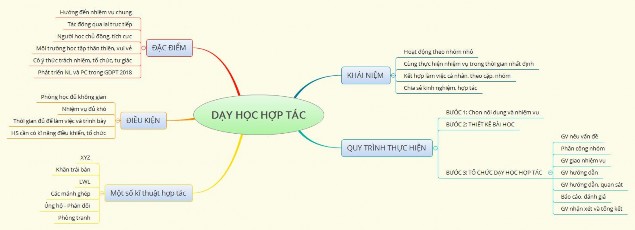
Activity 1. Learn about cooperative learning and group discussion techniques | - Target: + Present the concept, characteristics, implementation, and conditions of use of cooperative teaching. + List techniques for organizing group discussions in cooperative learning. - Student's duties: + Study documents, discuss in groups to solve learning tasks + Form: Small group + Product: Presentation on cooperative learning methods and techniques in the form of mind maps - Teaching methods and techniques: | - Method: + Evaluation through mind map products on cooperative teaching methods and techniques + Evaluation through observation of the technical implementation process in the group - Evaluation tools: | 45 |
+ Conversation combined with suggestive conversation + Organize group discussions + Technical steps, mind maps - Teaching aids: ppt presentation | + Criteria for evaluating mind maps | ||
Activity 2. Organizing learning activities to apply methods and techniques cooperative learning | - Objective: Apply cooperative learning and appropriate teaching techniques to organize learning activities for a specific geographical content. - Student's duties: + Group discussion to solve the initial situation + Form: Small group + Product: Learning activity organization plan - Teaching methods and techniques: + Situational method + Micro method - Teaching aids: situations, ppt presentations | - Method: + Evaluation through products: activity organization plan + Evaluation through observation of group activities - Evaluation tools: + Criteria for evaluating organizational plans work | 100 |
Conclude | - Objective: To evaluate the application of cooperative learning and appropriate teaching techniques to organize learning activities for a specific geographical content. - Student's duties: + Self-assess and assess your group on the quality of applying cooperative learning methods and techniques + Form: Small group + Product: Feedback results according to X/Y/Z technical instructions - Teaching methods and techniques: + Conversation combined with suggestive conversation + X/Y/Z technique - Teaching aids: ppt presentation | - Method: + Evaluation through product: feedback on performance results + Peer review + Evaluation through observation - Evaluation tools: + Criteria | 50 |
Self-study guide | Exercise: + Apply cooperative learning and group teaching techniques to design learning activities for specific content in a geography lesson/topic. + Practice organizing group activities in the NVSP practice room according to the instructions of the practice process outside the classroom. + Submit the final lecture video to GiV to evaluate the task performance. | - Method: + Evaluation through products: videos of learning activities - Evaluation tool: Criteria | 10 |
APPENDIX
PL1. Technical organization forms for stages
Vote No. 1
What is cooperative learning?
Cooperative teaching is organizing students to work in small groups so that students can perform a certain task together, within a certain period of time. During the working process, there is a combination of individual work with pair work and group work to share experiences and cooperate to perform the assigned tasks.
Vote No. 2 What are the characteristics of cooperative learning? Characteristics of Cooperative Learning: - Collaborative learning helps each member of the group work together, towards a common learning goal, a common task to be solved. - Collaborative learning creates direct interaction between group members in a two-way relationship, without intermediaries. - Cooperative learning puts learners in a proactive and positive position in seeking knowledge. - DH cooperates to create a friendly, comfortable, pleasant and fun learning environment. - DH cooperation requires each member to have a high sense of responsibility and self-awareness. - Cooperative teaching creates good conditions for developing communication skills and cooperation abilities. Cooperative teaching in groups creates an ideal environment for learners to develop communication skills and cooperation abilities. - Collaborative teaching helps learners have the opportunity to develop communication skills, autonomy and self-study skills, problem-solving skills and key skills in the 2018 General Education Program. |
Vote No. 3 How is the cooperative teaching process organized? Collaborative teaching organization process: Step 1. Choose the right content and tasks Step 2. Design a lesson plan to apply cooperative teaching. Step 3. Organize cooperative teaching: - The teacher presents the learning task or problem to be studied and solved for the class. - Assign study groups and group activity positions (each group should have 2-4 students) - Assign tasks to student groups - Instructions for student group activities - Teachers observe and support discussion groups in solving assigned tasks. - Organize for students to report results and evaluate - Teacher comments and summarizes |
Vote No. 4 What conditions are needed for cooperative learning? Conditions of Cooperative Learning: - The classroom has enough space. - The learning task is difficult enough. - Enough time for students to work in groups and present results. - Students need to have management skills, organizational skills and social skills. |
Vote No. 5 What group discussion techniques are used in Cooperative Learning? Group discussion techniques that can be used in Cooperative Learning: 1. The Pieces Technique 2. Tablecloth Technique 3. Support - Objection Technique 4. Gallery Techniques 5. KWL technique 6. XYZ Technique |
PL2. Criteria for evaluating mind map products
Criteria
Describe | Point | Give Score | |
Content | Present the full and accurate content of the criteria. cooperative learning method (concept, characteristics, process, conditions) in a logical and rigorous way | 0 – 6.0 | |
List the exact techniques of organizing group discussions. (at least 4 techniques) | 0 - 2.0 | ||
Form | Choose a visual mind map presentation format | 0 – 1.5 | |
Creative and aesthetic design | 0 – 0.5 | ||
TOTAL SCORE | 10 | ||
PL3. Mind map on cooperative teaching methods and techniques