
Warm welcome!
* Attendees:
Respectfully introduce:
1365 students from the whole school, especially the participation of 03 teams, attended and cheered for the contest.
Warm welcome! II. Opening program
Maybe you are interested!
-
 Organizing extracurricular activities in history teaching at Thanh Ha High School - Hai Duong on the occasion of the 90th anniversary of the founding of the Communist Party of Vietnam - 2
 -
 Innovation in extracurricular activities in history teaching in high schools Application through teaching in Nghe An province - 21
 -
 Current Status of Organizing Experiential Activities in Teaching History and Geography in Grades 4 and 5
 -
 Innovation in extracurricular activities in history teaching in high schools Application through teaching in Nghe An province - 24
 -
 Organizing physical education teaching activities at People's Security College I in the current reform period - 14
Next, we would like to respectfully introduce and invite Mr. Pham Van Phuong - Deputy Principal in charge of professional affairs, Deputy Organizing Committee of the contest to give the opening speech of the contest. We respectfully invite you!
III. Giving souvenir flags and flowers
We would like to respectfully invite representatives of the 3 teams participating in the Contest to come on stage to receive flowers and souvenir flags from the Organizing Committee.
We would like to invite representatives of Team Tran Phu (12A); Truong Chinh (12G); Nguyen Van Linh (12M);
Please invite teams (wait for stability)
Respectfully introduce and invite:
- Head of the Competition Organizing Committee.
Present flowers and souvenir flags to the teams. Warmest invitation!
Thank you very much, teachers. Please return to your positions to prepare for the competition.
* Dear distinguished guests, Dear students!
A very important and indispensable component in today's contest is the Jury. The author would like to respectfully introduce the members of the Jury:
And to help the judges summarize the results most accurately, the author would like to respectfully introduce the Contest Secretariat:
A big round of applause to the judges and secretary for their objective, fair and accurate work.
(The BCK and the secretariat stabilize their positions)
IV. Contest content
* Dear delegates.
Dear distinguished guests and all dear students!
Our contest program is presented in the form of dramatization. Including 05 parts:
- Part I: Rapid response;
- Part II: Understanding;
- Part III: Team support;
- Part IV: Historical codes.
- Part V: Rhetoric.
The maximum total score for all 5 sections is 100 points. The judges will score each team in each section. The final score for each team will be the average of the judges' scores in each section.
Based on the drawing of lots, the author hereby announces the order of participating teams in all 3 competitions as follows:
1st: Nguyen Van Linh (12M).
Monday: Truong Chinh (12G).
Tuesday: Tran Phu (12A) .
PART I: QUICK RESPONSE
Rules: There are 10 questions for three teams. After listening to the questions, the teams will signal to answer by waving their flags. Each correct answer is worth 10 points, if the answer is wrong, the second team has the right to answer, and a correct answer is worth 5 points. The maximum thinking time for each question is 10 seconds.
Question 1. From the time he left to find a way to save the country until he attended the Tours Congress, how many years had he been away from the Fatherland? ............................
Answer: 10 years..............................
Sentence 2. The same event, but the French called it "a bomb that shocked French public opinion", while the Vietnamese considered it a "signal fire"
our people rose up to fight for revolution. According to you, what event was that in the life of Nguyen Ai Quoc? ............................
Answer: Nguyen Ai Quoc sent a petition to the Versailles Conference in 1919. Question 3. Leader Nguyen Ai Quoc wrote: "When he was alive, he was a father and teacher.
our scholar, comrade and advisor. Today, he is the bright star guiding us to the social revolution”. Who did he write about? When did he write?..............................
Answer: The writer about Lenin wrote in 1924...............................
(Lenin died January 21, 1924) ............................
Sentence 4. In the epic poem "Following Uncle Ho's footsteps", poet To Huu wrote:
“Thirty years, my feet never rested
But just now arrived! ” ............................
What event in Uncle Ho's life do the two verses above remind us of? ............................
Answer: After 30 years away from the Fatherland, in 1941 Uncle Ho returned home.
Question 5. Name a commune in Huu Lung district that Uncle Ho gave a set of forestry work clothes to and he also wrote an article praising the forest planting movement of the people here. Which commune is that? ............................
Answer: Do Luong Commune.
Question 6. What is the name of the famous lawyer who defended Tong Van So (Nguyen Ai Quoc) in the famous case in Hong Kong? ............................
Answer: Lawyer Lo-Dơ-bai.
Question 7. There are four lines of poetry that Uncle Ho gave to the youth volunteer unit in 1950 - now they have become the slogan of our youth. What is the content of those four lines of poetry?
Answer:
“Nothing is difficult, only fear that the heart is not steadfast. Digging mountains and filling seas, with determination, one can do it.”
Sentence 8. And the fog of London, do you remember the drops of sweat that fell in the middle of the night (The man searching for the shape of water - Che Lan Vien)
According to you, what did poet Che Lan Vien say about the work Uncle Ho did when he found a way to save the country?
Answer: Snow plowing job...............................
Question 9. Fill in the blanks with … to complete the two verses of poet To Huu in the poem “Morning of May”?
You are... are... are... The big heart filters hundreds of small blood streams
Answer: He is Father, Uncle, Brother............................
Question 10. In the epic poem Following Uncle Ho's footsteps, poet To Huu wrote:
The stone trees rejoice with every step, the mountain village in the morning and evening is filled with the shadow of Autumn.
"Gia Thu" was the name Uncle Ho called when he was in where? Answer: Viet Bac resistance base.........................
PART II: UNDERSTANDING
Rules: There are 13 horizontal crosswords and 1 vertical crossword (keyword). Teams take turns choosing a horizontal crossword to answer. The thinking time is 10 seconds. If you answer 1 horizontal crossword correctly, you will get 10 points. If you answer a vertical crossword correctly, you will get 50 points. If you answer incorrectly, you will be eliminated from this round.
Note :
Teams are allowed to answer from the key when they open from 1 to 5 horizontal crosswords.
From the 6th horizontal row onwards, teams will not be allowed to answer the vertical crossword (key word).. ............................
Horizontal crossword puzzles that teams cannot answer will be answered by the audience.
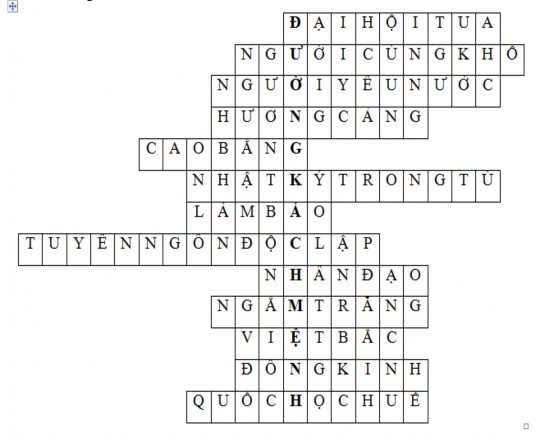
Horizontal intelligence crossword:
Horizontal row number 1 includes 9 letters: TUA CONGRESS............................
Question : In 1920, Nguyen Ai Quoc participated in this event as an Indochina delegate of the French Socialist Party. What event was this?
- TOURS CONGRESS: The congress was held from December 25 to 30, 1920. Nguyen Ai Quoc attended the 18th National Congress of the French Socialist Party held in the city of Tours. He sided with the majority of the congress delegates in voting in favor of joining the Communist International and establishing the French Communist Party. Nguyen Ai Quoc became a communist party member and was one of the founders of the French Communist Party.
Horizontal row number 2 includes 12 letters: THE POOR....................
Question : In 1922, Nguyen Ai Quoc and a number of colonial revolutionaries founded this newspaper to denounce the repressive and exploitative policies of imperialism in general and French colonialism in particular. What is the name of the newspaper?
- THE POOR: French Le Paria, is a newspaper published in 1922 in France, the governing body is the "Cooperative Association for the Poor" under the Association.
colonial union, the founder of the newspaper was Nguyen Ai Quoc, who also had a great influence on this newspaper (director and editor-in-chief). The newspaper was printed in three languages: French, Arabic, and Chinese. The first issue was published on April 1, 1922. The Poverty published a preface declaring that this newspaper "is a weapon for fighting, its mission is clear: to liberate people". ............................
Horizontal row number 3 includes 12 letters: PATRIOTISM
Question : By voting in favor of the establishment of the French Communist Party, Nguyen Ai Quoc moved from this position to that of a communist soldier. Please tell me what that position was?
- PATRIOTISM: The vote in favor of joining the Third International and participating in the founding of the French Communist Party marked a leap in Nguyen Ai Quoc's political thought, from a patriotic stance to a communist stance. This event opened a new stage of development for the Vietnamese revolution, "a stage of linking the Vietnamese revolutionary movement with the international workers' movement, leading the Vietnamese people to follow the path he had taken from true patriotism to Marxism-Leninism".
Horizontal row number 4 includes 9 letters: HUONG CANG............................ Question: The congress unified three communist organizations into the Communist Party of Vietnam.
The Vietnam War took place on February 3, 1930 and was held at which location in China?
- HONG KONG: In 1929, the struggle movement of workers, farmers, petty bourgeoisie and patriotic people developed strongly, requiring the close unity of a single political party. In 1929, three communist organizations were born and operated separately, competing for influence with each other, causing a lack of unity, pushing the Vietnamese revolutionary movement to the risk of division. The urgent need of the Vietnamese revolution was to have a unified Communist Party throughout the country. Faced with this situation, Nguyen Ai Quoc returned from Thailand to Hong Kong to convene a conference to unify the three Party organizations.
On January 6, 1930 in Kowloon (Hong Kong, China), Nguyen Ai Quoc chaired the Conference to unify communist organizations. Attending the Conference were representatives of
representatives of the Indochina Communist Party and the Annam Communist Party.
Horizontal row number 5 includes 7 letters: CAO BANG............................
Question : In 1941, Nguyen Ai Quoc returned to Vietnam and stayed at Coc Bo cave, Pac Bo village. Which province is this place in?
- CAO BANG: Pac Bo is located in Truong Ha commune, Ha Quang district, 52 km from Cao Bang town. The name Pac Bo in the local language means "headwaters". Pac Bo is the origin of the Vietnamese revolution because this place is associated with a particularly important historical period in the revolutionary life of President Ho Chi Minh and our country's revolution in the years 1941 - 1945. Pac Bo - Cao Bang is the first place that Uncle Ho chose to return to the country to lead the Vietnamese revolution after 30 years of leaving to find a way to save the country and working abroad. Cao Bang is also the place where Uncle Ho chaired the 8th Conference of the Party Central Committee at Khuoi Nam - Pac Bo hut from May 10 to May 19, 1941, deciding to establish the Viet Minh front and establish a revolutionary base.
Horizontal row number 6 consists of 13 letters: PRISON DIARY
Question: During his time in detention in China, Nguyen Ai Quoc published a collection of poems. What is the name of this collection of poems?
- PRISON DIARY: A collection of poems written by Ho Chi Minh from August 29 to September 10, 1943, during the time he was imprisoned by Chiang Kai-shek's government and taken to prisons in Guangxi, China. The original collection of poems was just a small notebook with a faded blue cover with four words "Prison Diary" written on it, along with four lines of poetry and a drawing of two chained fists. Inside were more than 100 Chinese poems and some notes. The work has been published many times, translated and introduced in many countries around the world.
Horizontal row number 7 includes 6 letters: JOURNALIST
Question : With his position as editor-in-chief of the newspaper “The Miserable”, Nguyen Ai Quoc had another job. What was that job?
- JOURNALISM: Not only was he an outstanding revolutionary, throughout his life he was also a journalist and the founder of Vietnamese revolutionary journalism.
Right from the beginning of his search for a way to save the country, Uncle Ho founded the newspaper "The Miserable" as a weapon for the revolutionary struggle. With 150 pen names, Uncle Ho was the author of thousands of articles, writing for the purpose of propagandizing and mobilizing the revolution, writing for the general public to read, with a simple, precise, and clear writing style. ....
Horizontal row number 8 includes 15 letters: DECLARATION OF INDEPENDENCE
Question : On September 2, 1945, at Ba Dinh Square (Hanoi), President Ho read a document declaring the establishment of the Democratic Republic of Vietnam. Please state the name of this document. ............................
- DECLARATION OF INDEPENDENCE: A historical document read by President Ho Chi Minh at Ba Dinh Square on September 2, 1945, declaring to the people of the whole country and the world about the abolition of the colonial and feudal regimes and the establishment of the Democratic Republic of Vietnam. “The Declaration of Independence is an immortal work of President Ho Chi Minh, an epic poem that opened the era of the Vietnamese people.
- the era of independence - freedom and socialism.
Horizontal row number 9 includes 7 letters : HUMANITY
Question : This is the name of a newspaper of the French Communist Party that Nguyen Ai Quoc often contributed articles to during his time in France. The French name is L'Humanite', what is the Vietnamese name of this newspaper?
- HUMANITY: During his life of revolutionary activities full of storms and hardships in the early 20th century, Uncle Ho often paid attention to press tools. He skillfully used press tools with the aim of propagating Marxism - Leninism in the revolutionary path of national liberation, leading the country out of slavery, moving towards socialism. He considered the press as a means of mobilizing and gathering revolutionary forces to organize and implement revolutionary goals in the most effective way. The newspapers published publicly and secretly from 1922 in France, 1925 in Guangzhou - China, 1928 in Thailand, 1929 in Hong Kong founded by Nguyen Ai Quoc abroad all contained the main theme: Propagating the revolutionary ideology of Marxism - Leninism in Vietnam, preparing the theoretical and practical foundations to establish a new type of Communist Party with enough political capacity to lead the people to rise up.