
appears when he does not know how to explain phenomena, events, processes of reality, when he cannot achieve his goals by familiar methods and actions. This situation stimulates people to find new ways of explanation or action. Problematic situations are the law of creative and effective cognitive activities…” [99, p.30].
The group of authors Tran Thi Tuyet Oanh, Pham Khac Chuong, Pham Viet Vuong... consider "a problematic situation as a psychological state that appears when people encounter a difficult situation that cannot be solved with existing knowledge or known methods. In other words, a problematic situation is a psychological state that appears when people encounter a conflict between what they know and what they do not know but want to know" [108, p.224].
For teaching and organizing history lessons by topic, teachers can design learning tasks, which can be a phenomenon event; can be a cognitive exercise to create problematic situations for students to research, exchange, discuss to come up with appropriate explanations. This process not only helps students be interested in learning history, understand the nature of historical problems but also trains students in the skills of presenting and arguing a historical problem; how to solve problems. On that basis, we aim to develop students' problem-solving skills; critical thinking skills and communication, cooperation, language skills, etc.
However, when creating problematic situations to implement in history lessons, teachers need to research to ensure scientific, systematic, appropriate to the lesson content, diversity and comprehensiveness. That is, the situations presented must be appropriate to the lesson objectives, must ensure a logical connection between scientific knowledge and real life and be appropriate to the psychology and age of students.
Based on the study of basic theory on problem-based teaching; the study of characteristics of organizing history teaching by topic; characteristics of historical knowledge, we propose the following process of organizing problem-based teaching:
Step 1: Problem detection : Teachers identify problems (create problematic situations) to assign tasks to students, help students detect problems, and clearly identify the requirements of learning activities.
With the above mentioned objectives, the content of this activity is mainly to explore and discover situations/events and phenomena. Depending on the specific conditions, this activity is organized in different forms: research through scientific documents (text, image, audio channels); field surveys, practice (visiting, learning about historical relics, museums).
To organize this activity, teachers need to design learning activities with specific learning tasks (which clearly describe the products that students need to complete). Depending on the specific content, this task can be done entirely in class or assigned to students to learn a part of before organizing a class discussion to determine the problem to be solved.
decided
Step 2: Research knowledge to solve problems: Teachers provide documents and guide students to perform learning tasks (research activities, knowledge acquisition) from the problem to be solved with tasks that need to be completed with specific requirements.
In essence, the content of this activity is to learn new knowledge to build and implement solutions to solve the problem. Teachers guide students to study textbooks and reference materials to acquire knowledge and practice skills according to the requirements of the topic.
Method of organizing learning activities: Teachers use active teaching methods and techniques in the direction of strengthening guidance for students to independently study textbooks and supplementary materials to receive and apply knowledge (outside of class time), spending more time in class to organize students to report and discuss to acquire knowledge and develop skills according to the requirements of the topic.
Product: The product that each student/group of students must complete when studying textbooks and supplementary materials is the basic knowledge to complete questions and exercises according to the requirements of each learning task.
Evaluation: Based on the learning products of students and student groups, teachers organize students to report and discuss; at the same time, comment, evaluate, and "finalize" knowledge and skills for students to record and use.
Step 3: Exchange and discuss the problem-solving results report: Students complete the learning tasks by proposing solutions to the problem. Teachers organize students to report on their learning products, organize students to exchange, discuss and comment on and evaluate the results of their task performance. On that basis, students complete their individual/group learning tasks.
- The criteria for evaluating the teaching method of raising and solving problems for teachers and students are:
+ The level of specificity, clarity, vividness and attractiveness in task transfer
Learning: Is the task clear, specific, and explicit?
i Can most students identify the tasks that need to be solved in the teacher's request?
ii Most students can identify the method (address of reference documents) to
solve the problem or not?
iii Teachers monitor , observe, and promptly detect students' difficulties in order to have measures to support and encourage students to cooperate and help each other when performing learning tasks.
iiii Teachers organize for students to exchange, discuss, and report implementation results.
For example, when organizing students to do the activity of Learning about the basic achievements of
Dai Viet civilization in the topic Dai Viet civilization, the teacher asks students to read the information in
Appendix 1 (appendix to the experimental topic Dai Viet Civilization) .
The goal of this activity is to help students present the achievements of Dai Viet civilization in terms of ideology, religion, literature, art, education, economy, politics and the material and spiritual life of Vietnamese people based on the synthesis of information from documents in Appendix 1 of the topic.
Content and form of implementation: Students will work individually, read the information in Appendix 1 about religion, beliefs, literature, education, art and science and technology, material and spiritual life... to complete the study sheet:
Field
Achievements | |
Ideology, religion | |
Literature | |
Ideology, religion | |
Education | |
Art, science and technology | |
Economy | |
Politics | |
Material and spiritual life |
Maybe you are interested!
-
 Survey Results on Feasibility of Management Measures for Capacity Building Activities for Teachers of Secondary Schools in Dinh Hoa District
 -
 Summary Table of Results After Inspecting the Management of Staff, Teachers, and Employees of Public Kindergartens, Primary Schools, and Secondary Schools
 -
 Survey Results by Question Content (Based on the Summary Table of Tourist Feedback in the Multiple Choice Questions Section)
 -
 Survey Results of Management Staff on Organizing Skills Training for Teachers
 -
 Summary of Patient Satisfaction Survey Results at Public Service Units under Dak Lak Provincial Department of Health from 2016 to 2020
How to do it:
- Teacher transfers tasks: ask students to read information number 1 to complete the study sheet; discuss in pairs to agree on the content on the study sheet.
- Students research information to solve problems according to the worksheet in two forms: individual work and pair discussion.
- Teachers organize students to report results in each field and organize students to discuss.
Exchange, discuss and comment on your presentations in each field.
Based on the results of the students' presentation on the achievements of Dai Viet civilization, the teacher raised the following questions:
Based on the achievements of Dai Viet civilization that you have just presented; based on the realities of daily life in the family and community that you have observed. Please present your own understanding of:
1) Material and spiritual life of Dai Viet residents?
2) Name typical traditions of Dai Viet residents and share your understanding of those traditions.
With this content, teachers can organize students to exchange and discuss in groups to
Agree on the answer content; on that basis, organize for students to report on their products.
Step 4; Evaluation
Based on the results of the students' presentation, exchange and discussion, the teacher summarizes, comments and concludes the knowledge.
Thus, with the method of organizing DH in the direction of raising and solving problems like
on creating conditions for students to promote initiative, positivity, creativity and development
ability to self-study, self-research and problem-solving
To verify the reasonableness of this group of measures, we asked for opinions from 7 teachers participating in the experimental teaching at Dong Dau High School (Vinh Phuc), Me Linh High School (Hanoi), and the ethnic boarding school in Bac Giang province and the results were as follows:
Table 4.4. Summary of survey results of teachers' opinions on the measure " Organizing students to learn history using the problem-posing and solving method"
Total comments
GV
Teacher's review | |||
Very reasonable | Reasonable | Not reasonable | |
Number of comments | 4/7 votes | 3/7 times | 0/7 votes |
Percentage | 57% | 43% | 0% |
Based on the results in Table 4.4, we have the following comments:
- The proposed solution of the research team is highly feasible: 100% of teachers
asked for measures to ensure the rationality of organizing history teaching.
- No opinion this is considered unreasonable
According to the results of interviews combined with teacher observations, designing learning activities and organizing learning activities with the above methods and techniques is convenient for teachers and students in teaching and learning LS. Teachers are actually the ones who design and organize learning activities, students are proactive in performing learning tasks, reporting the results of learning tasks. Designing and organizing learning activities as above also enhances the ability to interact between subjects in the teaching process, especially between students and students, between students and teachers and vice versa. Organizing students to report on learning tasks and organizing comments and evaluations of learning results also helps students develop argumentative thinking, one of the weak skills of Vietnamese students today.
4.1.3.3. Organizing students to learn history through learning projects
Project-based learning is understood as a learning activity for students to synthesize knowledge from many fields of study and apply the knowledge learned to real life. This means that the project-based teaching method is suitable for organizing teaching by topic. In historical teaching, project-based teaching is suitable for multi-disciplinary, interdisciplinary integrated topics, local history research topics or practical, field topics.
In terms of teaching organization methods, project-based teaching has many similarities with problem-solving teaching such as: identifying the problem to be solved (choosing a topic); solving the problem (implementing a project); summarizing and reporting the results. However, the difference between these two methods is the organization process. Specifically;
Step 1: Planning : This is an important step, the opening step that determines the quality.
quality of the project. Therefore, teachers need to organize for students to research to choose the topic, determine
define the requirements to be achieved and the tasks to be completed.
Step 2: Project implementation : Includes activities such as: information collection, information processing and information synthesis.
Step 3: Summary and reporting of results: Includes tasks such as product completion, product reporting and evaluation.
For example; With the topic Some ancient and medieval Eastern civilizations, we can also use the project-based learning form.
To organize teaching this topic in the form of project teaching, teachers need to guide and organize students to identify and select sub-topics, specific research issues or also known as names of projects. To carry out this step, teachers, based on the requirements of the topic, propose issues for students to discuss and select topics for the project according to the following mind map:
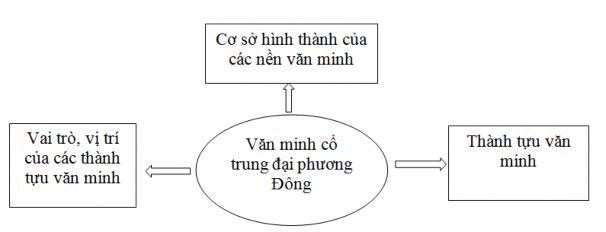
For each problem, the teacher continues to guide students to draw a mind map to find the problems that need to be solved. On that basis, the teacher asks students to choose sub-topics according to their abilities and interests and asks students with the same interests in a sub-topic to be in the same group.
Based on the results of the above activities, the groups will plan to implement the activities.
active with specific tasks/jobs.
For example, an activity plan might follow this suggestion:
Activity plan to implement the topic: ……………………………….. Implementer/implementing group:………………….……………………
Class:………………………………………………………………………
Time (1) | The performer (1) | Specific tasks (2) | Product Plan (3) | Self assessment (4) |
…. | ||||
….
Overall rating by item lesson plan | ||||
Thus, organizing teaching according to projects will bring opportunities for students to self-study, self-research and cooperate in learning to solve research problems. Organizing teaching according to projects is an effective method to implement the requirement of linking theory with practice in education towards forming and developing students' capacity.
According to teachers' sharing in the discussions and workshops on innovative teaching methods during the implementation of the pilot program and textbooks, problem-based teaching and project-based teaching are active teaching methods that promote the positivity, initiative and creativity of learners. Both of these methods are implemented by teachers in the teaching process at general schools. However, problem-based teaching is a teaching method commonly used by teachers in teaching activities at schools. Compared to project-based teaching, problem-based teaching is easy to apply and implement in current conditions.
However, a common limitation that teachers often encounter in problem-solving teaching is that teachers often raise the problem, call on a few students to answer, comment on the students' answers, and answer on behalf of the students. Another limitation of teachers in organizing teaching is designing too many activities in one class. Therefore, each activity can only be done by teachers for 2 to 3 minutes, then students are asked to answer. This limits the promotion of students' positivity and initiative.
For project-based learning, the limitation of teachers is that they often implement project-based learning in the form of problem-solving and posing. That is, they do not give students time to research, develop plans, and find information to complete their products. Most project-based learning activities are designed in the form of problem-solving and posing in class in small groups for each activity. The reason for this limitation is that teachers do not fully understand the nature of project-based learning and the operations and processes of organizing project-based learning.
4.1. 3.4 . Organizing group discussions in the organization of teaching topics
According to education experts, group teaching, also known as cooperative learning, is organizing the classroom into small groups for students to research, exchange, and discuss a problem together.
In fact, this teaching activity is widely applied by general teachers. When organizing group learning for students, teachers need to be aware of and properly guide the tasks of the members in group activities and the role of teachers in organizing group learning for students to avoid organizing group activities in a formal way. The results of the actual survey show that teachers pay great attention to organizing group activities. However, this organization is still heavy on formality. Specifically:
+ Teachers often divide students into large groups and ask them to move around to form groups. This makes group activities messy and cumbersome, and students spend a lot of time moving around and forming groups.
+ Time for group activities is very little (usually 3 to 5 minutes) so
not enough time for students to do the task
+ Teachers often organize too many group activities in a lesson with unclear tasks in terms of product requirements and activity content. This makes students confused and have difficulty in performing the tasks.
+ Focus more on the group leader and group secretary. This leads to
to the complaints of some members of the group.
The above organizational methods of teachers have made group activities not as effective as expected and made group teaching activities become forced, formal, and ineffective.
In terms of the nature of the group, it is for students to discuss and exchange, so it is not necessary to organize a large group of students. Depending on the area of the classroom and the requirements of the learning activities, teachers can organize students to discuss and exchange in pairs, trios... In our opinion, to organize effective group learning activities, teachers need to arrange enough time for students to perform their learning tasks, and at the same time, it is necessary to clearly define the roles of individuals, group leaders, group secretaries and teachers.
Drawing on experience from the practice of organizing group teaching, we have proposed a process for organizing group learning activities in a harmonious way that combines individual teaching activities, group teaching activities and teaching with the whole class to promote the proactiveness of group members and overcome the limitations of group teaching activities as follows:
- Step 1: ask students to work individually, write down the results on scratch paper or notebooks (teachers can guide students to divide their notebooks into three columns: Individual work results/group work results/consensus results after discussion).
- Step 2: The teacher organizes for students to discuss in groups (pairs, pairs of 3...)
to unify the answers in the group.
- Step 3: The teacher organizes for students to discuss, comment, complete the product (learning task) and conclude the knowledge.
To verify this organization method, we conducted a survey of 40 students of grade 10A6 at Me Linh High School who participated in the experimental class taught by teacher Dinh Thi Xuan. The survey results showed that 100% of students liked the group study method as proposed, of which 87% of students commented that they strongly agreed with the method, 13% of students agreed and no opinions disagreed. According to the students, they had studied in groups a lot before, but usually in the group, the teacher
Teachers usually only ask the group leader or group secretary to report the results. Therefore, some students do not study actively and often rely on the group's common activities. There were times when the teacher called on students who were not actively working to report on the group's activities and as a result, the whole group was deducted points. However, according to today's group learning method, all students in the group must do individual work before discussing in groups and the results of that work must be written in their notebooks. Thus, teachers will have a basis to evaluate the students' active participation.
With the above experimental results, organizing group learning will help students be proactive and positive in the learning process. Implementing this teaching method well will contribute to improving the quality of subject teaching.
4.1.3.5. Organizing experiential activities in internal history lessons
Enhancing experiential activities in the subject is a new teaching method that has been mentioned in recent years. However, in reality, this group of methods has been researched and applied in organizing history teaching in general schools from a very early age through forms, methods, and teaching techniques to actively promote and enhance the participation of learners, creating conditions for learners to develop their maximum learning ability, creativity, problem-solving ability, etc. For history teaching, the goal is not only to provide students with knowledge,
understanding knowledge deeply, but importantly, helping students apply knowledge to real life. To achieve this goal in the process of organizing history teaching, teachers flexibly choose active teaching methods and techniques, in which, the experiential method in the subject is the method with advantages in forming and developing learners' capacity. The experiential methods with advantages in organizing internal medicine lessons are using role-playing methods, historical teaching activities through organizing games; organizing history teaching through the form of debate...
Currently, in the organization of DHLS in general schools, teachers have applied experiential activities in the subject when organizing teaching activities, mainly warm-up activities with types such as: LS games, observing pictures, watching videos... These activities have had a positive impact on learners, creating motivation and interest for learners. However, the application of these methods has only been carried out spontaneously, according to the inspiration of teachers without any connection between experiential activities and the goals, requirements to be achieved and the content of the subject. Therefore, the effectiveness of experiential methods in the subject only stops at creating interest for learners.
In the 2018 General Education Program, the focus of the teaching process is to form learners' competencies and abilities. To form and develop learners' competencies and abilities, in addition to the requirements for knowledge, skills, and attitudes, the requirement for teaching situations is an indispensable component to create competencies for learners. In the General Education Program, teaching situations are