
Epicatechin ( 25 ) has been reported to have insulin-like effects, with hemoprotective effects. (-) Epicatechin also protects against lipid peroxidation and inhibits platelet aggregation. (-) Epicatechin is effective in assisting in the management of secondary complications of diabetes. Polyphenols in general have also been shown to be useful in preserving rat pancreatic islets in vitro [25].
Catechin ( 26 ), is a natural antioxidant phenolic compound. In the study of Nakayma et al. [26], catechin exhibited cytotoxic activity against O 2 - and H 2 O 2 on Chinese hamster V79 cells.
*.) Activity on the cardiovascular system:
Lavollay, Neumann, Porrot, have demonstrated: Catechin ( 26 ) has a stronger effect than vitamin C in maintaining vascular wall strength, mainly due to its ability to regulate and reduce capillary permeability, preventing blood proteins from permeating through other tissues, preventing capillary rupture, causing bleeding, and causing edema [27, 28].
Epicatechin ( 25 ), which may improve blood circulation and has potential benefits
Maybe you are interested!
-

 Characteristics of Business Activities and Business Management Organization at Small and Medium Enterprises in Vietnam
 -
 Characteristics of Activities During the 1000th Anniversary of Thang Long
 -
 Summary Table of Characteristics of Similar Studies Around the World
 -
 Some characteristics and risk factors of hearing loss in children from 2 to 5 years old in inner-city kindergartens in Hanoi - 1
 -
 Starting a business Opening a coffee and ornamental plant shop - 2
for heart health [25] .
*.) Cytotoxic and anti-cancer activity
New substance isolated from saw palmetto fruit: 2 S ,3 S –3,5,7,3′,5′–pentahydroxyflavan
( 19 ) had significant inhibitory effects against HL–60 cell line with IC50 of 0.2 ± 0.01 and CNE–1 with IC50 of 1.0 ± 0.1 μM overwhelmingly compared to reference compounds in the assays [16, 17].
A new flavone glycoside sulfate salt compound ( 30 ), isolated from Australian palm tree ( Livistona australis ) by Mona ES Kassem (Egypt) and colleagues, has good antioxidant activity, which has been evaluated by determining blood glutathione (GSH) levels [19].
1.2. Centella genus ( Hydrocotyle; Centella)
1.2.1. Plant characteristics and applications
Gotu kola is a herbaceous plant that grows wild everywhere, especially in moist places. According to traditional medicine, gotu kola has a bitter, slightly sweet taste, neutral properties, affects the liver, spleen and stomach, and has the effect of nourishing yin, clearing heat, moistening the liver, detoxifying, and diuretic. Gotu kola is often used as a tonic, antiseptic, and to treat hemoptysis, diarrhea, vaginal discharge, leukorrhea, pimples, and prickly heat.
Referring to documents [29, 30], it can be seen that in Vietnam there are 12 species of pennywort:
*. Gotu kola, Centella asiatica: Centella asiatica (L.) Urb.
*. Gotu kola chevalier: Hydrocotyle chevalieri (Chern.) Tard.
*. Chinese pennywort: Hydrocotyle chinensis (Dunn) Craib.
*. Java pennywort, big leaf pennywort: Hydrocotyle nepalense Hook.
*. Gotu kola petelot: Hydrocotyle petelotii Tard.
*. Hydrocotyle pseudosanicula De Boiss.
*. Siamese pennywort: Hydrocotyle siamica Craib.
*. Centella asiatica minor: Hydrocotyle sibthorpioides LamK.
*. Northern pennywort: Hydrocotyle tonkinensis Tard.
*. Pennywort wilford: Hydrocotyle wilfordii Maxim.
*. Gotu kola lotus leaf: Hydrocotyle vulgaris (L.)
*. Gotu kola lotus leaf: Hydrocotyle bonariensis (L.)
1.2.1.1. Java pennywort, large-leaf pennywort:
The large-leaf gotu kola plant is shown in figure 1.4.
Gotu kola ( Hydrocotyle nepalense Hook), ( H. javanica Thunb.), belongs to the Apiaceae family, it is also known as wild gotu kola, forest gotu kola. The herb has a stem that grows on the ground, 0.5-1.2m long. Gotu kola is commonly found in countries such as Nepal, India, China, Malaysia, Indonesia and Vietnam. In our country, this plant is often seen growing in large clumps.
in humid places in the provinces of Lang Son, Ha Tinh, Bac Thai, Khanh Hoa, Lam Dong, Kontum, Ninh Thuan.
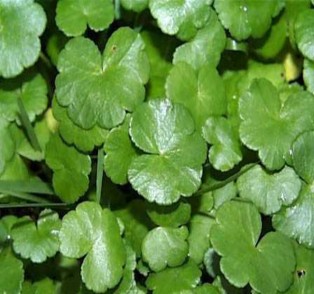
Figure 1.4. Big-leaf pennywort
According to Oriental medicine, gotu kola has a spicy, slightly bitter taste. It has the effect of stopping bleeding, relieving pain, clearing heat, clearing the lungs and stopping coughs. In some countries such as India, Sri Lanka, Malaysia, and China, this plant is used to treat hemoptysis, coughs, stomachaches, broken bones, itching, dog bites, and as an antiseptic. The Dao people use the whole plant, pound it, and sprinkle it into water to poison fish.
1.2.1.2. Small gotu kola, fatty gotu kola
Scientific name: Hydrocotyle sibthorpioides Lam. ( H. rotumdifolia Roxb.), belongs to the Apiaceae family. Small perennial herb, grows wild in damp places along roadsides and moist rice fields. This plant is often used to treat diseases such as: jaundice hepatitis, cirrhosis of the liver, gallstones, diarrhea, urinary tract diseases, urinary stones; flu, cough, cough
chicken, stomatitis, pharyngitis, tonsillitis, conjunctivitis, treatment of paronychia, eczema, shingles and nosebleeds.
1.2.1.3. Gotu kola lotus leaf:
The gotu kola lotus plant is shown in figure 1.5.
Gotu kola [ Hydrocotyle vulgaris (L.)], belonging to the Apiaceae family, is a newly discovered species in the Mekong Delta.
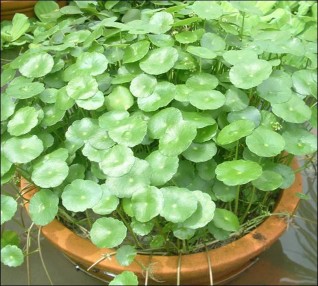
Figure 1.5. Lotus leaf pennywort plant
The species of Gotu kola lotus - Hydrocotyle vulgaris is easily confused with the species of Gotu kola lotus - Hydrocotyle bonariensis because they grow together and have very similar shapes. These two species of Gotu kola lotus differ only in the flower part, so they are often confused when harvesting.
1.2.1.4. Common gotu kola (Gotu kola):
Gotu kola is often shown in figure 1.6.
Among the gotu kola species, the common gotu kola [ Centella asiatica (Linn.) Urban], is the gotu kola species that has received special attention from scientists.
Gotu kola has the scientific name Centella asiatica (Linn.) Urban, belonging to the Apiaceae family. There are also other names such as Tich huyet thao, Lien tien thao. In our country, this plant is often simply called gotu kola... Gotu kola is a creeping herbaceous plant, the roots grow from the nodes of the stem, the plant branches a lot on the ground. Gotu kola leaves have long stalks growing from the base or from the nodes. The leaves are slightly round, have wavy edges, and look like small coins arranged one after another. Flowers appear in the leaf axils, forming clusters of 1 to 5 flowers, single umbels, white or light red flower stalks. The fruit is flat, with a fairly clear ridge.
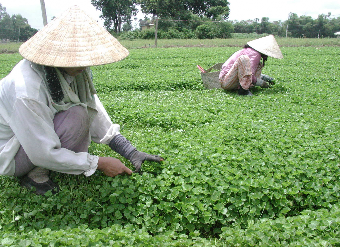
Figure 1.6. Common pennywort plant
According to traditional medicine, pennywort has a bitter, slightly sweet taste, neutral properties, and has the effect of nourishing yin, clearing heat, nourishing the liver, detoxifying, and diuretic. It is often used as a nutritious food, antiseptic, to treat hemoptysis, diarrhea, vaginal discharge, leukorrhea, boils, prickly heat, and to treat colds, chickenpox, measles, and yellow fever.
face, sore throat, tonsillitis, tracheitis, cough, urinary tract infection, urinating
cold
1.2.1.5. Gotu kola in some folk remedies [31]
In folk medicine, in addition to being widely used as a vegetable, a beverage..., pennywort is also used in some folk remedies such as:
- The basic prescription, created around 1950 by Mr. Vo Van Hung, an experienced physician in the Southeast region. It was later responded to and encouraged to be used by Doctor Nguyen Van Huong, the Minister of Health at that time. This prescription consists of 10 ingredients, a very familiar prescription in hospitals and medical stations from the army to the people, and has contributed greatly to protecting people's health during the two resistance wars against France and America. The basic prescription is characterized by being non-toxic, easy to use, has the effect of stimulating digestion, nourishing the liver, laxative, diuretic, detoxifying and enhancing the body's resistance. Depending on the patient's condition and local conditions, the medicinal ingredients or dosage can be flexibly increased or decreased.
The prescription includes: Gotu kola 8g, cogon root 8g, cassia leaves 4g, Cyperus rotundus 8g, Eclipta prostrata 8g, licorice 8g, Xanthium 8g, lemongrass root 4g, fresh ginger 4g, tangerine peel 4g. Pour 3 cups of water into one cup of decoction, drink while the medicine is still warm.
- Pills benefit Qi, nourish Yin, support muscles, and relieve hunger. Used as a tonic for children, the elderly, or people who have just recovered from illness, or used as dry food to bring along when traveling. The prescription includes 4 ingredients: Mulberry leaves, Black sesame, Chinese yam powder, and Gotu kola. Each ingredient is equal in quantity, ground into powder, each pill weighs about 5g. Use twice a day, 1 or 2 pills each time.
- Thoai nhiet don. Has the effect of reducing heat, reducing fever, quenching thirst, and calming the nerves. Gotu kola 15%, Alum 30%, Kudzu 20%, Saposhnikovia 15%, Gypsum 10%, Licorice 10%. Grind into powder, take 3 times a day, 4g each time.
- Blood pressure lowering medicine. 16g of Morinda root, 12g of Ant-stork root, 12g of Bamboo leaves, 12g of Cogon root, 12g of Scratch grass root, 16g of Gotu kola, 12g of Mulberry leaves, decoct to drink, or make tea to drink instead of water.
- Dengue fever: Gotu kola 20g, Eclipta prostrata 16g, Purslane 16g, Black beans 16g
g. Drink.
- Bleeding gums, nosebleeds and other bleeding symptoms: Gotu kola 30g, Eclipta prostrata and Thuja orientalis each 15g, stir-fry, boil in water to drink.
- Vaginal discharge: Dry pennywort and make powder, use 2 teaspoons to drink every morning.
- Dysmenorrhea, back pain, abdominal pain, poor appetite, lethargy: Gotu kola 30 g, motherwort 8 g, basil 12 g, Magnolia bark 16 g. Pour 600 ml of water, boil down to 200 ml, divide into 2 doses to drink during the day.
- Tonsillitis: Crush fresh pennywort to get the juice, mix with a little vinegar and swallow slowly.
Cough, painful urination, frequent urination: Crush fresh gotu kola to get the juice to drink or boil to drink.
- Inflammation, itching: Mix pennywort with vinegar oil, or crush and squeeze to get the extract.
water, add sugar to drink.
- Lactation medicine: Gotu kola eaten fresh or boiled, both the leaves and the water.
1.2.2. Research status on gotu kola
1.2.2.1.Chemical composition
Since the 1940s, gotu kola has been studied by scientists. Up to now, there have been many published research works on the chemical composition of gotu kola species as well as their biological activities.
Gotu kola (Hydrocotyle vulgaris)
In 2007, from the ethyl acetate extract of the plant Hydrocotyle vulgaris , the group of authors Ton Nu Lien Huong (Can Tho University) isolated 16 compounds: hexenal, (2E)-hexenal, hexen-1-ol, santalen, β -carnesen, β -cubeben ... and quercetin 3- O -galactopyranosid ( 43 ) [32].
OH
OH
HO
OH O
OH
OH
O
O
HO OH
43 . Quercetin 3- O -galactopyranoside
Gotu kola [ Centella asiatica (Linn.) Urban.]
+ Essential oils
The group of authors Qin LP, Ding RX Zhang WD and colleagues used the GC - MS method to study the composition of gotu kola essential oil, thereby identifying 45 substances in gotu kola essential oil. Caryophyllene, farnesol and elemen are the main components of gotu kola essential oil [33, 34]. From the essential oil of gotu kola grown in South Africa, this group of authors found 11 monoterpenoids, 9 oxygenated monoterpenoids, 14 sesquiterpenoids, 5 oxygenated sesquiterpenoids, and 1 sulfide sesquiterpenoid. α-humulene, β -caryophyllene and bicyclo-germacrene are the main substances in the essential oil of this plant [35].
+ Triterpenoids:
Triterpenoids are the most important components of gotu kola. The quality of gotu kola is assessed by the content of triterpenoids in the plant.
Triterpenes obtained from gotu kola are usually pentacyclic triterpene acids and glycosides, containing ursan or oleanan frameworks such as: asiatic acid, asiaticosid, madecassic acid, madecassosid, brahmosid, brahmic acid, brahminosid, thankunisid, isothankunisid, centellosid, madasiatic acid, centic acid, cenellic acid, betulinic acid, indocentic acid, ....