
Geographic coordinates from 12 0 00 '04" to 12 0 52 '00" North latitude and from 108 0 17 '00 " to 108 0 42 '00 " East longitude . The altitude above sea level ranges from 640 - 2,287m , with a slope of 15 - 30 0 , inclined from East to Southeast.
There are two distinct seasons in the area, the rainy season starts from April to November, the dry season starts from December to April of the following year. The average annual temperature is 18.4 0 C; the coldest month has an average temperature of 16 0 C (January), the hottest month has an average temperature of 19.9 0 C (May). The average annual rainfall is 1,920 mm (average from 2009 - 2016), at altitudes above 1,900 m such as Bidoup, Gia Rich, Chu Yen Du mountains, the rainfall can reach 2,800 - 3,000 mm/year.
Mainly red-yellow Feralit soil develops on acidic crystalline rock, light to medium loam, average soil layer thickness from 30 - 80 cm, mixed rock ratio below 20%, slightly tight structure.
This is the upstream area of the two river systems Serepok and Dong Nai, with a dense network of rivers and streams; and is the place that maintains and supplies water for Da Lat city and neighboring areas such as Dong Nai and Ho Chi Minh city.
Includes many different forest ecosystems such as: tropical humid evergreen closed forest, mixed broadleaf and coniferous closed forest, mountaintop dwarf forest, low mountain subtropical coniferous sparse forest.
b) Chu Yang Sin
Chu Yang Sin National Park is administratively located in two districts of Krong Bong and Lak of Dak Lak province, with a total natural area of 58,947 hectares. Geographic coordinates range from 12 0 14 '16 " to 12 0 30 '58 " North latitude and from 108 0 17 '47 " to 108 0 34 '48 " East longitude. Its altitude ranges from 440 - 2,405 m, with a slope of 25 - 35 0 .
There are two seasons, the rainy season starts from April to December, the dry season from late December to early April of the following year. The average annual temperature is 22 0 C, the hottest month temperature is 23.7 0 C (March) and the coldest month temperature is < 12 0 C (January). The average annual rainfall is high, ranging from 1,800 - 2,000 mm.
Mainly red-yellow Feralit soil developed on acidic Magma parent rock, thick soil layer
< 100cm, high organic content in soil, rich in humus (5 - 8%).
This is the headwaters of the Krong No and Krong Ana river systems, which flow into the Serepok river system.
Includes many main ecosystems/forest types such as: tropical humid evergreen closed forest, lowland subtropical humid evergreen closed forest, midland subtropical humid evergreen closed forest and lowland subtropical coniferous open forest.
c) Kon Ka Kinh
Kon Ka Kinh National Park is located in the Northeast of Gia Lai province, 50 km from Pleiku city center, with administrative area belonging to Mang Yang and Dak Doa districts, total natural area is 42,143.25 ha . Geographic coordinates: 14 0 20 '00 " North latitude 108 0 22 '00 " East longitude. With 3 main terrain types: high mountain terrain (from 1,700 - 1,748 m); medium mountain terrain (700 - 1,700 m) and low mountain terrain (600 - 700 m).
There are two seasons, the rainy season starts from May to November and the dry season from December to April of the following year. The average annual temperature is 21.5 0 C; the highest temperature is 25 0 C (April), the lowest temperature is 15 0 C (January). The average annual rainfall ranges from 2,000 - 2,500 mm.
Mainly the following main soil types are red-yellow Feralit soil on acidic Magma parent rock, red-brown Feralit soil developed on neutral alkaline Magma parent rock and red-yellow humus Feralit soil developed on metamorphosed clay rock.
This is the headwaters of three major river systems: the Ba River, the Sesan River and the Ayun River.
Including the following main forest ecosystems: medium mountain tropical humid evergreen closed forest; low mountain tropical humid evergreen closed forest; medium mountain tropical broadleaf and coniferous mixed forest.
CHAPTER 3
RESEARCH RESULTS AND DISCUSSION
3.1. Structural characteristics of forest stands with distribution of 5-needle pine
The research structure includes the structure of woody tree species composition, the structure of tree number by diameter class (N/D), by height (N/H) and the general ground structure for the forest stand and specifically for the 5-needle pine species.
Observational data from 17 2,500 m2 OTCs in three distribution areas of Bidoup - Nui Ba, Chu Yang Sin and Kon Ka Kinh, calculated the general average to get the following results:
- The average density of trees in the forest stand (N tb /ha) in all three distribution areas fluctuates from 1,087 - 1,750 trees/ha, in which the Chu Yang Sin area has the highest average density of 1,750 trees/ha, followed by the Bidoup - Nui Ba area with 1,251 trees/ha and the lowest is the Kon Ka Kinh area with 1,087 trees/ha.
- The average diameter of the forest stand (D, cm) of all three distribution areas fluctuates from 15.7 - 19.5 cm, the largest is Bidoup - Nui Ba area (19.5 cm), followed by Kon Ka Kinh (17.1 cm) and the smallest is Chu Yang Sin (15.7 cm).
- The average height of the forest stand (H) of all three regions fluctuates from 12.4 - 15.0 m, the highest is Bidoup - Nui Ba region (15.0 m), followed by Kon Ka Kinh (13.6 m) and the lowest is Chu Yang Sin (12.4 m).
3.1.1. Species composition structure of forest stands with distribution of 5-needle pine
Research results show that 5-needle pine is mainly distributed in evergreen broadleaf forests mixed with some coniferous species, but has not yet formed mixed broadleaf and coniferous forests. The total number of tree species is quite high, ranging from 107 - 130 species, 61 - 78 genera and 35 - 42 plant families.
In the studied forest type, if considering the dominant species with IV% > 5%, the BD area has 4 species with a total IV% of 29.2%, CYS has only 1 species with IV% = 8.4% and KKK has 3 species with a total IV% = 32.6%. Thus, these forest stands are mainly in the complex type, the dominance of the species is unclear compared to the classification of Thai Van Trung (1978) [71] (Figure 1.1). The study aims to examine the ecological relationship of the dominant species group of 5 - 10
species, at this time the dominant species is selected with IV% ≥ 3% in the three ecological regions distributed as in Table 3.1.
The number of dominant species ranges from 5 to 8 species; in which the 5-needle pine species always appears as the dominant species with IV% from 3.6% to 12.2% (Table 3.1). The list and scientific names of tree species appearing in the studied forest stands are shown in detail in Appendix 1.
Table 3.1. Dominant species composition by IV% in forest stands with 5-needle pine distribution
Distribution area
Order dominant species | Species | N (trees/ha) | N% | G (m 2 /ha) | G% | F | F% | IV% | |
Bidoup Nui Ba | 1 | Five elements | 137 | 10.9 | 6.42 | 10.8 | 54 | 6.5 | 9.4 |
2 | Flat-leaf pine | 42 | 3.4 | 10.66 | 17.9 | 30 | 3.6 | 8.3 | |
3 | 5-leaf pine | 21 | 1.7 | 9.18 | 15.4 | 17 | 2.1 | 6.4 | |
4 | Red shell hairpin | 70 | 5.6 | 3.41 | 5.7 | 43 | 5.2 | 5.5 | |
5 | Kha thu an | 68 | 5.4 | 1.81 | 3.0 | 32 | 3.8 | 4.1 | |
6 | Bidoup wooden cable | 57 | 4.5 | 1.91 | 3.2 | 33 | 4.0 | 3.9 | |
7 | Red pine | 24 | 1.9 | 3.97 | 6.7 | 20 | 2.4 | 3.7 | |
8 | sorry | 35 | 2.8 | 1.74 | 2.9 | 28 | 3.4 | 3.0 | |
9 | 99 other species | 797 | 63.8 | 20.34 | 34.2 | 576 | 69.1 | 55.7 | |
Total | 1,251 | 100.0 | 57.38 | 100.0 | 811 | 100.0 | 100.0 | ||
Chu Yang Sin | 1 | Red light | 219 | 11.8 | 4.48 | 10.1 | 38 | 3.5 | 8.4 |
2 | Oak | 83 | 4.5 | 1.75 | 3.9 | 31 | 2.9 | 3.8 | |
3 | Hedgehog lover | 77 | 4.1 | 1.78 | 4.0 | 33 | 3.0 | 3.7 | |
4 | Red shell hairpin | 66 | 3.5 | 1.92 | 4.3 | 33 | 3.0 | 3.6 | |
5 | 5-leaf pine | 11 | 0.6 | 4.11 | 9.2 | 9 | 0.8 | 3.6 | |
6 | 125 other species | 1,406 | 75.5 | 30.45 | 68.4 | 939 | 86.7 | 76.9 | |
Total | 1,750 | 100 | 42.92 | 100.0 | 951 | 100.0 | 100.0 | ||
Kon Ka Kinh | 1 | 5-leaf pine | 59 | 5.4 | 10.39 | 26.3 | 32 | 4.8 | 12.2 |
2 | Kha thu | 138 | 12.7 | 4.69 | 11.8 | 43 | 6.4 | 10.3 | |
3 | sorry | 83 | 7.7 | 6.18 | 15.6 | 48 | 7.1 | 10.1 | |
4 | Rice | 45 | 4.1 | 1.11 | 2.8 | 30 | 4.4 | 3.8 | |
5 | cheesy | 55 | 5.1 | 0.53 | 1.3 | 28 | 4.2 | 3.5 | |
6 | Wooden cable | 42 | 3.9 | 0.88 | 2.2 | 24 | 3.6 | 3.2 | |
7 | Lock | 45 | 4.1 | 0.34 | 0.9 | 28 | 4.2 | 3.0 | |
8 | Copper mound | 40 | 3.68 | 0.71 | 1.78 | 23 | 3.5 | 3.0 | |
9 | 119 Other species | 579 | 53.27 | 14.73 | 37.25 | 416 | 61.9 | 50.8 | |
Total | 1,087 | 100.0 | 39.55 | 100.0 | 672 | 100.0 | 100.0 |
Maybe you are interested!
-
 Research on the Current Characteristics of Forest Resources and Factors Affecting Forest Resources Management in the National Park Area
 -
 Characteristics of the Accounting Organization of Forestry Companies in Tuyen Quang Province
 -
 Study on some natural regeneration characteristics of forest stands containing Fernandoa brillettii Dop. Steenis distributed in Yen Lac commune, Yen Trach, Thai Nguyen province - 1
 -
 Assessment of non-compliance in forest management in 2014 and Forest management planning according to FSC standards for the period 2015-2020 at Song Thao Forestry Company, Phu Tho - 11
 -
 Community forestry in Quang Tri province and main activities in community forest management in Lang Cat village, Dakrong commune, Dakrong district, Quang Tri province - 12
From the results of Table 3.1, the species composition formula for each distribution area is determined:
- Bidoup - Ba Mountain :
9.4% Ngũ Mạc linh + 8.3% 2-leaf flat pine + 6.4% 5-leaf pine + 5.5% Red bark hairpin + 4.1% Kha thu an + 3.9% Cap moc bidoup + 3.7% Hong tung + 3.0% Cho lot
+ 55.7% other species.
- Chu Yang Sin :
8.4% Red light + 3.8% Oak + 3.7% Porcupine + 3.6% Red bark +
3.6% 5-needle pine + 76.9% other species.
- Kon Ka Kinh :
12.2% 5-leaf pine + 10.3% Kha thu + 10.1% Cho loit + 3.8% Com + 3.5% sen
+ 3.2% Wooden Cable + 3.0% Lock + 3.0% Copper Mound + 50.8% other species.
This result shows that unlike some other common pine species such as 2-leaf pine (Petroleum pine) and 3-leaf pine which can form pure populations, 5-leaf pine is not absolutely dominant but mixed with other broadleaf and coniferous species.
The IV% index used includes the F% index (distribution frequency of the sample plot) and is calculated in each distribution area, indicating an overview of the dominant species composition of the forest stands with the distribution of 5-needle pine in each ecological region in the Central Highlands.
In addition, the dominant species groups in different ecological regions such as Bidoup - Nui Ba, Chu Yang Sin and Kon Ka Kinh have clear differences (Table 3.1); this result is consistent with the conclusion of Narayan and Anshumali (2015) [135] when studying the important index IV% of dominant species, it was shown that there is a rapid change in dominant species when changing conditions and ecological regions in tropical forests.
3.1.2. Structure of regenerated tree species in forest stands with distribution of 5-needle pine
The results of calculating the IV% index of regenerated woody species (only calculated based on two factors N% and F%) and as the woody layer, determining the dominant regenerated species with IV% ≥ 3% for each distribution area are presented in Table 3.2. The total number of regenerated woody species fluctuates quite a lot, from 36 - 97 species, in which the highest number of regenerated woody species is in Chu Yang Sin with 97 species, the lowest is in Kon Ka Kinh with 36 species. Number of dominant regenerated woody species
fluctuating from 4 to 7 species. In all the regenerated tree species measured in the three distribution areas, it is very rare to encounter 5-needle pine regeneration and it is not dominant in the stands with mature 5-needle pine trees in the measurement plot. Meanwhile, 5-needle pine regeneration is still occasionally encountered in nature, especially 5-needle pine regeneration is quite abundant in open land (Figure 3.1), open canopy areas or along newly opened roads.
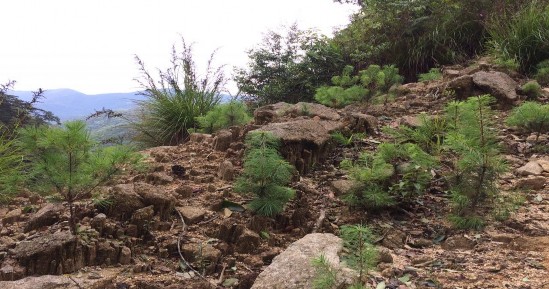
Figure 3.1. Natural regeneration of 5-needle pine on bare land in Chu Yang Sin National Park.
Photo: Le Canh Nam (2018)
Consider the coincidence or not between the dominant species in the upper layers and the regenerated species based on the comparison of Table 3.1 and Table 3.2; the results show that the composition of dominant tree species in the upper layers and the composition of dominant regenerated tree species in the 3 distribution areas of the 5-needle pine species are different; this shows that this is the result of the circular regeneration pattern according to the open canopy - a characteristic of the regeneration method of tropical rainforest ecosystems (Richard, 1952 [64]; Baur, 1975 [1]; Thai Van Trung, 1978 [71];
Phung Ngoc Lan, 1986 [43]).
The results from Table 3.2 determine the composition structure of regenerated tree species in 3 distribution areas as follows:
- Bidoup – Ba Mountain :
7.0% Agarwood + 4.8% Cinnamomum officinale + 4.1% Gong + 3.1% Langbiang Oak + 3.0% Horse dung + 77.9% other species.
- Chu Yang Sin :
4.5% Hedgehog + 3.9% Guava + 3.8% Red-shelled Myrtle + 3.0% Khao + 84.7% other species .
- Kon Ka Kinh :
23.4% Kha thu + 12.8% Tram + 7.3% Khao + 6.0% Sam + 5.3% Soi + 5.3% Su long + 3.5% Com + 35.5% other species .
Table 3.2. Dominant regenerating species composition by IV% in forest stands with distribution of 5-needle pine
Distribution area
Order of species superiority position | Species | N/ha (trees/ha) | N% | F | F% | IV% | |
Bidoup - Ba Mountain | 1 | Multi-Flavor | 1,500 | 8.2 | 750 | 5.8 | 7.0 |
2 | white | 1,083 | 5.9 | 500 | 3.9 | 4.9 | |
3 | Gong | 667 | 3.7 | 583 | 4.5 | 4.1 | |
4 | Langbiang Oak | 667 | 3.7 | 333 | 2.6 | 3.1 | |
5 | Horse shit | 750 | 4.1 | 250 | 1.9 | 3.0 | |
6 | 69 other species | 13,583 | 74.4 | 10,500 | 81.3 | 77.9 | |
Total | 18,250 | 100.0 | 12,917 | 100.0 | 100.0 | ||
Chu Yang Sin | 1 | Hedgehog lover | 1,300 | 5.4 | 600 | 3.7 | 4.5 |
2 | Small leaf guava | 1,600 | 6.6 | 200 | 1.2 | 3.9 | |
3 | Red hairpin | 1,100 | 4.5 | 500 | 3.1 | 3.8 | |
4 | Lock | 1,000 | 4.1 | 300 | 1.9 | 3.0 | |
5 | 93 other species | 19,200 | 79.3 | 14,600 | 90.1 | 84.7 | |
Total | 24,200 | 100.0 | 16,200 | 100.0 | 100.0 | ||
Kon Ka Kinh | 1 | Kha thu | 3,500 | 29.8 | 1,333 | 17.0 | 23.4 |
2 | Brooch | 1,500 | 12.8 | 1,000 | 12.8 | 12.8 | |
3 | Lock | 1,083 | 9.2 | 417 | 5.3 | 7.3 | |
4 | Slam | 750 | 6.4 | 583 | 7.4 | 6.0 | |
5 | Oak | 500 | 4.3 | 500 | 6.4 | 5.3 | |
6 | Hair follicle | 500 | 4.3 | 500 | 6.4 | 5.3 | |
7 | Rice | 333 | 2.8 | 333 | 4.3 | 3.5 | |
8 | 29 other species | 3,583 | 30.5 | 316 | 40.4 | 35.5 | |
Total | 11,750 | 100.0 | 7,833 | 100.0 | 100.0 |
The results of this analysis and from the reality in nature show that it is not that the Five-needle Pine does not regenerate naturally, but only regenerates in places with favorable ecological conditions, which are enough light, temperature, ... or in gaps in the forest, forest edges or open canopy areas. The mature forest canopy with the Five-needle Pine mother tree has hindered the natural regeneration of this species, mainly due to limitations in temperature and lack of light. Phi Hong Hai (2011) [16] and Trang (2011) [152] also had similar comments on the natural regeneration characteristics of this species. Another observation is that the difficulty in natural regeneration of the Five-needle Pine is also due to its periodic requirement for forest fires to clear weeds and promote seed germination (Hiep et al ., 2004 [110]).
3.1.3. Number of trees structure by diameter class (N/D) of forest stand with distribution of 5-leaf pine
The N/D distribution range of the forest stands with the distribution of 5-leaf pine for the three distribution regions is shown in Figure 3.2. The distribution pattern of these forest stands is completely identical to the general distribution pattern of tropical mixed broadleaf forests that many authors have confirmed (Nguyen Van Truong, 1973, 1983 [73, 74]; Dong Si Hien, 1974
[18]; Phung Ngoc Lan, 1986 [43]; Tran Van Con, 1991 [7], Bao Huy, 2017a [31]) that is an inverted J-shaped decreasing distribution or has a peak at the second diameter level.
BD
CYS
KKK
800
700
600
N (plants/ha)
500
400
300
200
100
0
11 21 31 41 51 61 71 81 91 101
D (cm)
Figure 3.2. N/D distribution of forest stands with 5-needle pine in distribution areas.
BD: Bidoup - Nui Ba, CYS: Chu Yang Sin, KKK: Kon Ka Kinh