
Repetition is the repetition of a poetic idea, a poetic line, a poetic verse, or even a poetic stanza according to the principles of repetition of ideas and grammatical structures to emphasize or expand ideas, to impress or evoke strong emotions in the hearts of readers and listeners.
This repetition formula is used a lot in lyrical folk songs in general and in Iieu singing of the Tay ethnic group in Bac Quang - Ha Giang in particular. However, each ethnic group has a different level of use, in Iieu singing, most of the lyrics use the repetition method. This is also a typical way of expression that creates rhythm, tempo, and appeal for Iieu folk songs here.
3.2.2.1. Repetition
In Hat Iieu, the Tay people of Bac Quang do not only use one image or one mood, but always repeat many images and moods according to a syntactic structure to deeply portray the content that needs to be expressed, like the lyrical character here sends a song in the soulful call of Butterfly and Flower:
Butterfly oh butterfly
Maybe you are interested!
-
 Characteristics of the Real Estate Market at the Present Time
 -
 The artistic view of space and time in To Hoai's memoirs Through the memoirs Cat bui chan ai and Chieu chieu - 7
 -
 Time, Content, Form of Organizing Knvđcb Educational Activities for Preschool Children at Kindergarten
 -
 Nguyen Khai's artistic style in novels after 1980 through three novels: Human Time, A Tiny Human World, God Laughs - 15
 -
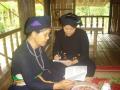 Hat Iieu in Bac Quang Ha Giang - Content and artistic characteristics - 21
The full moon calls butterflies and flowers to fly out. They fly to the clouds and misty sky. In the evening, butterflies fly along the water's surface. People see the pair of butterflies and they still fly. The pair of butterflies fly on the way back to their motherland. They fly on the way back to the sky.
The pair of butterflies flew forward, both hands plucking flowers to pay homage.
The deadly butterflies stir up sadness
[4. P.50]
And here is another image repeated to express the emotional state of mind of the young man "Than Pi" who wants to grow betel leaves "Piúc miâu luồm tham", wanting to
filling the ditch with water from the tank “Pan nam pe khau muong”, wanting to clear the dense forest to make a garden “Phat dong quang het thuon”… but that feeling was not reciprocated:
I also want to win the lottery, but the lottery is still going on.
The body of the pi cluck wants to reflect the year of the ditch. The ditch is empty and cannot reflect.
The body of the pi wants to be released in the East, the East needs to be released in the East, the price is also reduced.
You need to make friends and chat.
I want to plant many lush betel trees. The betel roots go in many directions, making it difficult. I want to build a ditch with tank water. The tank water goes in many directions, making it difficult. I want to clear a large forest to make a garden. The large forest has someone taking care of it.
No one makes fake friends like me
The fragrance of the flower cannot be returned . [40. Tr.55, 56]
Although the images are repeated, they are not completely repeated. Sometimes, the change in words makes the repeated idea not monotonous and boring, but adds new nuances, depicting the mood more deeply. For example, the repetition of syntax but the contrast in words will always create a new, attractive feeling that attracts readers and listeners:
Step to the left end of the field Step to the right end of the field.
[4.Tr. 64]
Small house with four walls
Big house, rich house. [4 .Tr.40]
The lyrics in Hat Iieu use repetition, repetition of ideas, repetition of poetic lines to vividly describe the mood of the lyrical character in the initial love song. In general: "The technique of repeating two poetic lines, three poetic lines, repeating entire stanzas creates fullness in the lyrical character's emotional flow, increases the persuasiveness of the argument and the consistency of the poetic image", [56.p. 64].
3.2.2.2. Repetition
Repetition is the repetition of a word in a sentence or in several subsequent sentences. Repetition is used with intensity in Hat Iieu. In the song inviting you to join the game, we see the girl's advice standing out very earnestly, she advises the water: "Thuom thum bau bon", "lup dom pai thai", "Thuom lac mon chi".
The earrings have lost their stripes. The earrings are all worn out. The earrings are all worn out. The earrings are all worn out.
I advise you again, I advise you to let the water flood the mon leaves, I advise you to let the water overflow the sandbank.
Advise to let water flood the mulberry roots. Advise to let the cicadas call out.
[8. P.2]
Or:
Watching the butterfly transformation beach Watching the countless butterflies on the sand beach This beach has buffaloes eating grass
This field is for horses.
[4. P.18]
The words “advice”, “watch” …repeated in the singer’s lyrics, filled with sincere sincerity. This dense repetition became the most effective means to express the lyrical character’s mood. And that repetition has the effect of emphasizing the idea, creating a deep impression, increasing the expressiveness and emotions of the singer such as:
I want to eat the betel in my pocket, I'm worried that your husband will wade through the stream to find me.
I want to eat betel in a handkerchief, I'm afraid my husband will come and scold me.
[40.Tr.56]
Many lyrics in Hat Ieu simultaneously use repetition of ideas, words, and syntax (sentence patterns) to create a flow of abundant emotions. The following lyrics about the young man's dream are a typical example:
Sleeping in the middle of the night, I had a vague dream. I dreamed of a new silk pillow. I dreamed of a friend inviting me on a trip. I woke up and couldn't find my friend anywhere.
Dreams are not sacred dreams. The rims are not wet.
Dream of fishing with a sinking hook Dream of casting a small net
Dream of chicken bait at the head of the boat Dream of playing chess on horseback
Dream of seeing the face of his lover.
[8.Tr.53]
This repetition technique is also a measure to create rhythm and tempo for the song. It creates refrains with melodious sounds, sometimes low, sometimes high, sometimes soaring, sometimes lingering, spreading out vastly, expressing rich diversity.
The variety of emotions makes the lyrics of Iieu songs have a lasting and intense vitality in the souls of those who love our national poetry in all ages.
3.3. Time and artistic space in Hat Iieu.
In the process of composing Iieu folk songs, the authors of those songs did not have a clear awareness of the two artistic aspects of space and time as a poetic category. However, through those lyrics, we can still feel the artistic signals of time and space that come back many times in the work. That shows us that Iieu singing has partly revealed their artistic value through those seemingly ordinary and simple compositions. As the opinion says: "Artistic time and space are aspects of objective phenomena reflected in the work, creating the artistic world in the work." [25]
The artistic space and time of a work are two factors that often go together, but in the research process we can consider these two factors separately to find the unique features of the work.
3.3.1. Art time
According to Professor Tran Dinh Su: “Artistic time is the time that we can experience in a work of art with its continuity and length, with its fast or slow pace, with the direction of time and present, past or future”. And therefore: “Artistic time is the time perceived psychologically, through a continuous series of changes (events) with aesthetic meaning occurring in the world of art”[55].
Thus, we see that artistic time is a system of time that connects and connects all phenomena in natural life. It is not only a means of developing images but also a means of exploring the movement of life. To say that artistic time is an artistic image is because it is an objective creative product in the material that makes up the art of the author.
Artistic time is also a symbol, representing the writer's concept of human life.
The artistic time in Hat Ieu is not simply a manifestation of the Tay people's concept of physical time, but it is also a vivid, organized, structured artistic image in the flow of human emotions and moods about life, especially the life of love in the early love songs. Therefore, the time perceived in Hat Ieu is a rich and diverse artistic time.
3.3.1.1. The artistic time in Hat Ieu is present time.
Hat Iieu is a folk literature work of the Tay people in Bac Quang performed in community life. If the lyrics of Hat Iieu are improvised, they will always be associated with the environment and specific performance method. Here the role of the performer is very important. Therefore, the author's time and the time of the audience (listener) also blend with the singer's present time. Therefore, we can affirm that the time in Hat Iieu is the present time. This is different from the time in fairy tales which is always the indefinite past time or the time in legends which is always the definite past time.
In the Iieu singing of the Tay people in Bac Quang, the singing environment and time are present time, mainly at night by the warm fire. Most of the Iieu singing lyrics do not have time words but are sung in a specific present time setting, so the lyrics have a present nature.
In the love song of Hat Iieu on a night of Luon, we immediately see the opening song usually takes place at Tuat hour (around 7 pm), at which time everything has been prepared and the song is sung with an open, sincere, and passionate heart:
Is dinner ready yet?
Have you all cleared the table yet? Arrange the tray in the left room for me to say hello. Remind the tray in the middle room for me to sing.
After the time was decided, Iieu's voice rang out:
Today I herded buffaloes in the rice fields and saw a man from another village come to my village. Today I herded horses in the high fields and saw a man from afar come to stay.
[8.Tr.34]
Although the adverb of time is today , in fact today is being spoken in real time - the performance time of the Io Night. This time is always suitable for all circumstances and subjects to express the feelings and psychology of the performer at the time of the singing. Therefore, that time is symbolic.
Similar to folk songs of other ethnic groups, the sign of the current performance time is expressed through the appearance of time-denoting words such as: Tonight, now, today, tomorrow, night and day... When singing, the performer can change those time-denoting words in the present to suit the situation, location, and time of performance. As the opinion says: "The key is to ensure the expression of lyrical emotions in the verse (song) to create sympathy and closeness among the participants in the current singing", [51: 133]. For example:
For many days he could not herd buffaloes and rice fields. Today he could herd buffaloes and rice fields.
Many days I have not been able to herd horses in the fields and hills. Today I am finally able to herd horses in the fields and hills.
Just saw a girl from another village come to stay
Let me say something before dinner.
The girls from the village are far away, let's have fun together.
[5.Tr.45].
Here the singer can change the adverb of time “today” with the word “now” to suit the space, mood, and circumstances of the song taking place.
Conventional time in folk songs of ethnic groups is used a lot, especially time expressing the concept and representing time as an unspecific quantity, lacking in certainty such as:
In Vietnamese folk songs:
Every afternoon I stand at the back alley, looking towards my motherland, my heart aches all afternoon.
Or in Dao folk songs:
We have known each other since long ago. Remember the promise from years ago. Because we are far away, we go our separate ways.
Today I remember that date.[54. P.202] In the lyrics of Iếu we also find:
Missing you in the middle of the night, the rooster crows, the stars disappear behind the white clouds, I go to bed.
[8.Tr.44] .
Or:
Meet flowers, be happy with flowers of spring. Meet wind, be happy with wind of a time.
[8.Tr.53]
Estimated time often goes hand in hand with the mood of the lyrical character, so time can stretch according to human subjectivity, meeting the need to express human emotions of sadness, joy, expectation...