
3.1.4. Discuss the current situation of using physical games to improve the positivity of 5-6 year old preschool children in physical education activities in Ho Chi Minh City
3.1.4.1. Current status of physical education program implementation in preschools in Ho Chi Minh City
The survey results of the implementation of the physical education program in kindergartens in Ho Chi Minh City show that 100% of them are implementing the physical education program for 5-6 year old kindergarten children according to the regulations of the Ministry of Education and Training.
In addition, 100% of schools ensure correct and adequate teaching; physical education classes are organized 2 periods/week, each period is 30-35 minutes and physical education classes are organized 1 period/week, each period is 35 minutes. Physical education activities for children are carried out regularly, but in reality, the effectiveness of these activities is not high, and the lessons are not exciting. There may be many objective and subjective reasons affecting the effectiveness of physical education activities for 5-6 year old kindergarten children.
Maybe you are interested!
-
 Car body electrical practice - 8
zt2i3t4l5ee
zt2a3gs
zt2a3ge
zc2o3n4t5e6n7ts
If the voltage is out of specification, replace the wire or connector.
If the voltage is within specification, install the front fog light relay and follow step 5.
Step 5 Check the front fog light switch
- Remove the D4 connector of the fog light switch
- Use a multimeter to measure the resistance of the front fog light switch.
Measurement location
Condition
Standard
D4-3 (BFG) -D4-4 (LFG)
Light switchFront Fog OFF
>10kΩ
D4-3 (BFG) -D4-4 (LFG)
Front fog light switchON
<1 Ω
- Standard resistor
D4 connector is located on the combination switch assembly.
If the resistance is out of specification, replace the combination switch (the fog light switch is located in the combination switch).
If the resistance is within specification, follow step 6.
Step 6 Check wiring and connectors (front fog light relay-light selector switch)
- Disconnect connector D4 of the combination switch assembly
- Use a voltmeter to measure the voltage value of jack D4 on the wire side.
Measurement location
Control modecontrol
Standard
D4-3 (BFG) - (-) AQ
TAIL
11 to 14 V
D4 connector for the wiring of the combination switch assembly
If the voltage does not meet the standard, replace the wire or connector.
If the voltage is within standard, there may have been an error in the previous measurements.
Step 7 Check the front fog lights
- Remove the front fog light electrical connector.
- Supply battery voltage to the fog lamp terminals
Jack 8, B9 of front fog lamp on the electrical side
blind first.
Power supply location
Terms and Conditions
Battery positive terminal - Terminal 2Battery negative terminal - Terminal 1
Fog lightsbefore morning
- If the light does not come on, replace the bulb.
If the light is on, re-plug the jack and continue to step 8.
Step 8 Check wiring and connectors (relay and front fog lights)
- Disconnect the B8 and B9 connectors of the front fog lights.
- Use a voltmeter to measure voltage at the following locations:
Measurement location
Switch location
Terms and Conditions
B8-2 - (-) AQ
Electric lock ON TAIL size switchFog switch ON
11 to 14 V
B9-2 - (-) AQ
Electric lock ONTAIL size switch Fog switch ON
11 to 14 V
B8 and B9 connectors on the front fog lamp wiring side
Voltage is not up to standard, repair or replace the jack. If up to standard, there may have been an error in the measurement process.
2.2.4. Procedure for removing, installing and adjusting fog lights 1. Procedure for removing
- Remove the front inner ear pads
Use a screwdriver to remove the 3 screws and remove the front part of the front inner ear liner
-Remove the fog light assembly
+ Disconnect the connector.
+ Use a screwdriver to remove 3 screws to remove the fog light cover
2. Installation sequence
-Rotate the fog lamp bulb in the direction indicated by the arrow as shown in the figure and remove the fog lamp from the fog lamp assembly.
-Rotate the fog light bulb in the direction indicated by the arrow as shown in the figure and install the light into the fog light assembly.
- Use a screwdriver to install the fog light cover
-Install the electrical connector
Attention: Be careful not to damage the plastic thread on the lamp assembly.
- Install the front inner ear pads
Use a screwdriver to install the front inner bumper with 3 screws.
3. Prepare the vehicle to adjust the fog light convergence. Prepare the vehicle:
- Make sure there is no damage or deformation to the vehicle body around the fog lights.
- Add fuel to the fuel tank
- Add oil to standard level.
- Add engine coolant to standard level.
- Inflate the tire to standard pressure.
- Place spare tire, tools and jack in original design position
- Do not leave any load in the luggage compartment.
- Let a person weighing about 75 kg sit in the driver's seat.
4. Prepare to check the fog light convergence
a/ Prepare the vehicle status as follows:
- Place the car in a dark enough place to see the lines. The lines are the dividing line, below which the light from the fog lights can be seen but above which it cannot.
- Place the car perpendicular to the wall.
- Keep a distance of 7.62 m between the center of the fog lamp and the wall.
- Park the car on level ground.
- Press the car down a few times to stabilize the suspension.
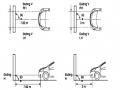
Note: A distance of approximately 7.62 m is required between the vehicle (fog lamp center) and the wall to adjust the convergence correctly. If the distance of 7.62 m cannot be achieved, set the correct distance of 3 m to check and adjust the fog lamp convergence. (Since the target area varies with the distance, please follow the instructions as shown in the figure.)
b/ Prepare a piece of thick white paper about 2 m high and 4 m wide to use as a screen.
c/ Draw a vertical line through the center of the screen (line V).
d/ Set the screen as shown in the picture. Note:
- Keep the screen perpendicular to the ground.
- Align the V line on the screen with the center of the vehicle.
e/Draw the reference lines (H, V LH and V RH lines) on the screen as shown in the figure.HINT:
Mark the center of the fog lamp on the screen. If the center mark cannot be seen on the fog lamp, use the center of the fog lamp or the manufacturer's name mark on the fog lamp as the center mark.
H line (fog light height):
Draw a line across the screen so that it passes through the center mark. Line H should be at the same height as the center mark of the fog light bulb.
Line V LH, V RH (center mark position of left fog lamp LH and right fog lamp RH):
Draw two lines so that they intersect line H at the center marks.
5. Check the fog light convergence
a/ Cover the fog lamp or remove the connector of the other side fog lamp to prevent light from the unchecked fog lamp from affecting the fog lamp convergence test.
b/ Start the engine.
c/ Turn on the fog lights and make sure that the dividing line is outside the standard area as shown in the drawing.
6. Adjust the fog light convergence
Use a screwdriver to adjust the fog light to the standard area by turning the toe adjustment screw.
Note: If the screw is adjusted too far, loosen it and then tighten it again, so that the last rotation of the light adjustment screw is clockwise.
3. Self-study questions
1. Describe the operating principle of the lighting system with automatic headlight function
2. Describe the operating principle of the lighting system with the function of rotating headlights when turning
3. Draw diagram and connect lighting system on Hyundai Porter car
4. Draw diagram and connect lighting system on Honda Accord 1992
5. Draw the lighting circuit on a 1993 Toyota Lexus
LESSON 3 MAINTENANCE AND REPAIR OF SIGNAL SYSTEM
I. IMPLEMENTATION GOAL
After completing this lesson, students will be able to:
- Distinguish between types of signals on cars
- Correctly describe common symptoms and suspected areas causing damage.
- Connecting signal circuits ensures technical requirements
- Disassemble, install, check, maintain and repair the signal system to ensure technical requirements.
- Ensure safety in work and industrial hygiene
II. LESSON CONTENT
1. General description
The signal system equipped on cars aims to create signals to notify other vehicles participating in traffic about the vehicle's operating status such as: stopping, parking, braking, reversing, turning...
Signals are used either by light such as headlamps, brake lights, turn signals….. or by sound such as horns, reverse music….
Just like the lighting system. A signal system circuit usually consists of: battery, fuse, wire, relay, electrical load and control switch. Only some switches of the signal system are on the combination switch. The switches of other signals are usually located in different locations such as in the gearbox or brake pedal……
2. Maintenance and repair
2.1. Turn signals and hazard lights
The installation location of the turn signal is shown in Figure 3.1. The turn signal control switch is located in the combination switch under the steering wheel. Turning this switch to the right or left will make the turn signal turn right or left.
The hazard light switch is used when the vehicle has a problem while participating in traffic. When the hazard light switch is turned on, all the turn signals on the vehicle will light up at a certain frequency. The hazard light switch is usually placed separately from the turn signal switch (some old cars integrate the hazard and turn signal switches on the same combination switch cluster).
Figure 3.1 Turn signal switch Figure 3.2 Hazard switch
The part that generates the flashing frequency for the lights is called a turn signal relay. The turn signal relay usually has 3 terminals: B (positive power supply); E (negative power supply); L (providing the turn signal switch to distribute to the
lamp)
2.1.1. Circuit diagram
To generate the frequency for the turn signal, a turn signal relay is used in the turn signal circuit. The current from the turn signal relay will be sent to the turn signal switch assembly to distribute the current to the turn signal lights for the driver's purpose.
Figure 3.3. Schematic diagram of a turn signal circuit without a hazard switch
1. Battery; 2. Electric lock; 3. Turn signal relay; 4. Turn signal switch; 5. Turn signal lamp; 6. Turn signal lamp; 7. Hazard switch
Figure 3.4 Schematic diagram of turn signal circuit with hazard switch
1. Battery; 2. Combination switch cluster; 3. Turn signal;
4. Turn signal light; 5. Turn signal relay
Today's cars no longer use three-pin turn signal relays (B, L, E) but use eight-pin turn signal relays (figure 3.5) (pin number 8 is used for hazard lights).
For this type, the current supplying the turn signal lights is supplied directly from the turn signal relay to the lights.
div.maincontent .p { color: black; font-family:"Times New Roman", serif; font-style: normal; font-weight: normal; text-decoration: none; font-size: 14pt; margin:0pt; } div.maincontent p { color: black; font-family:"Times New Roman", serif; font-style: normal; font-weight: normal; text-decoration: none; font-size: 14pt; margin:0pt; } div.maincontent .s1 { color: black; font-family:"Times New Roman", serif; font-style: normal; font-weight: normal; text-decoration: none; font-size: 13pt; } div.maincontent .s2 { color: black; font-family:"Times New Roman", serif; font-style: italic; font-weight: normal; text-decoration: none; font-size: 14pt; } div.maincontent .s3 { color: black; font-family:"Times New Roman", serif; font-style: normal; font-weight: normal; text-decoration: none; font-size: 14pt; } div.maincontent .s4 { color: black; font-family:"Times New Roman", serif; font-style: normal; font-weight: normal; text-decoration: none; font-size: 13pt; } div.maincontent .s5 { color: black; font-family:"Times New Roman", serif; font-style: normal; font-weight: normal; text-decoration: none; font-size: 13pt; vertical-align: 1pt; } div.maincontent .s6 { color: black; font-family:"Times New Roman", serif; font-style: normal; font-weight: normal; text-decoration: none; font-size: 11pt; } div.maincontent .s7 { color: black; font-family:"Times New Roman", serif; font-style: normal; font-weight: normal; text-decoration: none; font-size: 14pt; vertical-align: -9pt; } div.maincontent .s8 { color: black; font-family:"Times New Roman", serif; font-style: normal; font-weight: normal; text-decoration: none; font-size: 11pt; } div.maincontent .s9 { color: #008000; font-family:"Times New Roman", serif; font-style: normal; font-weight: normal; text-decoration: none; font-size: 14pt; } div.maincontent .s10 { color: black; font-family:"Times New Roman", serif; font-style: italic; font-weight: normal; te
Car body electrical practice - 8
zt2i3t4l5ee
zt2a3gs
zt2a3ge
zc2o3n4t5e6n7ts
If the voltage is out of specification, replace the wire or connector.
If the voltage is within specification, install the front fog light relay and follow step 5.
Step 5 Check the front fog light switch
- Remove the D4 connector of the fog light switch
- Use a multimeter to measure the resistance of the front fog light switch.
Measurement location
Condition
Standard
D4-3 (BFG) -D4-4 (LFG)
Light switchFront Fog OFF
>10kΩ
D4-3 (BFG) -D4-4 (LFG)
Front fog light switchON
<1 Ω
- Standard resistor
D4 connector is located on the combination switch assembly.
If the resistance is out of specification, replace the combination switch (the fog light switch is located in the combination switch).
If the resistance is within specification, follow step 6.
Step 6 Check wiring and connectors (front fog light relay-light selector switch)
- Disconnect connector D4 of the combination switch assembly
- Use a voltmeter to measure the voltage value of jack D4 on the wire side.
Measurement location
Control modecontrol
Standard
D4-3 (BFG) - (-) AQ
TAIL
11 to 14 V
D4 connector for the wiring of the combination switch assembly
If the voltage does not meet the standard, replace the wire or connector.
If the voltage is within standard, there may have been an error in the previous measurements.
Step 7 Check the front fog lights
- Remove the front fog light electrical connector.
- Supply battery voltage to the fog lamp terminals
Jack 8, B9 of front fog lamp on the electrical side
blind first.
Power supply location
Terms and Conditions
Battery positive terminal - Terminal 2Battery negative terminal - Terminal 1
Fog lightsbefore morning
- If the light does not come on, replace the bulb.
If the light is on, re-plug the jack and continue to step 8.
Step 8 Check wiring and connectors (relay and front fog lights)
- Disconnect the B8 and B9 connectors of the front fog lights.
- Use a voltmeter to measure voltage at the following locations:
Measurement location
Switch location
Terms and Conditions
B8-2 - (-) AQ
Electric lock ON TAIL size switchFog switch ON
11 to 14 V
B9-2 - (-) AQ
Electric lock ONTAIL size switch Fog switch ON
11 to 14 V
B8 and B9 connectors on the front fog lamp wiring side
Voltage is not up to standard, repair or replace the jack. If up to standard, there may have been an error in the measurement process.
2.2.4. Procedure for removing, installing and adjusting fog lights 1. Procedure for removing
- Remove the front inner ear pads
Use a screwdriver to remove the 3 screws and remove the front part of the front inner ear liner
-Remove the fog light assembly
+ Disconnect the connector.
+ Use a screwdriver to remove 3 screws to remove the fog light cover
2. Installation sequence
-Rotate the fog lamp bulb in the direction indicated by the arrow as shown in the figure and remove the fog lamp from the fog lamp assembly.
-Rotate the fog light bulb in the direction indicated by the arrow as shown in the figure and install the light into the fog light assembly.
- Use a screwdriver to install the fog light cover
-Install the electrical connector
Attention: Be careful not to damage the plastic thread on the lamp assembly.
- Install the front inner ear pads
Use a screwdriver to install the front inner bumper with 3 screws.
3. Prepare the vehicle to adjust the fog light convergence. Prepare the vehicle:
- Make sure there is no damage or deformation to the vehicle body around the fog lights.
- Add fuel to the fuel tank
- Add oil to standard level.
- Add engine coolant to standard level.
- Inflate the tire to standard pressure.
- Place spare tire, tools and jack in original design position
- Do not leave any load in the luggage compartment.
- Let a person weighing about 75 kg sit in the driver's seat.
4. Prepare to check the fog light convergence
a/ Prepare the vehicle status as follows:
- Place the car in a dark enough place to see the lines. The lines are the dividing line, below which the light from the fog lights can be seen but above which it cannot.
- Place the car perpendicular to the wall.
- Keep a distance of 7.62 m between the center of the fog lamp and the wall.
- Park the car on level ground.
- Press the car down a few times to stabilize the suspension.
Note: A distance of approximately 7.62 m is required between the vehicle (fog lamp center) and the wall to adjust the convergence correctly. If the distance of 7.62 m cannot be achieved, set the correct distance of 3 m to check and adjust the fog lamp convergence. (Since the target area varies with the distance, please follow the instructions as shown in the figure.)
b/ Prepare a piece of thick white paper about 2 m high and 4 m wide to use as a screen.
c/ Draw a vertical line through the center of the screen (line V).
d/ Set the screen as shown in the picture. Note:
- Keep the screen perpendicular to the ground.
- Align the V line on the screen with the center of the vehicle.
e/Draw the reference lines (H, V LH and V RH lines) on the screen as shown in the figure.HINT:
Mark the center of the fog lamp on the screen. If the center mark cannot be seen on the fog lamp, use the center of the fog lamp or the manufacturer's name mark on the fog lamp as the center mark.
H line (fog light height):
Draw a line across the screen so that it passes through the center mark. Line H should be at the same height as the center mark of the fog light bulb.
Line V LH, V RH (center mark position of left fog lamp LH and right fog lamp RH):
Draw two lines so that they intersect line H at the center marks.
5. Check the fog light convergence
a/ Cover the fog lamp or remove the connector of the other side fog lamp to prevent light from the unchecked fog lamp from affecting the fog lamp convergence test.
b/ Start the engine.
c/ Turn on the fog lights and make sure that the dividing line is outside the standard area as shown in the drawing.
6. Adjust the fog light convergence
Use a screwdriver to adjust the fog light to the standard area by turning the toe adjustment screw.
Note: If the screw is adjusted too far, loosen it and then tighten it again, so that the last rotation of the light adjustment screw is clockwise.
3. Self-study questions
1. Describe the operating principle of the lighting system with automatic headlight function
2. Describe the operating principle of the lighting system with the function of rotating headlights when turning
3. Draw diagram and connect lighting system on Hyundai Porter car
4. Draw diagram and connect lighting system on Honda Accord 1992
5. Draw the lighting circuit on a 1993 Toyota Lexus
LESSON 3 MAINTENANCE AND REPAIR OF SIGNAL SYSTEM
I. IMPLEMENTATION GOAL
After completing this lesson, students will be able to:
- Distinguish between types of signals on cars
- Correctly describe common symptoms and suspected areas causing damage.
- Connecting signal circuits ensures technical requirements
- Disassemble, install, check, maintain and repair the signal system to ensure technical requirements.
- Ensure safety in work and industrial hygiene
II. LESSON CONTENT
1. General description
The signal system equipped on cars aims to create signals to notify other vehicles participating in traffic about the vehicle's operating status such as: stopping, parking, braking, reversing, turning...
Signals are used either by light such as headlamps, brake lights, turn signals….. or by sound such as horns, reverse music….
Just like the lighting system. A signal system circuit usually consists of: battery, fuse, wire, relay, electrical load and control switch. Only some switches of the signal system are on the combination switch. The switches of other signals are usually located in different locations such as in the gearbox or brake pedal……
2. Maintenance and repair
2.1. Turn signals and hazard lights
The installation location of the turn signal is shown in Figure 3.1. The turn signal control switch is located in the combination switch under the steering wheel. Turning this switch to the right or left will make the turn signal turn right or left.
The hazard light switch is used when the vehicle has a problem while participating in traffic. When the hazard light switch is turned on, all the turn signals on the vehicle will light up at a certain frequency. The hazard light switch is usually placed separately from the turn signal switch (some old cars integrate the hazard and turn signal switches on the same combination switch cluster).
Figure 3.1 Turn signal switch Figure 3.2 Hazard switch
The part that generates the flashing frequency for the lights is called a turn signal relay. The turn signal relay usually has 3 terminals: B (positive power supply); E (negative power supply); L (providing the turn signal switch to distribute to the
lamp)
2.1.1. Circuit diagram
To generate the frequency for the turn signal, a turn signal relay is used in the turn signal circuit. The current from the turn signal relay will be sent to the turn signal switch assembly to distribute the current to the turn signal lights for the driver's purpose.
Figure 3.3. Schematic diagram of a turn signal circuit without a hazard switch
1. Battery; 2. Electric lock; 3. Turn signal relay; 4. Turn signal switch; 5. Turn signal lamp; 6. Turn signal lamp; 7. Hazard switch
Figure 3.4 Schematic diagram of turn signal circuit with hazard switch
1. Battery; 2. Combination switch cluster; 3. Turn signal;
4. Turn signal light; 5. Turn signal relay
Today's cars no longer use three-pin turn signal relays (B, L, E) but use eight-pin turn signal relays (figure 3.5) (pin number 8 is used for hazard lights).
For this type, the current supplying the turn signal lights is supplied directly from the turn signal relay to the lights.
div.maincontent .p { color: black; font-family:"Times New Roman", serif; font-style: normal; font-weight: normal; text-decoration: none; font-size: 14pt; margin:0pt; } div.maincontent p { color: black; font-family:"Times New Roman", serif; font-style: normal; font-weight: normal; text-decoration: none; font-size: 14pt; margin:0pt; } div.maincontent .s1 { color: black; font-family:"Times New Roman", serif; font-style: normal; font-weight: normal; text-decoration: none; font-size: 13pt; } div.maincontent .s2 { color: black; font-family:"Times New Roman", serif; font-style: italic; font-weight: normal; text-decoration: none; font-size: 14pt; } div.maincontent .s3 { color: black; font-family:"Times New Roman", serif; font-style: normal; font-weight: normal; text-decoration: none; font-size: 14pt; } div.maincontent .s4 { color: black; font-family:"Times New Roman", serif; font-style: normal; font-weight: normal; text-decoration: none; font-size: 13pt; } div.maincontent .s5 { color: black; font-family:"Times New Roman", serif; font-style: normal; font-weight: normal; text-decoration: none; font-size: 13pt; vertical-align: 1pt; } div.maincontent .s6 { color: black; font-family:"Times New Roman", serif; font-style: normal; font-weight: normal; text-decoration: none; font-size: 11pt; } div.maincontent .s7 { color: black; font-family:"Times New Roman", serif; font-style: normal; font-weight: normal; text-decoration: none; font-size: 14pt; vertical-align: -9pt; } div.maincontent .s8 { color: black; font-family:"Times New Roman", serif; font-style: normal; font-weight: normal; text-decoration: none; font-size: 11pt; } div.maincontent .s9 { color: #008000; font-family:"Times New Roman", serif; font-style: normal; font-weight: normal; text-decoration: none; font-size: 14pt; } div.maincontent .s10 { color: black; font-family:"Times New Roman", serif; font-style: italic; font-weight: normal; te -
 Analysis of Current Status of Tourism Activities in Phong Dien District
 -
 Management Status of Tcm Results Evaluation Through NCBH Form Table 2.9: Current Status of Evaluation of Professional Team Performance Results Through Form
 -
 Current Status of Teaching Capacity of Teachers at District-Level Vocational Education Centers in Cao Bang Province
 -
 Current Status of Credit Quality at Vietnamese Joint Stock Commercial Banks
The problem for the Board of Directors and teachers of preschools in Ho Chi Minh City is that in addition to properly implementing the physical education program for children, it is necessary to improve teaching content and change teaching methods to arouse interest and promote children's intellectual development.
3.1.4.2. Current status of facilities serving physical education activities in preschools in Ho Chi Minh City
In recent years, investment in physical facilities for physical education activities in kindergartens in Ho Chi Minh City has received attention and focus. The physical facilities have been improved, but still do not meet the physical education needs of children.
The research results show that the facilities for physical education activities in kindergartens in Ho Chi Minh City are only at an average and low level. Because kindergartens are located in Ho Chi Minh City with limited land, the playground system for children occupies a rather small area. Most schools have a separate physical training room for children, but there are still schools using multi-function rooms for this activity, the quality of the gyms is assessed at an average level. This
negatively affecting the effectiveness of physical education activities. This is also a common difficulty of physical education work for preschools in Ho Chi Minh City.
In addition, there is a lack of training equipment; indoor and outdoor equipment and toys; and safety equipment for children, which cannot meet the needs of the number of children. Most of the equipment and tools are used and rarely replaced. The lack of facilities and equipment for physical education activities is also a common situation in preschools across the country.
This reality requires managers of preschools to have specific strategies and directions in investing in the physical facilities system serving children's physical education activities in both quantity and quality to improve the effectiveness of physical education teaching.
3.1.4.3. Current status of awareness about the use of movement games in physical education activities in Ho Chi Minh City
Teachers have a correct understanding of the use of physical education activities to enhance the cognitive abilities of 5-6 year old preschool children in physical education activities in Ho Chi Minh City. Teachers also realize that organizing physical education activities has great educational significance for the comprehensive development of children.
The research results show that the majority of teachers believe that the use of TCVĐ in physical education activities for 5-6 year old preschool children is necessary, and highly appreciate the advantages of using TCVĐ in physical education activities; however, in reality, in order to exploit and effectively organize TCVĐ for children, teachers are still confused, especially the views on the role of TCVĐ in improving the physical skills of 5-6 year old preschool children in physical education activities are not really consistent. This causes negative impacts on the effectiveness of TCVĐ in physical education activities for children.
3.1.4.4. Current status of using movement games in physical education activities at preschools in Ho Chi Minh City
Most teachers are aware that introducing physical activities into physical education activities will contribute to improving children's cognitive abilities. Teachers know and have organized physical activities for children in physical education activities; however, in reality, when organizing physical activities for children, teachers are still confused. Teachers tend to use collective physical activities or simple physical activities that are easy to implement. These physical activities are often monotonous and lack
lively, repetitive, boring, uninteresting, not engaging for children.
The survey results also show that physical education is mainly applied in physical education and physical education (specialized) classes. This is a reasonable form of application, ensuring the frequency of pulse and physical fitness for children. However, in Table 3.14, 15.6% of teachers choose to apply it in the form of physical education between classes, because this form has a short duration. If teachers organize physical education for children during this period without scientific or careful consideration, it is very likely that after playing, children will not have enough time to recover their physical strength to enter the next class. This shows that teachers need to carefully study the content of physical education, duration, purpose of the class, etc. to improve the effectiveness of physical education activities for 5-6 year old kindergarten children.
3.1.4.5. Difficulties in using physical games to improve the positivity of 5-6 year old preschool children in physical education activities in Ho Chi Minh City
Research results show that, because the number of children in each class is currently quite large and the children have few life skills, the time spent on...
The average score in table 3.7 is 3.31 points, corresponding to the level of "sometimes" according to the established scale. This means that in the process of organizing physical education activities to improve the cognitive skills of 5-6 year old preschool children in physical education activities, teachers sometimes encounter difficulties.
Detailed analysis shows that GVMN faces the most difficulties in “Too many children in the class” and “Children have little life experience” (Average = 3.94, ranked 1). It can be easily seen that this is a common difficulty of most preschools in Ho Chi Minh City.
Ranked 2nd is the difficulty of "Limited time to organize physical activities" which was assessed by preschool teachers at a fairly high rate of 69.7%, followed by "Children have the habit of following teachers' requests" at 61.4% (ranked 3rd).
In 4th place is "Heavy curriculum puts pressure on teachers in organizing physical education activities for children". In this content, up to 43.2% of preschool teachers choose this option very often and often. However, through practical research, the current curriculum for children has been significantly reduced, and lessons are also organized scientifically.
If teachers still feel difficulty and pressure, it means that teachers are not proactive and flexible in arranging and building teaching plans.
The following positions are "Teachers have not really encouraged and created conditions for children to participate in physical education", "Tools and toys are still poor and lacking" and "Teachers' professional qualifications and teaching skills are still limited". This shows that preschool teachers have focused on selecting and applying physical education to improve the intellectual capacity of 5-6 year old preschool children in physical education activities by creating opportunities for children to express their creativity and ideas while playing; encouraging and motivating children to confidently express themselves. However, teachers also need the school to support them with additional tools and toys. This is a proposal that needs attention.
In recent years, the curriculum for children has been innovated, the content has been significantly reduced, and the lessons have been organized more scientifically. Mainly focusing on the development goals of children, but up to 43.2% of teachers still have difficulty in designing teaching plans and lesson plans. This shows that teachers are still limited in their capacity, and are not proactive in arranging and developing teaching plans.
Teachers have not really encouraged and created conditions for children to participate in physical education activities, and equipment and toys are still poor and lacking" and "The professional qualifications and teaching skills of teachers are still limited, making physical education activities boring, and children are no longer very active in these activities.
These difficulties are major problems that require schools to have specific solutions to overcome if they want to improve the quality of physical education activities for children.
The above results also coincide with the opinion of Ms. NTNQ, a kindergarten teacher: "We all know that kindergarten children are at an age where they easily lose focus, are often worried, and the psychological development among children is uneven, leading to some children quickly absorbing the rules of the game and participating very actively, and vice versa. Therefore, one of the biggest difficulties I encounter when organizing physical education for kindergarten children in grades 5-6 is managing the class so that all children can participate in physical education effectively . "
3.1.4.6. Determining criteria for assessing the positivity of 5-6 year old preschool children in physical education activities in Ho Chi Minh City
To determine the criteria for assessing the current status of TTC of 5-6 year old preschool children in physical education activities in Ho Chi Minh City through the factors constituting TTC including: interest, initiative, solving problems arising during play, effort, cooperation, the thesis analyzed the reliability and informativeness of the criteria based on a survey of 218 teachers working at preschools in Ho Chi Minh City. The results showed that there were 16 criteria with a total Cronbach's Alpha coefficient > 0.6, the correlation coefficient with the total variable was greater than the allowable standard (> 0.3). The KMO value > 0.5, Sig. = 0.000 in the Bartlett test < 0.05, which means rejecting the hypothesis H 0 that the variables are not correlated with each other in the whole. The total extracted variance is 76.341% > 50%, meeting the condition. The Eigenvalues level stops when extracted at the 16th criterion is 1.427>1. The criteria have factor loading coefficients greater than 0.5 and all meet the requirements.
3.1.4.7. Current status of 5-6 year old preschool children's positivity in physical education activities in Ho Chi Minh City
The research results in Table 3.16 show that children's TTC when playing physical education activities are mainly assessed at an average or negative level. When participating in the game, children still feel bored and have little energy. This fact makes the effectiveness of physical education activities for children not as expected. There are a number of reasons that can explain this situation: children are less active, physical education activities are monotonous, and have been organized many times, making children no longer feel interested. The school's Board of Directors and the teaching staff need to innovate in the content, approach and method of organizing physical education activities for preschool children aged 5-6.
The above results completely coincide with the opinion of Ms. PMH - Principal of the Kindergarten: "Currently, physical education for preschool children in general and preschool children aged 5-6 years old has not achieved the expected results. Children are often not interested in participating in activities" .
The thesis identifies physical fitness as one of the criteria for evaluating the effectiveness of physical education for 5-6 year old kindergarten children. To verify whether improving physical fitness is correlated with physical development? Theoretically, physical fitness will be the motivation for children to be enthusiastic.
exercise in physical education activities and this will help children develop better. The physical assessment tests for the research subjects identified in section 3.1.1 were selected and strictly tested through steps such as: conducting interviews with 30 physical education experts. The results of the 2 interviews in table 3.17 of the tests all have 2 < 2 table , so the difference between the two observed values of the sample is not statistically significant at the 5% probability threshold. This proves that the choices of physical education experts are highly consistent.
To confirm the reliability of the physical fitness tests, the thesis conducted a test on 66 5-6 year old kindergarten children at Hoang Yen Kindergarten using the Retest method with a 7-day interval. The results of the correlation analysis between the two test repetitions in Table 3.10 show that all physical fitness tests have a reliability coefficient of r>0.8 and P<0.01. Therefore, it can be concluded that the physical fitness tests for the research subjects are all sufficiently reliable.
Regarding the physical condition of 5-6 year old kindergarten children in Ho Chi Minh City: the thesis assessed the physical condition of children by testing 566 5-6 year old kindergarten children in kindergartens in Ho Chi Minh City according to 5 physical assessment tests. The results showed that:
For male children: the average test of 10m running (seconds), standing long jump (cm), hitting and catching the ball with 2 hands (times/minute) is better than the average physical strength of male children aged 5-6 years old, this difference is statistically significant at the probability threshold P<0.05. The average test of throwing long distance with dominant hand (m) but this difference is so small that it can be considered equivalent at the probability threshold P>0.05.
For female children: the average test of 10m running (seconds), standing long jump (cm), throwing with dominant hand (m), sitting forward bending (cm) is better than the average physical strength of female children in kindergarten 5-6 years old, this difference is statistically significant at the probability threshold P<0.05. The average test of hitting and catching the ball with 2 hands (times/minute) is better than the average physical strength of female children in kindergarten 5-6 years old but this difference is so small that it can be considered equivalent at the probability threshold P>0.05.
When compared with the results of the physical fitness survey of 5-6 year old kindergarten children in 2008, most of the physical fitness tests of 5-6 year old kindergarten children in Ho Chi Minh City were better, which is consistent with the law of development and reflects the positive impact of socio-economic development as well as the attention and physical development of children carried out over the years.
Conclusion of objective 1
Preschools in Ho Chi Minh City implement the physical education program according to the regulations of the Ministry of Education and Training but have not developed physical education in physical education activities for 5-6 year old preschool children.
The infrastructure system serving vocational education activities is still lacking, the level of meeting needs is average, most of the tools and equipment are used and rarely replaced.
The number of teachers who are aware of the role and importance of TCVĐ is relatively high. However, in reality, to exploit TCVĐ effectively, teachers are still very confused.
The biggest difficulty teachers currently face when using TCVĐ for 5-6 year old preschool children in physical education activities in Ho Chi Minh City is the large number of children in the class and the lack of new TCCĐ.
16 criteria were identified to evaluate the TTC of 5-6 year old preschool children in physical education activities in Ho Chi Minh City. The current TTC status of 5-6 year old preschool children in Ho Chi Minh City is at an average level, children are not active in the physical education activities organized in physical education activities.
Select 05 physical fitness assessment tests and better physical fitness tests compared to the age group on a general comparison basis with 5-6 year old kindergarten children in 2008. The physical development process of 5-6 year old kindergarten children in Ho Chi Minh City is currently consistent with the development laws of society.
3.2. Research on selecting physical education activities to improve the mental health of 5-6 year old preschool children in physical education activities in Ho Chi Minh City
3.2.1. Basis for selecting physical games to enhance the positivity of 5-6 year old preschool children in physical education activities in Ho Chi Minh City
3.2.1.1. Legal basis
Physical education occupies an important position in the lives of preschool children, physical education is considered one of the important means of education for children. Organizing children to play with physical education, interspersed reasonably in their daily activities at school is an extremely important and necessary issue.
TCVĐ is an activity that attracts children because of its appeal. With the psychological characteristics of children being hyperactive and liking to explore new things, TCVĐ is the most suitable content in
Physical education activities for children [80]. Physical education is also a means to combat fatigue and stress in children during learning activities. During physical education, not only is stress reduced, but children's bodies are also recharged with energy to actively move in play activities [86].
The legal basis for selecting TCVĐ to improve the TTC of 5-6 year old preschool children in physical education activities in Ho Chi Minh City is based on the viewpoints and guidelines of the Party and the laws of the State on physical education in schools in general and physical education for preschool children in particular in the documents, directives and resolutions that have been issued as follows:
Decision No. 14/2001/QD-BGD&DT dated May 3, 2001 of the Ministry of Education and Training on promulgating regulations on physical education and school health [7].
Directive No. 17 CT/TW dated October 23, 2002 of the Central Executive Committee of the Communist Party of Vietnam on the development of Physical Training and Sports to 2010 [4].
Law on Education 2005 [56].
Law on Physical Training and Sports 2006 [54].
Decision No. 1076/QD-TTg dated June 17, 2016 of the Prime Minister on approving the overall project on development of physical education and school sports for the period 2016 - 2020, with a vision to 2025 [70].
Decision No. 149/QD-TTg dated June 23, 2006 of the Prime Minister approving the Project "Developing Preschool Education for the period 2006 - 2015" [68].
Circular No. 17/2009/TT-BGDDT dated July 25, 2009 of the Ministry of Education and Training promulgating the preschool education program [8].
Decision No. 711/QD-TTg dated June 13, 2012 of the Prime Minister on approving the "Education Development Strategy 2011 - 2020" [69].
Decree No. 11/2015/ND-CP dated January 31, 2015 of the Government on regulations on physical education and sports activities in schools [12].
Documents of the 12th National Congress of the Communist Party of Vietnam 2016 [18].
Directive No. 2699/CT-BGDDT dated August 8, 2017 of the Ministry of Education and Training on the main tasks of the 2017-2018 school year of the education sector [11].
Law amending and supplementing a number of articles of the Law on Education 2019 [55].