
into total revenue is much larger than the general proportion such as VIB 21%, Sacombank 20%, MB 16%, Techcombank 15% [27]
2.2 Current status of credit quality at Vietnamese joint stock commercial banks
2.2.1 Current status of credit quality of Vietnam's sectors through assessment criteria
Joint stock commercial bank
2.2.1.1 Group of indicators on credit scale and growth
a. Outstanding credit balance of Nam
and growth
credit balance
at some Vietnamese commercial banks
Total outstanding credit is an indicator reflecting the amount of money banks have.
Vietnam Joint Stock Commercial Bank for Industry and Trade provides to the economy at a time. Total outstanding debt includes short-term, medium-term and long-term loans. Low total outstanding debt shows that the bank's credit activities are weak and it is unable to expand its customer base.
goods, ability
marketing ability
poor bank, level
staff
worker
low… However, if this indicator is high, it does not necessarily mean that the loan quality is good, and bad debt is likely to occur. However, if the total outstanding debt increases continuously over the years, it shows an upward trend in credit quality. Specifically, the outstanding credit balance of some Vietnamese commercial banks is shown in the figure below:
Table 2.5: Outstanding credit balance of 15 Vietnamese commercial banks from 2014-2018
Unit: billion VND
STT
Bank | 2014 | 2015 | 2016 | 2017 | 2018 | |
1 | ACB | 116,324 | 134,032 | 163,401 | 198,462 | 230,527 |
2 | BIDV | 445,693 | 598,434 | 723,697 | 866,885 | 988,739 |
3 | Eximbank | 87,146 | 84,759 | 86,891 | 101,324 | 104,242 |
4 | HDBank | 41,900 | 56,558 | 82,224 | 104,497 | 123,132 |
5 | LienVietPostbank | 51,667 | 64,784 | 84,908 | 100,621 | 119,193 |
6 | Maritime Bank | 22,967 | 27,491 | 34,667 | 35,784 | 48,762 |
7 | MBBank | 100,569 | 121,349 | 150,738 | 184,188 | 159,942 |
8 | Sacombank | 124,576 | 180,593 | 193,098 | 222,947 | 256,623 |
9 | SHB | 104,096 | 131,428 | 162,376 | 196.131 | 216,989 |
10 | Techcombank | 94,894 | 124,032 | 142,616 | 160,849 | 217,138 |
11 | TienPhongbank | 19,839 | 28,240 | 47,325 | 64,007 | 78,458 |
12 | VIB | 18,179 | 47,777 | 60,180 | 79,864 | 96,139 |
13 | Vietcombank | 323,332 | 387,700 | 460,800 | 543,434 | 632,633 |
14 | Vietinbank | 439,869 | 538,080 | 661,988 | 790,688 | 864,926 |
Maybe you are interested!
-

 Survey on the Current Status of Improvement in Service Quality Management for Credit Institutions for Managers at Shb Hoan Kiem.
 -
 Current status of short-term lending activities and some solutions to improve the quality of short-term credit services at Vietnam Joint Stock Commercial Bank for Industry and Trade Vietinbank - Branch 12 - 1
 -
 Current Status of Factors Affecting Credit Risk at Vietnamese Commercial Banks in the Period 2008 - 2016:
 -
 Improving credit quality at Vietnamese joint stock commercial banks 1669220937 - 31
 -
 Current Status of Risk Management of Vietnamese Banks Chapter 3: Perfecting Credit Risk Management of Vietnamese Banks
15 | VPBank | 78,379 | 116,804 | 144,673 | 182,666 | 221,962 |
Total | 2,069.43 0 | 2,642.06 1 | 3,199.58 2 | 3,832.34 7 | 4,359,405 | |
Growth rate | 16.10 | 27.67 | 21.10 | 19.78 | 13.75 | |
(Source: [27])
From 2014 to 2018, outstanding loans of commercial banks increased annually, higher than the average growth rate of credit growth of the entire banking system, the highest in 2015, increasing by 27.67% compared to 2014. Part of the reason came from the merger of banks in the period 2014 - 2015. In 2018, customer loan growth was the lowest in the past 5 years at 13.75% due to the State Bank implementing a tight monetary policy, limiting credit growth.
Unit: billion VND, %
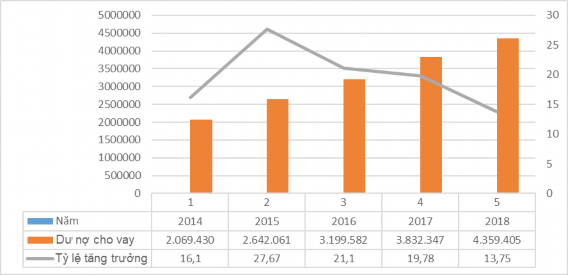
Figure 2.8: Outstanding credit balance of 15 Vietnamese commercial banks from 2014-2018
(Source: [27])
b. Credit growth rate of Vietnam's commercial banking system
0.2
0.18
0.16
0.14
0.12
0.1
0.08
0.06
0.04
0.02
0
18.71%
The average credit growth rate of Vietnamese Joint Stock Commercial Banks from Financial Reports over the years is shown in the figure below:
17, | 29% | 18, | 17% | |||||||
14, | 16% | 14, | 00% | |||||||
1 | 2 | 3 | 4 | 5 | ||||||
Year | 2014 | 2015 | 2016 | 2017 | 2018 | |||||
Growth rate | 14.16% | 17.29% | 18.71% | 18.17% | 14.00% | |||||
Figure 2.9: Credit growth rate of Vietnamese joint stock commercial banks
Male
20142018
(Source:[29])
Credit growth rate increased sharply in the period 2015-2017. During the year
In 2016, credit increased the most due to the monetary policy implemented by the State Bank.
The government has been operating in a cautious easing direction to support economic growth and control inflation. Credit growth in 2016 reached 18.71% compared to the end of 2015.
In 2018, credit growth of Vietnamese commercial banks increased
about 14% compared to 2017 (18.17%), this is the lowest rate in the 5-year period.
years from 2014 to 2018. The reason for low credit growth is that to simultaneously implement two goals of creating conditions for capital support for the economy and controlling inflation is an issue raised in 2018 for the monetary policy management of the State Bank. Right from the beginning of 2018, the State Bank has developed and implemented measures
credit growth control method according to index
both orientation
2018.
The State Bank of Vietnam has directed commercial banks to focus on strictly controlling the credit growth rate and quality of the entire system. In early August, the State Bank of Vietnam decided not to consider or adjust the credit growth target or "lock the credit room" in the
2018 except for special cases, such as some commercial banks participating in restructuring in 2018 for weak credit institutions. Along with that, conduct inspections of banks with high credit growth rates in the fields of real estate, securities, and consumption, accounting for a large proportion of total outstanding debt.
The impact of growth rate on credit quality of commercial banks is very large. Banks must control credit growth rate in accordance with capital mobilization capacity and credit growth target announced by the State Bank, ensuring safe and effective credit growth, creating favorable conditions for businesses and people to access credit capital, especially for businesses assessed to have transparent and healthy financial situation. Banks control credit growth rate to avoid interest rate races, not push interest rates higher than businesses can bear, reduce risks such as: credit quality decline, bad debt increase.
c. Loan/Asset ratio of Vietnamese commercial banks
Lending is the core business of every bank, however, the level of dependence of each bank on lending is different, shown through the ratio of outstanding customer loans/Assets as shown in the following table:
Table 2.6: Customer Loans/Assets Ratio of Vietnamese Joint Stock Commercial Banks from 2014 - 2018
Unit: %
STT
Bank | Year 2014 | Year 2015 | Year 2016 | Year 2017 | Year 2018 | Value medium | |
1 | ACB | 58.87 | 66.4 | 69.27 | 69.17 | 70.00 | 66.74 |
2 | BIDV | 72.15 | 73.91 | 74.34 | 75.55 | 75.3 | 74.25 |
3 | EximBank | 54.17 | 67.58 | 67.47 | 67.83 | 68.35 | 65.08 |
4 | HDBank | 42.98 | 54.23 | 55.86 | 56.36 | 57.79 | 53.44 |
5 | MBBank | 54.79 | 59.45 | 63.59 | 63.44 | 61.98 | 60.65 |
6 | Maritime Bank | 23.2 | 27.74 | 39.06 | 33.23 | 35.1 | 31.67 |
7 | LienVietPostBank | 46.37 | 53.44 | 57.55 | 62.44 | 68.59 | 57.68 |
8 | Sacombank | 67.12 | 64.69 | 60.54 | 60.63 | 63.29 | 63.25 |
9 | SHB | 65.17 | 65.79 | 69.37 | 71.31 | 67.12 | 67.75 |
10 | Techcombank | 48.53 | 61.81 | 64.03 | 64.87 | 53.38 | 58.52 |
11 | TienPhongbank | 39.04 | 37.52 | 44.61 | 51.42 | 57.16 | 45.95 |
12 | VIB | 49.27 | 58.93 | 59.89 | 65.57 | 69.58 | 60.65 |
13 | Vietinbank | 69.06 | 72.76 | 71.14 | 72.71 | 74.64 | 72.06 |
14 | Vietcombank | 63.67 | 65.23 | 66.44 | 59.63 | 64.78 | 63.95 |
15 | VPBank | 52.74 | 61.02 | 64.02 | 66.59 | 69.04 | 62.68 |
(Source: [27]) Unit: %
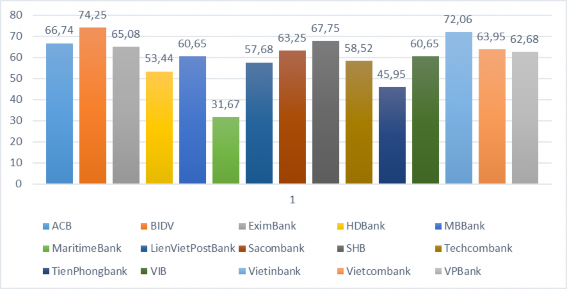
Figure 2.10: Average Loan/Asset ratio of Vietnamese commercial banks from 2014 to 2018
(Source: [27])
Statistics for the 5-year period (from 2014 to 2018) show that BIDV and VietinBank are the two banks that depend most on annual lending activities. Specifically, on average, BIDV's outstanding loans over the past 5 years accounted for 74.25% of total assets, while VietinBank's figure was 72.06%. These are also the two banks with the largest outstanding loans in 2018, with BIDV having VND 988,739 billion in outstanding loans while VietinBank had VND 864,926 billion. In general, the average loan-to-total-assets ratio of most banks is over 60%. In 2018, Sacombank had this ratio at 63.29%. However, in reality, Sacombank's loan ratio is even larger than the above banks, because there is a large amount of outstanding loans hidden in receivables and accrued interest.
(totaling up to over 46,800 billion VND, accounting for 18% of total assets). In particular,
Vietcombank and Techcombank, the two banks with the largest profits in the system in 2018, are in the group that is less dependent on lending activities. For Vietcombank, the ratio
The average 5-year loan balance to total assets ratio was 63.95%, while Techcombank's was only 58.52%.
The reality is that it is not the least dependent on lending that is
good but not bad
belonging to many is bad and the degree
extra
belong to no
determines bank profits, because there are many other factors such as profits, non-lending income, operating costs, provisioning ratio, etc. With Techcombank, the reason for the low loan balance ratio is because the bank has used most of the credit balance room granted (the State Bank allowed to increase by a maximum of 20% in 2018) to buy corporate bonds, instead of increasing customer loans. By the end of 2018, the amount of corporate bonds that Techcombank held amounted to about 20,000 billion VND [27]. This is the direction
Techcombank's special feature is partly because it wants to retain and cooperate symbiotically with
Big clients are selling bonds, partly because corporate bond profits are typically larger than traditional consumer lending, plus the large profits from bond underwriting.
d. Credit structure over time
Credit balance over time reflects the lending capital of commercial banks.
Okay
head
invest in the foundation
economy at
time
point
identify.
Presently
now residual classification
credit debt
in
Each given moment is expressed in many different criteria.
different such as: by time, by industry, economic sector,.... Determining
Balance sheet at the time to determine scale, investment level and diversity
In bank lending activities, outstanding debt is determined by the loan term.
balance
to
limit
risk management
safe and suitable
with
scale of mobilization
capital
and rules
determine
State Bank, banks have resources
mobilize
medium long term
short
cannot
Take a lot of short-term capital to lend medium and long term. Loan balance structure according to
Time also significantly affects CLTD, if the structure
loan agreement
reason will
promote the following figure:
growth
credit
and minimize
Okay
risk
yes
show
via
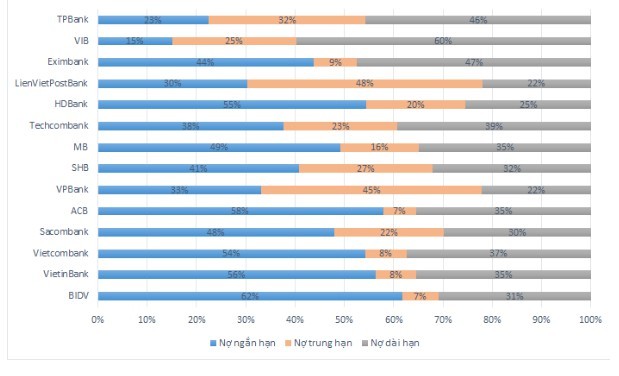
Figure 2.11: Credit structure over time of Vietnamese commercial banks in 2018
(Source: [27])
To ensure stable business operations, commercial banks do not
should practice
too much medium and long term lending,
medium and long term lending
depends on the growth rate of mobilized capital, especially capital
medium and long-term mobilization of customers. In general, at banks, medium and long-term lending is often more attractive than short-term lending, because it brings higher interest rates. However, this also means that the potential risks for the system in the future are greater, leading to a decline in credit quality, because the longer the lending term, the higher the risk of term balance, especially in the condition that the proportion of short-term deposits still accounts for the majority in the structure of mobilized capital in general, the pressure to mobilize is accordingly greater. The more banks focus on short-term debt, the less risk but also have to accept lower profits. The longer the lending term, the higher the profit but also the higher the risk.
Statistics from the Annual Report of Joint Stock Commercial Banks in 2018 show that some banks are choosing a safe direction, namely BIDV with a short-term debt ratio of 62%, VietinBank (56%), Vietcombank (54%), Sacombank (48%), ACB (58%), MB (49%). HDBank also chooses this direction with a fairly high short-term debt ratio of 55%. Meanwhile, SHB and EximBank are somewhat neutral with the ratio of times
Techcombank and VPBank, chose a profit-oriented direction with short-term debt ratios of 38% and 33% respectively. Taking on more risk are LienVietPostBank, TPBank and VIB with 30%, 23% and 15% respectively.
Since 2014, to promote
organizations
credit
growth
outstanding debt,
The State Bank of Vietnam has issued Circular 36/2014/TTNHNN regulating
the worlds
term,
proportion
ensure safety in the operations of credit institutions, thereby loosening the maximum allowable level of short-term capital used for medium and long-term loans.
up to
60% of the
This also helps organizations
credit
push
strong lending
medium and long term to have the level
interest rate
high density
special
is personal loan
and lending to businesses
Micro SMEs,
This is also the trend.
Good
increase
Chief
Okay
effect
loan results if
as bank guarantee
Okay
source
loan capital
stable.
However, to avoid this
invest in medium and long term projects
limit
special
special
are real estate projects
dynamic
product
and avoid repetition
again
risk
risk in period
Previously, the State Bank of Vietnam issued Circular 06/2016/TTNHNN to replace Circular 36 after a period of collecting feedback for the revised draft, according to which the content of Circular 06 has 2 major adjustments; first is the regulation that the risk conversion coefficient of receivables for real estate business is 200% from January 1, 2017 instead of 250% as in the draft, second is the capital usage ratio
Short-term and medium- and long-term loans are reduced according to the roadmap from 60% to 50% from
01/01/2017 and 40% from 01/01/2018. So from the period 2017 2018 banks
must proactively reduce the ratio of short-term capital used for medium and long-term loans
This means that banks need to reduce medium and long-term loans to the prescribed level according to the roadmap.
2.2.1.2 Group of indicators showing profitability from credit activities
a. Net interest margin (NIM)
The indicator to evaluate the profitability of Vietnamese commercial banks is the Net Interest Margin (NIM). Mobilizing capital from customer deposits and lending are the main activities that bring revenue to the bank, however, there are still other activities that bring profit to the bank such as: securities trading, derivatives, foreign exchange, guarantees, etc. Profitable assets are assets that bring profit to the bank such as customer loans, investments, etc.