
Often there is a need for spaces that are not only large enough but also properly zoned and grouped to meet the above needs.
d. Solutions for organizing traffic connections in the house
- Usually, there are two main solutions: using the front room as a traffic junction to connect to other rooms and using the living room as a common living area as a traffic junction. Of course, with an apartment, it is possible to combine with some internal family corridors to create privacy and secrecy for some rooms in the night area, as well as with multi-storey apartments, the stairs can be arranged in the front room. Then the lower floor is for daytime activities. The upper floors are for night activities.
- The advantages and disadvantages of each solution will be carefully studied when discussing each type of housing in the following chapters.
Maybe you are interested!
-
 Tasks, Requirements and Methods for Diagnosing the Technical Condition of the Movement System.
 -
 Car body electrical practice - 8
zt2i3t4l5ee
zt2a3gs
zt2a3ge
zc2o3n4t5e6n7ts
If the voltage is out of specification, replace the wire or connector.
If the voltage is within specification, install the front fog light relay and follow step 5.
Step 5 Check the front fog light switch
- Remove the D4 connector of the fog light switch
- Use a multimeter to measure the resistance of the front fog light switch.
Measurement location
Condition
Standard
D4-3 (BFG) -D4-4 (LFG)
Light switchFront Fog OFF
>10kΩ
D4-3 (BFG) -D4-4 (LFG)
Front fog light switchON
<1 Ω
- Standard resistor
D4 connector is located on the combination switch assembly.
If the resistance is out of specification, replace the combination switch (the fog light switch is located in the combination switch).
If the resistance is within specification, follow step 6.
Step 6 Check wiring and connectors (front fog light relay-light selector switch)
- Disconnect connector D4 of the combination switch assembly
- Use a voltmeter to measure the voltage value of jack D4 on the wire side.
Measurement location
Control modecontrol
Standard
D4-3 (BFG) - (-) AQ
TAIL
11 to 14 V
D4 connector for the wiring of the combination switch assembly
If the voltage does not meet the standard, replace the wire or connector.
If the voltage is within standard, there may have been an error in the previous measurements.
Step 7 Check the front fog lights
- Remove the front fog light electrical connector.
- Supply battery voltage to the fog lamp terminals
Jack 8, B9 of front fog lamp on the electrical side
blind first.
Power supply location
Terms and Conditions
Battery positive terminal - Terminal 2Battery negative terminal - Terminal 1
Fog lightsbefore morning
- If the light does not come on, replace the bulb.
If the light is on, re-plug the jack and continue to step 8.
Step 8 Check wiring and connectors (relay and front fog lights)
- Disconnect the B8 and B9 connectors of the front fog lights.
- Use a voltmeter to measure voltage at the following locations:
Measurement location
Switch location
Terms and Conditions
B8-2 - (-) AQ
Electric lock ON TAIL size switchFog switch ON
11 to 14 V
B9-2 - (-) AQ
Electric lock ONTAIL size switch Fog switch ON
11 to 14 V
B8 and B9 connectors on the front fog lamp wiring side
Voltage is not up to standard, repair or replace the jack. If up to standard, there may have been an error in the measurement process.
2.2.4. Procedure for removing, installing and adjusting fog lights 1. Procedure for removing
- Remove the front inner ear pads
Use a screwdriver to remove the 3 screws and remove the front part of the front inner ear liner
-Remove the fog light assembly
+ Disconnect the connector.
+ Use a screwdriver to remove 3 screws to remove the fog light cover
2. Installation sequence
-Rotate the fog lamp bulb in the direction indicated by the arrow as shown in the figure and remove the fog lamp from the fog lamp assembly.
-Rotate the fog light bulb in the direction indicated by the arrow as shown in the figure and install the light into the fog light assembly.
- Use a screwdriver to install the fog light cover
-Install the electrical connector
Attention: Be careful not to damage the plastic thread on the lamp assembly.
- Install the front inner ear pads
Use a screwdriver to install the front inner bumper with 3 screws.
3. Prepare the vehicle to adjust the fog light convergence. Prepare the vehicle:
- Make sure there is no damage or deformation to the vehicle body around the fog lights.
- Add fuel to the fuel tank
- Add oil to standard level.
- Add engine coolant to standard level.
- Inflate the tire to standard pressure.
- Place spare tire, tools and jack in original design position
- Do not leave any load in the luggage compartment.
- Let a person weighing about 75 kg sit in the driver's seat.
4. Prepare to check the fog light convergence
a/ Prepare the vehicle status as follows:
- Place the car in a dark enough place to see the lines. The lines are the dividing line, below which the light from the fog lights can be seen but above which it cannot.
- Place the car perpendicular to the wall.
- Keep a distance of 7.62 m between the center of the fog lamp and the wall.
- Park the car on level ground.
- Press the car down a few times to stabilize the suspension.
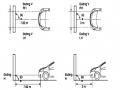
Note: A distance of approximately 7.62 m is required between the vehicle (fog lamp center) and the wall to adjust the convergence correctly. If the distance of 7.62 m cannot be achieved, set the correct distance of 3 m to check and adjust the fog lamp convergence. (Since the target area varies with the distance, please follow the instructions as shown in the figure.)
b/ Prepare a piece of thick white paper about 2 m high and 4 m wide to use as a screen.
c/ Draw a vertical line through the center of the screen (line V).
d/ Set the screen as shown in the picture. Note:
- Keep the screen perpendicular to the ground.
- Align the V line on the screen with the center of the vehicle.
e/Draw the reference lines (H, V LH and V RH lines) on the screen as shown in the figure.HINT:
Mark the center of the fog lamp on the screen. If the center mark cannot be seen on the fog lamp, use the center of the fog lamp or the manufacturer's name mark on the fog lamp as the center mark.
H line (fog light height):
Draw a line across the screen so that it passes through the center mark. Line H should be at the same height as the center mark of the fog light bulb.
Line V LH, V RH (center mark position of left fog lamp LH and right fog lamp RH):
Draw two lines so that they intersect line H at the center marks.
5. Check the fog light convergence
a/ Cover the fog lamp or remove the connector of the other side fog lamp to prevent light from the unchecked fog lamp from affecting the fog lamp convergence test.
b/ Start the engine.
c/ Turn on the fog lights and make sure that the dividing line is outside the standard area as shown in the drawing.
6. Adjust the fog light convergence
Use a screwdriver to adjust the fog light to the standard area by turning the toe adjustment screw.
Note: If the screw is adjusted too far, loosen it and then tighten it again, so that the last rotation of the light adjustment screw is clockwise.
3. Self-study questions
1. Describe the operating principle of the lighting system with automatic headlight function
2. Describe the operating principle of the lighting system with the function of rotating headlights when turning
3. Draw diagram and connect lighting system on Hyundai Porter car
4. Draw diagram and connect lighting system on Honda Accord 1992
5. Draw the lighting circuit on a 1993 Toyota Lexus
LESSON 3 MAINTENANCE AND REPAIR OF SIGNAL SYSTEM
I. IMPLEMENTATION GOAL
After completing this lesson, students will be able to:
- Distinguish between types of signals on cars
- Correctly describe common symptoms and suspected areas causing damage.
- Connecting signal circuits ensures technical requirements
- Disassemble, install, check, maintain and repair the signal system to ensure technical requirements.
- Ensure safety in work and industrial hygiene
II. LESSON CONTENT
1. General description
The signal system equipped on cars aims to create signals to notify other vehicles participating in traffic about the vehicle's operating status such as: stopping, parking, braking, reversing, turning...
Signals are used either by light such as headlamps, brake lights, turn signals….. or by sound such as horns, reverse music….
Just like the lighting system. A signal system circuit usually consists of: battery, fuse, wire, relay, electrical load and control switch. Only some switches of the signal system are on the combination switch. The switches of other signals are usually located in different locations such as in the gearbox or brake pedal……
2. Maintenance and repair
2.1. Turn signals and hazard lights
The installation location of the turn signal is shown in Figure 3.1. The turn signal control switch is located in the combination switch under the steering wheel. Turning this switch to the right or left will make the turn signal turn right or left.
The hazard light switch is used when the vehicle has a problem while participating in traffic. When the hazard light switch is turned on, all the turn signals on the vehicle will light up at a certain frequency. The hazard light switch is usually placed separately from the turn signal switch (some old cars integrate the hazard and turn signal switches on the same combination switch cluster).
Figure 3.1 Turn signal switch Figure 3.2 Hazard switch
The part that generates the flashing frequency for the lights is called a turn signal relay. The turn signal relay usually has 3 terminals: B (positive power supply); E (negative power supply); L (providing the turn signal switch to distribute to the
lamp)
2.1.1. Circuit diagram
To generate the frequency for the turn signal, a turn signal relay is used in the turn signal circuit. The current from the turn signal relay will be sent to the turn signal switch assembly to distribute the current to the turn signal lights for the driver's purpose.
Figure 3.3. Schematic diagram of a turn signal circuit without a hazard switch
1. Battery; 2. Electric lock; 3. Turn signal relay; 4. Turn signal switch; 5. Turn signal lamp; 6. Turn signal lamp; 7. Hazard switch
Figure 3.4 Schematic diagram of turn signal circuit with hazard switch
1. Battery; 2. Combination switch cluster; 3. Turn signal;
4. Turn signal light; 5. Turn signal relay
Today's cars no longer use three-pin turn signal relays (B, L, E) but use eight-pin turn signal relays (figure 3.5) (pin number 8 is used for hazard lights).
For this type, the current supplying the turn signal lights is supplied directly from the turn signal relay to the lights.
div.maincontent .p { color: black; font-family:"Times New Roman", serif; font-style: normal; font-weight: normal; text-decoration: none; font-size: 14pt; margin:0pt; } div.maincontent p { color: black; font-family:"Times New Roman", serif; font-style: normal; font-weight: normal; text-decoration: none; font-size: 14pt; margin:0pt; } div.maincontent .s1 { color: black; font-family:"Times New Roman", serif; font-style: normal; font-weight: normal; text-decoration: none; font-size: 13pt; } div.maincontent .s2 { color: black; font-family:"Times New Roman", serif; font-style: italic; font-weight: normal; text-decoration: none; font-size: 14pt; } div.maincontent .s3 { color: black; font-family:"Times New Roman", serif; font-style: normal; font-weight: normal; text-decoration: none; font-size: 14pt; } div.maincontent .s4 { color: black; font-family:"Times New Roman", serif; font-style: normal; font-weight: normal; text-decoration: none; font-size: 13pt; } div.maincontent .s5 { color: black; font-family:"Times New Roman", serif; font-style: normal; font-weight: normal; text-decoration: none; font-size: 13pt; vertical-align: 1pt; } div.maincontent .s6 { color: black; font-family:"Times New Roman", serif; font-style: normal; font-weight: normal; text-decoration: none; font-size: 11pt; } div.maincontent .s7 { color: black; font-family:"Times New Roman", serif; font-style: normal; font-weight: normal; text-decoration: none; font-size: 14pt; vertical-align: -9pt; } div.maincontent .s8 { color: black; font-family:"Times New Roman", serif; font-style: normal; font-weight: normal; text-decoration: none; font-size: 11pt; } div.maincontent .s9 { color: #008000; font-family:"Times New Roman", serif; font-style: normal; font-weight: normal; text-decoration: none; font-size: 14pt; } div.maincontent .s10 { color: black; font-family:"Times New Roman", serif; font-style: italic; font-weight: normal; te
Car body electrical practice - 8
zt2i3t4l5ee
zt2a3gs
zt2a3ge
zc2o3n4t5e6n7ts
If the voltage is out of specification, replace the wire or connector.
If the voltage is within specification, install the front fog light relay and follow step 5.
Step 5 Check the front fog light switch
- Remove the D4 connector of the fog light switch
- Use a multimeter to measure the resistance of the front fog light switch.
Measurement location
Condition
Standard
D4-3 (BFG) -D4-4 (LFG)
Light switchFront Fog OFF
>10kΩ
D4-3 (BFG) -D4-4 (LFG)
Front fog light switchON
<1 Ω
- Standard resistor
D4 connector is located on the combination switch assembly.
If the resistance is out of specification, replace the combination switch (the fog light switch is located in the combination switch).
If the resistance is within specification, follow step 6.
Step 6 Check wiring and connectors (front fog light relay-light selector switch)
- Disconnect connector D4 of the combination switch assembly
- Use a voltmeter to measure the voltage value of jack D4 on the wire side.
Measurement location
Control modecontrol
Standard
D4-3 (BFG) - (-) AQ
TAIL
11 to 14 V
D4 connector for the wiring of the combination switch assembly
If the voltage does not meet the standard, replace the wire or connector.
If the voltage is within standard, there may have been an error in the previous measurements.
Step 7 Check the front fog lights
- Remove the front fog light electrical connector.
- Supply battery voltage to the fog lamp terminals
Jack 8, B9 of front fog lamp on the electrical side
blind first.
Power supply location
Terms and Conditions
Battery positive terminal - Terminal 2Battery negative terminal - Terminal 1
Fog lightsbefore morning
- If the light does not come on, replace the bulb.
If the light is on, re-plug the jack and continue to step 8.
Step 8 Check wiring and connectors (relay and front fog lights)
- Disconnect the B8 and B9 connectors of the front fog lights.
- Use a voltmeter to measure voltage at the following locations:
Measurement location
Switch location
Terms and Conditions
B8-2 - (-) AQ
Electric lock ON TAIL size switchFog switch ON
11 to 14 V
B9-2 - (-) AQ
Electric lock ONTAIL size switch Fog switch ON
11 to 14 V
B8 and B9 connectors on the front fog lamp wiring side
Voltage is not up to standard, repair or replace the jack. If up to standard, there may have been an error in the measurement process.
2.2.4. Procedure for removing, installing and adjusting fog lights 1. Procedure for removing
- Remove the front inner ear pads
Use a screwdriver to remove the 3 screws and remove the front part of the front inner ear liner
-Remove the fog light assembly
+ Disconnect the connector.
+ Use a screwdriver to remove 3 screws to remove the fog light cover
2. Installation sequence
-Rotate the fog lamp bulb in the direction indicated by the arrow as shown in the figure and remove the fog lamp from the fog lamp assembly.
-Rotate the fog light bulb in the direction indicated by the arrow as shown in the figure and install the light into the fog light assembly.
- Use a screwdriver to install the fog light cover
-Install the electrical connector
Attention: Be careful not to damage the plastic thread on the lamp assembly.
- Install the front inner ear pads
Use a screwdriver to install the front inner bumper with 3 screws.
3. Prepare the vehicle to adjust the fog light convergence. Prepare the vehicle:
- Make sure there is no damage or deformation to the vehicle body around the fog lights.
- Add fuel to the fuel tank
- Add oil to standard level.
- Add engine coolant to standard level.
- Inflate the tire to standard pressure.
- Place spare tire, tools and jack in original design position
- Do not leave any load in the luggage compartment.
- Let a person weighing about 75 kg sit in the driver's seat.
4. Prepare to check the fog light convergence
a/ Prepare the vehicle status as follows:
- Place the car in a dark enough place to see the lines. The lines are the dividing line, below which the light from the fog lights can be seen but above which it cannot.
- Place the car perpendicular to the wall.
- Keep a distance of 7.62 m between the center of the fog lamp and the wall.
- Park the car on level ground.
- Press the car down a few times to stabilize the suspension.
Note: A distance of approximately 7.62 m is required between the vehicle (fog lamp center) and the wall to adjust the convergence correctly. If the distance of 7.62 m cannot be achieved, set the correct distance of 3 m to check and adjust the fog lamp convergence. (Since the target area varies with the distance, please follow the instructions as shown in the figure.)
b/ Prepare a piece of thick white paper about 2 m high and 4 m wide to use as a screen.
c/ Draw a vertical line through the center of the screen (line V).
d/ Set the screen as shown in the picture. Note:
- Keep the screen perpendicular to the ground.
- Align the V line on the screen with the center of the vehicle.
e/Draw the reference lines (H, V LH and V RH lines) on the screen as shown in the figure.HINT:
Mark the center of the fog lamp on the screen. If the center mark cannot be seen on the fog lamp, use the center of the fog lamp or the manufacturer's name mark on the fog lamp as the center mark.
H line (fog light height):
Draw a line across the screen so that it passes through the center mark. Line H should be at the same height as the center mark of the fog light bulb.
Line V LH, V RH (center mark position of left fog lamp LH and right fog lamp RH):
Draw two lines so that they intersect line H at the center marks.
5. Check the fog light convergence
a/ Cover the fog lamp or remove the connector of the other side fog lamp to prevent light from the unchecked fog lamp from affecting the fog lamp convergence test.
b/ Start the engine.
c/ Turn on the fog lights and make sure that the dividing line is outside the standard area as shown in the drawing.
6. Adjust the fog light convergence
Use a screwdriver to adjust the fog light to the standard area by turning the toe adjustment screw.
Note: If the screw is adjusted too far, loosen it and then tighten it again, so that the last rotation of the light adjustment screw is clockwise.
3. Self-study questions
1. Describe the operating principle of the lighting system with automatic headlight function
2. Describe the operating principle of the lighting system with the function of rotating headlights when turning
3. Draw diagram and connect lighting system on Hyundai Porter car
4. Draw diagram and connect lighting system on Honda Accord 1992
5. Draw the lighting circuit on a 1993 Toyota Lexus
LESSON 3 MAINTENANCE AND REPAIR OF SIGNAL SYSTEM
I. IMPLEMENTATION GOAL
After completing this lesson, students will be able to:
- Distinguish between types of signals on cars
- Correctly describe common symptoms and suspected areas causing damage.
- Connecting signal circuits ensures technical requirements
- Disassemble, install, check, maintain and repair the signal system to ensure technical requirements.
- Ensure safety in work and industrial hygiene
II. LESSON CONTENT
1. General description
The signal system equipped on cars aims to create signals to notify other vehicles participating in traffic about the vehicle's operating status such as: stopping, parking, braking, reversing, turning...
Signals are used either by light such as headlamps, brake lights, turn signals….. or by sound such as horns, reverse music….
Just like the lighting system. A signal system circuit usually consists of: battery, fuse, wire, relay, electrical load and control switch. Only some switches of the signal system are on the combination switch. The switches of other signals are usually located in different locations such as in the gearbox or brake pedal……
2. Maintenance and repair
2.1. Turn signals and hazard lights
The installation location of the turn signal is shown in Figure 3.1. The turn signal control switch is located in the combination switch under the steering wheel. Turning this switch to the right or left will make the turn signal turn right or left.
The hazard light switch is used when the vehicle has a problem while participating in traffic. When the hazard light switch is turned on, all the turn signals on the vehicle will light up at a certain frequency. The hazard light switch is usually placed separately from the turn signal switch (some old cars integrate the hazard and turn signal switches on the same combination switch cluster).
Figure 3.1 Turn signal switch Figure 3.2 Hazard switch
The part that generates the flashing frequency for the lights is called a turn signal relay. The turn signal relay usually has 3 terminals: B (positive power supply); E (negative power supply); L (providing the turn signal switch to distribute to the
lamp)
2.1.1. Circuit diagram
To generate the frequency for the turn signal, a turn signal relay is used in the turn signal circuit. The current from the turn signal relay will be sent to the turn signal switch assembly to distribute the current to the turn signal lights for the driver's purpose.
Figure 3.3. Schematic diagram of a turn signal circuit without a hazard switch
1. Battery; 2. Electric lock; 3. Turn signal relay; 4. Turn signal switch; 5. Turn signal lamp; 6. Turn signal lamp; 7. Hazard switch
Figure 3.4 Schematic diagram of turn signal circuit with hazard switch
1. Battery; 2. Combination switch cluster; 3. Turn signal;
4. Turn signal light; 5. Turn signal relay
Today's cars no longer use three-pin turn signal relays (B, L, E) but use eight-pin turn signal relays (figure 3.5) (pin number 8 is used for hazard lights).
For this type, the current supplying the turn signal lights is supplied directly from the turn signal relay to the lights.
div.maincontent .p { color: black; font-family:"Times New Roman", serif; font-style: normal; font-weight: normal; text-decoration: none; font-size: 14pt; margin:0pt; } div.maincontent p { color: black; font-family:"Times New Roman", serif; font-style: normal; font-weight: normal; text-decoration: none; font-size: 14pt; margin:0pt; } div.maincontent .s1 { color: black; font-family:"Times New Roman", serif; font-style: normal; font-weight: normal; text-decoration: none; font-size: 13pt; } div.maincontent .s2 { color: black; font-family:"Times New Roman", serif; font-style: italic; font-weight: normal; text-decoration: none; font-size: 14pt; } div.maincontent .s3 { color: black; font-family:"Times New Roman", serif; font-style: normal; font-weight: normal; text-decoration: none; font-size: 14pt; } div.maincontent .s4 { color: black; font-family:"Times New Roman", serif; font-style: normal; font-weight: normal; text-decoration: none; font-size: 13pt; } div.maincontent .s5 { color: black; font-family:"Times New Roman", serif; font-style: normal; font-weight: normal; text-decoration: none; font-size: 13pt; vertical-align: 1pt; } div.maincontent .s6 { color: black; font-family:"Times New Roman", serif; font-style: normal; font-weight: normal; text-decoration: none; font-size: 11pt; } div.maincontent .s7 { color: black; font-family:"Times New Roman", serif; font-style: normal; font-weight: normal; text-decoration: none; font-size: 14pt; vertical-align: -9pt; } div.maincontent .s8 { color: black; font-family:"Times New Roman", serif; font-style: normal; font-weight: normal; text-decoration: none; font-size: 11pt; } div.maincontent .s9 { color: #008000; font-family:"Times New Roman", serif; font-style: normal; font-weight: normal; text-decoration: none; font-size: 14pt; } div.maincontent .s10 { color: black; font-family:"Times New Roman", serif; font-style: italic; font-weight: normal; te -
 15th-18th century architectural materials in the Kinh Thien Hoang Palace area of Thang Long citadel through excavation documents in 2017-2019 - 16
 -
 Housing changes of the Black Thai people in Binh Son commune since the renovation until now - Vu Thi Dieu - 3
 -
 Managing teaching capacity building activities for teachers of high schools in Binh Giang district, Hai Duong province to meet the requirements of educational innovation - 16
- Up to now, housing can still be a rich combination of spaces. Continuous transformation with each room, each space is a separate function to satisfy the rich needs of modern family life, ensuring the right to exploit and use according to the homeowner's preferences, with extremely flexible and rich solutions to combine interior and exterior spaces, the spaces can be interwoven, dynamically transformed...
- Thus, housing is a product created by humans that is always being perfected and improved with experience in conquering nature, exploiting nature, taking advantage of scientific and technological advances and following the increasingly improved life of social civilization, so there will never be a housing model that is always ideal for everyone, at all times.

4.3.2 Solutions for modern apartment interior space combination
- Creating separate rooms by connecting through the entrance hall and corridor, a solution often applied to cold countries, countries with high lifestyle and personal living requirements. Organizations allow us to create privacy and facilitate local climate. Inside the apartment and family life is a bit rigid, cold, lacking the mutual care of a true oriental home.
- Use the common room, living room to combine other rooms around it, create a warm space for the family, create a rich interior and architectural space for the external space while creating the necessary isolation and privacy for night activities, however in cold countries, air conditioning and heating the common room will be very difficult to do economically and effectively.
- The continuous circulation space according to this solution, the rooms have no partitions. The entrance doors are clear and neat, creating private corners by means of standing cabinets, screens, light and mobile walls...
- In short
In these solutions, the interior space will be extremely diverse, always creating surprises, there are interweavings of space but still have the necessary isolation while allowing people to change the organization and divide the space as desired to meet the needs of the family's demographic fluctuations. However, it also needs to create privacy and confidentiality for the activities of each member, not thoroughly ensuring a suitable climate in the interior will be costly (air conditioning consumes energy).
4.4 Requirements for architectural, technical and aesthetic solutions for housing
4.4.1 Requirements for architectural solutions
- When designing housing, attention must be paid to climatic conditions, population structure, ethnic customs and other local conditions.
- In houses, bedrooms are arranged on the floors above ground. In high areas, it is allowed to arrange rooms on two floors at the foot of the wall. In this case, the floor level of the room compared to the sidewalk next to the house must not be lower than 1.2m, and the room's windows must be at least 3m away from the edge of the walkway.
- In residential houses, the floor height (from the floor of the lower floor to the floor of the upper floor) is regulated to be 3m, the clear height of the room must not be lower than 2.7m. (If the bedroom uses a bunk bed, the clear height of the room must not be less than 3m).
- The depth of the room (calculated in the direction of direct natural light) receiving light from one side must not exceed 6m (clear) and must not be greater than twice the room height.
- When the house faces the street or the square, it is allowed to be located on the first floor or at the foot of the wall of technological stores, public services serving life. In this case, the rooms of the above enterprises and agencies must ensure soundproofing and prevent odor pollution to the house by appropriate technical solutions. When there are stores in or adjacent to the house, it is not allowed to design the entrance to the house directly to the yard.
- In the house, the living rooms and kitchen must have direct natural light.
- Water pumps and boilers must not be installed in residential houses; transformer stations inside or adjacent to the house; automatic telephone stations (except for those serving the house; headquarters of city and district administrative agencies); medical clinics (except for gynecological and dental examinations); dining rooms with more than 50 seats; public toilets; parts containing or using flammable materials; parts that generate noise, toxic fumes and toxic waste exceeding the permitted limits; specialized fish shops; construction materials, chemical and grocery stores that, when operating, pollute the environment around the house.
4.4.2 Staircase in multi-storey apartment building
- The public transportation requirements in an apartment building are also directly related to the quality of living. People living in an apartment building require that the traffic intersections (lobby, elevator, stairs) be bright and should be naturally ventilated, the corridors leading to the apartments should be short, almost no corridor, but only the entrance to the apartments.
- Staircase is the vertical traffic junction of a house, has great importance for the quality of use, so when designing, it is necessary to pay due attention. Staircase ensures vertical connection functions and people escape in case of an accident.
- Stairs have different types such as stairs with natural light, closed stairs (in the middle of the house), outdoor stairs.
- Stairs with natural light
This type is placed indoors but one side of the elevator shaft is exposed to nature for ventilation, sunlight, and good fire protection; in terms of use, it is also convenient and suitable for human psychology, so it is the most widely used.
- Closed staircase
This type is placed in the middle of the house, without artificial lighting, saving space for traffic to enter the rooms. The floor plan of this type of staircase is relatively tight, favored by cold countries but requires certain regulations (for example, large floors must be designed with two staircases).
- Outdoor stairs
This staircase, in addition to its vertical connection function, also has a great aesthetic effect. In the case of high-rise buildings, for convenience and safety, this type of staircase is rarely designed, but is mainly used as an indoor staircase.
- According to the form of stairs can be divided into
+ Parallel staircase
+ One-way straight staircase
+ Three-sided stairs with right angles, horizontal stairs with diagonal steps at both ends, or circular stairs (less widely used than the two types above).
- Location, quantity and size of stairs depend on floor plan; number of floors; number of people.
- When designing stairs, pay attention to the following specifications:
+ The number of consecutive degrees on one side is not less than 3 and not greater than 18.
+ The width of the ladder body is taken as 0.6m wide for 100 people needing to escape.
+ Clear width of the staircase is at least 1.05m; width of the stairwell is at least 2.2m (clear).
+ Landing and approach height must not be less than 1.2m.
+ Stair slope I=1:2 or 1:1.75. Step size ensures a+2b = 60cm.
Internal family stairs can be sloped up to 45 degrees .
+ Step size I = 1:2 is taken as 15x30cm; in case of adding a bike ramp in the middle, make the slope smaller than I = 1:3.
+ The width of the stairwell in our country is usually taken as the column pitch of the house floor plan, most commonly 2.7m; 2.8m; 3m... sometimes 2.4m.
+ In some countries, the width of the stairs depends on the number of floors; for reference, please refer to the following:
2-3 storey house take 1.1 to 1.2m 4-5 storey house take 1.2 to 1.3m
Houses with 6 floors or more take 1.3 to 1.4m
- The design of the stairs in the house should pay attention to two ways of organizing the entrance of the first floor apartment.
+ Organize the entrance under the stairs (in this case, pay attention to ensuring the height from the floor to the stair beam of the first floor, as well as pay attention to organizing the awning at the entrance of the house outside higher than the floor to the stairs to ensure aesthetics).
+ The entrance to the house is placed in a small hall opposite the stairs through the hallway, this type is spacious but takes up an area equivalent to a living room.
4.4.3 Aesthetics in residential architecture
- Aesthetics is the enjoyment of the beauty of the surrounding world, beauty is always associated with perception.
- Architecture is considered a manifestation of mathematical beauty based on harmonious and rational symmetry.
- In residential architectural design, in addition to the familiar rules of combination and proportion such as rhyme, contrast, main and secondary... we also have to pay attention to the surrounding elements and location. The surrounding landscape element plays a special role in residential architectural design. If in architectural construction, compatibility and conformity between parts is a basic condition to create a unified and harmonious whole, then in housing, it is transferred to another level - the community level.
Question section :
Question 15 : Describe the functions of a modern apartment. Question 16 : Describe the current trends in apartment design.
Question 17 : What are the requirements in modern apartment design? State the design requirements suitable for human psychology.
Question 18 : What are the solutions for designing apartments that satisfy the conditions of comfort and energy saving?
Reference books
1. Associate Professor, Dr. Architect Nguyen Duc Thiem - 2004 - Principles of civil architecture design - Science and Technology Publishing House, Hanoi
2. Ministry of Construction - 1997 - Collection (Volume IV) of Vietnam's Construction Standards - Construction Publishing House, Hanoi
3. Architect Luong Anh Dung - 2003 - Housing quality for urban areas after 2000 - Science and Technology Publishing House, Hanoi
Reference website
www.kientrucviet.com.vn, www.diendanxaydung.vn , www.ashui.com, www.act.com.vn , www.wiki.com ,....
Chapter 5
Trends and experiences in residential architectural design
5.1. Trends and solutions to improve housing comfort and quality
5.1.1 Solutions to create a comfortable microclimate in the home
- Housing in the tropical climate conditions in Vietnam requires solutions to combat the harmful effects of the environment on human physiology. Housing needs to combine three types of spaces: closed, open and semi-closed, with large porches, loggias, and yards to create transitional spaces against heat and heavy rain.
- The indoor space must be airy, natural ventilation must be handled by the following methods:
+ Choose a suitable house direction to have cool wind in summer (Southeast), avoid cold wind in winter (Northeast)
+ Create gaps that are beneficial for natural cool breezes to blow into the room, using solutions to create air intake bridges through the arrangement of stairs, courtyards, common rooms, etc.
+ Heat-proof the roof by creating a convection air layer in the form of a double roof layer; using waterproof heat-insulating and heat-reflecting materials; heat-proofing walls and windows (combined with rain-proofing); using mobile and fixed sunshades; using climbing plant walls...
5.1.2 Flexibility in design and exploitation of living space
- In residential architectural design, it is necessary to create multi-functional spaces that include many different functions that can be used flexibly at different times. Using multi-functional spaces allows saving space, but still ensures comfort and quality of life.
- To create versatile, flexible spaces, it is necessary to
+ Qualitative space (determine the properties of space)
+ Determine the relationship between spaces in the house
+ Creates space circulation
5.2 Experience of countries around the world
5.2.1 Experience in organizing high-rise apartment buildings in Southeast Asian countries
a. Singapore's noteworthy experiences
- Urbanization is an inevitable path for every country in the process of industrialization and modernization of the country. As a country located in Southeast Asia, the old name of South Island speaks of its special location as well as the scarcity of land here. Singapore is the only country in Asia that has covered its entire 600km2 area with urban areas , with nearly 100% of the population living in urban areas.
- The population explosion, along with the consequences of migration from rural to urban areas, forces cities to expand and develop vertically. The construction of high-rise buildings and apartment buildings is inevitable in urban areas to meet the housing needs of the people.
urban. Singapore, famous for its multi-storey city, with the majority of
Multi-storey apartment buildings (from 16-25 floors), ensuring accommodation for nearly 90% of the urban population.
That also speaks to the efforts of the Government and people of Singapore since the post-colonial period with the implementation of a series of urban development stages, within a long-term development strategy.
- Singapore's urban areas originated from the shabby, cramped Chinatowns, which mainly served business activities. It also had a structure that was relatively suitable for the South Island climate (hot, humid, rainy) and the traditional lifestyle with wide tiled roofs and layers of houses, separated by skylights running from the street surface deep inside. This shows the relative homogeneity of the rice-growing residents in Southeast Asia with its climate and human characteristics. The island-wide planning was divided in 1958, completely eliminating the direction of developing the central urban area radiating outwards, but instead accepting the construction of the first stages of new suburban residential areas, mostly consisting of dense, low-cost high-rise buildings with minimal amenities to relieve the density of the center. This is also consistent with the early stages of new urban development based on the combination of the popular garden city style in the UK with the architectural concepts of Le Corbusier (these concepts emphasize the construction of high-rise blocks "city within the city" interspersed with convenient public service works between trees and gardens). A coincidental encounter of Singapore's architectural history resulted in areas that were completely suitable for the tropical climate overall. However, the quality of the apartments built during this period was not satisfactory in terms of ventilation, natural lighting as well as environmental landscape, due to limited area, few rooms, small auxiliary works, and lack of nature.
- Along with the construction of new urban areas in the suburbs, Singapore has tried every way to reduce the concentration of population in the central area, to relieve the pressure of overload here. By demolishing slums to replace them with green spaces, lakes, and squares, creating small green lungs in the inner city. In the area of interest, there are also construction sites and a healthy climate here, which is also a valuable experience in a period of full development, taking into account the preservation of a clean environment for the center. At the same time, traditional townhouses have also been restored to retain the architectural heritage of the city, control the height, inner courtyards, create a large lake to bring cool breezes to the city.... The large high-rise apartment buildings located far from the street give us the image of development in the spirit of symbiosis, to meet the ever-increasing needs of residents here.
- Recently, the Singapore government has raised the issue of urban quality of life to a new level. The top standard is a clean environment (tourists conclude that this is the cleanest country in the world, with high urban amenities). Environmental and climate indicators... have adapted to finding effective solutions for the whole and construction projects.
- The towers are the highlights of the moderately high buildings (multi-storey) with interwoven and spreading green areas. The area of the apartments increases very high such as 90m², 120m², 180m², creating conditions for designing airy toilets; bringing nature into the house as a factor in evaluating the quality of the apartment.
- In Singapore now there is a trend of choosing high-rise buildings.
Tropicalized architecture is located in central areas to save land, but is planted in the middle of trees, lakes, and open spaces, making the entire urban appearance here very different from Hong Kong.
- In nearly 30 years, Singapore has built 700,000 apartments, currently in the whole country about 87% of the population lives in these houses. This is a miracle that few countries in the world have achieved.
- Architectural features of Singapore
+ High-rise buildings account for a large proportion
+ Low-rise houses are mainly for very high living standards.
+ Beautiful and clean green space.
+ Reasonable apartment layout.
- Singapore is a land-scarce urban area, according to preliminary calculations, each person has an average of only about 213m2 , the proportion of high-rise buildings accounts for over 50%. The main houses have different numbers of floors, but the arrangement of the exterior of the house and the overall planning are very well-researched and orderly. Between the high-rise buildings are green gardens and playgrounds for children. The construction density is very high, but when entering the building, one feels comfortable. Living in houses with a wide view, a cool, beautiful green environment, and because of good ventilation, it is very cool in the summer. Areas with large parking lots and attentive staff make residents feel comfortable, relaxed, and convenient. The ground floor of high-rise buildings is often an empty space, so only elevators are arranged; between the stairs is a beautiful, clean, green grassy space, making people within the view not feel that high-rise buildings constrict the space, causing a feeling of being cramped, but like being in an endlessly large flower garden. Here people can sit and enjoy the cool breeze, relax or work.
conduct intimate communication activities. In this spacious lawn, there are some small and pretty architectural works built to serve as a playground for children or a resting place for the elderly. In such a landscape environment, there is no pollution, no noisy noise, only high sky, blue clouds and cool wind, the openness with clean land, green grass, fresh air makes people feel comfortable and pleasant.
- All houses have electricity and water (hot and cold) supplied regularly around the clock. Each household has its own garage, with a separate and public service manager. The garages outside the house are built with perforated bricks, with beautiful architecture and are connected to the green trees outside to form a beautiful and harmonious green strip. Household waste and garbage are contained in plastic bags for processing according to each type in the area.
- The layout of apartments in Singapore's high-rise apartments is very reasonable, usually each apartment is arranged with 3 to 4 rooms and the whole building has two common spaces (common halls) with an area of 120 - 140m2 . The rooms have the following dimensions:
+ Common living area 30m2 .
+ Kitchen 10m2 .
+ Dining room 10m2
+ Master bedroom 20 - 25m2
+ One or two secondary bedrooms 18 - 20m2
+ Can have an extra room for children
- Equivalent to the apartment layout with the above rooms, the bathrooms are designed for the master bedroom, secondary bedroom, and children's bedroom. The area of each bathroom is about 10m2 . All rooms use natural light, bright and airy. Each bedroom has a small warehouse (or wall cabinet) with an area of 1 - 2m2 . In general, the architectural layout of the apartment is quite reasonable, convenient to use and very good living conditions. Singaporean housing architecture is worthy for architectural researchers and urban planning managers in Southeast Asia in general and Vietnam in particular to survey, research and learn from experiments in the conditions of modernization and industrialization of the country.
b. Evaluation of design concepts according to climate characteristics (Malaysia)
- Designers and builders of high-rise buildings need to use local climatic factors to make the building have its own local characteristics, save energy, protect the environment and not create soulless closed boxes that can be placed anywhere in the world.
- In the design of high-rise buildings up to now, to build economically, it must have the largest internal area for each floor, the largest construction area on the land area. The following factors are considered as criteria to evaluate the efficiency of high-rise buildings:
+ Minimum outer wall length.
+ Vertical load-bearing members have the smallest dimensions.
+ Horizontal load-bearing structures have the smallest length.
+ Service core (elevator, toilet...) has the smallest area.
+ Minimum height of each floor.
- The above criteria are related to reducing construction costs. When economic efficiency is considered too much compared to aesthetics and humanity, the poetic aesthetics of architecture will inevitably be violated and the project will only be an ugly shell without any art. On the contrary, high-rise buildings designed according to climate characteristics are often considered to increase construction costs, we need to re-evaluate the synthesis of this point of view, of course, including aesthetic efficiency.
- It is often assumed that the construction of any high-rise building increases the local temperature, while this is only true in the case of houses built in a normal way. High-rise buildings designed according to climate characteristics use less energy, thereby reducing heat emissions into the environment. Furthermore, this design trend increases the planting of trees in the building, thus contributing to reducing the local temperature. Designing high-rise buildings according to this perspective can reduce 40% of energy costs during the operation of the house, because most of the costs are in the exploitation and use process. This is a significant amount of savings, in addition to having a good effect on improving the microclimate, it also creates ecological balance, although it increases the initial construction investment capital. One possible reason is the impact of the solution on users, the project will have better aesthetic effects and at the same time allow them to feel the changes in the outside climate, instead of having to spend long working hours in an artificial environment, year after year.
- Finally, and most importantly, from the perspective of human history and the history of human settlement, climate is the least variable factor and one of the most important factors in human history.