
The method has an impact on changing the mechanical composition of the soil compared to unburned forest land. However, in terms of soil type, with the changing ratio of sand, limon and clay particles not exceeding the threshold to change the soil type, compared to the standard ratio of grain levels, the soil is of medium loam type. Compared to the burned area of the same fire level without implementing technical measures for forest restoration, on the method of nurturing cutting, the grain level composition is often smaller.
General assessment of changes in some chemical and physical properties of forest soil based on three silvicultural techniques for forest restoration after fire. Research results show that:
Silvicultural techniques to restore burned forests have a significant impact on soil physical and chemical properties.
- The pH index decreased, N% decreased sharply after the fire. After 4 years of experimenting with silvicultural restoration techniques, the increase level was not equal to the control area but increased higher than the 3 corresponding fire levels without implementing silvicultural restoration techniques after the fire.
Maybe you are interested!
-
 Studies on Forest Structure
 -
 Production Value Structure of Forestry Sector in Vinh Phuc Province
 -
 Indicators Reflecting and Factors Affecting the Shift of Rural Economic Structure Towards Sustainable Development.
 -
 Assessment of non-compliance in forest management in 2014 and Forest management planning according to FSC standards for the period 2015-2020 at Song Thao Forestry Company, Phu Tho - 11
 -
 Community forestry in Quang Tri province and main activities in community forest management in Lang Cat village, Dakrong commune, Dakrong district, Quang Tri province - 12
Total phosphorus and total potassium increased sharply immediately after the fire and after applying the measures. The increase level depended on each measure. This result was partly due to the positive influence of the restoration measures.
Forest fires affect and reduce porosity. After 4 years of changes when applying forest restoration techniques, porosity is still lower than the control and higher than the area without applying the measures. This result is partly a positive influence of forest restoration techniques, because porosity indicates the ability to absorb water, retain water, facilitate the stimulation of root system development, and increase resistance when strongly impacted.
3.3.2. Changes in some forest structure indicators based on 3 measures to impact forest recovery after fire
Results of non-parametric statistical tests using Kruskal - Wallis criteria on structural indicators for 3 OTCs on the same silvicultural technique
The impact of forest recovery after fire shows: Low fire area is protected and promoted regeneration; Medium fire area is cut and nurtured: χ 2 (cut and nurture) = 7.53; p
= 0.14 > 0.05; High-burning area sowing χ 2 (sowing) = 6.43; p = 0.155 > 0.05, meaning that the 3 OTCs on the same silvicultural technical measures have no significant difference, so the thesis combines the 3 OTCs into one whole to calculate the indicators.
3.3.2.1. Characteristics of the upper tree layer structure based on 3 technical measures for forest restoration after fire
(i). High tree density on 3 measures
The results of assessing the density and changes in density of the remaining upper tree layer after fire when implementing 3 silvicultural techniques for forest restoration are shown in Figure 3.19.
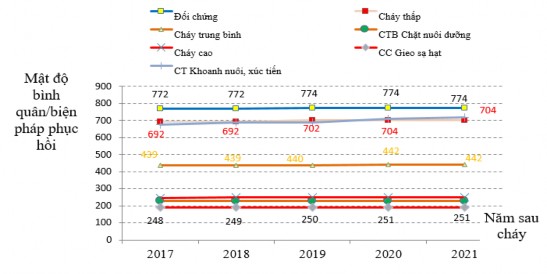
Figure 3.19. Annual density changes across forest restoration measures
Abbreviations in the picture: CT: Low fire; CTB: Medium fire; CC: High fire.
The results in Figure 3.19 show that: silvicultural measures to restore forests after fire such as: measures to protect and promote regeneration; measures to cut and nurture and measures to sow and plant, the density of the upper tree layer after fire is low and lower than the corresponding fire level without implementing silvicultural measures to restore forests. The average density after applying the measures in 2017 above
The 3 corresponding measures achieved: N knxtts = 657 trees/ha; N cnd = 228 trees/ha and N gs = 190 trees/ha. At the time of 2021, the density of the upper tree layer did not change significantly, the corresponding density reached N knxtts = 718 trees/ha; N cnd = 231 trees/ha and N gs = 193 trees/ha. Compared with the density of the upper tree layer on the 3 corresponding fire levels without implementing silvicultural technical measures to restore the forest, the density of the upper tree layer on the technical measures is often lower and changes less.
(ii). Regarding the quantity and species composition of trees above 3 impact measures.
Number and species composition of tall trees in 2021 across three forest restoration techniques. The comparison results are shown in Figure 3.20
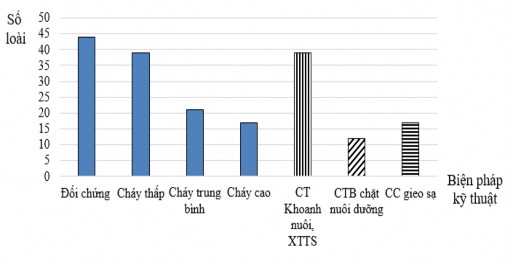
Figure 3.20. Number of tall tree species on silvicultural restoration techniques
Abbreviations in the picture: CT: Low fire; CTB: Medium fire; CC: High fire.
The results in Figure 3.18 above show that, similar to density, the number of species at the low fire level that carried out containment and regeneration promotion measures reached 39 species, the same number of species as at the low fire level that did not carry out containment and regeneration promotion. The number of species at the medium fire level that carried out containment and regeneration measures reached 12 species, lower than at the low fire level that did not carry out containment and regeneration promotion, because some species with low quality and strongly affected by forest fires were cut down.
The high fire level with sowing measures has a number of 17 species and is equal to the high fire area without sowing measures.
(iii). Dominant species composition on silvicultural techniques for post-fire forest restoration
The results of calculating the species importance index in 2021 corresponding to different post-fire forest restoration silvicultural techniques have identified the dominant tree species shown in the following composition formulas.
- Measures to contain and promote regeneration on low fire levels. The total number of recorded plant species is 39, the main species include: Pinus merkusii (Lao language) ( Paek sorng bai); Cinnamomum iners (Sa chouang); Dacrydium elatum (Hing horm); Elaeocarpus stipularis (E. siamensis)) ( Moun), etc. Among the 39 recorded species of the upper tree layer, they belong to 24 plant families. Compared with the control area, the low fire level did not carry out measures to contain and promote regeneration, the number of species composition did not change, but the number of individuals of each species changed significantly. Therefore, the species order changed, the number of species in the composition formula also changed. The calculation results (see Appendix 2) show that: out of a total of 39 species, there are 5 species with an IV importance index ≥ 5%. Thus, the forest burned with a low level of fire has 4 co-dominant species: Schima wallichii Choisy, Pinus merkusii (Lao language: Paek sorng bai) of the Pinaceae family, Dacrydium elatum (Hing horm), of the Pinaceae family; Elaeocarpus stipularis ( Moun), of the Pinaceae family.
Based on the species importance index, the tree species composition formula is established as follows:
CTTT: 15.40Vt + 8.05Thl + 6.61Hđg +5.89Clk + 70.06CLK (3.12)
In which: Vt: Medicinal myrtle; Thl: Two-leaf pine; Hdg: False huangdan; Clk: Ke-leaf com and CLK: Other species.
Thus, the enclosure area promotes regeneration at low fire level, the dominant tree species are: Myrtle, Two-leaf pine, False yellow-flower, and Coc la stipule.
- Cutting and nurturing above the average fire level. The total number of recorded plant species is 12, the main species include: Pinus merkusii ; Cinnamomum iners ; 3-leaf pine; Vên vên nghệ; Vối Thuốc, etc. The calculation results (see Appendix 3) show that: out of the total 12 recorded plant species, there are 5 species with an importance index IV ≥ 5%. Thus, the method of cutting and nurturing above the average fire level has 5 co-dominant species. The formula for tall tree species composition after cutting and nurturing in 2021 is established as follows:
CTTT: 16.40 Vt + 9.05Vvng + 7.11Tbl + 6.62Ql +5.33Thl+ 55.51CLK (3.13)
In which: Vt: Medicinal myrtle; Vvn: Turmeric; Thl: Two-leaf pine; Ql: Pig cinnamon; TBl: Three-leaf pine and CLK: Other species.
Thus, the forest burned at an average level, the dominant tree species were: Myrtle, Turmeric, Pine, Cinnamon, and Pine.
- Sowing method on high fire level. The results of the investigation and determination of the number of species recorded 17 species, the number of similar species on high fire level did not sow, important index on each species (see Appendix 4). A total of 17 species, belonging to 14 plant families, the main species include: Two-leaf pine; Cinnamon pig; Yellow heart; Chieu lieu khe, etc. Thus, the sowing method on high fire level has 6 co-dominant species. The formula for the composition of burnt rubber trees in 2021 is established as follows: CTTT: 17.4Thl + 10.0Ql + 8.61Vta + 7.89Clk + 5.28Vt + 5.02Hdg + 45.8CLK (3.14)
In which: Thl: Two-leaf pine; Ql: Cinnamon; Vta: Yellow heart ; Vt: Medicinal myrtle; Hdg: False sandalwood and CLK: Other species.
Thus, the forest burned with a high level of fire, the dominant tree species included: Pine ha la, Vối Thuốc, Cinnamon heo, Hoang dan giac, etc.
3.3.2.2. Characteristics of the regenerated tree layer on 3 technical measures for forest restoration after fire
(i). Density of regenerated tree layer on 3 measures
The results of evaluating silvicultural techniques for post-fire forest restoration in terms of density and changes in density of the regenerated tree layer over time on 3 silvicultural techniques for post-fire forest restoration are shown in Figure 3.21.
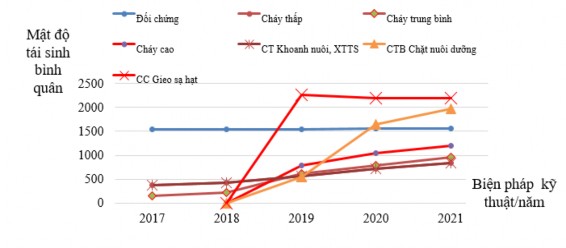
Figure 3.21. Density and density changes of the regenerated tree layer based on silvicultural restoration techniques
Abbreviations in the figure: CT: Low Burning; CTB: Medium Burning; CC: High Burning; XTTS: Promoted Regeneration.
The results in Figure 3.21 show that: silvicultural techniques for post-fire forest restoration have a very positive impact, significantly increasing the density of regenerated trees after fire. Before applying silvicultural techniques, in 2017, the density of regenerated trees recorded on the two measures of cutting and nurturing and sowing seeds was 0 (N ts = 0). At the time of the survey in 2021, the density of regenerated trees on the three impact measures and the corresponding unimpacted fire levels reached: (1). Cutting and nurturing: 1,982 trees/ha; (2). Sowing: 2,196 trees/ha; (3). Control: 1,553 trees/ha; (4). Low fire: 833 trees/ha; (5). Medium fire: 954 trees/ha and (6). High fire: 1,175 trees/ha and (7). Enclosure, promotion of regeneration; 845 trees/ha. The variation in density over time is shown as follows:
(i). Measure of sowing seeds at high level of fire: the density of regenerated trees at the time of sowing in 2017 was zero (all regenerated trees, shrubs, and low-lying trees were completely burned). After 2 years of sowing (2019), the density of regenerated trees increased sharply, reaching 2,189 trees/ha, higher than the control area (not burned). However, in 2021 and 2021, the density of regenerated trees was more stable compared to the first 2 years of sowing. (ii). Measure of Cutting and nurturing at high level of fire
On average, in the first year of nurturing cutting, due to the strong impact during exploitation and transportation, the number of regenerated trees in 2017 was almost non-existent. By 2018, regenerated trees had appeared and the number of regenerated trees began to increase sharply in 2019. In 2019, the average density reached 1,974 trees/ha, the number of regenerated trees was higher than in the control area. However, in 2021, the number of regenerated trees increased but not significantly and was relatively stable, reaching 1,982 trees/ha.
Comparing the regeneration density when applying 3 silvicultural technical measures with the natural regeneration density at the same fire levels without any impact measures shows that: the regeneration density of the 3 impact measures has a very clear difference compared to the natural regeneration density at the same fire level without any impact measures.
The test results on the density of regenerated trees on the fire levels and 3 impact measures show that: χ 2 = 7.56; df = 6 and Sig. = 0.17 > 0.05. Thus, it can be concluded that applying silvicultural techniques to restore forests after fire has an impact, increasing the density of regenerated trees. The sowing and nurturing measures have the most positive impact on the density of regenerated trees.
According to the time after fire, on 3 impact measures, the test results are statistically
shows that: χ 2
= 7.15; p = 0.23; χ 2
= 5.56; p = 0.16; with value
( Sowing ) ( Cutting and nurturing )
p > 0.05, meaning that with the same silvicultural technical measures, the variation in density of regenerated tree species between 5 years is significantly different.
Therefore, it can be said that the density of regenerated trees on the 3 post-fire impact measures compared to the density of the same level of fire without impact has a clear difference. The research results of some other authors in the world also recorded similar results of this study, the authors all stated that the number of regenerated trees increased and increased sharply from the 2nd to the 3rd year after fire when applying impact silvicultural measures (Sovu et al., 2010).
(ii). Number of tree species regenerated on 3 forest restoration measures
The results of evaluating silvicultural techniques for post-fire forest restoration in terms of quantity and species richness of regenerated trees over time using three silvicultural techniques for post-fire forest restoration are shown in Figure 3.22.
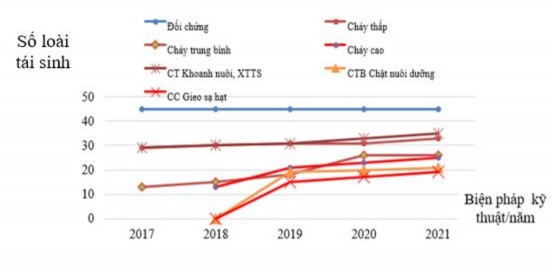
Figure 3.22. Number and change of regenerated tree species on silvicultural restoration techniques
Abbreviations in the figure: CT: Low Burning; CTB: Medium Burning; CC: High Burning; XTTS: Promoted Regeneration.
The results in Figure 3.22 show that the number of regenerated tree species between the 3 impact measures compared to the 3 fire levels without restoration measures, the number of species on technical measures is significantly different. In 2021, in the Chop and Nurture measure, 21 regenerated tree species were recorded, in the sowing measure, 19 species, in the enclosure and regeneration promotion measure, 35 species. However, in general impact measures, the number of species is still lower than the same level of medium and high fire without impact measures as well as the control area. It can be said that applying silvicultural technical measures has reduced the number of species in the first years after the fire compared to the area without applying measures at the same level of fire.