
3.3.2.4. Changes in brown planthopper density on brown planthopper-resistant rice varieties in Phu Vang in the Summer-Autumn crop 2011
Brown planthoppers began to appear on the varieties on June 25 (33 days after sowing). In this survey, the density of brown planthoppers on the low varieties ranged from 5.20 - 29.67 individuals/m 2 , the highest in the HT1 variety was 29.67 individuals/m 2 and the lowest in the HP28 variety was 5.20 individuals/m 2 and HP10 was 5.67 individuals/m 2 (Figure 3.7).
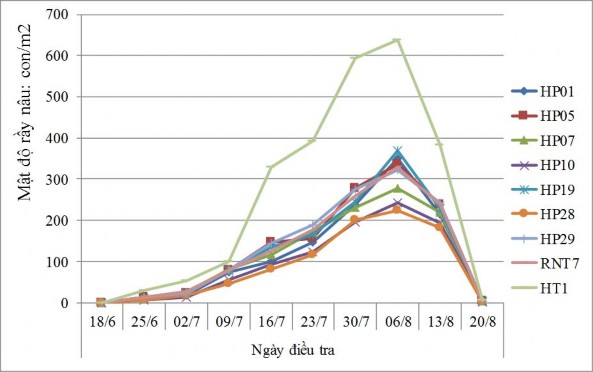
Figure 3.7. Graph of brown planthopper density changes on experimental varieties in Phu Vang in the Summer-Autumn crop of 2011
It can be seen that the hot weather conditions with high temperatures above 37 0 C in some early days of July were not very favorable for the development of brown planthoppers, so their density did not increase significantly in the next survey period. Moreover, because leaf roller insecticides were not sprayed in the 40-day period before mass production, the density of natural enemies of brown planthoppers increased. However, at the end of July, there were alternating sunny and rainy days that could make the temperature not too high, along with high humidity, which is one of the favorable factors for the development of brown planthoppers, so the density increased significantly on July 30 with a density ranging from 195.00 - 592.67 individuals/m2 corresponding to HP10 and HT1 varieties (Figure 3.7). The increase in brown planthopper population at this stage was due to the overlapping phenomenon, rice at the panicle initiation stage is a favorable food source for brown planthoppers, and the scattering of the leaf set
created a microclimate with high humidity, which is also the optimal condition for the development of brown planthopper populations. At the same time, some brown planthoppers have moved from surrounding fields due to the impact of spraying leaf roller insecticides the previous days.
Along with the development of rice plants, the density of brown planthoppers gradually increased and reached its peak on August 6. This is the stage when the rice is milky ripe, so the maximum amount of material is concentrated for the plant so that the photosynthesis process can take place best, providing a favorable food source for planthoppers. Moreover, the phenomenon of "planthopper burn" occurred in the nearby low-lying fields, causing them to lack food, so they moved to the experimental field. At the same time, a new generation of planthoppers was also formed. An equally important reason for the increase in population density of brown planthoppers at this stage is that the fields are drained of water to facilitate the process of rice solidification and ripening, which is also a favorable condition for planthoppers to develop.
After this period, the density of brown planthoppers gradually decreased until the end of the survey on August 20. The density of planthoppers varied among varieties and ranged from 1.00 to 6.80 individuals/m 2 , the highest was on HT1 variety and the lowest was HP28 with 1.00 individuals/m 2 . The reason for this decrease was due to consecutive rainy days at the end of August, which killed the planthoppers. At the same time, the older the rice plant, the harder the stem, which was not a favorable food for planthoppers, so some planthoppers died due to lack of food, the rest transformed into long-winged form and flew elsewhere to find food and overwinter.
Observing the density of brown planthoppers in each survey period on experimental varieties, we found that the two varieties HP10 and HP28 showed the highest resistance to brown planthoppers in the field.
3.3.3. General assessment of brown planthopper infection level of experimental varieties
In general, under the same cultivation conditions, the density of brown planthopper population in Thua Thien Hue in the Summer-Autumn crop is much higher than that in the Winter-Spring crop. This proves that the weather and climate conditions in the Summer-Autumn crop in Thua Thien Hue are suitable for brown planthopper growth, development and damage.
In the two research areas of Phu Vang and Huong Tra, the density of brown planthoppers on the experimental varieties was lower than that of the control variety HT1, which demonstrated the planthopper resistance of the experimental varieties. This result was completely consistent with the results of the laboratory study.
The density of brown planthoppers was different in the experimental varieties, this result indicated that the resistance to brown planthoppers of different varieties was different. Comparing the results of all the experiments in the laboratory and in the field, we can conclude: All 14 experimental varieties were resistant to brown planthoppers in Thua Thien Hue, in which the two varieties HP10 and HP28 showed the highest resistance to brown planthoppers.
3.3.4. Qualities of brown planthopper resistant rice varieties in Thua Thien Hue
Currently, in rice breeding, in addition to selecting high-yield rice varieties that are resistant to adverse external conditions and major pests and diseases, breeders also pay attention to the quality of rice grains to meet the needs of domestic and export markets.
In order to have a basis for evaluating and selecting rice varieties with the ability to resist planthoppers suitable for production conditions in Thua Thien Hue, both high yielding and good quality, meeting the needs and tastes of consumers, the project analyzed a number of post-harvest grain quality indicators.
According to IRRI's classification, rice quality is divided into the following four groups: Milling quality, commercial quality, cooking and eating quality, and nutritional quality.
3.3.4.1. Milling quality and commercial quality
* Milling quality: Evaluated based on the following criteria: Brown rice ratio, milled rice ratio, head rice ratio.
- Milled rice ratio: Is the percentage of white milled rice obtained compared to the initial amount of paddy. The higher this ratio, the greater the recovery value. This indicator depends on the nature of the variety, besides it is also affected by external conditions.
- Head rice ratio: This is the most important index among milling indexes and is of most interest in the market. When considering the milling quality of rice, people are interested in the head rice ratio. The head rice ratio is a genetic trait strongly influenced by the environment, especially temperature and humidity during the rice ripening and harvesting period.
* Commercial quality: Evaluated through the characteristics of rice grains such as: white belly, rice grain length, rice grain size, aroma...
- Grain size: Grain length preferences vary greatly from region to region. Japanese consumers prefer short-grain Japonica rice that is freshly processed and well-milled, which should be sticky, soft and flavourful. In the Middle East, consumers prefer long-grain, well-milled rice with a very aromatic flavour.
- Rate of chalky grains: The transparency of the grain is an indicator that does not affect the quality of the rice, but consumers prefer rice with high transparency. Therefore, this indicator is an important target for selecting varieties. The level of chalky endosperm is due to genetic factors on the one hand, and environmental conditions on the other. The process of chalky grains mainly occurs during the ripening period (the period of accumulation of dry matter in the endosperm), so if there is a lack of water in the post-flowering stage or the appearance of rice blast disease, or bugs sucking rice during the milky stage, the rate of chalky rice will increase.
The results of milling quality and commercial quality evaluation of rice varieties resistant to planthoppers are recorded in Table 3.15.
Table 3.15. Rice quality indicators of experimental rice varieties
Alike
TLGX (% rice) | TLGN (% milled rice) | Particle size | Granular | Silver belly grain rate | ||||
Length (mm) | Width (mm) | D/R | Classify | % | point | |||
HP01 | 66.10 | 67.90 | 9.16 | 2.50 | 3.66 | Long | 8 | 1 |
HP05 | 69.80 | 67.60 | 9.10 | 2.71 | 3.36 | Long | 7 | 1 |
HP07 | 69.00 | 66.50 | 9.22 | 2.30 | 4.01 | Long | 7 | 1 |
HP10 | 69.80 | 70.10 | 9.53 | 2.63 | 3.62 | Long | 16 | 2 |
HP19 | 68.30 | 63.60 | 9.68 | 2.48 | 3.9 | Long | 17 | 2 |
HP28 | 70.60 | 72.80 | 9.64 | 2.32 | 4.16 | Long | 8 | 1 |
HP29 | 68.60 | 66.50 | 9.28 | 2.70 | 3.44 | Long | 8 | 1 |
RNT07 | 66.30 | 67.30 | 9.79 | 2.71 | 3.61 | Long | 22 | 3 |
HT1 | 69.50 | 70.60 | 9.67 | 2.35 | 4.11 | Long | 7 | 1 |
Maybe you are interested!
-

 Revenue Forecast of Nam Viet Corporation 2014 Using Brown Method
 -
 Assessment of bone density and changes in bone metabolism markers osteocalcin, s-CTx in hyperthyroid patients - 1
 -
 Brown Belt Kyu 3 Upgrade Exam Content to Brown Belt Kyu 2
 -
 Drude's Symbol of Phytophthora Density
 -
 Using brown rice and broken rice instead of corn as pig feed - 17
Note: TLGX: Milled rice ratio; TLGN: Head rice ratio
The results in Table 3.15 show that the milled rice ratio of the experimental varieties ranges from 66.10 - 70.60%. The highest is the HP28 variety (70.60%) and is equivalent to the control variety HT1 (69.50%); in general, the head rice ratio of the varieties is quite good.
The height ranges from 63.60 - 72.80%, the highest is HP28 (72.80%) and the lowest is HP19 (63.60%). The rice grain length ranges from 9.10 - 9.79mm, of which RNT07 is the longest grain (9.79mm). The length/width ratio of the varieties ranges from 3.36 - 4.16, so according to 10TCN 558-2002, these varieties all have an elongated shape.
Regarding chalkiness: Varieties with chalkiness range from 7 - 22% of whole rice. Of which, 3 varieties have chalkiness rate of 7% and 3 varieties have chalkiness rate of 8%, scoring 1. The remaining varieties have chalkiness rate of 11 - 20%, scoring 2. Particularly, variety RNT07 has chalkiness rate of 22%, scoring 3. In general, in terms of morphological quality, all varieties are of good quality, suitable for consumer tastes.
3.3.4.2. Nutritional quality
Nutritional quality includes indicators such as: Gelatinization temperature, protein content, amylose content, starch content, gel strength...
From the analysis results, evaluate the biochemical indicators of the experimental variety.
recorded in table 3.16 we see that:
- Total protein content: Protein content is an important indicator to evaluate the nutritional quality of rice. The results presented in Table 3.20 show that all rice varieties have a fairly high protein content, ranging from 8.07 - 9.17%. Of which, there are 2 varieties HP10 and HP28 with protein content > 9 and equivalent to the control HT1.
- Amylose content: Amylose has a great influence on the cooking quality and eating quality of rice, this is the decisive factor in the quality of sticky, soft or hard rice. Rice varieties with amylose content in rice grains from 20 - 25% produce delicious, soft and sticky rice. Rice varieties with amylose content greater than 25% produce dry, hard and loose rice. The data in the table shows that the amylose content of the experimental varieties ranges from 16.84 - 21.97% corresponding to HP10 and HP07 and equivalent to the control HT1, so all produce delicious, soft and sticky rice, meeting the tastes of today's consumers.
- Gel strength: Gel strength is one of the criteria that determines the quality of rice. In the 09 rice varieties studied, we found that these rice varieties have small gel length, so they have hard gel strength.
- Gelatinization temperature: Gelatinization temperature is the temperature required for rice to turn into cooked rice. Normally, high gelatinization temperature means low amylose content, very sticky rice and bland rice. Average gelatinization temperature means average amylose content, soft rice, not dry. Low gelatinization temperature means high amylose content, hard dry rice. Rice with high gelatinization temperature consumes heat when cooked, rice is not delicious, average gelatinization temperature of 70 - 74 0 C is the optimal standard for good rice quality. The experimental varieties have high gelatinization temperature, especially HP10, HP28 and HT1 (control) varieties have average gelatinization temperature.
Table 3.16. Biochemical indicators of experimental rice varieties
Alike
Protein | Amylose | Thermochemistry | Gel strength | ||||
(%) | (%) | Classify | Score (1 - 7) | Classification | Length (mm) | Classify | |
HP01 | 8.07 | 19.46 | Short | 2 | High | 30.50 | Hard |
HP05 | 8.32 | 20.22 | TB | 2 | High | 31.69 | Hard |
HP07 | 8.46 | 21.97 | TB | 2 | High | 28.38 | Hard |
HP10 | 9.06 | 16.84 | Short | 4 | TB | 33.69 | Hard |
HP19 | 8.61 | 20.16 | TB | 2 | High | 29.94 | Hard |
HP28 | 9.05 | 19.87 | Short | 4 | TB | 31.69 | Hard |
HP29 | 8.41 | 19.58 | TB | 2 | High | 29.81 | Hard |
RNT07 | 8.47 | 20.86 | TB | 2 | High | 28.13 | Hard |
HT1 | 9.17 | 18.76 | Short | 4 | TB | 35.88 | Hard |
Note: - Average: Average
In summary, most of the selected brown planthopper resistant rice varieties (except HP01 and HP29) have high protein content in rice grains and low amylose content in rice grains. Some varieties such as HP10 and HP28 have protein content > 9%, so they have good rice quality, meeting commercial rice standards and meeting the tastes of today's consumers.
3.4. Impact of some cultivation techniques on brown planthopper resistant rice varieties in Thua Thien Hue
Among the varieties tested in the laboratory and in the field that showed high resistance to planthoppers, together with the results of quality analysis of the experimental rice varieties, we found that the HP28 variety had the highest resistance to planthoppers, while also giving quite good yield and quality. Based on this result,
We decided to choose HP28 variety to continue research to determine appropriate cultivation techniques to have a basis for proposing instructions on fertilizer use and appropriate planting density for this brown planthopper resistant rice variety.
3.4.1. Effects of sowing density on growth, development, yield and brown planthopper situation of HP28 rice variety
In rice production, applying direct seeding is a technical advance that helps reduce labor, reduce investment costs, especially seeds, shortening the time by 7-10 days compared to transplanted rice and increasing productivity by 10-20%. However, sowing and transplanting are long-standing farming practices of farmers in the northern provinces as well as in Thua Thien Hue. Since the 1980s, Thua Thien Hue province has tested and popularized the direct seeding method by hand. From the results obtained in terms of productivity and economic efficiency, up to now, the direct seeding method in the whole province has reached 90-95% of the area. The application of direct seeding technique has contributed to reducing production costs such as the amount of seeds and fertilizers has also been greatly reduced, mainly nitrogen fertilizer reduced by 10-20%. Direct seeding technique also contributes greatly to the prevention of pests and diseases, reducing many costs in plant protection work. In addition to reducing production costs and increasing economic efficiency, the rice sowing method is also a premise for the use of mechanization in rice production such as: using sprayers, using combine harvesters... thereby contributing to mechanization in agricultural production.
From the initial results, we determined that the HP28 rice variety is resistant to brown planthoppers, has high yield and good quality. However, to put it into production in Thua Thien Hue province, contributing to the work of preventing brown planthoppers, determining the appropriate sowing density to determine the amount of seeds needed per unit area effectively, reducing seed costs, and limiting the ineffective tillering of rice varieties is a necessary need to supplement and perfect the production process of brown planthopper-resistant rice varieties.
To study the effect of sowing density on growth, yield and brown planthopper resistance of HP28 rice variety, we conducted research on two main soil types in Thua Thien Hue: ancient alluvial soil that has not been deposited in Huong Tra district and coastal sandy soil in Phu Vang district in the 2011-2012 Winter-Spring crop and the 2012 Summer-Autumn crop. The results are as follows:
3.4.1.1. Effect of sowing density on some morphological indicators of HP28 rice variety in Huong Tra, Thua Thien Hue
The morphological characteristics of rice plants are determined by the genetic factors of the variety. However, on the same variety, different conditions such as cultivation techniques, fertilizer regimes, and sowing density also affect some morphological characteristics of rice plants.
Results of monitoring the impact of sowing density on some morphological characteristics of HP28 variety in Huong Tra district in Winter-Spring crop 2011 - 2012 and Summer-Autumn crop 2012 (Table 3.17), we recorded the following:
Table 3.17. Effect of sowing density on some morphological indicators of HP28 rice variety in Winter-Spring crop 2011 - 2012 and Summer-Autumn crop 2012
in Huong Tra, Thua Thien Hue
Sowing density (kg/ha)
Tree height (cm) | Cotton length (cm) | Number of leaves on the tree (leaf) | |
WINTER-SPRING CROP | |||
40 | 81.00 a | 16.80a | 9.93a |
50 | 78.5 ab | 15.50b | 9.80 ab |
60 | 80.29 ab | 16.40 ab | 9.73 ab |
70 | 76.00 b | 15.47b | 9.67b |
SUMMER-FALL CROP | |||
40 | 84.10a | 16.57a | 9.83a |
50 | 81.10 ab | 16.06a | 9.36b |
60 | 83.70 ab | 16.28a | 9.46b |
70 | 80.60 c | 15.86a | 9.30b |
Note: In the same column, same case, different letters mean significant difference with p<0.05.