
Information Technology Development 004
System of signs, appropriate language
004
Reasonable admission price 004
A complete and suitable system of public sanitation facilities
Tourist sites have suitable parking systems
004
004
3.35030.4030.45030.5030.55030.6030.65030.7030.75030.8030.8500
Figure 3.12 Tourists' reviews of some public services
Source: Author's synthesis of investigation and survey results
With the tourism activities of localities taking place vigorously and diversely, including both natural and cultural tourism, the large number of tourists will have a significant impact on the lives of local residents, especially on security and order, traffic safety. The role of authorities at all levels, tourism management agencies, and residents in maintaining social order and safety is extremely necessary. When surveying residents living near tourist attractions on the impact of tourism on the surrounding environment (Table 3.26 ) such as security and traffic, 66.1% of opinions said that local tourism activities have made local traffic better, but 14% said that the impact is worse and had no opinion.
Table 3.26 Percentage of responses from surveyed households on the impact of tourism on life
Unit: %
Target
Better | Are not change | Go bad | no idea ants | |
Security situation at tourist attractions locally | 73.7 | 22.1 | 1.6 | 2.6 |
How does it affect traffic? local | 66.1 | 19 | 7.9 | 6.9 |
Maybe you are interested!
-
 Identify Rating Levels and Rating Scales
zt2i3t4l5ee
zt2a3gstourism,quan lan,quang ninh,ecology,ecotourism,minh chau,van don,geography,geographical basis,tourism development,science
zt2a3ge
zc2o3n4t5e6n7ts
of the islanders. Therefore, this indicator will be divided into two sub-indicators:
a1. Natural tourism attractiveness a2. Cultural tourism attractiveness
b. Tourist capacity
The two island communes in Quan Lan have different capacities to receive tourists. Minh Chau Commune is home to many standard hotels and resorts, attracting high-income domestic and international tourists. Meanwhile, Quan Lan Commune has many motels mainly built and operated by local people, so the scale and quality are not high, and will be suitable for ordinary tourists such as students.
c. Time of exploitation of Quan Lan Island Commune:
Quan Lan tourism is seasonal due to weather and climate conditions and festivals only take place on certain days of the year, specifically in spring. In Quan Lan commune, the period from April to June and from September to November is considered the best time to visit Quan Lan because the cultural tourism activities are mainly associated with festivals taking place during this time.
Minh Chau island commune:
Tourism exploitation time is all year round, because this is a place with a number of tourist attractions with diverse ecosystems such as Bai Tu Long National Park Research Center, Tram forest, Turtle Laying Beach, so besides coming to the beach for tourism and vacation in the summer, Minh Chau will attract research groups to come for tourism combined with research at other times of the year.
d. Sustainability
The sustainability of ecotourism sites in Quan Lan and Minh Chau communes depends on the sensitivity of the ecosystems to climate changes.
landscape. In general, these tourist destinations have a fairly high level of sustainability, because they are natural ecosystems, planned and protected. However, if a large number of tourists gather at certain times, it can exceed the carrying capacity and affect the sustainability of the environment (polluted beaches, damaged trees, animals moving away from their habitats, etc.), then the sustainability of the above ecosystems (natural ecosystems, human ecosystems) will also be affected and become less sustainable.
e. Location and accessibility
Both island communes have ports to take tourists to visit from Van Don wharf:
- Quan Lan – Van Don traffic route:
Phuc Thinh – Viet Anh high-speed boat and Quang Minh high-speed boat, depart at 8am and 2pm from Van Don to Quan Lan, and at 7am and 1pm from Quan Lan to Van Don. There are also wooden boats departing at 7am and 1pm.
- Van Don - Minh Chau traffic route:
Chung Huong high-speed train, Minh Chau train, morning 7:30 and afternoon 13:30 from Van Don to Minh Chau, morning 6:30 and afternoon 13:00 from Minh Chau to Van Don.
f. Infrastructure
Despite receiving investment attention, the issue of infrastructure and technical facilities for tourism on Quan Lan Island is still an issue that needs to be resolved because it has a direct impact on the implementation of ecotourism activities. The minimum conditions for serving tourists such as accommodation, electricity, water, communication, especially medical services, and security work need to be given top priority. Ecotourism spots in Minh Chau commune are assessed to have better infrastructure and technical facilities for tourism because there are quite complete and synchronous conditions for serving tourists, meeting many needs of domestic and foreign tourists.
3.2.1.4. Determine assessment levels and assessment scales
Corresponding to the levels of each criterion, the index is the score of those levels in the order of 4, 3, 2, 1 decreasing according to the standard of each level: very attractive (4), attractive (3), average (2), less attractive (1).
3.2.1.5. Determining the coefficients of the criteria
For the assessment of DLST in the two communes of Quan Lan and Minh Chau islands, the students added evaluation coefficients to show the importance of the criteria and indicators as follows:
Coefficient 3 with criteria: Attractiveness, Exploitation time. These are the 2 most important criteria for attracting tourists to tourism in general and eco-tourism in particular, so they have the highest coefficient.
Coefficient 2 with criteria: Capacity, Infrastructure, Location and accessibility . Because the assessment area is an island commune of Van Don district, the above criteria are selected by the author with appropriate coefficients at the average level.
Coefficient 1 with criteria: Sustainability. Quan Lan has natural and human-made ecotourism sites, with high biodiversity and little impact from local human factors. Most of the ecotourism sites are still wild, so they are highly sustainable.
3.2.1.6. Results of DLST assessment on Quan Lan island
a. Assessment of the potential for natural tourism development
For Minh Chau commune:
+ Natural tourism attractiveness is determined to be very attractive (4 points) and the most important coefficient (coefficient 3), so the score of the Attractiveness criterion is 4 x 3 = 12.
+ Capacity is determined as average (2 points) and the coefficient is quite important (coefficient 2), then the score of Capacity criterion is 2 x 2 = 4.
+ Exploitation time is long (4 points), the most important coefficient (coefficient 3) so the score of the Exploitation time criterion is 4 x 3 = 12.
+ Sustainability is determined as sustainable (4 points), the important coefficient is the average coefficient (coefficient 1), so the score of the Sustainability criterion is 4 x 1 = 4 points
+ Location and accessibility are determined to be quite favorable (2 points), the coefficient is quite important (coefficient 2), the criterion score is 2 x 2 = 4 points.
+ Infrastructure is assessed as good (3 points), the coefficient is quite important (coefficient 2), then the score of the Infrastructure criterion is 3 x 2 = 6 points.
The total score for evaluating DLST in Minh Chau commune according to 6 evaluation criteria is determined as: 12 + 4 + 12 + 4 + 4 + 6 = 42 points
Similar assessment for Quan Lan commune, we have the following table:
Table 3.3: Assessment of the potential for natural ecotourism development in Quan Lan and Minh Chau communes
Attractiveness of self-tourismof course
Capacity
Mining time
Sustainability
Location and accessibility
Infrastructure
Result
Point
DarkMulti
Point
DarkMulti
Point
DarkMulti
Point
DarkMulti
Point
DarkMulti
Point
DarkMulti
CommuneMinh Chau
12
12
4
8
12
12
4
4
4
8
6
8
42/52
Quan CommuneLan
6
12
6
8
9
12
4
4
4
8
4
8
33/52
b. Assessment of the potential for humanistic tourism development
For Quan Lan commune:
+ The attractiveness of human tourism is determined to be very attractive (4 points) and the most important coefficient (coefficient 3), so the score of the Attractiveness criterion is 4 x 3 = 12.
+ Capacity is determined to be large (3 points) and the coefficient is quite important (coefficient 2), then the score of the Capacity criterion is 3 x 2 = 6.
+ Mining time is average (3 points), the most important coefficient (coefficient 3) so the score of the Mining time criterion is 3 x 3 = 9.
+ Sustainability is determined as sustainable (4 points), the important coefficient is the average coefficient (coefficient 1), so the score of the Sustainability criterion is 4 x 1 = 4 points.
+ Location and accessibility are determined to be quite favorable (2 points), the coefficient is quite important (coefficient 2), the criterion score is 2 x 2 = 4 points.
+ Infrastructure is rated as average (2 points), the coefficient is quite important (coefficient 2), then the score of the Infrastructure criterion is 2 x 2 = 4 points.
The total score for evaluating DLST in Quan Lan commune according to 6 evaluation criteria is determined as: 12 + 6 + 6 + 4 + 4 + 4 = 36 points.
Similar assessment with Minh Chau commune we have the following table:
Table 3.4: Assessment of the potential for developing humanistic eco-tourism in Quan Lan and Minh Chau communes
Attractiveness of human tourismliterature
Capacity
Mining time
Sustainability
Location and accessibility
Infrastructure
Result
Point
DarkMulti
Point
DarkMulti
Point
DarkMulti
Point
DarkMulti
Point
DarkMulti
Point
DarkMulti
Quan CommuneLan
12
12
6
8
9
12
4
4
4
8
4
8
39/52
Minh CommuneChau
6
12
4
8
12
12
4
4
4
8
6
8
36/52
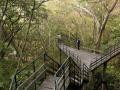
Basically, both Minh Chau and Quan Lan localities have quite favorable conditions for developing ecotourism. However, Quan Lan commune has more advantages to develop ecotourism in a humanistic direction, because this is an area with many famous historical relics such as Quan Lan Communal House, Quan Lan Pagoda, Temple worshiping the hero Tran Khanh Du, ... along with local festivals held annually such as the wind praying ceremony (March 15), Quan Lan festival (June 10-19); due to its location near the port and long exploitation time, the beaches in Quan Lan commune (especially Quan Lan beach) are no longer hygienic and clean to ensure the needs of tourists coming to relax and swim; this is also an area with many beautiful landscapes such as Got Beo wind pass, Ong Phong head, Voi Voi cave, but the ability to access these places is still very limited (dirt hill road, lots of gravel and rocks), especially during rainy and windy times; In addition, other natural resources such as mangrove forests and sea worms have not been really exploited for tourism purposes and ecotourism development. On the contrary, Minh Chau commune has more advantages in developing ecotourism in the direction of natural tourism, this is an area with diverse ecosystems such as at Rua De Beach, Bai Tu Long National Park Conservation Center...; Minh Chau beach is highly appreciated for its natural beauty and cleanliness, ranked in the top ten most beautiful beaches in Vietnam; Minh Chau commune is also home to Tram forest with a large area and a purity of up to 90%, suitable for building bridges through the forest (a very effective type of natural ecotourism currently applied by many countries) for tourists to sightsee, as well as for the purpose of studying and researching.
Figure 3.1: Thenmala Forest Bridge (India) Source: https://www.thenmalaecotourism.com/(August 21, 2019)
3.2.2. Using SWOT matrix to evaluate Quan Lan island tourism
General assessment of current tourism activities of Quan Lan island is shown through the following SWOT matrix:
Table 3.5: SWOT matrix evaluating tourism activities on Quan Lan island
Internal agent
Strengths- There is a lot of potential for tourism development, especially natural ecotourism and humanistic ecotourism.- The unskilled labor force is relatively abundant.- resource environmentunpolluted, still
Weaknesses- Poorly developed infrastructure, especially traffic routes to tourist destinations on the island.- The team of professional staff is still weak.- Tourism products in general
quite wild, originalintact
general and DLST in particularalone is monotonous.
External agents
Opportunity- Tourism is a key industry in the socio-economic development strategy of the province and Van Don economic zone.- Quan Lan was selected as a pilot area for eco-tourism development within the framework of the green growth project between Quang Ninh province and the Japanese organization JICA.- The flow of tourists and especially ecotourism in the world tends toincreasing
Challenge- Weather and climate change abnormally.- Competition in tourism products is increasingly fierce, especially with other localities in the province such as Ha Long, Mong Cai...- Awareness of tourists, especially domestic tourists, about ecotourism and nature conservation is not high.
Through summary analysis using SWOT matrix we see that:
To exploit strengths and take advantage of opportunities, it is necessary to:
- Diversify products and service types (build more tourism routes aimed at specific needs of tourists: experiential tourism immersed in nature, spiritual cultural tourism...)
- Effective exploitation of resources and differentiated products (natural resources and human resources)
div.maincontent .p { color: black; font-family:"Times New Roman", serif; font-style: normal; font-weight: normal; text-decoration: none; font-size: 14pt; margin:0pt; } div.maincontent p { color: black; font-family:"Times New Roman", serif; font-style: normal; font-weight: normal; text-decoration: none; font-size: 14pt; margin:0pt; } div.maincontent .s1 { color: black; font-family:"Times New Roman", serif; font-style: normal; font-weight: normal; text-decoration: none; font-size: 13pt; } div.maincontent .s2 { color: black; font-family:"Times New Roman", serif; font-style: normal; font-weight: normal; text-decoration: none; font-size: 13pt; } div.maincontent .s3 { color: #0D0D0D; font-family:"Times New Roman", serif; font-style: normal; font-weight: bold; text-decoration: none; font-size: 14pt; } div.maincontent .s4 { color: black; font-family:"Times New Roman", serif; font-style: italic; font-weight: normal; text-decoration: none; font-size: 14pt; } div.maincontent .s5 { color: black; font-family:"Times New Roman", serif; font-style: italic; font-weight: bold; text-decoration: none; font-size: 14pt; } div.maincontent .s6 { color: black; font-family:"Times New Roman", serif; font-style: italic; font-weight: normal; text-decoration: none; font-size: 14pt; vertical-align: -3pt; } div.maincontent .s7 { color: black; font-family:"Times New Roman", serif; font-style: italic; font-weight: normal; text-decoration: none; font-size: 14pt; vertical-align: -2pt; } div.maincontent .s8 { color: black; font-family:"Times New Roman", serif; font-style: italic; font-weight: normal; text-decoration: none; font-size: 14pt; vertical-align: -1pt; } div.maincontent .s9 { color: black; font-family:"Times New Roman", serif; font-style: normal; font-weight: normal; text-decoration: none; font-size: 14pt; } div.maincontent .s10 { color: black; font-family:"Times New Roman", serif; font-style: normal; font-weight: bold; text-decoration: none; font-size: 14pt; } div.maincontent .s11 { color: black; font-family:"Times New Roman", serif; font-style: normal; font-weight: normal; text-decoration: none; font-size: 14pt; } div.maincontent .s12 { color: black; font-family:Symbol, serif; font-style: normal; font-weight: normal; text-decoration: none; font-size: 14pt; } div.maincontent .s13 { color: black; font-family:Wingdings; font-style: normal; font-weight: normal; text-decoration: none; font-size: 14pt; } div.maincontent .s14 { color: black; font-family:"Times New Roman", serif; font-style: normal; font-weight: normal; text-decoration: none; font-size: 9pt; vertical-align: 5pt; } div.maincontent .s15 { color: black; font-family:"Times New Roman", serif; font-style: normal; font-weight: normal; text-decoration: none; font-size: 9pt; vertical-align: 5pt; } div.maincontent .s16 { color: black; font-family:Cambria, serif; font-style: italic; font-weight: normal; text-decoration: none; font-size: 14pt; } div.maincontent .s17 { color: #080808; font-family:"Times New Roman", serif; font-style: normal; font-weight: bold; text-decoration: none; font-size: 14pt; } div.maincontent .s18 { color: #080808; font-family:"Times New Roman", serif; font-style: normal; font-weight: normal; text-decoration: none; font-size: 14pt; } div.maincontent .s19 { color: black; font-family:"Times New Roman", serif; font-style: normal; font-weight: normal; text-decoration: none; font-size: 11pt; } div.maincontent .s20 { color: black; font-family:"Times New Roman", serif; font-style: normal; font-weight: normal; text-decoration: none; font-size: 10pt; } div.maincontent .s21 { color: black; font-family:"Times New Roman", serif; font-style: normal; font-weight: bold; text-decoration: none; font-size: 11pt; } div.maincontent .s22 { color: black; font-family:"Times New Roman", serif; font-style: normal; font-weight: normal; text-decoration: none; font-size: 11pt; } div.maincontent .s23 { color: black; font-family:"Times New Roman", serif; font-style: italic; font-weight: normal; text-decoration: none; font-size: 14pt; } div.maincontent .s24 { color: #212121; font-family:"Times New Roman", serif; font-style: normal; font-weight: normal; tex
Identify Rating Levels and Rating Scales
zt2i3t4l5ee
zt2a3gstourism,quan lan,quang ninh,ecology,ecotourism,minh chau,van don,geography,geographical basis,tourism development,science
zt2a3ge
zc2o3n4t5e6n7ts
of the islanders. Therefore, this indicator will be divided into two sub-indicators:
a1. Natural tourism attractiveness a2. Cultural tourism attractiveness
b. Tourist capacity
The two island communes in Quan Lan have different capacities to receive tourists. Minh Chau Commune is home to many standard hotels and resorts, attracting high-income domestic and international tourists. Meanwhile, Quan Lan Commune has many motels mainly built and operated by local people, so the scale and quality are not high, and will be suitable for ordinary tourists such as students.
c. Time of exploitation of Quan Lan Island Commune:
Quan Lan tourism is seasonal due to weather and climate conditions and festivals only take place on certain days of the year, specifically in spring. In Quan Lan commune, the period from April to June and from September to November is considered the best time to visit Quan Lan because the cultural tourism activities are mainly associated with festivals taking place during this time.
Minh Chau island commune:
Tourism exploitation time is all year round, because this is a place with a number of tourist attractions with diverse ecosystems such as Bai Tu Long National Park Research Center, Tram forest, Turtle Laying Beach, so besides coming to the beach for tourism and vacation in the summer, Minh Chau will attract research groups to come for tourism combined with research at other times of the year.
d. Sustainability
The sustainability of ecotourism sites in Quan Lan and Minh Chau communes depends on the sensitivity of the ecosystems to climate changes.
landscape. In general, these tourist destinations have a fairly high level of sustainability, because they are natural ecosystems, planned and protected. However, if a large number of tourists gather at certain times, it can exceed the carrying capacity and affect the sustainability of the environment (polluted beaches, damaged trees, animals moving away from their habitats, etc.), then the sustainability of the above ecosystems (natural ecosystems, human ecosystems) will also be affected and become less sustainable.
e. Location and accessibility
Both island communes have ports to take tourists to visit from Van Don wharf:
- Quan Lan – Van Don traffic route:
Phuc Thinh – Viet Anh high-speed boat and Quang Minh high-speed boat, depart at 8am and 2pm from Van Don to Quan Lan, and at 7am and 1pm from Quan Lan to Van Don. There are also wooden boats departing at 7am and 1pm.
- Van Don - Minh Chau traffic route:
Chung Huong high-speed train, Minh Chau train, morning 7:30 and afternoon 13:30 from Van Don to Minh Chau, morning 6:30 and afternoon 13:00 from Minh Chau to Van Don.
f. Infrastructure
Despite receiving investment attention, the issue of infrastructure and technical facilities for tourism on Quan Lan Island is still an issue that needs to be resolved because it has a direct impact on the implementation of ecotourism activities. The minimum conditions for serving tourists such as accommodation, electricity, water, communication, especially medical services, and security work need to be given top priority. Ecotourism spots in Minh Chau commune are assessed to have better infrastructure and technical facilities for tourism because there are quite complete and synchronous conditions for serving tourists, meeting many needs of domestic and foreign tourists.
3.2.1.4. Determine assessment levels and assessment scales
Corresponding to the levels of each criterion, the index is the score of those levels in the order of 4, 3, 2, 1 decreasing according to the standard of each level: very attractive (4), attractive (3), average (2), less attractive (1).
3.2.1.5. Determining the coefficients of the criteria
For the assessment of DLST in the two communes of Quan Lan and Minh Chau islands, the students added evaluation coefficients to show the importance of the criteria and indicators as follows:
Coefficient 3 with criteria: Attractiveness, Exploitation time. These are the 2 most important criteria for attracting tourists to tourism in general and eco-tourism in particular, so they have the highest coefficient.
Coefficient 2 with criteria: Capacity, Infrastructure, Location and accessibility . Because the assessment area is an island commune of Van Don district, the above criteria are selected by the author with appropriate coefficients at the average level.
Coefficient 1 with criteria: Sustainability. Quan Lan has natural and human-made ecotourism sites, with high biodiversity and little impact from local human factors. Most of the ecotourism sites are still wild, so they are highly sustainable.
3.2.1.6. Results of DLST assessment on Quan Lan island
a. Assessment of the potential for natural tourism development
For Minh Chau commune:
+ Natural tourism attractiveness is determined to be very attractive (4 points) and the most important coefficient (coefficient 3), so the score of the Attractiveness criterion is 4 x 3 = 12.
+ Capacity is determined as average (2 points) and the coefficient is quite important (coefficient 2), then the score of Capacity criterion is 2 x 2 = 4.
+ Exploitation time is long (4 points), the most important coefficient (coefficient 3) so the score of the Exploitation time criterion is 4 x 3 = 12.
+ Sustainability is determined as sustainable (4 points), the important coefficient is the average coefficient (coefficient 1), so the score of the Sustainability criterion is 4 x 1 = 4 points
+ Location and accessibility are determined to be quite favorable (2 points), the coefficient is quite important (coefficient 2), the criterion score is 2 x 2 = 4 points.
+ Infrastructure is assessed as good (3 points), the coefficient is quite important (coefficient 2), then the score of the Infrastructure criterion is 3 x 2 = 6 points.
The total score for evaluating DLST in Minh Chau commune according to 6 evaluation criteria is determined as: 12 + 4 + 12 + 4 + 4 + 6 = 42 points
Similar assessment for Quan Lan commune, we have the following table:
Table 3.3: Assessment of the potential for natural ecotourism development in Quan Lan and Minh Chau communes
Attractiveness of self-tourismof course
Capacity
Mining time
Sustainability
Location and accessibility
Infrastructure
Result
Point
DarkMulti
Point
DarkMulti
Point
DarkMulti
Point
DarkMulti
Point
DarkMulti
Point
DarkMulti
CommuneMinh Chau
12
12
4
8
12
12
4
4
4
8
6
8
42/52
Quan CommuneLan
6
12
6
8
9
12
4
4
4
8
4
8
33/52
b. Assessment of the potential for humanistic tourism development
For Quan Lan commune:
+ The attractiveness of human tourism is determined to be very attractive (4 points) and the most important coefficient (coefficient 3), so the score of the Attractiveness criterion is 4 x 3 = 12.
+ Capacity is determined to be large (3 points) and the coefficient is quite important (coefficient 2), then the score of the Capacity criterion is 3 x 2 = 6.
+ Mining time is average (3 points), the most important coefficient (coefficient 3) so the score of the Mining time criterion is 3 x 3 = 9.
+ Sustainability is determined as sustainable (4 points), the important coefficient is the average coefficient (coefficient 1), so the score of the Sustainability criterion is 4 x 1 = 4 points.
+ Location and accessibility are determined to be quite favorable (2 points), the coefficient is quite important (coefficient 2), the criterion score is 2 x 2 = 4 points.
+ Infrastructure is rated as average (2 points), the coefficient is quite important (coefficient 2), then the score of the Infrastructure criterion is 2 x 2 = 4 points.
The total score for evaluating DLST in Quan Lan commune according to 6 evaluation criteria is determined as: 12 + 6 + 6 + 4 + 4 + 4 = 36 points.
Similar assessment with Minh Chau commune we have the following table:
Table 3.4: Assessment of the potential for developing humanistic eco-tourism in Quan Lan and Minh Chau communes
Attractiveness of human tourismliterature
Capacity
Mining time
Sustainability
Location and accessibility
Infrastructure
Result
Point
DarkMulti
Point
DarkMulti
Point
DarkMulti
Point
DarkMulti
Point
DarkMulti
Point
DarkMulti
Quan CommuneLan
12
12
6
8
9
12
4
4
4
8
4
8
39/52
Minh CommuneChau
6
12
4
8
12
12
4
4
4
8
6
8
36/52
Basically, both Minh Chau and Quan Lan localities have quite favorable conditions for developing ecotourism. However, Quan Lan commune has more advantages to develop ecotourism in a humanistic direction, because this is an area with many famous historical relics such as Quan Lan Communal House, Quan Lan Pagoda, Temple worshiping the hero Tran Khanh Du, ... along with local festivals held annually such as the wind praying ceremony (March 15), Quan Lan festival (June 10-19); due to its location near the port and long exploitation time, the beaches in Quan Lan commune (especially Quan Lan beach) are no longer hygienic and clean to ensure the needs of tourists coming to relax and swim; this is also an area with many beautiful landscapes such as Got Beo wind pass, Ong Phong head, Voi Voi cave, but the ability to access these places is still very limited (dirt hill road, lots of gravel and rocks), especially during rainy and windy times; In addition, other natural resources such as mangrove forests and sea worms have not been really exploited for tourism purposes and ecotourism development. On the contrary, Minh Chau commune has more advantages in developing ecotourism in the direction of natural tourism, this is an area with diverse ecosystems such as at Rua De Beach, Bai Tu Long National Park Conservation Center...; Minh Chau beach is highly appreciated for its natural beauty and cleanliness, ranked in the top ten most beautiful beaches in Vietnam; Minh Chau commune is also home to Tram forest with a large area and a purity of up to 90%, suitable for building bridges through the forest (a very effective type of natural ecotourism currently applied by many countries) for tourists to sightsee, as well as for the purpose of studying and researching.
Figure 3.1: Thenmala Forest Bridge (India) Source: https://www.thenmalaecotourism.com/(August 21, 2019)
3.2.2. Using SWOT matrix to evaluate Quan Lan island tourism
General assessment of current tourism activities of Quan Lan island is shown through the following SWOT matrix:
Table 3.5: SWOT matrix evaluating tourism activities on Quan Lan island
Internal agent
Strengths- There is a lot of potential for tourism development, especially natural ecotourism and humanistic ecotourism.- The unskilled labor force is relatively abundant.- resource environmentunpolluted, still
Weaknesses- Poorly developed infrastructure, especially traffic routes to tourist destinations on the island.- The team of professional staff is still weak.- Tourism products in general
quite wild, originalintact
general and DLST in particularalone is monotonous.
External agents
Opportunity- Tourism is a key industry in the socio-economic development strategy of the province and Van Don economic zone.- Quan Lan was selected as a pilot area for eco-tourism development within the framework of the green growth project between Quang Ninh province and the Japanese organization JICA.- The flow of tourists and especially ecotourism in the world tends toincreasing
Challenge- Weather and climate change abnormally.- Competition in tourism products is increasingly fierce, especially with other localities in the province such as Ha Long, Mong Cai...- Awareness of tourists, especially domestic tourists, about ecotourism and nature conservation is not high.
Through summary analysis using SWOT matrix we see that:
To exploit strengths and take advantage of opportunities, it is necessary to:
- Diversify products and service types (build more tourism routes aimed at specific needs of tourists: experiential tourism immersed in nature, spiritual cultural tourism...)
- Effective exploitation of resources and differentiated products (natural resources and human resources)
div.maincontent .p { color: black; font-family:"Times New Roman", serif; font-style: normal; font-weight: normal; text-decoration: none; font-size: 14pt; margin:0pt; } div.maincontent p { color: black; font-family:"Times New Roman", serif; font-style: normal; font-weight: normal; text-decoration: none; font-size: 14pt; margin:0pt; } div.maincontent .s1 { color: black; font-family:"Times New Roman", serif; font-style: normal; font-weight: normal; text-decoration: none; font-size: 13pt; } div.maincontent .s2 { color: black; font-family:"Times New Roman", serif; font-style: normal; font-weight: normal; text-decoration: none; font-size: 13pt; } div.maincontent .s3 { color: #0D0D0D; font-family:"Times New Roman", serif; font-style: normal; font-weight: bold; text-decoration: none; font-size: 14pt; } div.maincontent .s4 { color: black; font-family:"Times New Roman", serif; font-style: italic; font-weight: normal; text-decoration: none; font-size: 14pt; } div.maincontent .s5 { color: black; font-family:"Times New Roman", serif; font-style: italic; font-weight: bold; text-decoration: none; font-size: 14pt; } div.maincontent .s6 { color: black; font-family:"Times New Roman", serif; font-style: italic; font-weight: normal; text-decoration: none; font-size: 14pt; vertical-align: -3pt; } div.maincontent .s7 { color: black; font-family:"Times New Roman", serif; font-style: italic; font-weight: normal; text-decoration: none; font-size: 14pt; vertical-align: -2pt; } div.maincontent .s8 { color: black; font-family:"Times New Roman", serif; font-style: italic; font-weight: normal; text-decoration: none; font-size: 14pt; vertical-align: -1pt; } div.maincontent .s9 { color: black; font-family:"Times New Roman", serif; font-style: normal; font-weight: normal; text-decoration: none; font-size: 14pt; } div.maincontent .s10 { color: black; font-family:"Times New Roman", serif; font-style: normal; font-weight: bold; text-decoration: none; font-size: 14pt; } div.maincontent .s11 { color: black; font-family:"Times New Roman", serif; font-style: normal; font-weight: normal; text-decoration: none; font-size: 14pt; } div.maincontent .s12 { color: black; font-family:Symbol, serif; font-style: normal; font-weight: normal; text-decoration: none; font-size: 14pt; } div.maincontent .s13 { color: black; font-family:Wingdings; font-style: normal; font-weight: normal; text-decoration: none; font-size: 14pt; } div.maincontent .s14 { color: black; font-family:"Times New Roman", serif; font-style: normal; font-weight: normal; text-decoration: none; font-size: 9pt; vertical-align: 5pt; } div.maincontent .s15 { color: black; font-family:"Times New Roman", serif; font-style: normal; font-weight: normal; text-decoration: none; font-size: 9pt; vertical-align: 5pt; } div.maincontent .s16 { color: black; font-family:Cambria, serif; font-style: italic; font-weight: normal; text-decoration: none; font-size: 14pt; } div.maincontent .s17 { color: #080808; font-family:"Times New Roman", serif; font-style: normal; font-weight: bold; text-decoration: none; font-size: 14pt; } div.maincontent .s18 { color: #080808; font-family:"Times New Roman", serif; font-style: normal; font-weight: normal; text-decoration: none; font-size: 14pt; } div.maincontent .s19 { color: black; font-family:"Times New Roman", serif; font-style: normal; font-weight: normal; text-decoration: none; font-size: 11pt; } div.maincontent .s20 { color: black; font-family:"Times New Roman", serif; font-style: normal; font-weight: normal; text-decoration: none; font-size: 10pt; } div.maincontent .s21 { color: black; font-family:"Times New Roman", serif; font-style: normal; font-weight: bold; text-decoration: none; font-size: 11pt; } div.maincontent .s22 { color: black; font-family:"Times New Roman", serif; font-style: normal; font-weight: normal; text-decoration: none; font-size: 11pt; } div.maincontent .s23 { color: black; font-family:"Times New Roman", serif; font-style: italic; font-weight: normal; text-decoration: none; font-size: 14pt; } div.maincontent .s24 { color: #212121; font-family:"Times New Roman", serif; font-style: normal; font-weight: normal; tex -
 Factors affecting the development of public passenger transport services by bus in urban areas in Vietnam: a case study of Hanoi city - 2
 -
 Current situation and solutions for sustainable tourism development in Thien Cam beach tourist area - Ha Tinh - 1
 -
 Experience in Business Development According to the Sharing Economy Model of Enterprises in the Field of Online Tourism Services Around the World and Lessons Learned
 -
 Tourist Reviews For Ben Tre Tourism

Source: Author's synthesis of investigation and survey results
Regarding the security situation at local tourist attractions, 73.7% of respondents said that local security has improved, 22.1% said it has not changed, and 4.2% said it has worsened and had no opinion.
* Other services
Financial, banking and insurance service establishments in the southern provinces of the Red River Delta are regularly equipped with modern techniques, applying high technology in management and payment; improving professional skills, service style, customer care..., increasingly creating favorable conditions and meeting the needs of customers.
client.
Health: Among the southern provinces of the Red River Delta, Thai Binh is a province with a health development index that is always in the top 10 nationwide. Thai Binh's health system covers the entire province, with a complete apparatus from the province to the villages, with many specialized units that neighboring provinces do not have such as Ophthalmology, Pediatrics, Obstetrics... With the advantage of having 01 University and 01 College of Medicine in the province, the labor supply is always guaranteed, health will be a strong industry of Thai Binh in the coming years. The health system in the two provinces of Ninh Binh and Nam Dinh basically meets the medical examination and treatment needs of the people. However, the quality of medical examination and treatment, facilities and equipment in some hospitals are still limited.
The results of the survey of tourists evaluating the quality of ancillary services in the southern provinces of the Red River Delta are summarized in Table 3.27. Of which, the health system scored 3.38 points, the banking scored 3.37 points, meaning the quality of ancillary services reached an average level. When considering the percentage of tourists, it shows that over 56% of tourists rated the quality of the health system as average, and banking services were rated at a normal level of over 60%. Therefore, in the coming time, the provinces need to increase the quality of ancillary services, especially the quality of health and banking services, to contribute to increasing the satisfaction of tourists when coming to the southern Red River Delta.
Table 3. 27 Percentage of tourists evaluating ancillary services in the southern provinces of the Red River Delta
Unit: %
Target
Very poor (1) | Least (2) | Jar usually (3) | Good (4) | Very good (5) | GTTB (point) | |
Medical | 0 | 3.28 | 56.83 | 38.25 | 1.64 | 3.38 |
Banking Services | 0 | 1.65 | 60.44 | 37.36 | 0.55 | 3.37 |
Other services | 0 | 2.25 | 63.48 | 33.71 | 0.56 | 3.33 |
Source: Author's synthesis of investigation and survey results
3.3.3 Human resources
Data from the Department of Statistics of Ninh Binh, Nam Dinh, Thai Binh provinces (2018) and the Department of Tourism of the provinces (2018) are shown in Table 3.28, the number of tourism workers in the southern provinces of the Red River Delta has increased sharply over the years, in 2005 this force had 2,143 people, by 2017 it had increased to 10,658 people . However, according to the assessment of the Department of Tourism of the provinces (2017), the rate of tourism workers with formal and professional training is still low, the quality of tourism worker training is still limited, not meeting the requirements, demands on professionalism, management skills, communication, service quality and lack of tour guides (of which, 12.5% have master's and university degrees; 26.2% graduated from college, intermediate; the number of untrained workers is up to 41.7%). Among the trained workers, many have not been trained in the right tourism majors but are mainly trained in other majors such as economics, finance, banking.
goods and foreign languages. The number of professional tour guides in the provinces is very lacking, such as Thai Binh in 2016 had 34 tour guides out of a total of 3,148 workers with
With 570,000 visitors, Nam Dinh has a team of about 40 professional tour guides. Such a small number of tour guides is also a huge difficulty in terms of manpower if we want to link tourism between provinces and localities together.
Table 3.28 Situation of labor participating in tourism in the southern provinces of the Red River Delta in the period 2005 - 2017
Target
2005 | 2011 | 2017 | Average growth rate (%) | |||||
Structure (%) | Structure (%) | Structure (%) | 2005- 2011 | 2011- 2017 | ||||
Total direct labor (people) | 2,143 | 100 | 6,558 | 100 | 10,658 | 100 | 34.3 | 10.4 |
University and post-graduate | 192 | 9.0 | 594 | 9.1 | 1,332 | 12.5 | 34.9 | 20.7 |
College, secondary school | 457 | 21.3 | 1,679 | 25.6 | 2,793 | 26.2 | 44.6 | 11.1 |
Other training | 492 | 23.0 | 1,098 | 16.7 | 2,090 | 19.6 | 20.5 | 15.1 |
Untrained | 1,002 | 46.8 | 3,187 | 48.6 | 4.443 | 41.7 | 36.3 | 6.6 |
Source: Provincial Department of Tourism
The southern provinces of the Red River Delta all have a common situation where the state management level and tourism public service units are mainly located in the central city with the departments directly managing tourism: tourism business departments, tourism promotion centers under the Department of Tourism. The staff, civil servants and public employees working in the tourism sector in the southern provinces of the Red River Delta account for 3.0% of the total number of direct workers in the tourism industry - this force is too small to be able to participate in management work as well as advise the leaders. This workforce still needs to be trained and improve their knowledge and professional skills in tourism to be able to fulfill the role of directing and guiding tourism business activities at the grassroots level. At the district level (Ninh Binh province has 6 districts, Thai Binh has 7 districts, Nam Dinh has 9 districts), there is no specialized tourism management organization but only experienced staff under the staff of the district cultural department. Therefore, the district Department of Culture and Information does not have the capacity to advise on tourism development management in the area.
* Tourists' reviews of tourism workers' services
The average score of tourists' evaluation of the service of tourism workers shows ( Table 3.29) : the service of hotel/motel staff reached 3.56 points and food and beverage reached 3.47 points; other workers scored from 3.25 to 3.39 points, meaning that most tourists rated the service of these workers at an average level. The proportion of tourists who rated the workers well was relatively high, especially accommodation and food services, while more than 70% of tourists rated the service of these workers as good.
The service of staff at entertainment areas is poor and normal, the service of a part of tourism workers still needs to be improved and their skills further enhanced.
Table 3.29 Percentage of tourists evaluating the service of tourism workers
Unit: %
Target
Very poor (1) | Poor (2) | Normal (3) | Good (4) | Very good (5) | GTTB (point) | |
Hotel/Motel | 0 | 0.55 | 44.81 | 53.01 | 1.64 | 3.56 |
Restaurant | 0 | 1.07 | 51.87 | 45.99 | 1.07 | 3.47 |
Amusement park | 0 | 3.28 | 67.21 | 26.23 | 1.09 | 3.19 |
Shipping Services | 0 | 0.00 | 63.13 | 34.64 | 2.23 | 3.39 |
Protect | 0 | 0.56 | 62.01 | 36.31 | 1.12 | 3.38 |
Other services | 0 | 1.47 | 72.06 | 26.47 | 0.00 | 3.25 |
Source: Author's synthesis of investigation and survey results
One of the main reasons for this problem is the low rate of trained tourism workers and the lack of skilled workers. At the same time, the pressure of seasonal operations is too great, especially from the 1st to the 10th of the third lunar month, when the number of visitors is too large to provide enough services to ensure the best quality.
3.3.4 Tourism cooperation and linkage between provinces
Developing tourism in the southern provinces of the Red River Delta in tourism linkage activities between provinces as well as the contribution of provincial tourism associations is still very limited. Ninh Binh Provincial Tourism Association was established on October 16, 2009, currently has about 100 members in many industries of travel, accommodation, restaurants, and destinations. The Association has many activities in coordination with the Department of Tourism, agencies, and units in the province to implement promotion programs, participate in stimulus programs, and mobilize member businesses to participate in tourism events. Thai Binh: Identifying the important position of tourism and the role of tourism linkage, Thai Binh tourism has strengthened coordination and regional linkage to create significant changes in tourism promotion activities. Thai Binh Tourism Association was established in 2004, however, it was not until 2016 that the Congress for the 2nd term of 2016-2021 was held and its activities have not really had any outstanding achievements. The Association's activities are only organizing seminars; signing cooperation documents; surveying tourism activities in other provinces to exchange and learn from experiences; and mobilizing tourism businesses in the province to join the Association. Nam Dinh: Nam Dinh Tourism Association was established in 2010. Up to now, the Association has 95 members with 2 branches in coastal tourist areas: Quat Lam (Giao Thuy) and Thinh Long (Hai Hau). Since its establishment, the Association's activities have mainly focused on perfecting the organizational structure and linking with each other.
mutual support among members in the province such as: promoting and introducing information about businesses, products, goods and services of member businesses in publications, on electronic information pages; member businesses support each other in organizing events such as opening the annual sea tourism season at sea tourism areas, organizing kite competitions... There are no outstanding connections with neighboring provinces. The connection between the special tourism products of Nam Dinh province with the provinces in the Red River Delta and the northern provinces as highlights on the tour itinerary and route is still limited and fragmented.
3.3.5 Tourist needs
As analyzed in the above section, the number of tourists to the southern provinces of the Red River Delta has been increasing continuously over the past 10 years. However, when determining the structure of tourists by domestic and international sources, it can be seen that visitors to the 3 provinces are mainly domestic tourists (over 90%) and the majority come to Ninh Binh (74%).
According to the survey and investigation of graduate students, tourists coming to the provinces have the following characteristics:
Firstly, the majority of tourists are between the ages of 31-45 (48.7%).
03%
05%
20%
24%
49%
Under 18
18-30
31-45
46-60
Over 60
Figure 3.13 Age structure of tourists
Source: Author's synthesis of investigation and survey results
Second, the guests' occupations are diverse, from office workers, researchers, workers, students, of which office workers account for the highest proportion (37%).
020%
019%
014%
011%
37%
Other
Students
Worker
Education, researcher
Office staff
0% 10% 20% 30% 40%
Figure 3.14 Tourist occupational structure
Source: Author's synthesis of investigation and survey results
Third, most visitors come for the first time (42.2%). However, the number of visitors returning for the second time is 36.9%, a positive signal for the tourist market in the provinces in the southern Red River Delta.
05%
16%
42%
37%
First time Second time Third time More..
Figure 3.15 Number of local visits by tourists
Source: Author's synthesis of investigation and survey results
Fourth, the main purpose of visiting the locality is sightseeing (55.9%), while the purpose of studying, researching, and having fun combined with sightseeing is 44.1%.
From the above results, it shows that there are many positive signals in the strategy of building and developing tourism, promoting the image in the southern provinces of the Red River Delta. The provinces need to further promote their advantages in developing tourism. Closely combine with the needs of tourists to come up with appropriate plans and solutions to attract each type of customer.
3.3.6 Tourism promotion and advertising
The southern provinces of the Red River Delta have paid attention to and diversified the forms of promotion and
tourism promotion. Promote on media, on website in 4 languages: English, French, Japanese, Vietnamese; attract 4,870,000 visitors, increase 75.18% (in 2017). Promote on domestic and international television channels, newspapers, magazines such as: Vietnam Tourism magazine, VTV2, VTC1, VTC2, VTC4, VTC9 of Vietnam Television, Japanese television channels TBS, NHK, CNN... Ninh Binh Radio and Television has the column "Ninh Binh Tourism" and "Travel through Radio"; Hoa Lu District Radio Station has the column "Hoa Lu Tourism"; Yen Mo District Radio Station has the column "Learn about homeland tourism"; Kim Son district radio station has a column "Learning about the landscape and people of Ninh Binh" ... to introduce tourists to the potential, tourist attractions, tourism products and services of each locality in particular and the whole province in general. Organizing to welcome famous film crews in the world (film crew from Legendary Pictures - USA; Game show film crew - Belgium; World Race Productions television production company; film crews to film in Ninh Binh, bringing images of the land and friendly, hospitable people of Ninh Binh to domestic and international tourists, at the same time raising awareness, sense of responsibility of cadres, party members, communities and tourists in preserving and protecting the value of tourism resources. The work of promoting and promoting tourism of the World Cultural and Natural Heritage - Trang An Scenic Landscape Complex has been focused on investment in both funding and organization methods, achieving many positive results.
In addition, the Department of Tourism of the southern provinces of the Red River Delta has coordinated with departments, branches, sectors, tourism enterprises in the province, with the Tourism Association of neighboring provinces... in promoting socialization in tourism promotion activities at the National Tourism Year programs; international tourism seminars and fairs: International Fair in Berlin (Germany), International Tourism Fair ITE in Ho Chi Minh City, Vietnam International Tourism Fair VITM in Hanoi, Da Nang International Tourism Fair, Hue Festival Trade Fair, Hoa Lu Festival...; Organize famtrip programs inviting travel agencies and press agencies to Ninh Binh to research, survey, discuss, and develop new tourism products to introduce to tourists such as the famtrip program "Returning to the Ancient Capital of Thousand Lau", the conference "Promoting linkages to promote Ninh Binh tourism with provinces in the Red River Delta and neighboring regions in 2016" with the participation of 17 tourism promotion units of provinces and cities in the Red River Delta and neighboring regions... In 2017, over 20,000 publications and documents were published; over 30,000 documents and publications were provided to promote tourism in the southern provinces of the Red River Delta at festivals, fairs, conferences, seminars, and major tourism events inside and outside the province; online consultation and provision of tourism information for 6,300 tourists and travel agencies requesting tourism advice via phone and email; Replace many large tourism advertising panels, placed at central locations to promote tourism in each province, creating a good impression for people and tourists.
Although there has been investment, in general, the tourism promotion and advertising work of the southern provinces of the Red River Delta still has many limitations and is not very effective due to low investment costs; promotional publications are few, the content and form are simple, not suitable for the tastes of visitors; access to international tourist markets is still limited, research and integration between product development and promotion and advertising activities are not yet smooth; on the other hand, the Ninh Binh tourism industry has not yet developed a tourism promotion strategy to have specific action programs for parties participating in tourism promotion and advertising activities effectively.
Regarding tourism promotion and local tourism promotion, according to the survey results, state management officials rated the effectiveness of promoting new market segments, exploiting new market opportunities, and promoting new markets at average and poor levels (nearly 53%, 55%, and 53%). This shows that travel businesses and state management agencies have not yet played their role in providing information about local tourism to tourists.
- Promote new markets
- Exploit new market opportunities
- Effective promotion into new market segments
7.75%
10.56%
9.86%
4.93%
9.15%
6.34%
44.37%
37.32%
45.77%
38.73%
43.66%
40.85%
Very poor (1)
Poor (2)
Average (3)
Good (4)
Very good (5)
0 10 20 30 40 50
Figure 3.16 Percentage of responses from officials at management agencies evaluating tourism promotion activities in the southern Red River Delta
Source: Author's synthesis of investigation and survey results
3.3.7 Other factors
3.3.7.1 . Impact of climate change, natural disaster risks
In recent years, due to the impact of climate change, extreme weather phenomena have occurred more frequently, with more complex developments and wider ranges of influence... making forecasting difficult. The southern provinces of the Red River Delta are among the places most affected by natural disasters such as floods, landslides, climate change and rising sea levels, erratic climate changes, adverse weather phenomena... According to some studies, if the sea level rises by 1m, over 10% of the Red River Delta area is at risk of being flooded. ( Ministry of Natural Resources and Environment, 2012 ). Some studies have shown that the impact of climate change has increased the intensity and frequency of many