
Because it does not inflate the model fit, it demonstrates that the regression model is appropriate to explain the above factors affecting tourist return.
The significance of the adjusted R 2 coefficient is that 48.2% of the variation in visitor return is explained by the twelve independent variables included in the model.
* Durbin – Watson test
Durbin – Watson test is used to check the serial correlation in measurement error, when Durbin – Watson value is close to 2, the residuals have no serial correlation with each other. The result in Durbin – Watson model is 1.586, showing that
There is no correlation between the residuals. This is significant.
is a regression model
no violation
assumption of independence of errors
Table 4.11: Model fit test
Model
Total average direction | Df | Average value direction | F | Meaning | |
Regression | 111,149 | 12 | 9,262 | 35,463 | .000 b |
Remainder | 113,094 | 433 | .261 | ||
Total | 224,243 | 445 | |||
a. Dependent variable: Return | |||||
b. Prediction: (Constant), ANNINH, DITICHLICHSU, AMTHUC, LIENKET, SUHAILONG, NGUOIDANDIAPHUONG, MOITRUONG, VANHOA, TRAFFIC, MEDICAL, CONSTRUCTION, TRANSPORTATION | |||||
Maybe you are interested!
-

 The Values of Dien Khanh Ancient Citadel in Attracting Tourists
 -
 Scatter Plot of Moran's I Local Index of Tourism Revenue in the North Central and South Central Coast Regions in 2012 and 2019
 -
 Number of Domestic Tourists in Vietnam from 2000 - 2007
 -
 Methods of Organizing Life Values Education Activities
 -
 Some solutions to attract tourists to Ramsar Tram Chim, Tam Nong District, Dong Thap Province - 18
From the results of the model suitability test (Table 4.11), we see that the F value is
35.463 and has a very small significance level of 0.000 less than 0.05 so the hypothesis H 0 is rejected with 95% confidence. In other words, the proposed model is suitable for the data and the independent variables in the model can explain the change in the dependent variable.
* Linear contact test
According to Hoang Trong & Chu Nguyen
Dream Jade
(2008) then the change is systematic.
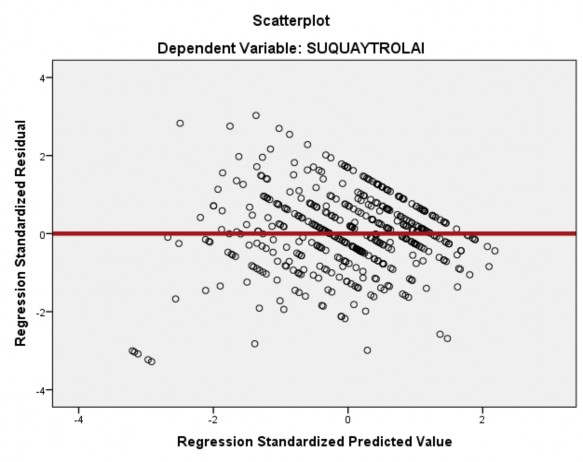
The correlation between the predicted values and the residuals suggests that there is a linear relationship between the two variables .
The violated property must be dispersed randomly.
and if the linearity assumption is satisfied ( true) then the remainder is in a region around the line passing through 0.
Figure 4.2 Scatter plot of residuals and predicted values of multiple regression model
The scatter plot between the residuals and the predicted values of the linear regression model (Figure 4.2) shows that the residual values are randomly scattered in a region around the line passing through the zero intercept , suggesting that the hypothesis
Linear contact is not violated.
* Check with Histogram chart
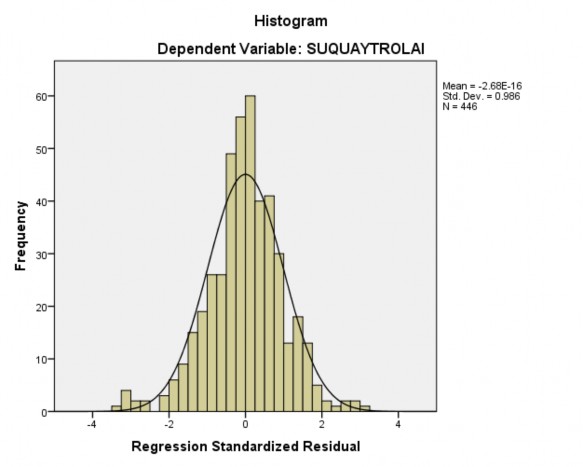
Figure 4.3: Frequency plot of standardized residuals
In the Histogram plot of the standardized residuals, it is shown that the distribution of the residuals is approximately normal ( with a mean of approximately 0 and a standard deviation of 0.995, approximately equal to 1). Therefore, it can be concluded that the assumption of normal distribution of the residuals
not violated
Chapter 4 Summary:
This chapter has introduced the research results obtained from the processing and analysis of the collected data. First, the data was screened, cleaned and coded before being processed. The sample description has helped us have an overview of the research sample by gender and income. Determining the Cronbach's Alpha coefficient and factor analysis has helped us confirm 12 factors from
in the scale component has reliability in measuring the influencing factors. Finally, the linear regression analysis conducted with the ordinary least squares method helped the author find the linear regression equation as well as the level of influence of the factors on the return of international tourists. The results of the regression analysis showed that there are 12 factors that have a strong influence on the return of international tourists: Political security, Accommodation facilities, Links with other provincial tourist attractions, Satisfaction of previous trips, Culture, Historical relics, Service staff attitude, Cuisine, Friendly locals, Shopping locations, Transportation, Environmental sanitation.
Chapter 5: CONCLUSION AND POLICY IMPLICATIONS
By using the SPSS software analysis tool, the author obtained the research results in chapter 4. Accordingly, the author has measured and evaluated the level of influence of factors on the return of international tourists in Ho Chi Minh City. In this chapter, based on the information selected from the analysis process and the results obtained, the author will discuss the application of the results of the topic into practice.
5.1 Summary of research results
The study assessed the impact of each factor on the return of international tourists to Ho Chi Minh City as follows:
Table 5.1: Impact level of each factor on the return of international tourists in Ho Chi Minh City
Element
Correlate | Level of impact | |
Security | favorable | Most impactful |
Accommodation | favorable | Second Impact |
Links to tourist attractions calendar | favorable | Third Impact |
Trip satisfaction before | favorable | 4th Impact |
Culture | favorable | 5th Impact |
Historical site | favorable | 6th Impact |
Service staff attitude | favorable | 7th Impact |
Cuisine | favorable | 8th Impact |
Local people friendly | favorable | Impact 9 |
Shopping Places | favorable | 10th Impact |
Traffic | favorable | 11th Impact |
Environmental sanitation | favorable | 12th Impact |
(Source: Synthesis from research results, 2017)
The research results met the research objectives.
Compared with the research results of some authors such as: Bo Hu (2003), Ho Huy Tuu and Tran Thi Ai Cam (2012), Vo Thi Cam Nga (2014), Luu Duc Thanh Hai and Nguyen Hong Giang (2011), Tran Thi Kim Thoa (2015), Pham To Thuc Han (2014), Phung Vu Bao Ngoc (2014) there are also similarities between the factors affecting tourist satisfaction. However, this study has added some factors: historical relics, shopping locations, links with other provincial tourist attractions, political security and culture affecting tourists, which is a difference from previous studies.
Regarding the scale system: The qualitative research results have built a scale including: The return of international tourists and its 12 components with 46 observed variables. The quantitative research results have adjusted a small part of the observed variables to be more complete but still keep the 46 observed variables. The research contributes to building a scale to measure the factors affecting the return of international tourists in Ho Chi Minh City.
Regarding the research model and research hypothesis: Based on the theoretical basis of the thesis, the initial research model proposed includes 12 components affecting return.
Results of data analysis
obtained
From 446 survey samples, the following results were obtained :
The results of Cronbach 's alpha analysis show that all observed variables and all
metamorphosis
set up
all guarantee reliability
In measurement , you can use the following steps :
next analysis
Exploratory factor analysis ( EFA ) showed that the scales measuring the concepts
The research concepts all meet the requirements of value, there is a distinction between the scales and the
each other and also achieve convergence between the observed variables in the same scale .
Results obtained
accept
12 initial hypotheses
out when establishing the model
proposed research model . According to previous domestic and foreign research documents, a number of factors affecting the return of tourists have been found, such as: cuisine - food hygiene and safety, environmental hygiene, accommodation facilities, service staff attitude, etc. The author 's research results have added a number of
Other factors such as culture, security, transportation, shopping locations, service staff attitude, etc. also have an important influence on the intention to return to travel of international tourists. In particular, the author found that political security is the factor that has the strongest impact on the return of international tourists to Ho Chi Minh City. This shows that international tourists are very concerned about their safety while traveling. After a long period of fierce war, Vietnam has now become one of the countries with a fairly good level of security. This makes tourists feel more secure when traveling here.
5.2 Some policy implications
5.2.1. Increase tourist satisfaction
Tourist satisfaction is measured by the quality and service of tourist attractions, the quality and service of accommodation facilities, the quality of cuisine and the attentive and thoughtful service at dining establishments.
If a destination creates satisfaction among tourists who have visited it, those tourists will spread positive word of mouth and be willing to recommend it to their relatives and friends. Therefore, it is necessary to maintain and increase tourist satisfaction so that they can become “tourism ambassadors” of Vietnam.
One of the ways to increase tourist satisfaction is to increase additional services. Lack of additional services does not lead to tourist dissatisfaction, but the presence of additional services increases customer satisfaction (Chase and Hayes, 1991).
5.2.2. Developing culinary and shopping in Ho Chi Minh City
Ho Chi Minh City is a place where cultural values intersect, especially culinary culture. Currently, the city's cuisine can be said to be diverse and colorful. In addition, there are many shortcomings in hygiene, and there are also problems related to prices and quality such as: prices are too high compared to the quality of the food, or the quality of the food is not the same as the restaurant/eatery's introduction, etc. There needs to be strict management from all levels of government and leadership. Restaurants/eateries should be required to clearly list prices to avoid "ripping off" tourists, especially international tourists.
Organizing culinary events in the area is increasingly diverse, larger in scale, better in quality, and focused on depth.
In addition, Ho Chi Minh City needs to effectively promote tourism combined with outstanding shopping events. Organize programs to stimulate purchases of Vietnamese goods.
5.2.3. Improving and enhancing the landscape environment of Ho Chi Minh City
It is necessary to promote sustainable tourism growth in Ho Chi Minh City, creating strong changes in the quality of tourism services and products on the basis of strengthening promotion and international cooperation.
In the coming time, Ho Chi Minh City needs to promote propaganda and raise awareness to protect the tourism environment, behave civilly and politely to build a good image of the destination and the city's people with international tourists. Specifically: propaganda to raise awareness of local people, vendors, tour guides, etc. about civilized and polite behavior.