
6. Q: Before 1990, did you fish in Yen stream or do any other work? Do you remember anything about those years? Please tell me.
A: Before tourism developed, I also often went fishing, not only in Yen stream but also in countless river mouths. I still remember that each time I went fishing, each catch of several dozen kilos was normal.
7. Q: How do you evaluate the government policies before 1990? Are they reasonable?
A: The government's policies before 1990 were generally outdated, also due to general social conditions. However, they basically failed to fully exploit the potential of Huong Son residents.
Maybe you are interested!
-
 Tourism Revenue of Yen Tu Area in the Last 5 Years
 -
 Applying MIKE 11 model to determine minimum flow on the main stream of Vu Gia - Thu Bon river and proposing maintenance solutions - 13
 -
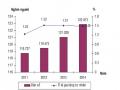 Divergence of Land Use Criteria in the Planning of Van Yen District in 2014 and Forecast for 2015 (Unit: %)
 -
 Growth of Caribbean Pine in Species Trial Model in Cao Bang and Yen Bai Provinces
 -
 Evaluating the effectiveness of agricultural and forestry farming models on limestone terrain in Yen Minh district, Ha Giang province as a basis for planning the district's agricultural and forestry development - 10
8. Q: Some people say that 1990 was the year that tourism industries developed, associated with the land reform policy - no more dividing public land but fixing public land, is that correct? Why?
A: That's right. The changes in Huong Son commune after 1990 were clear.

9. Q: How does your work change on weekdays and during the spring festival?
A: On normal days, my work is not very busy, mainly dealing with issues in the commune, administration and related to the commune. But during the spring festival, I am very busy. In addition to dealing with administrative matters, I also have to participate in management and protection work at relics, inspect and promptly handle issues for tourists.
10. Q: Where do tourists who come to Huong Pagoda mainly come from today?
A: Tourists mainly come from Hanoi, but they can also come from many neighboring provinces in the North. International visitors come from many other provinces and cities.
11. Q: The media has condemned the situation of a group of people here asking for money from passengers when taking the boat or acting as brokers to take customers to restaurants during the spring festival at the beginning of the road or selling wild animal meat... As a member of the management board, what do you think about the current phenomenon of such a group in your hometown?
A: The original residents here are poor, tourists who take the boat or give money gradually get used to it or ask for more, even before the management board organized the organization as it is today, there were still phenomena of competing for customers and fighting. The management board also tries to deal with such social evils but sometimes there are too many. Currently, the festival organizing board has hotlines every year and increases the number of commune police to patrol and handle.
timely those evils.
12. Q: Let me ask you: What do the communities here worship? What do they pray for the villagers?
A: Foresters often worship mountain gods on the mountain, worship Mother Goddesses on the altars, and during festivals and New Year ceremonies, they also worship objects that bless the agricultural industry. Nowadays, they often worship the God of Wealth at the door or in the house.
13. Q: In your opinion, which occupations are original or existed long before 1990?
A: According to him, the original occupation of Huong Son is wet rice farming, going to the forest to collect firewood, medicinal plants and forest products. Huong Son also has the occupation of growing Apricots and picking wild Sang vegetables. The occupation of growing mulberry and raising silkworms is also influenced by the land of "Ha Tay, the silk homeland", so it can also be considered the original occupation of the residents here.
14. Q: Let me ask you: What do the people of Huong Son do outside of the Spring Festival? Is their income guaranteed all year round?
A: In addition to the spring festival, people often return to their traditional occupations, and can also do transit businesses (for both tourists and local residents). Their income comes mainly from the spring festival, and many households do not have enough to eat, so they have to sell rice or borrow money at high interest rates.
Yes, thank you for helping me complete the interview!
IN-DEPTH INTERVIEW
IN HUONG SON COMMUNE, MY DUC DISTRICT, HANOI CITY
4.3.
Interviewee: LTN Gender: Female
Age: 41
Job title/job: Boatman, photographer, guide and farmer
Address: Ben Yen, Huong Son commune Interview date: February 2016
Questions and answers:
1. Q: Please tell me: What was your main job before 1990 and after 1990? What are you doing now?
A: Before, I worked as a boat rower. My family was poor so I had to row a boat to help my parents since I was little. When I grew up, I followed my mother to go fishing and work in the fields. When more tourists came here after 1990, I worked as a photographer, carried goods, and guided pilgrims and tourists.
2. Q: How many people are there in your family? What do the rest of you do?
A: My family has 4 people. 2 small children and my husband. One of the children is still young, but is not good at studying so he stays home to cook and sometimes goes to the forest to collect firewood for his mother. The older child and his father sometimes go fishing and work as a construction worker.
3. Q: If each person in the family has their own income, will that ensure daily living expenses?
A: During the spring festival, there is enough work. But there are times when it is not enough, because the management board now prohibits electric fishing in streams and river mouths, so sometimes we have to work at night, and the income is not stable.
4. Q: With such an unstable income, how do you ensure your family's life?
A: Sometimes the income is not enough, so I have to sell rice to eat. If it is not enough, I have to borrow money with interest and pay back the interest at the beginning of the year when I have money.
5. Q: How much money did your family spend to invest in a corrugated iron or iron boat to transport tourists like today?
A: To make a metal boat like this (Ms. N rowed the boat while looking up at the boat) costs about a few million dong .
6. Q: As I know, you have been rowing boats since you were little, so is there any difference between the boats before 1990 and now?
A: Previously, Huong Son used sampans, then used asphalt-coated coracles. Nowadays, corrugated iron or iron boats are still used to carry tourists, with larger capacity and can carry more passengers.
7. Q: Can you tell me: Did the government or local government provide any support to the people before 1990?
A: The state assigned fields to farmers to cultivate, dividing the fields according to the number of men in the family. After 1990, policies to encourage farming no longer existed.
8. Q: What crops did farmers grow to feed themselves and their families before the 1990s? What animals did they raise in their families, and how many animals did each family have?
A: In the past, besides growing rice, Huong Son people also grew cassava for food. They used cassava, sweet potatoes, figs, and cassava to get by. Animal husbandry was not developed before. It was considered that a wealthy family had chickens and pigs in their gardens, otherwise several families would raise one. The whole commune probably had a few dozen pigs, buffaloes, and cows at most.
9. Q: Can you tell me: Is the boat rowing profession different now compared to 1990?
A: The boat rowing profession today is much different from the past. In the past, Huong Son boats were asphalt-coated basket boats. Later, with more passengers, people stopped using those boats and instead used corrugated iron boats, which have a larger carrying capacity and are lighter.
10. Q: Sister, if the income of Huong Son residents is so good, can people from other localities or villages sell goods or do tourism here, or is it purely Huong Son residents? If it is only HS residents, who are they?
A: The village rules here are very strict, only native Huong Son residents are allowed to row boats and sell goods. If another villager comes to sell, if discovered, they can have their goods thrown away. Only people from Huong Son village, Yen Vy hamlet are allowed to trade here.
11. Q: Please tell us: How have the working tools and practices changed before and after the development of student tourism?
A: Before 1990, I sometimes went into the forest to collect Rau Sang and Cu Yai, and had to carry sacks into the forest to collect Rau Sang from high up. Wild Rau Sang is no longer available, so people have to grow it on the edge of the forest, in gardens or vacant lots. Plastic bags have now replaced the heavy sacks of the past.
Agriculture now has plows, threshers, seeders, and harvesters, so it's better than before.
12. Q: I would like to ask you, how can I go fishing in the current context of the management board banning fishing?
A: In the past, there were a lot of fish and the management board did not prohibit it, so residents could fish freely. However, now, to prevent the extinction and pollution of the Yen River, the management board prohibits fishing. So your husband has to fish at night and electric shock will have a higher capacity and be less laborious.
Yes, thank you for sharing!
IN-DEPTH INTERVIEW
IN HUONG SON COMMUNE, MY DUC DISTRICT, HANOI CITY
4.4.
Interviewee: NVH Gender: Male
Age: 61
Title/job: Ferry Management Board of Huong Son Commune Address: Yen Wharf, Huong Son Commune
Interview date: 2/2017
Questions and answers:
1. Q: Could you please tell me: What is your main job now?
A: I currently work in the ferry management board of Huong Son commune. I am usually in charge of arranging ferries for tourists. Managing ticket sales and collecting money from passengers. Calling ferrymen from households during times when there is a sudden increase in visitors.
2. Q: Besides your current main job, do you have any other jobs? Do other family members have any other jobs?
A: My family also makes wine to sell to restaurants to make plum wine. My wife raises livestock and does farming at home.
3. Q: How much was the income from those previous jobs?
A: I work in the ferry management board and earn a few hundred thousand a month. I sell alcohol and earn a few hundred a month. My wife raises livestock and does agriculture and earns a few dozen million a year after deducting all expenses.
4. Q: Is your and your family's income enough to ensure your family's life?
A: Basically, living frugally in the countryside is enough. The grown-up children are all studying and working in Hanoi. There are two grandparents, a small vegetable garden, and chickens, so life is basically enough for the children.
5. Q: Uncle, let me ask you: How were the cultural activities of the commune and the local community before 1990? Were you satisfied with life at that time?
A: The cultural life of the commune before was very difficult, not enough to eat. We often had to go into the forest to pick wild vegetables and roots to eat instead of rice to relieve hunger. Since tourism has developed, the material life has become better and better. Life before 1990 was so difficult, but the spiritual life was very good, there were many cultural and sports activities, the commune was very happy.
6. Q: Can you tell me a little about your social background, career, and family life before the 1990s?
A: Before 1990, tourism here was not developed, the villagers mainly lived by growing rice. There were forests so people could go into the forest to collect forest products, wild animals, and medicinal plants. The state allocated land to each household to cultivate. Life in general was backward, poor, and not enough to eat. The education of the residents was also limited. My family still had many jobs, but it was normal for many households to eat rice mixed with potatoes and cassava for the whole month.
7. Q: Did the state or local government provide any support to the people before 1990?
A: The state assigned land to the people to cultivate, dividing the land according to the number of men in the family. The later period was better, but after the August Revolution, the landlords also made demands on the people, and agricultural life became very difficult.
8. Q: How do you evaluate the government policies before 1990? Are they reasonable?
A: State policies before 1990 were generally outdated, also due to general social conditions.
9. Q: I would like to ask you: After tourism develops, or in other words, tourists coming to Huong Pagoda, will it bring any advantages or difficulties to the local people?
A: After 1990, when tourism had the conditions to develop, it made the countryside have many different professions to earn a living. Residents had more and higher incomes. Life was better. However, when social conditions improved, many social evils appeared that had never existed in Huong Son before, such as: pickpocketing, dressing inappropriately, gambling, lottery, drug addiction...
10. Q: Some people say that 1990 was the year that tourism industries developed, linked to the land reform policy - no more dividing public land but fixing public land, is that correct? Why?
A: That's right, my dear. Some policies to encourage the development of trade and tourism existed a few years before that, but the actual changes in Huong Son commune were not clear until 1990.
11. Q: Where do tourists who come to Huong Pagoda mainly come from today?
A: Tourists mainly come from Hanoi, but they can also come from many neighboring provinces in the North. International visitors come from many other provinces and cities.
12. Q: What measures can be taken to further develop tourism in Huong Son while preserving traditional culture?
A: There are many Huong Son caves that have not been exploited and put into tourism. There are some tourist routes besides Huong Son but they are not really attractive to tourists so tourists usually only go to Huong Son. There is still a lot of land for tourism development but it has not been invested in and upgraded.
13. Q: Sir, is the Sang vegetable growing profession today different from that of 1990?
A: Rau Sang used to grow on limestone mountains, but not anymore. Nowadays, most of the Rau Sang in Huong Pagoda is grown by the people. They grow it on the edge of the forest, in their home gardens or in their family's vacant land. Now, the people of Huong Son grow a lot of Rau Sang and on a large scale. Some families have large gardens of Rau Sang to sell to tourists and restaurants during the spring festival.
14. Q: I see some motorboats traveling on the river, why don't they use them to transport tourists?
A: Motorboats pollute the stream with oil when running. While rowing boats brings income to local people, tourists can enjoy the scenery on the stream, so rowing boats are conventionally used for traveling and transporting mainly on Yen stream for tourists. Some motorboats are used on the river but they are used by the relic management board and some shops to transport goods on the stream.
Yes, thank you for sharing!