
In work, one must be fair, impartial, objective, cultured, respectful and loving to people; have professional knowledge in the field assigned to manage; have knowledge of modern management science, have professional working methods; have knowledge of market economy; knowledge of economics, economic law, financial market. In leadership and management activities, one must know how to start from local reality, from economic and social life to have specific measures, avoiding dogma and books.
In terms of organizational and management skills, a person with courage, flexibility, and the ability to observe and grasp tasks from the general to the details to organize the system to operate synchronously and effectively. Calm, self-controlled but decisive and resolute in work, having a clear work plan and carrying out work consistently according to the plan. Dynamic, creative, resourceful, quick to react, daring to think, daring to do, daring to take responsibility, always knowing how to anticipate all possible situations, knowing how to focus resources on weak links, knowing how to take advantage of opportunities that are beneficial to the system. Having the right style, sympathizing and understanding subordinates, having a sincere attitude, and at the same time knowing how to build a united, cooperative, and mutually supportive collective. Knowing how to use and evaluate the right people for the right jobs; knowing how to handle relationships well inside and outside the system, with subordinates and with superiors.
Thanks to the clearly defined conditions and standards, Party committees and authorities at all levels clearly distinguish between conditions and standards for cadres. Conditions are necessary factors, mandatory factors for each cadre and standards include broader and more complete content, which is a measure of the quality of cadres. Overcoming the situation of using necessary conditions of cadres such as degrees, titles, age, work history, etc., to replace standards such as moral qualities, knowledge, work capacity, etc. Specific conditions and standards for each key position of cadres at the grassroots level are the basis for Party committees and authorities at all levels to evaluate, select, arrange, and use cadres.
Maybe you are interested!
-
 Managing political theory training activities for key grassroots cadres in Tuyen Quang City Party Committee, Tuyen Quang Province according to human resource development orientation - 2
 -
 Solutions for tourism development in Tien Lang - 10
zt2i3t4l5ee
zt2a3gstourism, tourism development
zt2a3ge
zc2o3n4t5e6n7ts
- District People's Committees and authorities of communes with tourist attractions should support, promote, and provide necessary information to people, helping them improve their knowledge about tourism. Raise tourism awareness for local people.
*
* *
Due to limited knowledge and research time, the thesis inevitably has shortcomings. Therefore, I look forward to receiving guidance from teachers, experts as well as your comments to make the thesis more complete.
Chapter III Conclusion
Through the issues presented in Chapter II, we can come to some conclusions:
Based on the strengths of available tourism resources, the types of tourism in Tien Lang that need to be promoted in the coming time are sightseeing and resort tourism, discovery tourism, weekend tourism. To improve the quality and diversify tourism products, Tien Lang district needs to combine with local cultural tourism resources, at the same time combine with surrounding areas, build rich tourism products. The strengths of Tien Lang tourism are eco-tourism and cultural tourism, so developing Tien Lang tourism must always go hand in hand with restoring and preserving types of cultural tourism resources. Some necessary measures to support and improve the efficiency of exploiting tourism resources in Tien Lang are: strengthening the construction of technical facilities and labor force serving tourism, actively promoting and advertising tourism, and expanding forms of capital mobilization for tourism development.
CONCLUDE
I Conclusion
1. Based on the results achieved within the framework of the thesis's needs, some basic conclusions can be drawn as follows:
Tien Lang is a locality with great potential for tourism development. The relatively abundant cultural tourism resources and ecological tourism resources have great appeal to tourists. Based on this potential, Tien Lang can build a unique tourism industry that is competitive enough with other localities within Hai Phong city and neighboring areas.
In recent years, the exploitation of the advantages of resources to develop tourism and build tourist routes in Tien Lang has not been commensurate with the available potential. In terms of quantity, many resource objects have not been brought into the purpose of tourism development. In terms of time, the regular service time has not been extended to attract more visitors. Infrastructure and technical facilities are still weak. The labor force is still thin and weak in terms of expertise. Tourism programs and routes have not been organized properly, the exploitation content is still monotonous, so it has not attracted many visitors. Although resources have not been mobilized much for tourism development, they are facing the risk of destruction and degradation.
2. Based on the results of investigation, analysis, synthesis, evaluation and selective absorption of research results of related topics, the thesis has proposed a number of necessary solutions to improve the efficiency of exploiting tourism resources in Tien Lang such as: promoting the restoration and conservation of tourism resources, focusing on investment and key exploitation of ecotourism resources, strengthening the construction of infrastructure and tourism workforce. Expanding forms of capital mobilization. In addition, the thesis has built a number of tourist routes of Hai Phong in which Tien Lang tourism resources play an important role.
Exploiting Tien Lang tourism resources for tourism development is currently facing many difficulties. The above measures, if applied synchronously, will likely bring new prospects for the local tourism industry, contributing to making Tien Lang tourism an important economic sector in the district's economic structure.
REFERENCES
1. Nhuan Ha, Trinh Minh Hien, Tran Phuong, Hai Phong - Historical and cultural relics, Hai Phong Publishing House, 1993
2. Hai Phong City History Council, Hai Phong Gazetteer, Hai Phong Publishing House, 1990.
3. Hai Phong City History Council, History of Tien Lang District Party Committee, Hai Phong Publishing House, 1990.
4. Hai Phong City History Council, University of Social Sciences and Humanities, VNU, Hai Phong Place Names Encyclopedia, Hai Phong Publishing House. 2001.
5. Law on Cultural Heritage and documents guiding its implementation, National Political Publishing House, Hanoi, 2003.
6. Tran Duc Thanh, Lecture on Tourism Geography, Faculty of Tourism, University of Social Sciences and Humanities, VNU, 2006
7. Hai Phong Center for Social Sciences and Humanities, Some typical cultural heritages of Hai Phong, Hai Phong Publishing House, 2001
8. Nguyen Ngoc Thao (editor-in-chief, Tourism Geography, Hai Phong Publishing House, two volumes (2001-2002)
9. Nguyen Minh Tue and group of authors, Hai Phong Tourism Geography, Ho Chi Minh City Publishing House, 1997.
10. Nguyen Thanh Son, Hai Phong Tourism Territory Organization, Associate Doctoral Thesis in Geological Geography, Hanoi, 1996.
11. Decision No. 2033/QD – UB on detailed planning of Tien Lang town, Hai Phong city until 2020.
12. Department of Culture, Information, Hai Phong Museum, Hai Phong relics
- National ranked scenic spot, Hai Phong Publishing House, 2005. 13. Tien Lang District People's Committee, Economic Development Planning -
Culture - Society of Tien Lang district to 2010.
14.Website www.HaiPhong.gov.vn
APPENDIX 1
List of national ranked monuments
STT
Name of the monument
Number, year of decisiondetermine
Location
1
Gam Temple
938 VH/QĐ04/08/1992
Cam Khe Village- Toan Thang commune
2
Doc Hau Temple
9381 VH/QĐ04/08/1992
Doc Hau Village –Toan Thang commune
3
Cuu Doi Communal House
3207 VH/QĐDecember 30, 1991
Zone II of townTien Lang
4
Ha Dai Temple
938 VH/QĐ04/08/1992
Ha Dai Village –Tien Thanh commune
APPENDIX II
STT
Name of the monument
Number, year of decision
Location
1
Phu Ke Pagoda Temple
178/QD-UBJanuary 28, 2005
Zone 1 - townTien Lang
2
Trung Lang Temple
178/QD-UBJanuary 28, 2005
Zone 4 – townTien Lang
3
Bao Khanh Pagoda
1900/QD-UBAugust 24, 2006
Nam Tu Village -Kien Thiet commune
4
Bach Da Pagoda
1792/QD-UB11/11/2002
Hung Thang Commune
5
Ngoc Dong Temple
177/QD-UBNovember 27, 2005
Tien Thanh Commune
6
Tomb of Minister TSNhu Van Lan
2848/QD-UBSeptember 19, 2003
Nam Tu Village -Kien Thiet commune
7
Canh Son Stone Temple
2160/QD-UBSeptember 19, 2003
Van Doi Commune –Doan Lap
8
Meiji Temple
2259/QD-UBSeptember 19, 2002
Toan Thang Commune
9
Tien Doi Noi Temple
477/QD-UBSeptember 19, 2005
Doan Lap Commune
10
Tu Doi Temple
177/QD-UBJanuary 28, 2005
Doan Lap Commune
11
Duyen Lao Temple
177/QD-UBJanuary 28, 2005
Tien Minh Commune
12
Dinh Xuan Uc Pagoda
177/QD-UBJanuary 28, 2005
Bac Hung Commune
13
Chu Khe Pagoda
177/QD-UBJanuary 28, 2005
Hung Thang Commune
14
Dong Dinh
2848/QD-UBNovember 21, 2002
Vinh Quang Commune
15
President's Memorial HouseTon Duc Thang
177/QD-UBJanuary 28, 2005
NT Quy Cao
Ha Dai Temple
Ben Vua Temple
Tien Lang hot spring
div.maincontent .p { color: black; font-family:"Times New Roman", serif; font-style: normal; font-weight: normal; text-decoration: none; font-size: 14pt; margin:0pt; } div.maincontent p { color: black; font-family:"Times New Roman", serif; font-style: normal; font-weight: normal; text-decoration: none; font-size: 14pt; margin:0pt; } div.maincontent .s1 { color: black; font-family:"Times New Roman", serif; font-style: normal; font-weight: normal; font-size: 16pt; } div.maincontent .s2 { color: black; font-family:"Times New Roman", serif; font-style: italic; font-weight: bold; text-decoration: none; font-size: 14pt; } div.maincontent .s3 { color: black; font-family:"Times New Roman", serif; font-style: italic; font-weight: normal; text-decoration: none; font-size: 14pt; } div.maincontent .s4 { color: black; font-family:"Times New Roman", serif; font-style: normal; font-weight: normal; font-size: 14pt; } div.maincontent .s5 { color: black; font-family:"Times New Roman", serif; font-style: normal; font-weight: bold; font-size: 14pt; } div.maincontent .s6 { color: black; font-family:"Times New Roman", serif; font-style: normal; font-weight: normal; text-decoration: none; font-size: 14pt; } div.maincontent .s7 { color: black; font-family:"Times New Roman", serif; font-style: normal; font-weight: bold; text-decoration: none; font-size: 14pt; } div.maincontent .s8 { color: black; font-family:"Times New Roman", serif; font-style: normal; font-weight: normal; text-decoration: none; font-size: 9pt; vertical-align: 6pt; } div.maincontent .s9 { color: black; font-family:"Times New Roman", serif; font-style: normal; font-weight: bold; text-decoration: none; font-size: 12pt; } div.maincontent .s11 { color: black; font-family:"Times New Roman", serif; font-style: normal; font-weight: normal; tex
Solutions for tourism development in Tien Lang - 10
zt2i3t4l5ee
zt2a3gstourism, tourism development
zt2a3ge
zc2o3n4t5e6n7ts
- District People's Committees and authorities of communes with tourist attractions should support, promote, and provide necessary information to people, helping them improve their knowledge about tourism. Raise tourism awareness for local people.
*
* *
Due to limited knowledge and research time, the thesis inevitably has shortcomings. Therefore, I look forward to receiving guidance from teachers, experts as well as your comments to make the thesis more complete.
Chapter III Conclusion
Through the issues presented in Chapter II, we can come to some conclusions:
Based on the strengths of available tourism resources, the types of tourism in Tien Lang that need to be promoted in the coming time are sightseeing and resort tourism, discovery tourism, weekend tourism. To improve the quality and diversify tourism products, Tien Lang district needs to combine with local cultural tourism resources, at the same time combine with surrounding areas, build rich tourism products. The strengths of Tien Lang tourism are eco-tourism and cultural tourism, so developing Tien Lang tourism must always go hand in hand with restoring and preserving types of cultural tourism resources. Some necessary measures to support and improve the efficiency of exploiting tourism resources in Tien Lang are: strengthening the construction of technical facilities and labor force serving tourism, actively promoting and advertising tourism, and expanding forms of capital mobilization for tourism development.
CONCLUDE
I Conclusion
1. Based on the results achieved within the framework of the thesis's needs, some basic conclusions can be drawn as follows:
Tien Lang is a locality with great potential for tourism development. The relatively abundant cultural tourism resources and ecological tourism resources have great appeal to tourists. Based on this potential, Tien Lang can build a unique tourism industry that is competitive enough with other localities within Hai Phong city and neighboring areas.
In recent years, the exploitation of the advantages of resources to develop tourism and build tourist routes in Tien Lang has not been commensurate with the available potential. In terms of quantity, many resource objects have not been brought into the purpose of tourism development. In terms of time, the regular service time has not been extended to attract more visitors. Infrastructure and technical facilities are still weak. The labor force is still thin and weak in terms of expertise. Tourism programs and routes have not been organized properly, the exploitation content is still monotonous, so it has not attracted many visitors. Although resources have not been mobilized much for tourism development, they are facing the risk of destruction and degradation.
2. Based on the results of investigation, analysis, synthesis, evaluation and selective absorption of research results of related topics, the thesis has proposed a number of necessary solutions to improve the efficiency of exploiting tourism resources in Tien Lang such as: promoting the restoration and conservation of tourism resources, focusing on investment and key exploitation of ecotourism resources, strengthening the construction of infrastructure and tourism workforce. Expanding forms of capital mobilization. In addition, the thesis has built a number of tourist routes of Hai Phong in which Tien Lang tourism resources play an important role.
Exploiting Tien Lang tourism resources for tourism development is currently facing many difficulties. The above measures, if applied synchronously, will likely bring new prospects for the local tourism industry, contributing to making Tien Lang tourism an important economic sector in the district's economic structure.
REFERENCES
1. Nhuan Ha, Trinh Minh Hien, Tran Phuong, Hai Phong - Historical and cultural relics, Hai Phong Publishing House, 1993
2. Hai Phong City History Council, Hai Phong Gazetteer, Hai Phong Publishing House, 1990.
3. Hai Phong City History Council, History of Tien Lang District Party Committee, Hai Phong Publishing House, 1990.
4. Hai Phong City History Council, University of Social Sciences and Humanities, VNU, Hai Phong Place Names Encyclopedia, Hai Phong Publishing House. 2001.
5. Law on Cultural Heritage and documents guiding its implementation, National Political Publishing House, Hanoi, 2003.
6. Tran Duc Thanh, Lecture on Tourism Geography, Faculty of Tourism, University of Social Sciences and Humanities, VNU, 2006
7. Hai Phong Center for Social Sciences and Humanities, Some typical cultural heritages of Hai Phong, Hai Phong Publishing House, 2001
8. Nguyen Ngoc Thao (editor-in-chief, Tourism Geography, Hai Phong Publishing House, two volumes (2001-2002)
9. Nguyen Minh Tue and group of authors, Hai Phong Tourism Geography, Ho Chi Minh City Publishing House, 1997.
10. Nguyen Thanh Son, Hai Phong Tourism Territory Organization, Associate Doctoral Thesis in Geological Geography, Hanoi, 1996.
11. Decision No. 2033/QD – UB on detailed planning of Tien Lang town, Hai Phong city until 2020.
12. Department of Culture, Information, Hai Phong Museum, Hai Phong relics
- National ranked scenic spot, Hai Phong Publishing House, 2005. 13. Tien Lang District People's Committee, Economic Development Planning -
Culture - Society of Tien Lang district to 2010.
14.Website www.HaiPhong.gov.vn
APPENDIX 1
List of national ranked monuments
STT
Name of the monument
Number, year of decisiondetermine
Location
1
Gam Temple
938 VH/QĐ04/08/1992
Cam Khe Village- Toan Thang commune
2
Doc Hau Temple
9381 VH/QĐ04/08/1992
Doc Hau Village –Toan Thang commune
3
Cuu Doi Communal House
3207 VH/QĐDecember 30, 1991
Zone II of townTien Lang
4
Ha Dai Temple
938 VH/QĐ04/08/1992
Ha Dai Village –Tien Thanh commune
APPENDIX II
STT
Name of the monument
Number, year of decision
Location
1
Phu Ke Pagoda Temple
178/QD-UBJanuary 28, 2005
Zone 1 - townTien Lang
2
Trung Lang Temple
178/QD-UBJanuary 28, 2005
Zone 4 – townTien Lang
3
Bao Khanh Pagoda
1900/QD-UBAugust 24, 2006
Nam Tu Village -Kien Thiet commune
4
Bach Da Pagoda
1792/QD-UB11/11/2002
Hung Thang Commune
5
Ngoc Dong Temple
177/QD-UBNovember 27, 2005
Tien Thanh Commune
6
Tomb of Minister TSNhu Van Lan
2848/QD-UBSeptember 19, 2003
Nam Tu Village -Kien Thiet commune
7
Canh Son Stone Temple
2160/QD-UBSeptember 19, 2003
Van Doi Commune –Doan Lap
8
Meiji Temple
2259/QD-UBSeptember 19, 2002
Toan Thang Commune
9
Tien Doi Noi Temple
477/QD-UBSeptember 19, 2005
Doan Lap Commune
10
Tu Doi Temple
177/QD-UBJanuary 28, 2005
Doan Lap Commune
11
Duyen Lao Temple
177/QD-UBJanuary 28, 2005
Tien Minh Commune
12
Dinh Xuan Uc Pagoda
177/QD-UBJanuary 28, 2005
Bac Hung Commune
13
Chu Khe Pagoda
177/QD-UBJanuary 28, 2005
Hung Thang Commune
14
Dong Dinh
2848/QD-UBNovember 21, 2002
Vinh Quang Commune
15
President's Memorial HouseTon Duc Thang
177/QD-UBJanuary 28, 2005
NT Quy Cao
Ha Dai Temple
Ben Vua Temple
Tien Lang hot spring
div.maincontent .p { color: black; font-family:"Times New Roman", serif; font-style: normal; font-weight: normal; text-decoration: none; font-size: 14pt; margin:0pt; } div.maincontent p { color: black; font-family:"Times New Roman", serif; font-style: normal; font-weight: normal; text-decoration: none; font-size: 14pt; margin:0pt; } div.maincontent .s1 { color: black; font-family:"Times New Roman", serif; font-style: normal; font-weight: normal; font-size: 16pt; } div.maincontent .s2 { color: black; font-family:"Times New Roman", serif; font-style: italic; font-weight: bold; text-decoration: none; font-size: 14pt; } div.maincontent .s3 { color: black; font-family:"Times New Roman", serif; font-style: italic; font-weight: normal; text-decoration: none; font-size: 14pt; } div.maincontent .s4 { color: black; font-family:"Times New Roman", serif; font-style: normal; font-weight: normal; font-size: 14pt; } div.maincontent .s5 { color: black; font-family:"Times New Roman", serif; font-style: normal; font-weight: bold; font-size: 14pt; } div.maincontent .s6 { color: black; font-family:"Times New Roman", serif; font-style: normal; font-weight: normal; text-decoration: none; font-size: 14pt; } div.maincontent .s7 { color: black; font-family:"Times New Roman", serif; font-style: normal; font-weight: bold; text-decoration: none; font-size: 14pt; } div.maincontent .s8 { color: black; font-family:"Times New Roman", serif; font-style: normal; font-weight: normal; text-decoration: none; font-size: 9pt; vertical-align: 6pt; } div.maincontent .s9 { color: black; font-family:"Times New Roman", serif; font-style: normal; font-weight: bold; text-decoration: none; font-size: 12pt; } div.maincontent .s11 { color: black; font-family:"Times New Roman", serif; font-style: normal; font-weight: normal; tex -
 Key Solutions to Strengthen the Leadership of Hai Phong City Party Committee in Security and Order Work by 2030
 -
 Binh Duong Provincial Party Committee leads the building of key grassroots cadres from 1997 to 2015 - 21
 -
 Complete Solution for Human Resource Training at the Ethnic Committee
Correct and accurate training is the basis for planning, developing training plans, implementing policies and regimes for cadres and is the criterion for each cadre to strive, study, practice, and improve themselves. It is the basis for cadres and party members to supervise cadre work.
Second , conduct staff assessment closely linked to planning for key staff positions at the grassroots level.
In Resolution No. 42/NQ-TU dated October 10, 1997 on personnel work until 2005 , Binh Duong Provincial Party Committee requires: evaluation of cadres must be based on standards, work efficiency, ensuring objectivity and taking cadre standards, work efficiency as a measure for evaluating and selecting cadres. At the same time, there must be a plan, inspection and evaluation of reserve cadres to promptly adjust and supplement the planning accordingly and when arranging cadres, it must be based on standards and results of cadre evaluation. At the same time, the Provincial Party Committee issues plans on cadre evaluation, departments, branches and sectors issue guidelines on review, self-criticism and criticism of Party committees, Party organizations and leaders and managers at all levels in conjunction with annual and end-of-term work review and cadre evaluation.
The Binh Duong Provincial Party Committee has determined that cadre assessment is the first very important step to create a solid foundation for planning, developing plans for training and fostering cadres. Implementing the policies and directions of the Provincial Party Committee, the competent authorities have issued many documents for the grassroots level to carry out cadre assessment, annually and for term, such as: Instruction No. 86-HDLN/BTCTU-SNV dated November 1, 2003 on cadre assessment ; Instruction No. 01-HDLN/BTCTU-SNV dated November 1, 2010 on annual assessment and classification of cadres and civil servants . Therefore, the assessment of cadres has had positive changes, with an impartial, objective, comprehensive, historical, specific, substantive, democratic attitude in the assessment, based on the viewpoint of common and local interests.
Correctly evaluating cadres has had a strong effect in motivating grassroots cadres to constantly strive to improve and accurately evaluate results.
The work of cadres is the basis for selecting, arranging, assigning, promoting, using according to their capacity and strengths, developing plans, being proactive in training, fostering, practicing and appointing cadres. At the same time, cadre assessment activities have provided feedback information so that cadres know clearly about their current capacity and work performance, helping them strive to improve themselves and complete assigned tasks well. On the basis of cadre assessment, Party committees carry out planning, develop training plans, foster, arrange, mobilize, rotate cadres, prepare the next cadre team and personnel for the congress and election of People's Councils, People's Committees at the grassroots level, gradually appoint and introduce personnel for election according to the plan, gradually overcoming the situation of formal cadre planning.
The issuance of many directive documents on the work of evaluating and planning cadres has shown that the Party Committee of Binh Duong province always closely links the work of evaluating cadres with the work of building plans for leaders and managers. Due to the attention of synchronous leadership and direction, closely linking the stages of evaluating and planning cadres, the team of key cadres at the grassroots level has gradually ensured structure, continuity, inheritance, and overcome the shortage to meet the development requirements at the grassroots level of communes, wards, and towns.
Third , clearly define the authority and responsibility of all levels and sectors in building a team of key grassroots cadres.
In the process of leading the development of key grassroots cadres, the Binh Duong Provincial Party Committee realized that in order to improve the quality of key grassroots cadres, it is necessary to promote decentralization of cadre management, to clearly define the responsibilities, powers, and relationships between Party and State agencies, between superiors and subordinates, between sectors and localities. The Binh Duong Provincial Party Committee determined that promoting decentralization is a breakthrough in improving the quality of grassroots cadres, promoting administrative reform and improving operational efficiency.
In order to promote the development of the administrative system, the Provincial Party Committee issued Decision No. 528-QD/TU dated April 29, 2003, agreeing on the policy of strong decentralization and delegation of power to departments, branches and localities according to the principle of " delegation of power associated with responsibility ". On that basis, the Provincial People's Committee issued Decision No. 50/2014/QD-UBND on decentralization of management for civil servants and public employees of communes, wards and towns in Binh Duong province . District Party Committees, Town Party Committees and City Party Committees issued decisions on decentralization of cadre management, such as Decision No. 181-QD/HU dated October 20, 2014 of the Bac Tan Uyen District Party Committee, Regulations on decentralization of cadre management. This is a new development step, aiming to promote the capacity of the grassroots and the Chairman of the District People's Committee.
Decentralization of personnel management has strengthened the role and responsibility of the People's Committees of districts, towns and cities, ensuring close coordination between sectoral management and local management on the basis of clearly defining the state management tasks of departments, sectors, districts, towns and cities according to the principle that the task of whichever level performs better will be assigned to that level to perform. The promotion of decentralization has created synchronization and consistency in personnel planning, development and management, in accordance with the characteristics and requirements of urban and rural government management. More importantly, decentralization has achieved the goal of reducing the levels in processing procedures, aiming to reform administrative stages in personnel work.
Implementing decentralization and delegation of authority in cadre management at the grassroots level to departments, branches, districts, towns, cities and grassroots levels has helped the grassroots level quickly rearrange human resources, improve the level of state management to ensure the implementation of tasks. At the same time, regularly evaluate the quality of activities after decentralization of cadre management, determine the role, management capacity as well as individual responsibilities of agencies and localities. In organizing implementation, the participation, monitoring and supervision of many organizations and components in society have been mobilized to evaluate the effectiveness and efficiency of decentralization of management and serve the
Research, adjust and amend regulations to improve the quality of key staff at the grassroots level.
4.1.1.2. On results achieved in practice
Firstly, the work of training, fostering and creating a source of key cadres at the grassroots level receives special attention.
In order to promote all potentials and strengths of the province to contribute to promoting the industrialization and modernization of the locality, the Party Committee of Binh Duong province is well aware of the importance of training and fostering work, which is both an immediate requirement and a long-term task . Therefore, the Provincial Party Committee, the People's Council, and the Provincial People's Committee have issued many programs, projects, and plans related to training and fostering of key cadres at the grassroots level. As the industrialization and modernization of Binh Duong province has increasingly developed comprehensively, in terms of scale, nature, and depth, the People's Committee of Binh Duong province has issued regulations on training and fostering work, in which, it determines the conditions, authority, and procedures for sending for training and fostering, closely linking cadre standards with planning and requiring planned cadres to undergo training and fostering to meet the standards, within the prescribed time.
The relationship in training and fostering between localities and training institutions has been strengthened; the coordination in organizing and managing cadres during the study period has become increasingly close; regularly monitoring and grasping the learning situation of cadres and promptly exchanging and coordinating with training institutions to resolve difficulties and problems arising in the coordination work. Local Party committees have paid more attention to training and fostering cadres; increased the sending of cadres to participate in training programs at training institutions located in the province; created favorable conditions to support cadres to complete their qualifications according to common standards; encouraged and motivated cadres to study for postgraduate qualifications.
With close direction and requirements on time to meet standards, each cadre has determined to study to improve their political theory level.
Professionalism is a political task, and at the same time, it is a criterion for evaluating cadres. Therefore, cadres sent to study are all self-aware and comply with the rules and regulations of the training institution. Cadres are trained and educated on the right subjects, and the cadre training and education program is gradually improved to suit reality. After training, the team of key cadres have political will, professional qualifications, and political theory levels that meet the standardization requirements according to the regulations of the Central and Provincial Party Committees. The training content has shifted, from mainly focusing on political theory, heavy on theory, academic knowledge to updating new knowledge on state management, professional expertise and skills according to job positions.
The work of creating a source of key cadres at the grassroots level is carried out from three main sources: (1) From students and graduates of public universities and postgraduates who participate in selection and training to become a source of key cadres; (2) Source of cadres currently working in the locality, those with sufficient capacity and qualifications are planned and sent for training and development; (3) Source from excellent students in the province. From 1998 to 2015, Binh Duong Provincial Party Committee opened 7 classes to create a source of key cadres at the grassroots level, training 727 students.
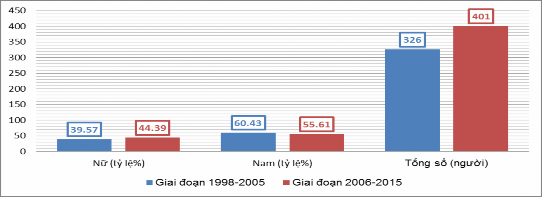
Chart 4.1: Number of people participating in creating key grassroots cadres in Binh Duong province in the period 1998-2005 and 2005-2015
Source : [133], [134], [135].
Through training and development, the quality and capacity of key staff at the grassroots level are improved to meet the requirements of the task.
The results of training and fostering have contributed to building a team of key grassroots cadres who basically meet the standards prescribed by the Government, ensuring sufficient quantity and quality to meet the operational requirements of the political system at the grassroots level.
Second, the quality of cadres included in the planning of key positions at the grassroots level is increasingly high.
When developing the cadre planning, special attention was paid to both conditions and standards. The cadres included in the planning must be people with strong political will, morals and a clean lifestyle, the ability to unite and gather cadres, and the capacity to organize and implement. Attention was paid to discovering, selecting and creating planning sources from young cadres, with basic training, with development prospects, those who come from workers, farmers, and children of families with revolutionary traditions. The proportion of female cadres included in the planning in many districts and towns is higher than the requirements of the Provincial Party Committee, such as: Ben Cat District, Bac Tan Uyen District, Thu Dau Mot City, Thuan An Town. The level of professional expertise, political theory, state management, foreign languages, and information technology of the cadre team included in the planning for the next term is higher than the previous term. The age structure has changed in an increasingly positive direction, the average age of staff is gradually lower than the previous term ( Appendix 7, 8 ).
In the early years of re-establishing the province, the team of key grassroots cadres and cadre work still had many limitations. After 18 years, the quality of cadres included in the planning of key positions at the grassroots level in the Binh Duong Provincial Party Committee by 2015 was equal to that of Dong Nai Province and Ho Chi Minh City. In which, there were aspects that were higher than that of the Dong Nai Provincial Party Committee, such as: The percentage of female cadres planned to hold the position of Party Secretary at the commune level in Binh Duong was 23%, Dong Nai was 18.50%; the position of Deputy Secretary of the grassroots Party Committee in Binh Duong was 29.7%, Dong Nai was 26.4%. Post-graduate qualifications for
The rate of Party Secretary at the commune level in Binh Duong is 5.5% and in Dong Nai is 1.02%; the rate of Deputy Party Secretary with advanced political theory qualifications in Binh Duong is 28.6% and in Ho Chi Minh City is 25.8% ( Appendix 13 ).
Third, the work of arranging and using cadres is given special attention.
The Party Committee and the government always pay attention to linking training and fostering with the use of cadres. Of the 727 people who attended the class to create key cadres at the grassroots level, by 2015, 16 comrades were elected to hold the positions of Secretary, Chairman of the People's Council, and People's Committee at the commune level; 31 comrades held the positions of Vice Chairman of the People's Council, and People's Committee at the commune level; 55 people were assigned to work in district-level departments and offices; 18 people worked in provincial-level departments, offices, and branches, with 01 comrade being elected to hold the position of Vice Chairman of the District People's Council for the term (2011-2016); 69 cases were included in the planning of commune, ward, and town Party Committees. All students upon graduation were assigned to work for testing and evaluation as a basis for placement.
In the arrangement and use of cadres, the Party Committee of Binh Duong province always focuses on the inheritance principle, focusing on promoting young and female cadres. Combining the arrangement and use of on-site cadres with increasing cadre rotation. At the same time, in order to improve the quality of management, reduce the number of focal points and solve the problem of the shortage of key cadres at the grassroots level in some localities that need highly qualified and capable cadres, the Party Committee of Binh Duong province has proactively implemented a pilot model of Party Secretary concurrently serving as Chairman of the People's Committee of communes, wards and towns. The selected grassroots localities are those with large populations, with growth rates and economic restructuring towards industry and services as the basis, in addition to choosing localities with strengths in developing high-tech agriculture.
In 2015, in 06 communes, wards and towns of Binh Duong province, the model of Party Committee Secretary concurrently being Chairman of the People's Committee was implemented, 58 Party Committee Secretaries concurrently being Chairman of the People's Council, 21 Deputy Party Committee Secretaries concurrently being Chairman of the People's Committee was implemented.