
- VA Xukhomlinsky, VP Xtrezicondin, Jaxapob studied and proposed a number of management issues of the Principal of a general school such as the assignment of tasks of the Principal and Vice Principal, and VAXukhominsky especially valued the exchange between the Principal and Vice Principal to find the best way of management. According to the authors, these exchanges were like a lever, giving rise to plans that were later developed in the management work in the creative work of the pedagogical collective.
Author VA Xukhomlinsky also pointed out the importance of organizing lesson observation and pedagogical analysis of lessons. He pointed out the weak state of lesson analysis even though lesson observation and feedback to teachers after the observation by managers took place regularly. From there, he proposed many ways to analyze lesson pedagogy for teachers.
In the world today, there are countries such as the Federal Republic of Germany; the Netherlands... that tend to integrate subjects in the field of social sciences such as History, Geography, Civic Education... to create new subjects, with the form of interdisciplinary integration and cross-disciplinary integration. The second trend is to implement the integration perspective but not create new subjects. The interdisciplinary teaching method aims at the following goals: mastering scientific knowledge content, understanding the scientific process and practicing scientific process skills such as: observing, collecting information, data; processing (comparing, arranging, classifying, relating... information); reasoning, applying in practice. Promoting the positivity, initiative, creativity and application of knowledge and skills of learners; overcoming the one-way imposition of transmission and mechanical memorization.
Thus, it can be seen that many authors in the world have been very interested in researching teaching activities and managing interdisciplinary teaching activities to find effective management measures to improve the quality of education.
1.1.2. In Vietnam
Maybe you are interested!
-
 Managing English teaching activities at Hong Hai secondary school, Ha Long city according to the competency development approach - 1
 -
 Managing experiential activities of students at Nam Son Secondary School, Bac Ninh City according to the orientation of the new general education program - 2
 -
 Managing sex education activities for students at Nong Trang secondary school, Viet Tri city, Phu Tho province in the current context - 19
 -
 Theoretical Basis of Managing Experiential Activities for Secondary School Students According to the New General Education Program.
 -
 Managing Teaching Activities According to the Competency Approach for Primary School Students
Right from the first years of its establishment, our country has paid great attention to the issue of education, especially the issue of teaching. In 1945, Uncle Ho issued a directive:
“Education at school has a great influence on the future of youth and youth are the future of our country. Therefore, we must teach students to love their country and their people, (...), we must teach them to have the will to be independent and self-reliant, determined not to be inferior to anyone, determined not to be slaves” [quoted from 13, p. 25] .
The above thought of Uncle Ho suggests some issues for the subject of teaching management: teaching management must be closely linked to social institutions, teaching discipline, teacher qualifications, self-study capacity, independent thinking spirit and creativity of learners.
Our Party and State consider education as the "top national policy", this has been legalized in the Law on Education: "Developing education is the top national policy to improve people's knowledge, train human resources, and foster talents" [27, p.3].
Socio-economic development in the context of globalization poses new demands on workers, thus also posing new demands for the education of the young generation and human resource training. Faced with the task of innovation in Education and Training in general and innovation in content and teaching methods in particular. One of the basic orientations of educational innovation is to shift from an academic, scholastic education that is far from reality to an education that focuses on forming the capacity to act, promoting the initiative and creativity of learners.
As part of the roadmap for synchronous innovation of teaching methods, testing and assessment in general schools towards developing students' capacity in the spirit of Resolution 29-NQ/TU on fundamental and comprehensive innovation of education and training, after the National Assembly approved the Project on innovation of general education programs and textbooks, the Ministry of Education and Training continued to direct educational institutions to strengthen training and improve the capacity of teachers to be ready to meet the innovation goals, in which enhancing teaching capacity in the direction of "integration and interdisciplinary" is one of the priority issues.
The important orientation in interdisciplinary teaching innovation is to promote positivity, self-reliance and creativity, develop action capacity and collaboration capacity.
work of learners. These are also trends in reforming teaching methods in secondary schools.
Some textbooks and documents such as: Educational management science [21], Some issues on educational management and educational science [12], Theoretical basis of educational management science [17], Basic concepts of educational management theory [36], School management and leadership [20], Educational management [15],... have been widely applied and brought about certain effects in general management, educational management, and school management in particular.
In addition to the documents in book form as mentioned above, there are also many master's theses by the following authors:
Do Thi Kim Anh: Some measures to manage teaching activities of the Principal of the Boarding High School for Ethnic Minorities in Tuyen Quang province.
Le Si Hai : Some measures to manage teaching activities of the Principal to promote the active and proactive role in learning of high school students in Tho Xuan district - Thanh Hoa.
Nguyen Dang Khoa : Measures to manage teaching activities of Principals of secondary schools in Phu Ninh district, Phu Tho province in the current period.
Nguyen Duc Loi : Some measures to manage teaching activities of high school principals in Dong Hy district, Thai Nguyen province, 2013, Thai Nguyen University of Education.
However, there has been no topic mentioning the measures to manage interdisciplinary teaching activities in secondary schools. Therefore, the issue we research in this thesis is to survey and evaluate the current status of activities and management of interdisciplinary teaching activities in secondary schools in Doan Hung district, Phu Tho province and propose some measures to manage interdisciplinary teaching activities in secondary schools in Doan Hung district to improve the quality of teaching activities to meet new requirements in the current period.
1.2. Some concepts of the topic
1.2.1. Management
Management is one of the most basic human activities, from the individual, corporate, national or group of countries. In all areas of social life, if people want to survive and develop, they must rely on the efforts of an organization, from a small group to a larger national or international scale, and must acknowledge and be subject to some kind of management. C. Marx wrote: "All direct social labor or any collective labor carried out on a relatively large scale, more or less leads to a direction to coordinate individual activities and perform common functions. An individual violinist conducts himself, while an orchestra needs a conductor" [5, p.34]. Thus, C. Marx pointed out that the nature of management is a labor activity to control labor, an inevitable and important activity in the development process of human society. Management has become a popular activity everywhere, at all times, in all fields, at all levels and is related to everyone. It is a social activity originating from the nature of the community based on the division of labor and cooperation to do a job for a common goal. As society develops, the types of labor become more and more diverse and complex, the role of management becomes more and more important. Correct management leads to success, existence, stability and sustainable development; while incorrect management leads to failure, degradation, dependence, degeneration and collapse.
People can approach the concept of management in many different ways: Monitoring, governing, leading, directing, and controlling from an organizational perspective. Controlling and steering from a control perspective.
- According to the system approach: management is the impact of the management subject on the management object (or management object) to organize and coordinate human activities in social production processes to achieve certain goals.
- According to the cybernetics perspective: Management is the function of organized systems with different natures (biological, social, technical) it preserves the structure of the systems and maintains the operating mode.
Scientists have also given many definitions of management from different perspectives.
According to author Nguyen Ngoc Quang: "Management is the purposeful and planned impact of the management subject on the collective of workers (generally the management object) to achieve the expected goals" [36, p.35]
According to authors Nguyen Quoc Chi and Nguyen Thi My Loc: "Management activities are the directed, purposeful impact of the management subject (manager) on the management object (managed person) - in an organization - to make the organization operate and achieve the organization's goals" . Another definition: "Management is the process of achieving the organization's goals by applying the activities (functions) of planning, organizing, directing and controlling" [25, p.1]
Author Tran Kiem believes that: "Management is the impact of the management subject in mobilizing, promoting, combining, using, adjusting, and coordinating resources (human resources, material resources, financial resources) inside and outside the organization (mainly internal resources) in an optimal way to achieve the organization's goals with the highest efficiency" [21, p.15]. Author Tran Quoc Thanh defines: "Management is the conscious impact of the management subject to command, control, and guide social processes, human behavior and activities to achieve the goal, in accordance with the manager's will, in accordance with objective laws" [42, p.21].
There are many different definitions of management. However, in general, the above definitions all emphasize the following aspects:
- Management is an inherent, constant attribute of every social labor process. Management labor is an important condition for human society to exist, operate and develop.
- The human factor plays a central role in management activities.
- Management is an activity carried out in an organization or social group.
- Management is both a science and an art. Therefore, in management activities, managers must be extremely creative, flexible, and adaptable to direct the organization's activities to their goals. Somehow, the managed must be willing to devote themselves, use all their abilities and intelligence to create benefits for themselves, the organization, and society.
Thus, according to the most general definition from the perspective of Management Psychology, management can be understood as follows: Management is the oriented, purposeful, planned and systematic influence of a subject on its object.
1.2.2. Educational management
Educational management is the systematic, planned, conscious and targeted impact of the management subject at all different levels on all links of the entire system with the aim of ensuring the formation of personality for the young generation on the basis of awareness and application of the laws of society as well as the laws of the educational process on the development of physical strength, intelligence and human psychology. The quality of education is mainly created by the school, so when talking about educational management, we must talk about school management together with the educational management system.
According to modern educational theory, the phrase "educational management" is understood as the full implementation of planning, organizing, directing and controlling functions for all educational activities.
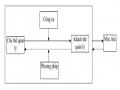
There are many different definitions of educational management, but they are basically consistent in content and nature. Like the concept of management, educational management has a management subject, a management object, and a management relationship.
The nature of educational management is the process of conscious impact of the management subject on the management object and the factors participating in the educational process, in order to effectively implement educational goals.
* Basic functions of educational management:
- Planning: drafting, approving and building a system of policies and management decisions.
- Organizing and directing: implementing management decisions by building the organizational structure of the management object, selecting, arranging, training and educating staff to make the goals meaningful, increasing the effectiveness of the organization; guiding, adjusting and coordinating educational forces according to the assigned tasks and plans to achieve the desired targets.
* The goal of educational management is to control the educational system to reach the desired future state for the educational system, for the school or for some key parameters of the school's educational system.
- Ensure students' rights to study in the right fields, levels, and classes according to quotas and standards.
- Build and maintain good technical facilities for teaching and learning.
- Develop a sufficient and synchronous teaching staff to improve professional qualifications and life.
- Build and perfect government, Party and mass organizations, educational and social relationships to effectively carry out educational and training tasks.
* Educational management methods:
- Psychological and social method: is to stimulate the management subjects to make them dedicated and devoted to their work, achieving the highest efficiency.
- Economic method: impact them with economic benefits to make them work effectively. Especially in educational management, this method needs to be applied to calculate efficiency to achieve goals.
- Organizational and administrative methods: need to influence the person performing the task by management, direction, guidance, and compulsion to perform correctly and achieve the desired results of the leader.
To implement the above methods, managers need expertise, management experience and flexibility in applying them in each specific situation.
1.2.3. Concept of interdisciplinary teaching
Integrated teaching is to incorporate relevant educational content into the teaching process of subjects such as: integrating ethics and lifestyle education; legal education; education on national sovereignty over borders, seas and islands; education on the use of energy economically and efficiently, environmental protection, traffic safety...
Interdisciplinary teaching is to identify knowledge content related to two or more subjects to teach, avoiding students having to re-learn the same knowledge content in different subjects many times. For interdisciplinary knowledge but one subject is dominant, it can be arranged to teach in the program of that subject and not taught in other subjects. In cases where the knowledge content is more interdisciplinary, it will be separated into interdisciplinary topics to organize separate teaching at a suitable time, parallel to the teaching process of related subjects.
"Integration" refers to the method and goals of teaching activities, while "interdisciplinary" refers to the content of teaching. If "integrated" teaching is done, then "interdisciplinary" knowledge must be taught, and vice versa. To ensure the effectiveness of interdisciplinary teaching, it must be done in a way and towards the goal of integration.
Interdisciplinary integrated topics are topics with knowledge content related to two or more subjects, expressed in their application in the same phenomenon, process in nature or society. For example: Physics and Technology knowledge in engines, generators; Physics and Chemistry knowledge in chemical power sources; History and Geography knowledge in sea and island sovereignty; Literature and Civic Education knowledge in ethics education, lifestyle...
Interdisciplinary integrated topics are practical, lively and attractive to students, and have the advantage of creating motivation and interest in learning for students. By studying integrated, interdisciplinary topics, students are enhanced in their application.