
8. Research methods
8.1. Theoretical research methods
Methods of analysis, comparison, synthesis, systematization and generalization of documents related to the research content, to build the theoretical framework of the topic.
8.2. Practical research methods
Investigation methods using questionnaire system, interview method, pedagogical observation method, product research method, expert method.
Maybe you are interested!
-
 Theoretical Basis for Managing Learning Activities of Primary Education Students
 -
 Managing experiential activities of students at Nam Son Secondary School, Bac Ninh City according to the orientation of the new general education program - 2
 -
 Managing life skills education through experiential activities for secondary school students in Dak Glong district, Dak Nong province - 12
 -
 Theoretical and Practical Basis for Developing the Capacity to Use Information Technology in Teaching Information Technology for Ethnic Minority Students.
 -
 Managing national cultural identity education through experiential activities for students of Dai Tu secondary school for ethnic minorities, Dai Tu district, Thai Nguyen province - 2
8.3. Accounting method
Use mathematical and statistical formulas to process data.
9. Contributions of the topic
Systematize the theoretical basis for managing experiential activities for secondary school students according to the new general education program.
Proposing measures to manage experiential activities for students at Hung Lo Secondary School, Viet Tri City, Phu Tho Province according to the new general education program.
10. Thesis structure
In addition to the Introduction, Conclusion and Recommendations, List of References, Appendices, the thesis is presented in 3 chapters:
Chapter 1. Theoretical basis of managing experiential activities for secondary school students according to the new general education program.
Theoretical basis of managing experiential activities for secondary school students according to the new general education program.
Chapter 2. Current status of managing experiential activities for students of Hung Lo Secondary School, Viet Tri City, Phu Tho Province according to the new general education program.
Chapter 3. Measures to manage experiential activities for students of Hung Lo Secondary School, Viet Tri City, Phu Tho Province according to the new general education program.
CHAPTER 1
THEORETICAL BASIS OF MANAGING EXPERIENTIAL ACTIVITIES FOR SECONDARY SCHOOL STUDENTS
ACCORDING TO THE NEW GENERAL EDUCATION PROGRAM
1.1. Overview of research problem
1.1.1. Overseas research
Jacob Mensky (1592 - 1670), the founder of modern pedagogy, attached great importance to practical activities. Jacob Mensky emphasized that students' learning should be combined with extracurricular activities as a way to free learning from the "confined four walls" of medieval high schools. He also believed that "Learning is not acquiring knowledge from books but acquiring knowledge from the sky, the earth,...".
Petxlalozi (1746-1827) was a great Swiss educator, called by the Swiss people as “the teacher of teachers”. Through experimental education, he wanted to save orphans from poor families. Petxlalozi built a new camp to help children both study and work. Petxlalozi believed that HĐTN not only created material wealth but was also a way to comprehensively educate students.
In 1907 in England, Robert Baden-Powell organized the first Scout camp at Brownsea Island in England. Scouting is a type of “Experiential Education”, focusing on outdoor practical activities, including: camping, forest skills, survival skills, campfires, group games and sports [25].
In particular, with the establishment of the “Association for Experiential Education” (AEE), Experiential Education has been officially recognized in writing and widely declared [25].
Experiential education continues to grow worldwide today.
UNESCO also recognizes “Experiential Education” as a bright future prospect for global education in the coming decades. Some countries in the world have typical models of organizing experiential education such as:
UK: Provide students with a variety of situations and contexts and require them to be creative and think, thereby solving problems in different ways to achieve better results.
Japan nurtures children with the ability to cope with social change, thereby helping to form a strong foundation to encourage children to be creative.
A 2002 comparative study by American educators between American education and 8 countries in the G8 bloc found that practical activities are one of the conditions that bring high quality education in countries [39]. Recent research by American educational scientists shows the great impact of practical activities on students' lives: 49% of students who do not participate in practical drug use, 37% of students aged 13-19 have to become parents 1 to 4 hours earlier than other students who participate in practical experience activities. Nearly 8/10 students who participate in practical experience activities achieve high learning results... [25].
1.1.2. Domestic research
In the early days of the founding of the Democratic Republic of Vietnam, President Ho Chi Minh clearly stated the method to train talented and virtuous people: " Learning goes hand in hand with practice, education is combined with productive labor, schools are closely linked to society".
There have been many domestic studies mentioning about the activities of creative experience such as: Creative experience activities - international experience and issues of Vietnam by author Do Ngoc Thong [39], Creative experience activities - Perspective from the theory of "learning from experience" by author Dinh Thi Kim Thoa [37], Some issues about creative experience activities in the new general education program -
Author Le Huy Hoang [22], Organizing creative experiential educational activities to develop learners' capacity - author Nguyen Thi Thu Hoai [21]. At the international scientific conference and competency-based education held at the Academy of Educational Management in April 2015, author Dinh Thi Kim Thoa had an article "Building an experiential educational program in the general education program"... In those articles, the authors focused on clarifying the issues: Position, goals, content, forms of organization and analyzing strengths, ways to implement and organize experiential educational activities of countries around the world, thereby proposing measures to apply in Vietnam.
Author Bui Ngoc Diep [17] suggested the most effective form of organizing experiential activities to meet the needs and educational goals in the article Forms of organizing creative experiential activities in general schools. Besides, there are other studies such as: Designing creative experiential activities associated with teaching and developing students' capacity by author Dang Van Nghia,...
Thus, many authors have researched on different aspects of HĐTN, but most of the authors have not specifically analyzed the measures to manage HĐTN programs at secondary school level. Therefore, through this research topic, the author wants to improve the quality of education through the management of HĐTN for students of Hung Lo Secondary School, Viet Tri City, Phu Tho Province.
1.2. Some basic concepts
1.2.1. school
Management is a broad concept, but in essence it consists of two processes: The "Management" process includes caring for, preserving, and maintaining a "stable" state; the "Reason" process includes fixing, arranging, innovating, and bringing into a "development" state.
Management is an attribute of society at every historical stage. Management is a conscious human activity to achieve its goals.
There are different views on management:
According to traditional concept, management is the process of conscious impact of the subject on a machine (management object) by outlining goals for the machine and finding measures to influence the machine to achieve the determined goals.
According to Nguyen Quoc Chi and Nguyen Thi My Loc: "Management activities are the directed and intentional impact of the management subject (manager) on the management object (managed person) in an organization to make the organization operate and achieve the organization's goals" [14] .
Although there are many different definitions, it can be understood that: Management is the impact of the management subject on the management object and object with the purpose of changing the state of the management object by a system of measures to achieve high efficiency.
This impact is modeled in the following diagram:
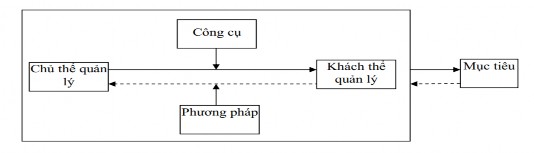
Figure 1.1: Diagram of modeling elements of management
Management activities, in essence, are the process of achieving organizational goals by performing management functions. The basic functions of management include: planning, organizing, leading, operating, controlling, and evaluating . The successive and independent management functions are only relative, but the management functions have a close dialectical relationship depending on the time and content, some functions can be carried out simultaneously, intertwined, and influence each other.
A school is an institution established to educate students under the supervision of teachers. In Vietnamese, school can also include secondary schools, colleges, universities and other facilities.
other education. School is the place to organize and manage the educational process. This process includes the activities of the educational subject and the educational object that are always closely connected, interacting, supporting each other and relying on each other to achieve the goals required by society.
There are also many opinions on the concept of school management.
According to Pham Minh Hac: School management is to implement the Party's educational guidelines within the scope of one's responsibilities, that is, to operate the school according to educational principles to achieve educational goals, training goals for the education sector, for the young generation and for each student [19].
Nguyen Ngoc Quang said: " School management is a collection of optimal impacts of the management subject on the collective of teachers, students and other staff to take advantage of the reserve resources invested by the state, social forces contributed and labor to build up own capital; towards promoting all school activities, the convergence point of which is the process of training the young generation; implementing quality training goals and plans, bringing the school to a new state" [34].
Thus, we can understand: school management is educational management within the school. School management is an activity carried out on the basis of general rules of management, and at the same time has its own characteristics specific to education. Therefore, school management needs to apply all general principles of educational management to promote all school activities according to training goals. The purpose of school management is to move the school from its current state to a new state of development by building and strongly developing resources to serve the purpose of improving the quality of education. The ultimate goal of educational management is to organize an effective educational process to train young people who are intelligent, creative, dynamic, autonomous, know how to live and strive for their own happiness and that of society.
In short, school management is a system of voluntary impacts of the management subject on the collective of teachers, the collective of students, parents and social forces inside and outside the school to achieve the quality and effectiveness of the school's educational goals.
1.2.2. Experiential activities
* Experience
The Vietnamese dictionary clearly states: "Trai means to have gone through, to know, to endure; and nghiem means to experience reality and realize that something is true. Creativity is to create new material or spiritual values; to find new things, new solutions, not to be constrained or dependent on what already exists" [33].
The Vietnamese Encyclopedia defines: Experience in the most general sense is any emotional state that the subject feels, goes through, and remains a part (along with knowledge, consciousness...) in the psychological life of each person [23].
In terms of psychology, it can be understood that experiences "are internal signals, thanks to which the meaning of events taking place for the individual is consciously perceived, transformed into the individual's own ideas, contributing to the conscious choice of necessary motives, adjusting the individual's behavior,..." [43].
From the above understandings, we believe that: experience is drawn from all human activities in all aspects, as a unified entity between knowledge, skills, emotions and will. Characterized by the mechanism of inheriting social, historical and cultural heritage. Experience is the process in which each individual, when operating in the environment, will directly contact objects and phenomena. From there, use the senses to observe and perceive objects and phenomena, and draw experiences for themselves. Experience brings people rich experience because when experiencing, we have gone through the path of "trial" and "error". People who experience a lot will have a lot of knowledge and life experience for themselves, helping people form their capacity and quality of life.
* Experiential activities
In the new general education program, the term HĐTN is defined as: "an educational activity in which each student directly participates in practical activities in school or society under the guidance and organization of educators, thereby developing emotions, ethics, skills and accumulating personal experiences" [9]. The research team belongs to the University of Education, National University.
Hanoi gives another definition: Experiential activities are educational activities in which, under the guidance of educators, each individual student participates directly in various activities of school life as well as in society as the subject of the activity, thereby developing practical capacity, personality qualities and promoting their individual creative potential... [25].
Experiential activities are very flexible and adaptable (in terms of location, time, scale, content, etc.), so experiential activities can be viewed from different perspectives:
- Experiential activities can be a form of teaching organization: so, here, experiential activities will be one of the forms of teaching and education organization to organize educational activities, a "way" for students to acquire knowledge, skills, techniques, and form capacity and qualities.
- Experiential activities can be understood as an educational content: thus, it will be a very large content, including many other small contents such as: social life, culture - art, sports, science and technology,... designed by educators to develop students' personalities comprehensively.
- Experiential activities can be understood as equivalent to a subject, similar to the viewpoint in the draft of the General Education Program.
Thus, the experiential activity itself can be viewed from many different angles depending on each person's perspective and research. With each perspective, it is organized and implemented in a different way.