
In the direction of sustainable stability, restoring and maintaining the health, biodiversity and stability of ecosystems is ecological management " (Lackey, 1995).
In the academic world, it is believed that: "Social management is related to the structure and function within the social system, regulating and controlling input and output, thereby achieving the ideal state of society " (Johnson and Agee, 1988).
From the above definitions, it can be seen that ecosystem management is the basis of ecosystem composition, optimal explanation of the composition, structure and functional processes of the ecosystem , at a certain time and space within the standard range so that human values and socio-economic conditions are synthesized together, to restore and maintain the overall nature of the ecosystem and its maintainability. Ecosystem management is the requirements of society with ecological processes, economic balance, in which ecological processes include biodiversity, nutrient cycling components, water cycling, succession with disturbance, soil properties change, wild flora and fauna, marine production. Social requirements include spirit, aesthetics, education, leisure, air and water quality, tourism, and harm reduction. Economic requirements include tourism, grazing, timber production, hunting, mining, agriculture.
Principles of ecosystem management
Maybe you are interested!
-
 Initial approach to some principles in mangrove ecosystem management at Xuan Thuy National Park - Nam Dinh - 11
 -
 Identify Rating Levels and Rating Scales
zt2i3t4l5ee
zt2a3gstourism,quan lan,quang ninh,ecology,ecotourism,minh chau,van don,geography,geographical basis,tourism development,science
zt2a3ge
zc2o3n4t5e6n7ts
of the islanders. Therefore, this indicator will be divided into two sub-indicators:
a1. Natural tourism attractiveness a2. Cultural tourism attractiveness
b. Tourist capacity
The two island communes in Quan Lan have different capacities to receive tourists. Minh Chau Commune is home to many standard hotels and resorts, attracting high-income domestic and international tourists. Meanwhile, Quan Lan Commune has many motels mainly built and operated by local people, so the scale and quality are not high, and will be suitable for ordinary tourists such as students.
c. Time of exploitation of Quan Lan Island Commune:
Quan Lan tourism is seasonal due to weather and climate conditions and festivals only take place on certain days of the year, specifically in spring. In Quan Lan commune, the period from April to June and from September to November is considered the best time to visit Quan Lan because the cultural tourism activities are mainly associated with festivals taking place during this time.
Minh Chau island commune:
Tourism exploitation time is all year round, because this is a place with a number of tourist attractions with diverse ecosystems such as Bai Tu Long National Park Research Center, Tram forest, Turtle Laying Beach, so besides coming to the beach for tourism and vacation in the summer, Minh Chau will attract research groups to come for tourism combined with research at other times of the year.
d. Sustainability
The sustainability of ecotourism sites in Quan Lan and Minh Chau communes depends on the sensitivity of the ecosystems to climate changes.
landscape. In general, these tourist destinations have a fairly high level of sustainability, because they are natural ecosystems, planned and protected. However, if a large number of tourists gather at certain times, it can exceed the carrying capacity and affect the sustainability of the environment (polluted beaches, damaged trees, animals moving away from their habitats, etc.), then the sustainability of the above ecosystems (natural ecosystems, human ecosystems) will also be affected and become less sustainable.
e. Location and accessibility
Both island communes have ports to take tourists to visit from Van Don wharf:
- Quan Lan – Van Don traffic route:
Phuc Thinh – Viet Anh high-speed boat and Quang Minh high-speed boat, depart at 8am and 2pm from Van Don to Quan Lan, and at 7am and 1pm from Quan Lan to Van Don. There are also wooden boats departing at 7am and 1pm.
- Van Don - Minh Chau traffic route:
Chung Huong high-speed train, Minh Chau train, morning 7:30 and afternoon 13:30 from Van Don to Minh Chau, morning 6:30 and afternoon 13:00 from Minh Chau to Van Don.
f. Infrastructure
Despite receiving investment attention, the issue of infrastructure and technical facilities for tourism on Quan Lan Island is still an issue that needs to be resolved because it has a direct impact on the implementation of ecotourism activities. The minimum conditions for serving tourists such as accommodation, electricity, water, communication, especially medical services, and security work need to be given top priority. Ecotourism spots in Minh Chau commune are assessed to have better infrastructure and technical facilities for tourism because there are quite complete and synchronous conditions for serving tourists, meeting many needs of domestic and foreign tourists.
3.2.1.4. Determine assessment levels and assessment scales
Corresponding to the levels of each criterion, the index is the score of those levels in the order of 4, 3, 2, 1 decreasing according to the standard of each level: very attractive (4), attractive (3), average (2), less attractive (1).
3.2.1.5. Determining the coefficients of the criteria
For the assessment of DLST in the two communes of Quan Lan and Minh Chau islands, the students added evaluation coefficients to show the importance of the criteria and indicators as follows:
Coefficient 3 with criteria: Attractiveness, Exploitation time. These are the 2 most important criteria for attracting tourists to tourism in general and eco-tourism in particular, so they have the highest coefficient.
Coefficient 2 with criteria: Capacity, Infrastructure, Location and accessibility . Because the assessment area is an island commune of Van Don district, the above criteria are selected by the author with appropriate coefficients at the average level.
Coefficient 1 with criteria: Sustainability. Quan Lan has natural and human-made ecotourism sites, with high biodiversity and little impact from local human factors. Most of the ecotourism sites are still wild, so they are highly sustainable.
3.2.1.6. Results of DLST assessment on Quan Lan island
a. Assessment of the potential for natural tourism development
For Minh Chau commune:
+ Natural tourism attractiveness is determined to be very attractive (4 points) and the most important coefficient (coefficient 3), so the score of the Attractiveness criterion is 4 x 3 = 12.
+ Capacity is determined as average (2 points) and the coefficient is quite important (coefficient 2), then the score of Capacity criterion is 2 x 2 = 4.
+ Exploitation time is long (4 points), the most important coefficient (coefficient 3) so the score of the Exploitation time criterion is 4 x 3 = 12.
+ Sustainability is determined as sustainable (4 points), the important coefficient is the average coefficient (coefficient 1), so the score of the Sustainability criterion is 4 x 1 = 4 points
+ Location and accessibility are determined to be quite favorable (2 points), the coefficient is quite important (coefficient 2), the criterion score is 2 x 2 = 4 points.
+ Infrastructure is assessed as good (3 points), the coefficient is quite important (coefficient 2), then the score of the Infrastructure criterion is 3 x 2 = 6 points.
The total score for evaluating DLST in Minh Chau commune according to 6 evaluation criteria is determined as: 12 + 4 + 12 + 4 + 4 + 6 = 42 points
Similar assessment for Quan Lan commune, we have the following table:
Table 3.3: Assessment of the potential for natural ecotourism development in Quan Lan and Minh Chau communes
Attractiveness of self-tourismof course
Capacity
Mining time
Sustainability
Location and accessibility
Infrastructure
Result
Point
DarkMulti
Point
DarkMulti
Point
DarkMulti
Point
DarkMulti
Point
DarkMulti
Point
DarkMulti
CommuneMinh Chau
12
12
4
8
12
12
4
4
4
8
6
8
42/52
Quan CommuneLan
6
12
6
8
9
12
4
4
4
8
4
8
33/52
b. Assessment of the potential for humanistic tourism development
For Quan Lan commune:
+ The attractiveness of human tourism is determined to be very attractive (4 points) and the most important coefficient (coefficient 3), so the score of the Attractiveness criterion is 4 x 3 = 12.
+ Capacity is determined to be large (3 points) and the coefficient is quite important (coefficient 2), then the score of the Capacity criterion is 3 x 2 = 6.
+ Mining time is average (3 points), the most important coefficient (coefficient 3) so the score of the Mining time criterion is 3 x 3 = 9.
+ Sustainability is determined as sustainable (4 points), the important coefficient is the average coefficient (coefficient 1), so the score of the Sustainability criterion is 4 x 1 = 4 points.
+ Location and accessibility are determined to be quite favorable (2 points), the coefficient is quite important (coefficient 2), the criterion score is 2 x 2 = 4 points.
+ Infrastructure is rated as average (2 points), the coefficient is quite important (coefficient 2), then the score of the Infrastructure criterion is 2 x 2 = 4 points.
The total score for evaluating DLST in Quan Lan commune according to 6 evaluation criteria is determined as: 12 + 6 + 6 + 4 + 4 + 4 = 36 points.
Similar assessment with Minh Chau commune we have the following table:
Table 3.4: Assessment of the potential for developing humanistic eco-tourism in Quan Lan and Minh Chau communes
Attractiveness of human tourismliterature
Capacity
Mining time
Sustainability
Location and accessibility
Infrastructure
Result
Point
DarkMulti
Point
DarkMulti
Point
DarkMulti
Point
DarkMulti
Point
DarkMulti
Point
DarkMulti
Quan CommuneLan
12
12
6
8
9
12
4
4
4
8
4
8
39/52
Minh CommuneChau
6
12
4
8
12
12
4
4
4
8
6
8
36/52
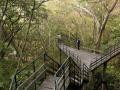
Basically, both Minh Chau and Quan Lan localities have quite favorable conditions for developing ecotourism. However, Quan Lan commune has more advantages to develop ecotourism in a humanistic direction, because this is an area with many famous historical relics such as Quan Lan Communal House, Quan Lan Pagoda, Temple worshiping the hero Tran Khanh Du, ... along with local festivals held annually such as the wind praying ceremony (March 15), Quan Lan festival (June 10-19); due to its location near the port and long exploitation time, the beaches in Quan Lan commune (especially Quan Lan beach) are no longer hygienic and clean to ensure the needs of tourists coming to relax and swim; this is also an area with many beautiful landscapes such as Got Beo wind pass, Ong Phong head, Voi Voi cave, but the ability to access these places is still very limited (dirt hill road, lots of gravel and rocks), especially during rainy and windy times; In addition, other natural resources such as mangrove forests and sea worms have not been really exploited for tourism purposes and ecotourism development. On the contrary, Minh Chau commune has more advantages in developing ecotourism in the direction of natural tourism, this is an area with diverse ecosystems such as at Rua De Beach, Bai Tu Long National Park Conservation Center...; Minh Chau beach is highly appreciated for its natural beauty and cleanliness, ranked in the top ten most beautiful beaches in Vietnam; Minh Chau commune is also home to Tram forest with a large area and a purity of up to 90%, suitable for building bridges through the forest (a very effective type of natural ecotourism currently applied by many countries) for tourists to sightsee, as well as for the purpose of studying and researching.
Figure 3.1: Thenmala Forest Bridge (India) Source: https://www.thenmalaecotourism.com/(August 21, 2019)
3.2.2. Using SWOT matrix to evaluate Quan Lan island tourism
General assessment of current tourism activities of Quan Lan island is shown through the following SWOT matrix:
Table 3.5: SWOT matrix evaluating tourism activities on Quan Lan island
Internal agent
Strengths- There is a lot of potential for tourism development, especially natural ecotourism and humanistic ecotourism.- The unskilled labor force is relatively abundant.- resource environmentunpolluted, still
Weaknesses- Poorly developed infrastructure, especially traffic routes to tourist destinations on the island.- The team of professional staff is still weak.- Tourism products in general
quite wild, originalintact
general and DLST in particularalone is monotonous.
External agents
Opportunity- Tourism is a key industry in the socio-economic development strategy of the province and Van Don economic zone.- Quan Lan was selected as a pilot area for eco-tourism development within the framework of the green growth project between Quang Ninh province and the Japanese organization JICA.- The flow of tourists and especially ecotourism in the world tends toincreasing
Challenge- Weather and climate change abnormally.- Competition in tourism products is increasingly fierce, especially with other localities in the province such as Ha Long, Mong Cai...- Awareness of tourists, especially domestic tourists, about ecotourism and nature conservation is not high.
Through summary analysis using SWOT matrix we see that:
To exploit strengths and take advantage of opportunities, it is necessary to:
- Diversify products and service types (build more tourism routes aimed at specific needs of tourists: experiential tourism immersed in nature, spiritual cultural tourism...)
- Effective exploitation of resources and differentiated products (natural resources and human resources)
div.maincontent .p { color: black; font-family:"Times New Roman", serif; font-style: normal; font-weight: normal; text-decoration: none; font-size: 14pt; margin:0pt; } div.maincontent p { color: black; font-family:"Times New Roman", serif; font-style: normal; font-weight: normal; text-decoration: none; font-size: 14pt; margin:0pt; } div.maincontent .s1 { color: black; font-family:"Times New Roman", serif; font-style: normal; font-weight: normal; text-decoration: none; font-size: 13pt; } div.maincontent .s2 { color: black; font-family:"Times New Roman", serif; font-style: normal; font-weight: normal; text-decoration: none; font-size: 13pt; } div.maincontent .s3 { color: #0D0D0D; font-family:"Times New Roman", serif; font-style: normal; font-weight: bold; text-decoration: none; font-size: 14pt; } div.maincontent .s4 { color: black; font-family:"Times New Roman", serif; font-style: italic; font-weight: normal; text-decoration: none; font-size: 14pt; } div.maincontent .s5 { color: black; font-family:"Times New Roman", serif; font-style: italic; font-weight: bold; text-decoration: none; font-size: 14pt; } div.maincontent .s6 { color: black; font-family:"Times New Roman", serif; font-style: italic; font-weight: normal; text-decoration: none; font-size: 14pt; vertical-align: -3pt; } div.maincontent .s7 { color: black; font-family:"Times New Roman", serif; font-style: italic; font-weight: normal; text-decoration: none; font-size: 14pt; vertical-align: -2pt; } div.maincontent .s8 { color: black; font-family:"Times New Roman", serif; font-style: italic; font-weight: normal; text-decoration: none; font-size: 14pt; vertical-align: -1pt; } div.maincontent .s9 { color: black; font-family:"Times New Roman", serif; font-style: normal; font-weight: normal; text-decoration: none; font-size: 14pt; } div.maincontent .s10 { color: black; font-family:"Times New Roman", serif; font-style: normal; font-weight: bold; text-decoration: none; font-size: 14pt; } div.maincontent .s11 { color: black; font-family:"Times New Roman", serif; font-style: normal; font-weight: normal; text-decoration: none; font-size: 14pt; } div.maincontent .s12 { color: black; font-family:Symbol, serif; font-style: normal; font-weight: normal; text-decoration: none; font-size: 14pt; } div.maincontent .s13 { color: black; font-family:Wingdings; font-style: normal; font-weight: normal; text-decoration: none; font-size: 14pt; } div.maincontent .s14 { color: black; font-family:"Times New Roman", serif; font-style: normal; font-weight: normal; text-decoration: none; font-size: 9pt; vertical-align: 5pt; } div.maincontent .s15 { color: black; font-family:"Times New Roman", serif; font-style: normal; font-weight: normal; text-decoration: none; font-size: 9pt; vertical-align: 5pt; } div.maincontent .s16 { color: black; font-family:Cambria, serif; font-style: italic; font-weight: normal; text-decoration: none; font-size: 14pt; } div.maincontent .s17 { color: #080808; font-family:"Times New Roman", serif; font-style: normal; font-weight: bold; text-decoration: none; font-size: 14pt; } div.maincontent .s18 { color: #080808; font-family:"Times New Roman", serif; font-style: normal; font-weight: normal; text-decoration: none; font-size: 14pt; } div.maincontent .s19 { color: black; font-family:"Times New Roman", serif; font-style: normal; font-weight: normal; text-decoration: none; font-size: 11pt; } div.maincontent .s20 { color: black; font-family:"Times New Roman", serif; font-style: normal; font-weight: normal; text-decoration: none; font-size: 10pt; } div.maincontent .s21 { color: black; font-family:"Times New Roman", serif; font-style: normal; font-weight: bold; text-decoration: none; font-size: 11pt; } div.maincontent .s22 { color: black; font-family:"Times New Roman", serif; font-style: normal; font-weight: normal; text-decoration: none; font-size: 11pt; } div.maincontent .s23 { color: black; font-family:"Times New Roman", serif; font-style: italic; font-weight: normal; text-decoration: none; font-size: 14pt; } div.maincontent .s24 { color: #212121; font-family:"Times New Roman", serif; font-style: normal; font-weight: normal; tex
Identify Rating Levels and Rating Scales
zt2i3t4l5ee
zt2a3gstourism,quan lan,quang ninh,ecology,ecotourism,minh chau,van don,geography,geographical basis,tourism development,science
zt2a3ge
zc2o3n4t5e6n7ts
of the islanders. Therefore, this indicator will be divided into two sub-indicators:
a1. Natural tourism attractiveness a2. Cultural tourism attractiveness
b. Tourist capacity
The two island communes in Quan Lan have different capacities to receive tourists. Minh Chau Commune is home to many standard hotels and resorts, attracting high-income domestic and international tourists. Meanwhile, Quan Lan Commune has many motels mainly built and operated by local people, so the scale and quality are not high, and will be suitable for ordinary tourists such as students.
c. Time of exploitation of Quan Lan Island Commune:
Quan Lan tourism is seasonal due to weather and climate conditions and festivals only take place on certain days of the year, specifically in spring. In Quan Lan commune, the period from April to June and from September to November is considered the best time to visit Quan Lan because the cultural tourism activities are mainly associated with festivals taking place during this time.
Minh Chau island commune:
Tourism exploitation time is all year round, because this is a place with a number of tourist attractions with diverse ecosystems such as Bai Tu Long National Park Research Center, Tram forest, Turtle Laying Beach, so besides coming to the beach for tourism and vacation in the summer, Minh Chau will attract research groups to come for tourism combined with research at other times of the year.
d. Sustainability
The sustainability of ecotourism sites in Quan Lan and Minh Chau communes depends on the sensitivity of the ecosystems to climate changes.
landscape. In general, these tourist destinations have a fairly high level of sustainability, because they are natural ecosystems, planned and protected. However, if a large number of tourists gather at certain times, it can exceed the carrying capacity and affect the sustainability of the environment (polluted beaches, damaged trees, animals moving away from their habitats, etc.), then the sustainability of the above ecosystems (natural ecosystems, human ecosystems) will also be affected and become less sustainable.
e. Location and accessibility
Both island communes have ports to take tourists to visit from Van Don wharf:
- Quan Lan – Van Don traffic route:
Phuc Thinh – Viet Anh high-speed boat and Quang Minh high-speed boat, depart at 8am and 2pm from Van Don to Quan Lan, and at 7am and 1pm from Quan Lan to Van Don. There are also wooden boats departing at 7am and 1pm.
- Van Don - Minh Chau traffic route:
Chung Huong high-speed train, Minh Chau train, morning 7:30 and afternoon 13:30 from Van Don to Minh Chau, morning 6:30 and afternoon 13:00 from Minh Chau to Van Don.
f. Infrastructure
Despite receiving investment attention, the issue of infrastructure and technical facilities for tourism on Quan Lan Island is still an issue that needs to be resolved because it has a direct impact on the implementation of ecotourism activities. The minimum conditions for serving tourists such as accommodation, electricity, water, communication, especially medical services, and security work need to be given top priority. Ecotourism spots in Minh Chau commune are assessed to have better infrastructure and technical facilities for tourism because there are quite complete and synchronous conditions for serving tourists, meeting many needs of domestic and foreign tourists.
3.2.1.4. Determine assessment levels and assessment scales
Corresponding to the levels of each criterion, the index is the score of those levels in the order of 4, 3, 2, 1 decreasing according to the standard of each level: very attractive (4), attractive (3), average (2), less attractive (1).
3.2.1.5. Determining the coefficients of the criteria
For the assessment of DLST in the two communes of Quan Lan and Minh Chau islands, the students added evaluation coefficients to show the importance of the criteria and indicators as follows:
Coefficient 3 with criteria: Attractiveness, Exploitation time. These are the 2 most important criteria for attracting tourists to tourism in general and eco-tourism in particular, so they have the highest coefficient.
Coefficient 2 with criteria: Capacity, Infrastructure, Location and accessibility . Because the assessment area is an island commune of Van Don district, the above criteria are selected by the author with appropriate coefficients at the average level.
Coefficient 1 with criteria: Sustainability. Quan Lan has natural and human-made ecotourism sites, with high biodiversity and little impact from local human factors. Most of the ecotourism sites are still wild, so they are highly sustainable.
3.2.1.6. Results of DLST assessment on Quan Lan island
a. Assessment of the potential for natural tourism development
For Minh Chau commune:
+ Natural tourism attractiveness is determined to be very attractive (4 points) and the most important coefficient (coefficient 3), so the score of the Attractiveness criterion is 4 x 3 = 12.
+ Capacity is determined as average (2 points) and the coefficient is quite important (coefficient 2), then the score of Capacity criterion is 2 x 2 = 4.
+ Exploitation time is long (4 points), the most important coefficient (coefficient 3) so the score of the Exploitation time criterion is 4 x 3 = 12.
+ Sustainability is determined as sustainable (4 points), the important coefficient is the average coefficient (coefficient 1), so the score of the Sustainability criterion is 4 x 1 = 4 points
+ Location and accessibility are determined to be quite favorable (2 points), the coefficient is quite important (coefficient 2), the criterion score is 2 x 2 = 4 points.
+ Infrastructure is assessed as good (3 points), the coefficient is quite important (coefficient 2), then the score of the Infrastructure criterion is 3 x 2 = 6 points.
The total score for evaluating DLST in Minh Chau commune according to 6 evaluation criteria is determined as: 12 + 4 + 12 + 4 + 4 + 6 = 42 points
Similar assessment for Quan Lan commune, we have the following table:
Table 3.3: Assessment of the potential for natural ecotourism development in Quan Lan and Minh Chau communes
Attractiveness of self-tourismof course
Capacity
Mining time
Sustainability
Location and accessibility
Infrastructure
Result
Point
DarkMulti
Point
DarkMulti
Point
DarkMulti
Point
DarkMulti
Point
DarkMulti
Point
DarkMulti
CommuneMinh Chau
12
12
4
8
12
12
4
4
4
8
6
8
42/52
Quan CommuneLan
6
12
6
8
9
12
4
4
4
8
4
8
33/52
b. Assessment of the potential for humanistic tourism development
For Quan Lan commune:
+ The attractiveness of human tourism is determined to be very attractive (4 points) and the most important coefficient (coefficient 3), so the score of the Attractiveness criterion is 4 x 3 = 12.
+ Capacity is determined to be large (3 points) and the coefficient is quite important (coefficient 2), then the score of the Capacity criterion is 3 x 2 = 6.
+ Mining time is average (3 points), the most important coefficient (coefficient 3) so the score of the Mining time criterion is 3 x 3 = 9.
+ Sustainability is determined as sustainable (4 points), the important coefficient is the average coefficient (coefficient 1), so the score of the Sustainability criterion is 4 x 1 = 4 points.
+ Location and accessibility are determined to be quite favorable (2 points), the coefficient is quite important (coefficient 2), the criterion score is 2 x 2 = 4 points.
+ Infrastructure is rated as average (2 points), the coefficient is quite important (coefficient 2), then the score of the Infrastructure criterion is 2 x 2 = 4 points.
The total score for evaluating DLST in Quan Lan commune according to 6 evaluation criteria is determined as: 12 + 6 + 6 + 4 + 4 + 4 = 36 points.
Similar assessment with Minh Chau commune we have the following table:
Table 3.4: Assessment of the potential for developing humanistic eco-tourism in Quan Lan and Minh Chau communes
Attractiveness of human tourismliterature
Capacity
Mining time
Sustainability
Location and accessibility
Infrastructure
Result
Point
DarkMulti
Point
DarkMulti
Point
DarkMulti
Point
DarkMulti
Point
DarkMulti
Point
DarkMulti
Quan CommuneLan
12
12
6
8
9
12
4
4
4
8
4
8
39/52
Minh CommuneChau
6
12
4
8
12
12
4
4
4
8
6
8
36/52
Basically, both Minh Chau and Quan Lan localities have quite favorable conditions for developing ecotourism. However, Quan Lan commune has more advantages to develop ecotourism in a humanistic direction, because this is an area with many famous historical relics such as Quan Lan Communal House, Quan Lan Pagoda, Temple worshiping the hero Tran Khanh Du, ... along with local festivals held annually such as the wind praying ceremony (March 15), Quan Lan festival (June 10-19); due to its location near the port and long exploitation time, the beaches in Quan Lan commune (especially Quan Lan beach) are no longer hygienic and clean to ensure the needs of tourists coming to relax and swim; this is also an area with many beautiful landscapes such as Got Beo wind pass, Ong Phong head, Voi Voi cave, but the ability to access these places is still very limited (dirt hill road, lots of gravel and rocks), especially during rainy and windy times; In addition, other natural resources such as mangrove forests and sea worms have not been really exploited for tourism purposes and ecotourism development. On the contrary, Minh Chau commune has more advantages in developing ecotourism in the direction of natural tourism, this is an area with diverse ecosystems such as at Rua De Beach, Bai Tu Long National Park Conservation Center...; Minh Chau beach is highly appreciated for its natural beauty and cleanliness, ranked in the top ten most beautiful beaches in Vietnam; Minh Chau commune is also home to Tram forest with a large area and a purity of up to 90%, suitable for building bridges through the forest (a very effective type of natural ecotourism currently applied by many countries) for tourists to sightsee, as well as for the purpose of studying and researching.
Figure 3.1: Thenmala Forest Bridge (India) Source: https://www.thenmalaecotourism.com/(August 21, 2019)
3.2.2. Using SWOT matrix to evaluate Quan Lan island tourism
General assessment of current tourism activities of Quan Lan island is shown through the following SWOT matrix:
Table 3.5: SWOT matrix evaluating tourism activities on Quan Lan island
Internal agent
Strengths- There is a lot of potential for tourism development, especially natural ecotourism and humanistic ecotourism.- The unskilled labor force is relatively abundant.- resource environmentunpolluted, still
Weaknesses- Poorly developed infrastructure, especially traffic routes to tourist destinations on the island.- The team of professional staff is still weak.- Tourism products in general
quite wild, originalintact
general and DLST in particularalone is monotonous.
External agents
Opportunity- Tourism is a key industry in the socio-economic development strategy of the province and Van Don economic zone.- Quan Lan was selected as a pilot area for eco-tourism development within the framework of the green growth project between Quang Ninh province and the Japanese organization JICA.- The flow of tourists and especially ecotourism in the world tends toincreasing
Challenge- Weather and climate change abnormally.- Competition in tourism products is increasingly fierce, especially with other localities in the province such as Ha Long, Mong Cai...- Awareness of tourists, especially domestic tourists, about ecotourism and nature conservation is not high.
Through summary analysis using SWOT matrix we see that:
To exploit strengths and take advantage of opportunities, it is necessary to:
- Diversify products and service types (build more tourism routes aimed at specific needs of tourists: experiential tourism immersed in nature, spiritual cultural tourism...)
- Effective exploitation of resources and differentiated products (natural resources and human resources)
div.maincontent .p { color: black; font-family:"Times New Roman", serif; font-style: normal; font-weight: normal; text-decoration: none; font-size: 14pt; margin:0pt; } div.maincontent p { color: black; font-family:"Times New Roman", serif; font-style: normal; font-weight: normal; text-decoration: none; font-size: 14pt; margin:0pt; } div.maincontent .s1 { color: black; font-family:"Times New Roman", serif; font-style: normal; font-weight: normal; text-decoration: none; font-size: 13pt; } div.maincontent .s2 { color: black; font-family:"Times New Roman", serif; font-style: normal; font-weight: normal; text-decoration: none; font-size: 13pt; } div.maincontent .s3 { color: #0D0D0D; font-family:"Times New Roman", serif; font-style: normal; font-weight: bold; text-decoration: none; font-size: 14pt; } div.maincontent .s4 { color: black; font-family:"Times New Roman", serif; font-style: italic; font-weight: normal; text-decoration: none; font-size: 14pt; } div.maincontent .s5 { color: black; font-family:"Times New Roman", serif; font-style: italic; font-weight: bold; text-decoration: none; font-size: 14pt; } div.maincontent .s6 { color: black; font-family:"Times New Roman", serif; font-style: italic; font-weight: normal; text-decoration: none; font-size: 14pt; vertical-align: -3pt; } div.maincontent .s7 { color: black; font-family:"Times New Roman", serif; font-style: italic; font-weight: normal; text-decoration: none; font-size: 14pt; vertical-align: -2pt; } div.maincontent .s8 { color: black; font-family:"Times New Roman", serif; font-style: italic; font-weight: normal; text-decoration: none; font-size: 14pt; vertical-align: -1pt; } div.maincontent .s9 { color: black; font-family:"Times New Roman", serif; font-style: normal; font-weight: normal; text-decoration: none; font-size: 14pt; } div.maincontent .s10 { color: black; font-family:"Times New Roman", serif; font-style: normal; font-weight: bold; text-decoration: none; font-size: 14pt; } div.maincontent .s11 { color: black; font-family:"Times New Roman", serif; font-style: normal; font-weight: normal; text-decoration: none; font-size: 14pt; } div.maincontent .s12 { color: black; font-family:Symbol, serif; font-style: normal; font-weight: normal; text-decoration: none; font-size: 14pt; } div.maincontent .s13 { color: black; font-family:Wingdings; font-style: normal; font-weight: normal; text-decoration: none; font-size: 14pt; } div.maincontent .s14 { color: black; font-family:"Times New Roman", serif; font-style: normal; font-weight: normal; text-decoration: none; font-size: 9pt; vertical-align: 5pt; } div.maincontent .s15 { color: black; font-family:"Times New Roman", serif; font-style: normal; font-weight: normal; text-decoration: none; font-size: 9pt; vertical-align: 5pt; } div.maincontent .s16 { color: black; font-family:Cambria, serif; font-style: italic; font-weight: normal; text-decoration: none; font-size: 14pt; } div.maincontent .s17 { color: #080808; font-family:"Times New Roman", serif; font-style: normal; font-weight: bold; text-decoration: none; font-size: 14pt; } div.maincontent .s18 { color: #080808; font-family:"Times New Roman", serif; font-style: normal; font-weight: normal; text-decoration: none; font-size: 14pt; } div.maincontent .s19 { color: black; font-family:"Times New Roman", serif; font-style: normal; font-weight: normal; text-decoration: none; font-size: 11pt; } div.maincontent .s20 { color: black; font-family:"Times New Roman", serif; font-style: normal; font-weight: normal; text-decoration: none; font-size: 10pt; } div.maincontent .s21 { color: black; font-family:"Times New Roman", serif; font-style: normal; font-weight: bold; text-decoration: none; font-size: 11pt; } div.maincontent .s22 { color: black; font-family:"Times New Roman", serif; font-style: normal; font-weight: normal; text-decoration: none; font-size: 11pt; } div.maincontent .s23 { color: black; font-family:"Times New Roman", serif; font-style: italic; font-weight: normal; text-decoration: none; font-size: 14pt; } div.maincontent .s24 { color: #212121; font-family:"Times New Roman", serif; font-style: normal; font-weight: normal; tex -
 Assessing the current status and proposing a community-based mangrove conservation model in Le Loi commune, Hoanh Bo district, Quang Ninh province - 15
 -
 Assessing the current status and proposing a community-based mangrove conservation model in Le Loi commune, Hoanh Bo district, Quang Ninh province - 14
 -
 Analyzing the role of shrimp-mangrove farming model in serving strategic planning towards sustainable development in Duyen Hai district - Tra Vinh - 1
+ Guiding principles:
1. Identify management objects and goals.
2. Determine the management unit and limits.
3. Determine management and implementation plan.
4. Identify policies, laws and regulations that directly affect management activities.
5. Select and utilize HST management tools and techniques.
+ Operational principles:
6. Collect, analyze and edit economic, social, ecological and information resources.
7. Be aware of limitations or shortcomings in terms of STH.
8. Managing the use of “Greed and Consciousness”.
9. Promote adaptive management with ecological, social, policy and economic environmental protection.
10. HST Management is the Management of a specific unit, (the objectives, policies and basic principles of different management structures give rise to changes).
1.2.2. Ecosystem approach
In the CBD's view, the ecosystem approach is defined as: “a strategy for managing land, water and living resources that promotes their conservation and sustainable use.”
This approach places people and resource use practices at the heart of the decision-making framework, with four key points: (1) It is designed to balance the three goals of conservation, sustainable use and equitable sharing of resources, (2) It places people at the heart of management, (3) It extends management beyond protected areas, and (4) It meets the concerns of the broadest range of sectors.
1.2.3. Overview of issues on QLRBV in the world
For countries around the world, especially in countries with early industrial and economic development (UK, Germany, France, Japan, Netherlands, etc.), forest resource management is always considered an important factor in ensuring environmental security for the stable development of each country. Therefore, policies related to the development of forest resources are often closely linked to the interests and needs of the community living on the forest. People are always considered as the central factor in the process of forest resource development.
In recent years, in some countries: Indonesia, Philippines, Nepal, Bangladesh, Zimbabwe, Panama, Canada... there have been frequent protests by communities and environmental organizations demanding that the Government and other industries stop exploiting their forest resources. Protecting and sustainably developing forest resources is to ensure safety and maintain a long-term, stable life for communities around the world.
In the world, the history of forest management began in European countries.
In the early 18th century, German foresters GL Hartig and Heyer proposed the principle of sustainable use for monoculture forests of the same age. At the same time, French (Gournad, 1922) and Swiss (H. Boioley) foresters also proposed methods of controlling and adjusting yields for selectively harvested forests of different ages. During this period, the forest management system was still largely based on national management models from the central government (forests were mainly managed by state-owned enterprises), with centralized management. The area of forest land managed by the state accounted for 25-75% of the total land area of many countries.
Since the mid-20th century, when forest resources in many countries have been seriously degraded, directly affecting the ecological environment and the lives of people in mountainous areas, the previous centralized forest management method has become inappropriate. Governments in some countries have sought ways to save the state of forest degradation by issuing a number of policies to encourage and attract people to participate in the management and use of forest resources. The method of community forest management (or community forestry) first appeared in India and gradually transformed into different forms of management such as: agroforestry, farms, social forestry (Nepal, Thailand, Philippines, ...). Currently, in developing countries, when agricultural and forestry production still occupies an important position for rural people in mountainous areas, forest management according to the method of developing social forestry will be the most sustainable form in terms of both economy, society and ecological environment.
In 1967-1969, the FAO organization paid attention to the development of agroforestry and came to a consensus: applying agroforestry measures is the best way to use tropical forest land in a reasonable and comprehensive way, and to solve the problem of food, food and surplus labor while establishing ecological balance. Also according to the FAO report, every year the world's tropical forests lose an average of about 15 million hectares, then in just over 100 years, the tropical forests will completely disappear, and humans will have to suffer unpredictable economic, social and environmental disasters [4].
To prevent deforestation, protect and develop forest capital on a large scale.
Worldwide, the international community has organized many conferences, established many organizations, proposed and committed to many conventions to protect and develop forests such as: International Conservation Strategy (1980 and adjusted in 1991), Establishment of the International Tropical Timber Organization (ITTO in 1983), development of the Tropical Forest Action Program (TFAP in 1985) of the Food and Agriculture Organization of the United Nations (FAO), the International Conference on Environment and Development (UNCED in Rio de Janeiro in 1992, the Convention on Trade in Endangered Species of Wild Fauna and Flora (CITES), the Convention on Biological Diversity (CBD, 1992), the Convention on Global Climate Change (CGCC, 1994), the Convention to Combat Desertification (CCD, 1996), the International Agreement on Tropical Timber (ITTA, 1997). In recent years, many international and national conferences and seminars on sustainable forest management have been continuously held. At the 2007 Environment Summit held in Bali (Indonesia), it was once again affirmed that environmental protection and especially the protection and maintenance of forest resources is a common responsibility of all countries in the world.
The International Timber Organization (ITTO) was the first organization to respond to the issue of sustainable management of tropical forests. It compiled the “Guidelines for the Management of Tropical Natural Forests” (ITTO, 1990), “Criteria for the Assessment of Sustainable Management of Tropical Natural Forests” (ITTO, 1992), “Guidelines for the Establishment of a Sustainable Management System for Planted Forests in Tropical Forests” (ITTO, 1993) and “Guidelines for the Conservation of Biodiversity of Production Forests in the Tropics” (ITTO, 1993). It developed a strategy for the sustainable management of tropical forests for the trade in tropical forest products for the year 2000. The two driving forces behind the development of a sustainable forest management system were the desire of tropical wood product producing countries to re-establish a stable production forest area and the desire of tropical wood product consumers to regulate the exploitation of forests to meet global ecological functions. The problem is to build organizations that evaluate forest management. On an international scale, the Forest Stewardship Council has been established to consider and recognize forest certification organizations, in order to ensure the value of the certificates. With the development of sustainable forest management, Canada has proposed to put the issue of sustainable forest management in the environmental management system according to the ISO 14001 standard [29].
Currently, in the world, there are national sustainable forest management standards (Cacada, Sweden, Malaysia, Indonesia, etc.) and international CAAPSB of the Helsinki process, Montreal process. The Forest Stewardship Council (FSC) and the Tropical Timber Organization have a set of standards "Criteria and Indicators for Forest Management (P&C)" that have been recognized and applied in many countries around the world and forest certification organizations use this set of criteria to evaluate management and recognize forest certification.
The countries in the Southeast Asian region held the 18th conference in Hanoi in September 1998 and agreed on Malaysia's proposal to develop a set of ASEAN regional criteria and indicators on QLRBV (abbreviated as ASEAN C&I). In essence, ASEAN's C&I is similar to ITTO's C&I, including 7 criteria and also divided into 2 management levels: national level and management unit level [5]. However, the application to each country in the region and each locality in a country still faces many difficulties, because the standards are not completely suitable for each locality in the region.
1.2.4. Overview of issues on QLRBV in Vietnam
According to the land inventory results up to January 1, 2005 of the Government, the national forest area is 12.28 million hectares (forest cover 36.7%), of which about 10 million hectares are natural forests and 2.28 million hectares are planted forests; divided into 3 types of forests as follows:
- Special-use forests: 1.9 million hectares, accounting for 15.7%
- Protective forests: 5.9 million hectares, accounting for 47.0%
- Production forests: 4.5 million hectares, accounting for 36.6%
With the above forest capital, the current average target in our country is 0.15 ha of forest/person and 9.16 m3 / person, which is low compared to the corresponding world targets of 0.97 ha/person and 75 m3 / person [2].
In the past 50 years, in Vietnam, up to 5 million hectares of natural forests have been lost. In addition to the causes of deforestation due to population growth, food shortages, deforestation for farming land, overexploitation of forest products... like most developing countries, two long wars are also important causes of the decline in forest resources. Another cause is management.
Ineffective forests for many years have caused the forest area to decrease, more and more bare land and hills are left, forest quality has decreased, many rare species of animals and plants are at risk of extinction... This is also one of the direct causes leading to climate change in our country in recent times.
The management and use of forests in our country has only been focused on in the last 10 years with Decision No. 661/QD-TTg, dated July 29, 1998 of the Prime Minister on the objectives, tasks, policies and organization of the implementation of the project to plant 5 million hectares of new forests to restore the current status of forest resources, increasing the coverage equivalent to that in 1943 (43%). However, according to the historical process of socio-economic development of Vietnam, the organization of management and use of forest resources can be divided into 4 periods as follows:
Pre-1945 period
This was the period when our country was under French colonial rule. During this period, the forest area reached 14.3 million hectares, forest resources were still abundant, mainly natural forests. The level of human impact on forest resources was low, so forest resources were still abundant and diverse.
Period from 1945-1975
This was the period when the Socialist Republic of Vietnam was formed, but this was also the period of 30 years of arduous war for the Vietnamese people. Forest management and use during this period was initially focused on and achieved certain results:
- Regarding management organization: The central State management level has the General Department of Forestry, later the Ministry of Forestry, which is a specialized agency of the Government. In 1973, there was an additional Forest Protection Department, which is an agency to enforce forest protection laws. At the provincial level, there are Forestry Companies, the predecessors of the Forestry Departments, which are the provincial forestry management agencies that also control the management of forestry enterprises. At the district level, there are Forestry Districts under the District People's Committees, which are also vertical agencies of the Forestry Departments. Most of the forest area and forest land in the North is
assigned to State Forest Enterprises for management.
- Regarding forest use organization: Forests are divided into 3 functions for management and use: production forests, protection forests, and special-use forests. In each province, forests and forest land are divided into sub-areas with an average area of 1,000 hectares and numbered from 1 to the last number within the province.
Period from 1976-1990
During this period, a large part of the natural forest area was exploited for export to develop the economy, along with the rapid increase in population, which was the fundamental cause of rapid forest resource degradation. By 1990, our country's forest area was only 9.18 million hectares, with a forest cover of 27.2% (during the period 1980-1990, an average of more than 100 thousand hectares of forest were lost each year) [2].
Period from 1991 to present
In 1991, the Law on Forest Protection and Development was promulgated by the State for the first time in history (amended and supplemented in 2004) [28], marking the development and recognition of the importance of the forestry sector to the national economy. This is also an important legal basis for formulating policies and orientations for the development of our country's forest resources.
The question is how to manage forests? What conditions must be satisfied to sustainably manage forests? Among the management solutions, which solution will have a positive impact on sustainable forest resource management in the research area? These are the research questions that the topic needs to address, based on the study of the current status of mangrove ecosystem management in Xuan Thuy National Park - Nam Dinh, in order to propose some solutions for sustainable forest management.
1.3. Some scientific studies related to the topic
Since 1928, Watson has established a hydrological classification table related to the zonation of mangrove species in West Malaysia, which is still used by many scientists to study the distribution of species in different regions of the world (Snedaker and Lugo, 1973; Chapman, 1977; Santisuk, 1983; Aksornkoae, 1986). Based on some experimental results as well as field observations,
Some authors have suggested that mangroves also grow in non-tidal areas (Stodart et al., 1973).
In West Bengal, the Village Protection Committee (VPC) program has been successful in areas with abundant Sal forests, rapid regeneration, and faster production of NTFPs than where harvesting is concentrated in plantations. In addition, resource management is likely to be more effective if the resources are close to the user groups and can be easily monitored. Another factor is that the resource management system must be easily adopted by the user groups (cited in Hoang Huu Cai, 2006).
Le Thanh Binh (2003) pointed out the diversity and richness of flora and fauna in mangrove areas and the risk of decline of these flora and fauna due to agricultural, forestry and fishery production activities of local people, thereby proposing solutions for sustainable development of mangrove ecosystems with the participation of local communities [1].
Mazda et al. (1997) conducted a study on the wave-reducing effect of mangrove forests in the newly planted mangrove area of Thai Binh province, with the main tree species being Kendelia candel . The results showed that mangrove forests significantly reduced the pressure of sea waves before impacting the sea dike [33]…
Currently, in Vietnam, the issue of forest management has been paid attention for a long time, but forest management and forest certification are still new issues, not yet interested by many people and have not been studied in depth on a national scale, there is no effective solution for the issue of sustainable forest management and development. Some topics and scientific works related to forest management have been deployed, namely:
- The work "Sustainable integrated land use" by Nguyen Xuan Quat in 1996, the work presented models of sustainable land use, models of effective forest protection and restoration in Vietnam.
- The work "Assessing the current status of forest and forest land management as a basis for proposing sustainable use of forest resources in Dak Lak" by Dr. Bao Huy (1998), based on analyzing the current status, assessing the potential and value of forest resources, the author proposed