
- Bond issuance 70% of total investment
+ Funding sources: Focus on key subjects such as Insurance Companies, Commercial Banks and other investment organizations.
+ Expected bond issuance: Bonds are issued with a face value of 100,000 VND, including many terms: 5 years, 7 years and 10 years. The issuance amount is determined based on the disbursement and revenue of the project during construction and operation. The bond interest rate is about 9.43%/year.
+ Bond type: In Vietnamese Dong issued by PMU 1, guaranteed by the Ministry of Finance for payment of both principal and interest.
In order for the project to be successful, ensuring a reasonable source of payment for maximum term loans, according to the capital recovery progress of the investment project, VEC has proposed that the State should provide at least 30% of the total investment cost for the project to prepare for investment, carry out site clearance and some other initial costs. Also to increase the attractiveness to ensure the ability to call for investment capital for the project, VEC proposed that the Government approve the Ministry of Finance to guarantee the payment of both principal and interest for the entire number of bonds planned to be issued. In addition, VEC also proposed that the Government allow the implementation of preferential regimes or exemption of income tax on bond interest for organizations participating in investment in project bonds. This can both encourage increased investment and reduce the pressure on interest rates to mobilize capital for the project; During the implementation process, the Investor can proactively set flexible interest rates, in accordance with the market interest rate level to increase the ability to mobilize capital. At the same time, the Investor will proactively consider listing the issued bonds on the stock exchange market to create more liquidity for the bonds, which also increases the attractiveness of the bonds.
The project implementation process is as follows:
- 2006: Started construction of the Cau Gie - Ninh Binh expressway section, with a minimum highway scale of 4 lanes.
- 2011: Operate Cau Gie - Ninh Binh expressway, with a minimum scale of 4 lanes. At the same time, carry out sub-projects to enhance traffic capacity in phase I.
- 2014-2015: Phase II investment, implementing the expansion of Cau Gie - Phu Ly and Phu Ly - Ninh Binh sections, to 6 lanes.
- 2016: Complete 6-lane Cau Gie - Ninh Binh expressway
Jar.
* Nature of the project according to the capital mobilization model using construction bonds
A project under the project bond model is a project through which investors issue bonds to raise capital to build a project, exploit that project for a number of years to earn revenue, mainly from project users during the agreed operating period to repay the capital and interest raised, at the end of this period the project will be handed over to the Government. Thus, the mobilization of capital outside the State budget in this project, through indirect investment from the non-State budget sector, is demonstrated by the purchase of project bonds. The strength and attractiveness of project bonds is that they are guaranteed by the Government, but the issuance of bonds to create capital for project implementation has not been as expected. In particular, the issuance in 2011 encountered difficulties, that is, the Ministry of Finance announced that it would no longer guarantee the issuance of project bonds.
In Vietnam, this model has traditionally been applied to projects with small investment scales. Current road projects such as highways are often projects with quite large investment scales, while state budget capital is limited, so projects mobilizing capital through project bonds are considered a feasible and promising method of investing in large-scale infrastructure.
In early 2011, the Ministry of Finance issued document No. 17387/BTC-TCNH, affirming to "stop guaranteeing the issuance of project bonds" and requesting VEC to "find other legal sources of capital" for the project. Furthermore, the Ministry of Finance also did not approve VEC's proposal to guarantee this enterprise to borrow commercial capital from banks and international financial institutions, with an average interest rate lower than the interest rate issued.
issue domestic bonds as well as repay all interest and principal due for the issued project bond capital during the time VEC has not issued bonds (due to guarantee procedures). The reason why the Ministry of Finance stopped guaranteeing the issuance of bonds is because the debt ratio on charter capital of VEC has now exceeded at least 3 times the mobilization limit (maximum 3 times charter capital) prescribed in Decree 199/2004/ND-CP dated December 3, 2004 of the Government promulgating regulations on financial management of State-owned enterprises and management of State capital invested in other enterprises. However, the ability of VEC to mobilize other capital sources at the time of the project's withdrawal is impossible at this time, so it has delayed the payment of some payment documents, the debt for each contractor is up to tens of billions of VND.
However, the Cau Gie - Ninh Binh Expressway Project is the first expressway project to implement this measure, so it has a special meaning, possibly opening a new direction for mobilizing investment capital for infrastructure development in Vietnam.
* Characteristics of highway construction projects using the project bond capital mobilization model.
Highway construction projects under the construction bond model have some special features compared to other projects, which are:
- The longest bond term is 15 years, so the minimum payback period of the Project is only 15 years. Road construction projects often have a slow payback period, so the revenue is realized over a long period of time in the future, which is important for the financial capacity and potential attractiveness in the investor's appraisal, and the risk of the currency market.
- Pressure on high interest rates.
- There are many commercial risks for businesses investing in construction bonds because there will be other roads, such as Highway 5A, competing with Highway 5B in terms of traffic toll collection after Highway 5B is put into use. These roads may not collect tolls from users, although the road may be in poor condition and will be renovated.
Future upgrades or renovations may have attractive toll rates or may not have tolls, so toll revenue may be affected.
- Because the Government's tax incentives only take effect when traffic fees are collected and the project starts to make a profit. Investors will have to suffer a lot of tax losses during the project construction phase.
- Because investors have direct relations with road users, they will be greatly affected, directly affected by any price fluctuations in traffic fees.
- Risks in issuing construction bonds when the guarantor declares that it will not guarantee the bond issuance.
These characteristics mean that the implementation of certain legal provisions and incentives on conditions and possible future incidents is important to help investors cope with risks and recover an acceptable turnover within a certain period. Thus, the need to recover investment costs by collecting traffic tolls means that there is pressure to maintain high toll levels, which discourages road users and may be contrary to the Government's objective of optimizing road use for economic development. Therefore, a clear legal system is needed to accept and manage the differences that may arise as mentioned.
* The main characteristics of highway construction projects under the construction bond model can be summarized as:
+ Projects often have high initial investment costs.
+ Because of the high costs and the minimum payback period of a Project of 15 years, the level of future revenue is very important for the ability to mobilize financial resources. Therefore, it is necessary to implement a clear regulatory system from the beginning of the project on future changes in traffic toll prices and the Government's support is very much needed.
+ The need to recover investment capital may make transportation fees higher than required to optimize economic profits.
+ The need to recover project costs means that regular toll rates need to be increased over time.
Issuing project bonds is also a capital mobilization channel to repay advanced capital from the State budget and to mature and repay interest when the project's cash flow has not yet reached a positive state.
If the project's capital flow does not continue to be cleared, the 56 km long, 4-lane highway from Cau Gie to Ninh Binh will certainly not be able to open to traffic as planned. Not only that, this situation will make it impossible for VEC to repay previous loans, so it is very possible that VEC will fall into a difficult situation due to objective circumstances.
Thus, through analysis of the project implementation status, it shows that:
* Legally : VEC fully complies with the regulations of the State, the Ministry of Transport, and relevant Ministries through compliance with legal documents, from formulating feasible plans to mobilizing capital sources.
* About the risks of the Project::
+ Revenue risks: Although the Cau Gie - Ninh Binh expressway is a key expressway, it has many branch roads, which makes toll collection difficult, for example, National Highway 1 (QL1) and the railway running parallel, the Red River - Day River waterway (from Pha Den port to Ninh Phuc port). Moreover, the cost of toll collection is often quite large (construction of toll stations, human resources for toll collection...).
+ Project financial risks: Project financial risks include
(a) Inability to generate sufficient revenue to pay interest, especially in the early years.
(b) Inability to mobilize sufficient capital to invest in the project, and
(c) The possibility of not having enough resources to pay the principal on time due to the project's payback period being too long while the bond's maturity does not match the project's payback period.
+ Natural disaster risk: If a natural disaster occurs that is greater than expected, maintenance and repair costs will increase, and the destroyed part of the structure may even have to be rebuilt. Thus,
Interest and principal payments will be greatly affected as revenues are reduced or interrupted and the project payback period is extended.
+ Policy risk: This is considered an objective risk. If the mechanism and policy change (due to State management requirements...), then the project implementation will certainly be significantly affected.
+ Financial market risks: When there is inflation, imbalance in currency supply and demand, regional economic crisis...
+ Risk of bond issuance when the guarantor stops guaranteeing.
There are also risks such as the resettlement not being implemented, making the lives of people in the relocated households difficult; construction risks; exchange rate risks... Thus, risk management also needs to be given due attention, and must be included as part of the preferential conditions later. The Government will hold an important position to control the risks as mentioned above, therefore, the reasonable decentralization of the Government to the State agencies in the licensing of an agreed process to ensure risk minimization for the project.
3.2.3. Hanoi - Hai Phong Expressway Project
*. General assessment: The core cities of the Northern Key Economic Zone (KTTĐ) are the three vertices of the triangle: Hanoi, Hai Phong and Ha Long. The developed core cities will be the locomotives and promote the development process of the entire Northern region. The urbanization rate from 29.5% in 2005, has reached 56% in 2010, requiring the infrastructure to be commensurate.
+ Regarding planning : According to the planning and design, the Hanoi - Hai Phong expressway, also known as National Highway 5B, will be a modern road of international stature, overcoming the limitations of the current National Highway 5A.
+ Regarding legal basis: The Prime Minister issued Decision No. 1621/QD-TTg dated November 29, 2007 on a number of mechanisms and policies for pilot investment in the Hanoi - Hai Phong Expressway Project. The Hanoi - Hai Phong Expressway Project is a national key project, this is the first expressway in Vietnam to be built.
according to international standards and implemented under the BOT method approved by the Government for implementation. Through the Government's issuance of Document No. 1393/CP-CN dated September 24, 2004, through the pre-feasibility study report of the Hanoi - Hai Phong expressway project in the form of BOT, approving the route plan and investment scale in the pre-feasibility study report. On October 12, 2004, the Ministry of Transport permitted the establishment of an investment project to build the Hanoi - Hai Phong expressway. Decision No. 3026/QD - TTg of the Prime Minister, the BOT project was implemented with the goal of building a modern expressway connecting two major cities in the Northern region, the capital Hanoi and the port city of Hai Phong, combined with other national and provincial highways to form a smooth road traffic network for the Northeast region of Vietnam. At the same time, along the highway, a system of industrial parks, modern urban areas, services and logistics will be formed and developed with planning suitable to the socio-economic development orientation of the provinces and cities through which the route passes.
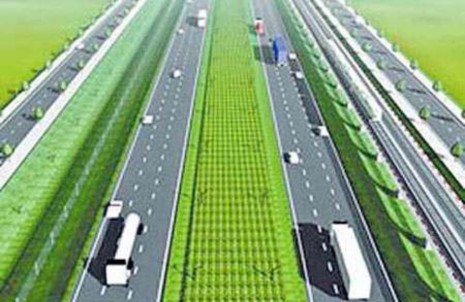
Hanoi – Hai Phong Expressway Project, Photo by Duc Thang
+ Form of capital mobilization: According to Decision No. 1621/QD-TTg of the Prime Minister "On some mechanisms and policies for pilot investment in the Hanoi - Hai Phong Expressway Project", the Infrastructure Development and Financial Investment Corporation
Vietnam (VIDIFI) is the project investor under the BOT contract form. VIDIFI has a charter capital of 5,000 billion VND, of which the Vietnam Development Bank (VDB) holds 51%. This is a national key project, but the capital is mobilized from society (including foreign loans), and the works around the project are used to recover capital: Industrial parks, urban areas, when the project is completed, put into use, organize toll collection to recover capital for about 35 years, then hand it over to the State for management.
Table 3.10. Main technical parameters of the Project.
STT
Technical specifications name | Unit | Specifications | |
1 | Rank | Class A highway | |
2 | Calculation speed | km/hour | 120 |
3 | Number of design lanes | Lane | 6 |
4 | Roadbed width | meter | 35 |
5 | Vehicle running area (6 lanes x 3.75m) | meter | 22.5 |
6 | Median strip | meter | 3.0 |
7 | Safety strip 2 x 0.75 m/side | meter | 1.5 |
8 | Emergency stop lane (both sides: 2 x 3.0m/side) | meter | 6.0 |
9 | Land curb (2 x 1.0 m on both sides of the road, side) | meter | 2.0 |
10 | Minimum curve radius | meter | 650 |
11 | Design hydrological frequency | % | P= 1% |
12 | Design loads of bridges | HL.93, pedestrian 300kg/m2 | |
13 | Earthquake level calculation | Grant | 7 and 8 |
14 | Bridge width on highway | meter | 35 |
15 | Asphalt concrete highway surface structure | Eyc | >= 237.5 Mpa |
16 | Other contents according to the Construction Investment Project approved construction |
Maybe you are interested!
-
 Solutions for tourism development in Tien Lang - 10
zt2i3t4l5ee
zt2a3gstourism, tourism development
zt2a3ge
zc2o3n4t5e6n7ts
- District People's Committees and authorities of communes with tourist attractions should support, promote, and provide necessary information to people, helping them improve their knowledge about tourism. Raise tourism awareness for local people.
*
* *
Due to limited knowledge and research time, the thesis inevitably has shortcomings. Therefore, I look forward to receiving guidance from teachers, experts as well as your comments to make the thesis more complete.
Chapter III Conclusion
Through the issues presented in Chapter II, we can come to some conclusions:
Based on the strengths of available tourism resources, the types of tourism in Tien Lang that need to be promoted in the coming time are sightseeing and resort tourism, discovery tourism, weekend tourism. To improve the quality and diversify tourism products, Tien Lang district needs to combine with local cultural tourism resources, at the same time combine with surrounding areas, build rich tourism products. The strengths of Tien Lang tourism are eco-tourism and cultural tourism, so developing Tien Lang tourism must always go hand in hand with restoring and preserving types of cultural tourism resources. Some necessary measures to support and improve the efficiency of exploiting tourism resources in Tien Lang are: strengthening the construction of technical facilities and labor force serving tourism, actively promoting and advertising tourism, and expanding forms of capital mobilization for tourism development.
CONCLUDE
I Conclusion
1. Based on the results achieved within the framework of the thesis's needs, some basic conclusions can be drawn as follows:
Tien Lang is a locality with great potential for tourism development. The relatively abundant cultural tourism resources and ecological tourism resources have great appeal to tourists. Based on this potential, Tien Lang can build a unique tourism industry that is competitive enough with other localities within Hai Phong city and neighboring areas.
In recent years, the exploitation of the advantages of resources to develop tourism and build tourist routes in Tien Lang has not been commensurate with the available potential. In terms of quantity, many resource objects have not been brought into the purpose of tourism development. In terms of time, the regular service time has not been extended to attract more visitors. Infrastructure and technical facilities are still weak. The labor force is still thin and weak in terms of expertise. Tourism programs and routes have not been organized properly, the exploitation content is still monotonous, so it has not attracted many visitors. Although resources have not been mobilized much for tourism development, they are facing the risk of destruction and degradation.
2. Based on the results of investigation, analysis, synthesis, evaluation and selective absorption of research results of related topics, the thesis has proposed a number of necessary solutions to improve the efficiency of exploiting tourism resources in Tien Lang such as: promoting the restoration and conservation of tourism resources, focusing on investment and key exploitation of ecotourism resources, strengthening the construction of infrastructure and tourism workforce. Expanding forms of capital mobilization. In addition, the thesis has built a number of tourist routes of Hai Phong in which Tien Lang tourism resources play an important role.
Exploiting Tien Lang tourism resources for tourism development is currently facing many difficulties. The above measures, if applied synchronously, will likely bring new prospects for the local tourism industry, contributing to making Tien Lang tourism an important economic sector in the district's economic structure.
REFERENCES
1. Nhuan Ha, Trinh Minh Hien, Tran Phuong, Hai Phong - Historical and cultural relics, Hai Phong Publishing House, 1993
2. Hai Phong City History Council, Hai Phong Gazetteer, Hai Phong Publishing House, 1990.
3. Hai Phong City History Council, History of Tien Lang District Party Committee, Hai Phong Publishing House, 1990.
4. Hai Phong City History Council, University of Social Sciences and Humanities, VNU, Hai Phong Place Names Encyclopedia, Hai Phong Publishing House. 2001.
5. Law on Cultural Heritage and documents guiding its implementation, National Political Publishing House, Hanoi, 2003.
6. Tran Duc Thanh, Lecture on Tourism Geography, Faculty of Tourism, University of Social Sciences and Humanities, VNU, 2006
7. Hai Phong Center for Social Sciences and Humanities, Some typical cultural heritages of Hai Phong, Hai Phong Publishing House, 2001
8. Nguyen Ngoc Thao (editor-in-chief, Tourism Geography, Hai Phong Publishing House, two volumes (2001-2002)
9. Nguyen Minh Tue and group of authors, Hai Phong Tourism Geography, Ho Chi Minh City Publishing House, 1997.
10. Nguyen Thanh Son, Hai Phong Tourism Territory Organization, Associate Doctoral Thesis in Geological Geography, Hanoi, 1996.
11. Decision No. 2033/QD – UB on detailed planning of Tien Lang town, Hai Phong city until 2020.
12. Department of Culture, Information, Hai Phong Museum, Hai Phong relics
- National ranked scenic spot, Hai Phong Publishing House, 2005. 13. Tien Lang District People's Committee, Economic Development Planning -
Culture - Society of Tien Lang district to 2010.
14.Website www.HaiPhong.gov.vn
APPENDIX 1
List of national ranked monuments
STT
Name of the monument
Number, year of decisiondetermine
Location
1
Gam Temple
938 VH/QĐ04/08/1992
Cam Khe Village- Toan Thang commune
2
Doc Hau Temple
9381 VH/QĐ04/08/1992
Doc Hau Village –Toan Thang commune
3
Cuu Doi Communal House
3207 VH/QĐDecember 30, 1991
Zone II of townTien Lang
4
Ha Dai Temple
938 VH/QĐ04/08/1992
Ha Dai Village –Tien Thanh commune
APPENDIX II
STT
Name of the monument
Number, year of decision
Location
1
Phu Ke Pagoda Temple
178/QD-UBJanuary 28, 2005
Zone 1 - townTien Lang
2
Trung Lang Temple
178/QD-UBJanuary 28, 2005
Zone 4 – townTien Lang
3
Bao Khanh Pagoda
1900/QD-UBAugust 24, 2006
Nam Tu Village -Kien Thiet commune
4
Bach Da Pagoda
1792/QD-UB11/11/2002
Hung Thang Commune
5
Ngoc Dong Temple
177/QD-UBNovember 27, 2005
Tien Thanh Commune
6
Tomb of Minister TSNhu Van Lan
2848/QD-UBSeptember 19, 2003
Nam Tu Village -Kien Thiet commune
7
Canh Son Stone Temple
2160/QD-UBSeptember 19, 2003
Van Doi Commune –Doan Lap
8
Meiji Temple
2259/QD-UBSeptember 19, 2002
Toan Thang Commune
9
Tien Doi Noi Temple
477/QD-UBSeptember 19, 2005
Doan Lap Commune
10
Tu Doi Temple
177/QD-UBJanuary 28, 2005
Doan Lap Commune
11
Duyen Lao Temple
177/QD-UBJanuary 28, 2005
Tien Minh Commune
12
Dinh Xuan Uc Pagoda
177/QD-UBJanuary 28, 2005
Bac Hung Commune
13
Chu Khe Pagoda
177/QD-UBJanuary 28, 2005
Hung Thang Commune
14
Dong Dinh
2848/QD-UBNovember 21, 2002
Vinh Quang Commune
15
President's Memorial HouseTon Duc Thang
177/QD-UBJanuary 28, 2005
NT Quy Cao
Ha Dai Temple
Ben Vua Temple
Tien Lang hot spring
div.maincontent .p { color: black; font-family:"Times New Roman", serif; font-style: normal; font-weight: normal; text-decoration: none; font-size: 14pt; margin:0pt; } div.maincontent p { color: black; font-family:"Times New Roman", serif; font-style: normal; font-weight: normal; text-decoration: none; font-size: 14pt; margin:0pt; } div.maincontent .s1 { color: black; font-family:"Times New Roman", serif; font-style: normal; font-weight: normal; font-size: 16pt; } div.maincontent .s2 { color: black; font-family:"Times New Roman", serif; font-style: italic; font-weight: bold; text-decoration: none; font-size: 14pt; } div.maincontent .s3 { color: black; font-family:"Times New Roman", serif; font-style: italic; font-weight: normal; text-decoration: none; font-size: 14pt; } div.maincontent .s4 { color: black; font-family:"Times New Roman", serif; font-style: normal; font-weight: normal; font-size: 14pt; } div.maincontent .s5 { color: black; font-family:"Times New Roman", serif; font-style: normal; font-weight: bold; font-size: 14pt; } div.maincontent .s6 { color: black; font-family:"Times New Roman", serif; font-style: normal; font-weight: normal; text-decoration: none; font-size: 14pt; } div.maincontent .s7 { color: black; font-family:"Times New Roman", serif; font-style: normal; font-weight: bold; text-decoration: none; font-size: 14pt; } div.maincontent .s8 { color: black; font-family:"Times New Roman", serif; font-style: normal; font-weight: normal; text-decoration: none; font-size: 9pt; vertical-align: 6pt; } div.maincontent .s9 { color: black; font-family:"Times New Roman", serif; font-style: normal; font-weight: bold; text-decoration: none; font-size: 12pt; } div.maincontent .s11 { color: black; font-family:"Times New Roman", serif; font-style: normal; font-weight: normal; tex
Solutions for tourism development in Tien Lang - 10
zt2i3t4l5ee
zt2a3gstourism, tourism development
zt2a3ge
zc2o3n4t5e6n7ts
- District People's Committees and authorities of communes with tourist attractions should support, promote, and provide necessary information to people, helping them improve their knowledge about tourism. Raise tourism awareness for local people.
*
* *
Due to limited knowledge and research time, the thesis inevitably has shortcomings. Therefore, I look forward to receiving guidance from teachers, experts as well as your comments to make the thesis more complete.
Chapter III Conclusion
Through the issues presented in Chapter II, we can come to some conclusions:
Based on the strengths of available tourism resources, the types of tourism in Tien Lang that need to be promoted in the coming time are sightseeing and resort tourism, discovery tourism, weekend tourism. To improve the quality and diversify tourism products, Tien Lang district needs to combine with local cultural tourism resources, at the same time combine with surrounding areas, build rich tourism products. The strengths of Tien Lang tourism are eco-tourism and cultural tourism, so developing Tien Lang tourism must always go hand in hand with restoring and preserving types of cultural tourism resources. Some necessary measures to support and improve the efficiency of exploiting tourism resources in Tien Lang are: strengthening the construction of technical facilities and labor force serving tourism, actively promoting and advertising tourism, and expanding forms of capital mobilization for tourism development.
CONCLUDE
I Conclusion
1. Based on the results achieved within the framework of the thesis's needs, some basic conclusions can be drawn as follows:
Tien Lang is a locality with great potential for tourism development. The relatively abundant cultural tourism resources and ecological tourism resources have great appeal to tourists. Based on this potential, Tien Lang can build a unique tourism industry that is competitive enough with other localities within Hai Phong city and neighboring areas.
In recent years, the exploitation of the advantages of resources to develop tourism and build tourist routes in Tien Lang has not been commensurate with the available potential. In terms of quantity, many resource objects have not been brought into the purpose of tourism development. In terms of time, the regular service time has not been extended to attract more visitors. Infrastructure and technical facilities are still weak. The labor force is still thin and weak in terms of expertise. Tourism programs and routes have not been organized properly, the exploitation content is still monotonous, so it has not attracted many visitors. Although resources have not been mobilized much for tourism development, they are facing the risk of destruction and degradation.
2. Based on the results of investigation, analysis, synthesis, evaluation and selective absorption of research results of related topics, the thesis has proposed a number of necessary solutions to improve the efficiency of exploiting tourism resources in Tien Lang such as: promoting the restoration and conservation of tourism resources, focusing on investment and key exploitation of ecotourism resources, strengthening the construction of infrastructure and tourism workforce. Expanding forms of capital mobilization. In addition, the thesis has built a number of tourist routes of Hai Phong in which Tien Lang tourism resources play an important role.
Exploiting Tien Lang tourism resources for tourism development is currently facing many difficulties. The above measures, if applied synchronously, will likely bring new prospects for the local tourism industry, contributing to making Tien Lang tourism an important economic sector in the district's economic structure.
REFERENCES
1. Nhuan Ha, Trinh Minh Hien, Tran Phuong, Hai Phong - Historical and cultural relics, Hai Phong Publishing House, 1993
2. Hai Phong City History Council, Hai Phong Gazetteer, Hai Phong Publishing House, 1990.
3. Hai Phong City History Council, History of Tien Lang District Party Committee, Hai Phong Publishing House, 1990.
4. Hai Phong City History Council, University of Social Sciences and Humanities, VNU, Hai Phong Place Names Encyclopedia, Hai Phong Publishing House. 2001.
5. Law on Cultural Heritage and documents guiding its implementation, National Political Publishing House, Hanoi, 2003.
6. Tran Duc Thanh, Lecture on Tourism Geography, Faculty of Tourism, University of Social Sciences and Humanities, VNU, 2006
7. Hai Phong Center for Social Sciences and Humanities, Some typical cultural heritages of Hai Phong, Hai Phong Publishing House, 2001
8. Nguyen Ngoc Thao (editor-in-chief, Tourism Geography, Hai Phong Publishing House, two volumes (2001-2002)
9. Nguyen Minh Tue and group of authors, Hai Phong Tourism Geography, Ho Chi Minh City Publishing House, 1997.
10. Nguyen Thanh Son, Hai Phong Tourism Territory Organization, Associate Doctoral Thesis in Geological Geography, Hanoi, 1996.
11. Decision No. 2033/QD – UB on detailed planning of Tien Lang town, Hai Phong city until 2020.
12. Department of Culture, Information, Hai Phong Museum, Hai Phong relics
- National ranked scenic spot, Hai Phong Publishing House, 2005. 13. Tien Lang District People's Committee, Economic Development Planning -
Culture - Society of Tien Lang district to 2010.
14.Website www.HaiPhong.gov.vn
APPENDIX 1
List of national ranked monuments
STT
Name of the monument
Number, year of decisiondetermine
Location
1
Gam Temple
938 VH/QĐ04/08/1992
Cam Khe Village- Toan Thang commune
2
Doc Hau Temple
9381 VH/QĐ04/08/1992
Doc Hau Village –Toan Thang commune
3
Cuu Doi Communal House
3207 VH/QĐDecember 30, 1991
Zone II of townTien Lang
4
Ha Dai Temple
938 VH/QĐ04/08/1992
Ha Dai Village –Tien Thanh commune
APPENDIX II
STT
Name of the monument
Number, year of decision
Location
1
Phu Ke Pagoda Temple
178/QD-UBJanuary 28, 2005
Zone 1 - townTien Lang
2
Trung Lang Temple
178/QD-UBJanuary 28, 2005
Zone 4 – townTien Lang
3
Bao Khanh Pagoda
1900/QD-UBAugust 24, 2006
Nam Tu Village -Kien Thiet commune
4
Bach Da Pagoda
1792/QD-UB11/11/2002
Hung Thang Commune
5
Ngoc Dong Temple
177/QD-UBNovember 27, 2005
Tien Thanh Commune
6
Tomb of Minister TSNhu Van Lan
2848/QD-UBSeptember 19, 2003
Nam Tu Village -Kien Thiet commune
7
Canh Son Stone Temple
2160/QD-UBSeptember 19, 2003
Van Doi Commune –Doan Lap
8
Meiji Temple
2259/QD-UBSeptember 19, 2002
Toan Thang Commune
9
Tien Doi Noi Temple
477/QD-UBSeptember 19, 2005
Doan Lap Commune
10
Tu Doi Temple
177/QD-UBJanuary 28, 2005
Doan Lap Commune
11
Duyen Lao Temple
177/QD-UBJanuary 28, 2005
Tien Minh Commune
12
Dinh Xuan Uc Pagoda
177/QD-UBJanuary 28, 2005
Bac Hung Commune
13
Chu Khe Pagoda
177/QD-UBJanuary 28, 2005
Hung Thang Commune
14
Dong Dinh
2848/QD-UBNovember 21, 2002
Vinh Quang Commune
15
President's Memorial HouseTon Duc Thang
177/QD-UBJanuary 28, 2005
NT Quy Cao
Ha Dai Temple
Ben Vua Temple
Tien Lang hot spring
div.maincontent .p { color: black; font-family:"Times New Roman", serif; font-style: normal; font-weight: normal; text-decoration: none; font-size: 14pt; margin:0pt; } div.maincontent p { color: black; font-family:"Times New Roman", serif; font-style: normal; font-weight: normal; text-decoration: none; font-size: 14pt; margin:0pt; } div.maincontent .s1 { color: black; font-family:"Times New Roman", serif; font-style: normal; font-weight: normal; font-size: 16pt; } div.maincontent .s2 { color: black; font-family:"Times New Roman", serif; font-style: italic; font-weight: bold; text-decoration: none; font-size: 14pt; } div.maincontent .s3 { color: black; font-family:"Times New Roman", serif; font-style: italic; font-weight: normal; text-decoration: none; font-size: 14pt; } div.maincontent .s4 { color: black; font-family:"Times New Roman", serif; font-style: normal; font-weight: normal; font-size: 14pt; } div.maincontent .s5 { color: black; font-family:"Times New Roman", serif; font-style: normal; font-weight: bold; font-size: 14pt; } div.maincontent .s6 { color: black; font-family:"Times New Roman", serif; font-style: normal; font-weight: normal; text-decoration: none; font-size: 14pt; } div.maincontent .s7 { color: black; font-family:"Times New Roman", serif; font-style: normal; font-weight: bold; text-decoration: none; font-size: 14pt; } div.maincontent .s8 { color: black; font-family:"Times New Roman", serif; font-style: normal; font-weight: normal; text-decoration: none; font-size: 9pt; vertical-align: 6pt; } div.maincontent .s9 { color: black; font-family:"Times New Roman", serif; font-style: normal; font-weight: bold; text-decoration: none; font-size: 12pt; } div.maincontent .s11 { color: black; font-family:"Times New Roman", serif; font-style: normal; font-weight: normal; tex -
 Solutions to enhance capital mobilization at Lien Viet Post Joint Stock Commercial Bank - Hai Phong Branch - 9
 -
 Perfecting mechanisms and policies to attract foreign direct investment in Hanoi capital in the period 2001-2010 - 28
 -
 Domestic Research on Project Investment Management Using State Budget Capital.
 -
 Total Investment Capital of Phu My 2.2 Thermal Power Plant Project