
Then calculate the actual price of the warehouse.
Actual price
=
Maybe you are interested!
-

 Completing the accounting of raw materials at Son Thuy Production and Trading Joint Stock Company - 1
 -
 Completing the accounting of raw materials for yarn production at Ha Nam Textile Company - 9
 -
 Completing the accounting of raw materials at Thai Hoa Production and Trading Company Limited - 2
 -
![Biogas Production Ability of Some Raw Materials [1]](https://tailieuthamkhao.com/uploads/2022/10/17/nghien-cuu-qua-trinh-chay-va-phat-thai-o-nhiem-dong-co-hybrid-biogas-xang-4-1-120x90.png) Biogas Production Ability of Some Raw Materials [1]
Biogas Production Ability of Some Raw Materials [1] -
 Completing the management and supply of raw materials at the training equipment manufacturing factory X55 - 7
materials out of stock
Accounting price of
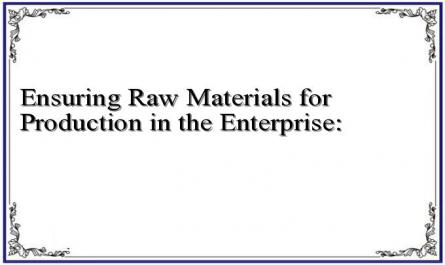
Material out of stock x Price coefficient
Depending on the characteristics, requirements and management level of the enterprise, the price coefficient can be calculated separately for each item, each group or for the entire type of material of the enterprise.
This method reduces the daily calculation workload and is suitable for businesses with large inventories and many types of materials.
II. CONTENT OF MATERIALS MANAGEMENT WORK IN
BUSINESS:
1. Building consumption standards :
1.1. Concept:
Material consumption level is the maximum amount of raw materials allowed to produce a unit of product or to complete a certain job under certain organizational and technical conditions.
Establishing accurate material consumption norms and applying them in production is the most important measure to save materials based on strict management of material usage. Material consumption norms are also the basis for planning material supply and usage, creating conditions for economic accounting and promoting emulation movements and practicing thrift in enterprises.
1.2 Method of determining raw material consumption standards:
The method of determining the consumption of raw materials has a decisive influence on the quality of the determined level.
Depending on the technical and economic characteristics and specific conditions of each enterprise, choose the appropriate construction method. In practice, the following construction methods are appropriate for material consumption.
1.2.1. Statistical and empirical norming method:
This method is based on two bases: statistical data on raw material consumption of the reporting period, the experiences of advanced workers, and then using the weighted average method to determine and set standards.
Advantages: simple to use, can be done quickly, service
in time for production
Disadvantages: less scientific and accurate.
1.2.2. Experimental method:
It is a method based on laboratory results combined with certain production conditions to check modifications and calculated results to conduct trial production to determine the level for the plan.
Advantages: More accurate and scientific than statistical methods.
Disadvantages: Not all factors affecting the standard have been analyzed and still depend on the laboratory, may not be suitable for production conditions.
1.2.3. Analytical method: It is a combination of economic and technical calculations with the analysis of factors affecting the consumption of raw materials, so it is carried out in two steps.
Step 1: Collect and research documents, especially on product design, material characteristics, equipment quality, worker skills...
Step 2: Analyze each component in the standard structure and calculate the coefficient.
Use and propose measures to strive to reduce the level in the planning period.
Advantages: Scientific and highly accurate, providing the most reasonable consumption level. Moreover, when using this method, the consumption level is always in a state of improvement.
Disadvantages: It requires a relatively large amount of comprehensive and accurate information, which means that the information work in the enterprise must be well organized. Another obvious thing is that such an amount of information requires a team of highly qualified and capable information processors, but in any case, this is the most advanced method.
2. Ensuring raw materials for production in the enterprise :
Ensuring the integrity of quantity and quality of raw materials is essential in a business because it is where the company's components are gathered before being put into production and consumption.
2.1 Determine the amount of raw materials needed:
Originating from the characteristics of product diversity and the production process of each project is different. This shows that to ensure the production process and product quality of the company, a relatively large amount of materials must be used, diverse in types. For each different product, the product entity is different.
For example, for road and bridge production, the main raw material is cement.
iron, steel, bricks and stones.
For the glass frame installation team, the main materials are aluminum frames, glass, corrugated iron...
q (mdk) = Error!
In which: M is the actual volume of raw materials in reserve at the beginning of the period.
and plan.
mk : consumption level of raw materials for production of product units in the accounting period
plan
q (mck) = Error!
In there:
M ck1 , Mckk: Actual and estimated quantity of raw materials in stock at the end of the period
plan.
2.2 Determine the amount of raw materials to be stored:
- In construction enterprises: the main products are construction works. When construction works are started, the volume of raw materials is often transferred directly to the construction works for direct construction.
However, to avoid fluctuations in raw materials, storage should be
Raw materials are essential.
- Enterprises can apply the following reserve methods:
2.2.1 Regular reserves:
Regular reserves are reserves to ensure the production process.
occurs continuously under normal supply conditions.
Regular reserve of each type is calculated by the formula: DTtx = Tcu DMth
In which: DTtx: Regular reserve.
often
Tcu: Time, date of supply under normal conditions
DMth: Usage rate (consumption in one day)
2.2.2 Insurance reserves:
Insurance reserves are reserves to ensure the production process.
Production is carried out continuously under abnormal supply conditions. To determine the reserve level, the following bases can be used:
+The level of physical damage caused by raw materials.
+ Statistics on the number of times, amount of materials and number of days that
The supplier did not deliver on time.
+ Forecasts of future fluctuations.
The insurance reserve salary of each type can be calculated by a simple formula.
simple as follows:
DTbh = t sl DM th In which:
DTbh: Amount of raw materials regularly stored
t sl : Delivery time deviation from event DMth : Standard in one day
2.2.3 Minimum required reserve:
For normal operations to be carried out under all calculated business conditions, the minimum amount of raw materials required to be stored is equal to the sum of regular reserves and insurance reserves.
DTttct = DTtx + DTbh .
In which the minimum reserve required
In addition, seasonal businesses will have to determine additional seasonal reserves.
2.2.4. Seasonal on-call duty.
Seasonal reserves ensure the continuity of production and business, especially during lean periods for raw materials. Seasonal production enterprises such as tobacco, sugarcane, tea, etc.
Material reserves are calculated according to 3 criteria:
- Absolute reserves: Is the volume of each type of main material, expressed as
expressed in physical units, such as tons, kg, m, m 2 ...
Absolute reserves are essential to help businesses organize
Organize, build and perfect the warehouse system
- Relative reserve: Calculated by the number of reserve days.
Relative reserve quantity only shows the quantity of reserved materials to ensure that the production and business of the enterprise can be carried out continuously for how many days the enterprise can carry out continuously. Relative reserve of materials is very necessary, helping to analyze the reserve situation of the main materials in the enterprise.
Absolute reserves and relative reserves are closely related to each other, through the average consumption (or supply) level of materials for one day and night.
If the symbol:
M - Absolute reserve.
t- relative reserve
m - level of material consumption for production in one day and night.
Then
M = t . m or : t = Error!
- Reserve expressed in money: Is the quantity of reserve materials expressed in value, equal to the product between the absolute quantity of reserve materials and the unit price of purchasing materials.
Reserve indicators expressed in money are essential for determining demand.
working capital needs and material supply situation.
Analysis method: Compare the actual quantity of materials in reserve by type with the quantity of materials that need to be in reserve. Too high or too low is not good. If the reserve is too high, it will cause capital congestion. In fact, reserve is dead capital during the time waiting to be put into production.
2.3 Determine the amount of raw materials to purchase:
Based on the monthly and quarterly production plan and the approved material demand book, the production and business plan seeks suitable supply sources to ensure materials of the right quality, sufficient quantity, and reasonable price.
3. Develop a plan for purchasing raw materials :
Depending on the field of operation, it is necessary to build a purchasing plan to avoid sudden fluctuations in raw materials in the present and in the future.
3.1 In the present: It is necessary to build a tight plan, need to carefully study the market and from there develop a plan to purchase raw materials: what to buy, where to buy...
3.2 in the future: Based on the ability to rely on future plans, businesses must build for themselves specific, tight plans so that when constructing production facilities, there will be no cases of lack of raw materials causing work to be interrupted, leading to reduced profits for the business.
4. Organize the purchase and receipt of raw materials.
4.1 Purchasing organization:
+ Check quality and quantity of raw materials
+Organization of raw material warehouse.
+ Organize and arrange raw materials
4.2 Organization of receiving raw materials:
Receive the exact quantity, quality, and type of raw materials according to the regulations in the contract, delivery note, and shipping note.
Quickly transfer raw materials from the receiving location to the enterprise warehouse, avoiding damage and loss. On the other hand, the work of receiving raw materials must thoroughly follow the following requirements.
+All received goods and materials must have full valid documents.
+All received materials must undergo full inspection and testing procedures.
+ Accurately determine quantity, quality and type
+ There must be a record confirming that there is any excess, shortage or incorrect specification.
Good reception organization enables the warehouse keeper to grasp the quantity, quality and type of materials, promptly detect material shortages, and limit possible irresponsible mistakes.
5. Organization of raw material preservation:
To preserve raw materials well, it is necessary to have a reasonable warehouse system. Each warehouse must be suitable for each type of raw material, so it is necessary to classify raw materials and arrange them in each warehouse with reasonable external impact conditions.
6. Organization of material distribution: