
3
IV. Instructions for using the program
1. Scope of application of the curriculum
This program is for students of skilled workers specializing in seafood processing and preservation and is also used as a reference for the food processing industry.
Maybe you are interested!
-
![Experience in Bank Marketing Activities in Some Countries [4] & [24]](https://tailieuthamkhao.com/en/uploads/2024/08/22/experience-in-bank-marketing-activities-in-some-countries-4-24-120x90.jpg)
![Experience in Bank Marketing Activities in Some Countries [4] & [24]](data:image/svg+xml,%3Csvg%20xmlns=%22http://www.w3.org/2000/svg%22%20viewBox=%220%200%2075%2075%22%3E%3C/svg%3E) Experience in Bank Marketing Activities in Some Countries [4] & [24]
Experience in Bank Marketing Activities in Some Countries [4] & [24] -
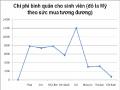 Compare Annual Expenditures for Education Based on Purchasing Power Parity
 -
 Accounting for production costs and product pricing of P&G Advertising and Trading Company Limited - 1
 -
 Current Status of Organizing and Preserving Document Capital at the Information Center - Library of the University of Transport
 -
 The World's Most Populous Continent, Young Population and Growing Purchasing Power
2. Some key points about the modular teaching method
- Each lesson in the module will be taught in the subject room and followed by practical workshop skills training.
- The theory part will be taught in class. After finishing the theory part, students' knowledge will be tested in class.
- Practical training at purchasing facilities and at markets for purchasing and selling aquatic products after students are fully equipped with the theoretical knowledge they have learned. After completing the internship, students are required to write a report on the internship process at the facility and submit it to the teacher for evaluation.
- Before teaching, teachers need to base on the framework program and the actual conditions of the school to prepare a detailed program and full and appropriate teaching content to ensure the quality of teaching and learning.
3. Program highlights to note
+ Classification of aquatic raw materials.
+ Purchase, transport original, determine variable damage
+ Methods of preserving aquatic products.
THEORY SECTION
Chapter I
CLASSIFICATION AND IDENTIFICATION OF AQUATIC MATERIALS
Lesson 1
RESOURCES OF VIETNAMESE AQUACULTURE
A. Objective
Describe the characteristics of Vietnam's seas and the benefits gained from exploitation.
sea.
List the output from exploitation and aquaculture of Vietnamese aquatic products.
B. Main content
1. General characteristics of Vietnam's seas
The land area of Vietnam's sea is nearly 330 thousand km 2 . of which the length of Vietnam's coastline is more than 3,260 km. Compared to the territory, on average, every 100 km 2 of land area has 1 km of coastline. This is a coastline ratio that is not the highest, but is also very high among countries and territories with sea.
Vietnam's coastline stretches from Mong Cai (Quang Ninh) to Ha Tien (Kien Giang) overlooking the Gulf of Tonkin in the North, the Pacific Ocean in the Central region and the Gulf of Thailand in the Southwest. Vietnam's sea area belongs to the fishing grounds of the Central and Western Pacific Ocean, with rich and diverse biological resources, and is one of the fishing grounds with the highest reserves in the world's seas.
In the sea area, there are 4,000 large and small islands, including large inhabited islands such as Van Don, Cat Ba, Phu Quy, Con Dao, Phu Quoc with many bays, coves, straits, inlets, and ocean currents, which are also favorable fishing grounds.
Vietnam has freshwater aquatic resources in 2,860 large and small rivers, millions of hectares of wetlands, lakes, low-lying fields, and mangrove forests, especially in the Red River and Mekong River basins.
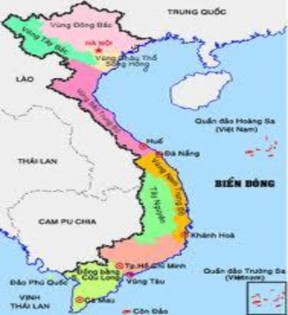
Figure 1.1 Map of Vietnam
2. Total fishery production
Through the ups and downs of development since the late 20th century, the fisheries industry has achieved important results.
As of November 2008, the total export turnover of aquatic products of the whole country reached 4 billion USD. According to the Directorate of Fisheries, the total aquatic product output in 2012 is estimated at 5.8 million tons, an increase of 8.5% compared to 2011, of which, the output of exploitation reached 2.6 million tons, the output of aquaculture reached 3.2 million tons.
Specifically, in terms of aquaculture, the brackish water shrimp farming area is 658 thousand hectares, with an output of 500 thousand tons (up 0.9%). The diseased area is 104 thousand hectares, up 3.2% compared to 2011. The catfish farming area from the beginning of the year to now is 5.6 thousand hectares (up 1.8%). The harvested area is 4.3 thousand hectares. The estimated fish output is 1.19 million tons (up 3.4%), with an average yield of 274 tons/ha. In 2012, the country had 1,529 facilities producing black tiger shrimp seeds, down 319 facilities; there were 185 white-leg shrimp seed facilities, down 71 facilities; more than 37 billion black tiger shrimp and nearly 30 billion white-leg shrimp seeds were produced.
Regarding exploitation, the total output of aquatic products is estimated at 2.6 million tons, up 10.6% over the same period, of which seafood exploitation is estimated at 2.4 million tons (up 9.6%). Currently, the country has about 3,500 groups and teams with about 21,500 participating fishing vessels and 136,000 workers; nearly 20 fishing unions have been established.
The conference also set out the plan for 2013. Accordingly, the total aquatic product output in 2013 reached 5,700 tons, of which exploitation reached 2,400 tons and aquaculture reached 3,300 tons.
Concluding the Conference, Deputy Minister Vu Van Tam assessed that in 2012, the whole industry made efforts and achieved some remarkable results. However, the direction of disease prevention is still not thorough and still recurs. In 2013, it is necessary to focus on doing well the following tasks: in aquaculture, focus on disease control, quality of input materials. In exploitation, reorganize exploitation at sea, complete the investigation of marine resources (large, small, pelagic fish); improve the quality of post-harvest preservation and exploitation. In international cooperation, strengthen cooperation in aquatic exploitation with countries in the region; remove obstacles and barriers in the market... Review policy mechanisms for 5 key subjects (fish
Tra, shrimp, brackish water shrimp, molluscs, tilapia) for planned production, sustainable development, efficiency
3. Sea exploitation capability
In seafood exploitation, from a small-scale, artisanal fishery operating in near-shore areas, it has shifted towards becoming a mechanized fishery that increases exploitation of offshore waters, targeting high-value exploited objects and export objects.
In 2003, fishery exploitation reached 1,426,223 tons.
In 1991, the number of motor boats was 44,347, accounting for 59.6%. By 2003, the total number of motor boats was 83,123. Since then, the proportion of offshore fishing products has increased rapidly, reaching 38.8% in 2003.
4. Aquaculture
Aquaculture has changed from a secondary production profession of a self-sufficient nature to a concentrated commodity production industry with advanced technical level, developing in all freshwater, brackish water and saltwater areas in a sustainable direction, protecting the environment in harmony with other economic sectors.
Aquaculture area increases steadily every year, in 2008 the farming area was 1.05 million hectares.
Aquaculture has gradually become one of the key commodity production industries, widely developed and holding an important position and is moving towards building concentrated production areas.
Along with the remarkable progress of the industry, there are also great difficulties and challenges, which are the process of growth to the process of development. In which, the top task is to improve the quality of development, ensure to meet the requirements of fast, effective, sustainable with high competitiveness, when the Vietnamese seafood industry has a significant scale on the global seafood map, in the unpredictable changes of the world economic picture that we are integrating, in the limitations of resources, warnings, environmental degradation, in the urgent demands linking the development of the industry with the process of industrialization of the country towards modernization, with the shift of economic structure in general and in agriculture in particular, with the reorganization of production to promote more strongly the role of economic sectors, truly participate in hunger eradication, poverty reduction and enriching the country, turning myths into reality, making worthy contributions to building a Vietnam with rich people and strong country.
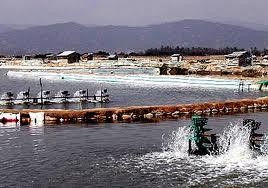
Figure 1.2: Shrimp pond
C. Question
1/ Please describe the characteristics of Vietnam's sea? How is marine exploitation in Vietnam demonstrated?
2/ How is aquaculture represented in Vietnam?
Lesson 2
IDENTIFICATION AND CLASSIFICATION OF AQUATIC MATERIALS
A. Objective
Describe how to identify aquatic animals compared to other animals. Classify aquatic animals according to their habitat.
Describe the characteristics of each type of seafood.
B. Main content
1. Identification of aquatic raw materials
- Contains a very large amount of water compared to body weight, much larger than the meat of land animals.
- Contains many types of enzymes with very high biological activity, so seafood spoils very quickly after being caught.
2. Classification of aquatic raw materials
2.1. Fish classification
2.1.1. Saltwater fish
Mackerel
In our country's sea, there are two types: striped mackerel and spotted mackerel with high productivity.
- Having an elongated shape, striped mackerel has horizontal stripes on its body. Mackerel has more connecting dots on its body than on its belly.
- Exploitation weight 500-1500g. Mackerel is a fish with high economic value, living on the surface and available all year round, especially in spring. Used to process frozen products, canned food, fish sauce.
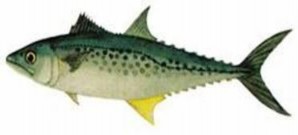
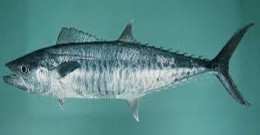
Figure 2.3a: Spotted mackerel Figure 2.3b: Striped mackerel
Tuna
- It is an economic fish belonging to the pelagic fish species. The ripening season is from April to September every year and can appear earlier or later depending on the weather.
- Has a slightly flattened shape. There are many species in our country, only 3 species have been found: beef tuna, skipjack tuna and spotted tuna, of which beef tuna has the highest production.