
Chapter 6
LEADERSHIP, COLLABORATION, PARTNERSHIP ONE HEALTH
6.1. CONCEPT OF LEADERSHIP
Maybe you are interested!
-
 Comparing Some Outstanding Tourist Resources Of Hanoi And Bangkok (Thailand)
 -
 Managing interdisciplinary teaching activities at secondary schools in Doan Hung district, Phu Tho province - 3
 -
 Comparing Electronic Retail Marketplaces and B2B Electronic Marketplaces
 -
 Comparing Student Assessments with Assessments of Lecturers, Training Managers, and Student Managers on Planning Skills
 -
 Comparing Positive and Negative Characteristics of Satisfaction
Leadership is the ability to build and share a common vision, inspire and motivate those who work with you, pioneer collaborative solutions by making strategic, critical decisions, and commit to contributing to a multi-sectoral approach to addressing One Health challenges.
Leadership plays a vital role in achieving organizational success. Good leaders are strategic and systematic, setting goals and strategies for the entire team and One Health organization. They can maximize the potential of their subordinates, assess the capabilities and performance of each individual, and then influence individuals to improve their work. Leadership is also demonstrated in the role of advocacy, creating partnerships, and promoting collaboration within a One Health team. This is evident in the ability to create and communicate a shared vision across sectors and disciplines, foster mutual respect among different professionals within a One Health team, and use change management strategies to guide people or teams to accept new ideas.
One of the most important roles of leadership is the ability to make decisions to achieve cooperation or consensus among multidisciplinary teams. From there, it creates solutions for cooperation and mutual trust, as well as long-term commitment to work throughout the process of dealing with an outbreak. In addition, the ability to support “team commitment” also helps the leader motivate the team to deal with the outbreak, work together to achieve the team's agreed goals. Team commitment will create a favorable environment for the participation and commitment of members, energizing the goal commitment among
©2017 One Health Curriculum
123
industry and sector, and mobilize, train and guide others from many fields. The goal of leaders is to develop groups or teams that function most effectively by always monitoring and supporting group members to perform tasks and paying attention to some basic aspects: Making all members clearly understand the goals and objectives of the group or organization; Being flexible in how group members also coordinate to achieve the goals; Communicating effectively and understanding group members; Having a strategy for making effective decisions, ensuring the commitment of members to important group decisions; For the development of the group, the leader can share, assign responsibilities in accordance with the abilities and consensus of group members; Developing group cohesion while maintaining the necessary measures to ensure individual freedom; Focusing on using the different abilities of group members; Maintain a healthy balance between emotions and work - bring emotions into the team's work results.
Leadership is not one-size-fits-all. There are many different leadership styles, each with its own strengths and weaknesses. Each style can be more or less effective depending on the situation. There is no standard style for a leader. The leadership style that a One Health practitioner adopts will depend on the people they lead, the work they do, and the environment in which they work. Leaders should adapt their style to suit each situation or group. That is why leadership competencies are useful to gain a thorough understanding of different leadership styles so that leaders can shape, adapt and flexibly lead in different situations.
Some typical leadership styles are authoritative, democratic, laissez-faire, leader, friendly cooperation, etc. For example, authoritative leadership is a style in which leaders have a lot of power over their subordinates. Employees and team members have little opportunity to make suggestions and opinions even when those suggestions are beneficial to the team. The advantage of authoritative leadership is that decisions are made quickly, and work is done effectively. The disadvantage is that the leader will not receive support from team members. However, in some cases where decisions need to be made quickly and decisively, such as dealing with rapidly spreading and complex epidemics, this style will be highly effective.
6.2. CONCEPT OF COOPERATION
Collaboration is the process of two or more people, two or more organizations working together to accomplish something effectively.
One of the challenges facing the world today is the issue of cooperation and partnership. Cooperation and partnership between countries, cooperation and partnership between organizations, cooperation and partnership in the fields of economics, agriculture, finance, etc.
Cooperation is also the cause of success, but sometimes it is also the cause of contradictions and conflicts. According to existing definitions, cooperation means working together, building together, thinking together, having something in common to be able to work together equally (sharing), without misunderstandings, the ultimate goal is success:
Operational objectives
Share personal ideas
Unanimity of opinion, no contradiction or disagreement
Take action
Achieve success
Figure 6.1 . Diagram of cooperation for success
However, in reality, people do not tend to work together naturally and comfortably, but the motivations for working together of individuals and organizations are very complex and diverse. They often work together for a number of reasons, conditions or even due to some pressure. This can be seen in many different areas of cooperation such as political cooperation, economic cooperation, military cooperation, medical cooperation, etc. Some of the reasons that force individuals or organizations to cooperate with each other are:
• They are required to go through the government or comply with the law.
• Cooperate to exercise power or control over other people or organizations.
• Cooperate to achieve greater efficiency in the use of scarce resources.
• Cooperation to reduce transaction costs of organizational forms.
• Cooperate to seek stability by sharing risks.
• Collaborate to enhance their reputation, image or profile.
• Cooperation to access new resources.
• Collaborate to promote individual and organizational learning.
It is clear that when individuals and organizations collaborate, they both gain and profit. The potential benefits of collaboration are often compelling, including sharing ideas, knowledge, and resources to achieve collective synergies that organizations and individuals could not create independently.
In general, working cooperation includes the following contents:
• Shared purpose: Working together to achieve common goals.
• Shared needs: Achieving a common goal requires combining the skills, resources and ideas of all parties.
• Communicate openly and listen actively.
• Mutual support: Coordinate actions and negotiate effectively within a group.
In fact, the participation of many different sectors in a working group is increasingly mentioned and emphasized, especially in the field of medicine, including medical research, health care services, medical training and health policy development with other sectors such as industry, agriculture, transport and other departments.
6.3. METHODS OF COLLABORATION IN ONE HEALTH
To achieve effective cooperation in One Health, we need to understand the term “sector”. The term “sector” is a separate scientific field of knowledge, education, training and other activities, serving economic and social development.
Nowadays, many activities in many fields involve different industries, bringing great value and benefits to the parties involved.
For example: In hospitals, emergency teams or treatment teams are established with the participation of medical staff from many different specialties (specialties). The organization of universities always has to have many functional departments, specialized faculties, research institutes, centers... with different fields, specialties, many departments with many different teaching programs... Obviously, there is always cooperation between the sectors in the same organizational structure as well as activities in all fields, with the ultimate goal of achieving the set goals.
In One Health, the terms multidisciplinary, interdisciplinary and transdisciplinary have been used to denote different forms of collaboration to jointly produce a product or address a goal. However, the use of these terms remains unclear and often confusing.
So, what is multi-sectoral, interdisciplinary and transdisciplinary collaboration? What are the similarities and differences between these levels (forms) of collaboration? What level of collaboration is One Health currently focusing on, and what are the difficulties and challenges?
Figure 6.2. Models of forms of cooperation between sectors, multi-sectors, interdisciplinary and cross- sectors
(Source: Bill Dennison, 1996)
Multidisciplinarity is the combination of several relevant disciplines to redefine problems outside conventional boundaries and achieve solutions based on new understandings of complex situations. Research teams, in which members from different disciplines work together on a conventional problem in limited interaction (Grossman, 1979).
According to Klein, multidisciplinarity is a process of forming bridges between disciplines, without integration.
Example 1: In a multidisciplinary team dealing with child malnutrition, members (including nutritionists, social workers, health educators, psychologists, etc.) act as independent experts, with absolutely no interaction with each other to solve the problem. Through a multidisciplinary approach, several disciplines come together, with experts from different disciplines working together on different aspects of the same problem (in this particular case, malnutrition) rather than a general integration. The result is a connection between the outputs of the disciplines, edited and put together in a logical way. The One Health Coordination Team includes experts from all disciplines.
Example 2: When an avian influenza outbreak occurs in the area, it requires the cooperation of many different functional sectors, the participation of the entire system including: veterinary, preventive medicine, youth union, women's union, media, finance... to prevent the epidemic from spreading to other poultry flocks, to humans, and to resolve the damage caused by the epidemic.
In short, the characteristic of multidisciplinary cooperation is not to seek to integrate many related fields but rather that the members work together. This cooperation still shows certain barriers, which are:
• Time pressure: This is usually the most important issue in One Health, when schools, institutes, and government agencies coordinate to organize an activity or implement a certain One Health issue, the agency in charge
Organizations not only have to do their job, but also have to spend time connecting, communicating or responding to changes if any from other partners.
• Disciplinary differences: Collaboration is intended to share knowledge and compare results from across fields, rather than to attempt to cross disciplinary boundaries or create new knowledge.
Interdisciplinary is the combination of two or more disciplines or fields, necessary in a particular activity. For example : When nuclear physics is combined with medicine, it will lead to new treatments for cancer; research on the epidemiology of AIDS or global warming requires the cooperation of many disciplines, the ultimate goal is to solve a problem or a disease.
In today's practice, interdisciplinary collaboration can create new disciplines and new disciplines. For example , the combination of chemistry and biology has created biochemistry. In an interdisciplinary team working on child malnutrition, members discuss their views and develop a common action plan for children. Interdisciplinary work is a systematic process that develops the ability to analyze and synthesize from the perspectives of several disciplines. The goal is to try to synthesize and link knowledge from disciplines, placing it in a larger systemic framework.
So why is cross-sectoral collaboration important because:
• Creativity often requires interdisciplinary knowledge.
• Newcomers make important contributions to the new field.
• Researchers in one field often make mistakes that are discovered by those familiar with two or more fields.
• Some valuable research topics create gaps between traditional disciplines.
• Many intellectual, social and practical problems require interdisciplinary approaches.
• An interdisciplinary approach will be more flexible in research problems.
• Interdisciplinary plays an important role in protecting the independence of the discipline.
Transdisciplinarity involves a research strategy that crosses the boundaries of multiple disciplines to create a holistic approach that requires the dynamics of the entire system. Transdisciplinarity is applied to research efforts that focus on problems that cross the boundaries of two or more disciplines. It is also the highest level of One Health approach.
A transdisciplinary approach to an issue such as infectious disease or food safety, with collaboration both within and outside the veterinary profession, can lead to new perspectives in the field. For example, in the field of paediatrics, a multidisciplinary team to combat child malnutrition, with members sharing roles as each specialist, will help other members gain skills relevant to the specialist’s field, which requires both role extension (accepting that others can do what they are trained to do) and role expansion (allowing one person to do more than what they are trained to do).
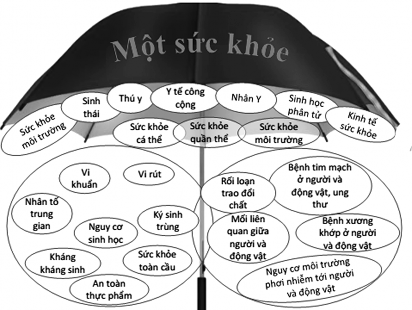
Figure 6.3 . The One Health Collaborative Umbrella
(Source: One Health Sweden, 2014)
The transdisciplinary approach is more desirable than multidisciplinary or interdisciplinary. Its philosophy is the result of unifying all knowledge regardless of field. The prefix “trans” shows that its purpose goes beyond narrow specialized units. Transdisciplinarity starts from real problems and draws from many disciplines with the aim of building its own content and methods. The One Health transdisciplinary approach focuses on problems that require two or more disciplines to solve together, with the following characteristics:
• The aim is to create a unity of knowledge, but not necessarily to develop coordinated activities.
• Transdisciplinary collaboration may be most appealing, but it is difficult to achieve integrated research.
• Transdisciplinary collaboration is the highest form of integrated projects, involving not only multiple sectors, but also multiple participants in line with the One Health approach.
• In a One Health cross-sectoral collaborative environment, no sector has priority over others.
Cross-disciplinary collaboration requires significant effort by participants to carry out the work of each discipline, or to replace traditional ways of thinking.
The advantages and barriers between multi-sectoral, interdisciplinary and trans-sectoral collaborations in the One Health approach are shown in Figure 6.4 .
Figure 6.4 . Multidisciplinary, interdisciplinary and transdisciplinary approaches in holistic research practice
(Source: Paul Stock and Rob
JF Burton, 2011).
Table 6.1. Comparison of multidisciplinary, interdisciplinary and transdisciplinary approaches
Multidisciplinary Interdisciplinary Transdisciplinary
Working with several disciplines Working across disciplines Working beyond disciplines
Covers more than two industries Covers two industries (focuses on
Reciprocal activities of the sectors)
Includes scientists from prominent fields, partners, non-scientific and non-teaching members.
Members come from different disciplines, working independently on different aspects of a project, either in parallel or sequentially.
Members come from different industries, working together on the same project.
Members come from different disciplines, work together, and all use a common framework of goals.
Single goals in different disciplines
Participants are separate but in interactive relationship with each other.
Shared goals Shared goals and skills Participants have common roles Participants have expanded roles
Participants maintain their own industry
Participants give up some points in their own discipline, but maintain their basic science discipline.
Participants develop a framework of goals, together creating the fundamental science of the discipline.
Not facing industry barriers
Summarize and juxtapose the industries
Blurring Industry Barriers Overcoming Industry Barriers
Integration and synthesis of industries Integration, consolidation, homogenization, combination,
unify and harmonize industries with each other in terms of views and approaches
Complementary, integrated, collaborative Interactive, integrated, collaborative Comprehensive, superior, integrated and collaborative Externally cohesive Internally cohesive Internally and externally cohesive
Participants learn from others
Participants learn from others
Participants learn from others and vice versa