
Culture is an organic system of material and spiritual values created and accumulated by humans through practical activities, in the interaction between humans and their natural and social environment.
1.2. Systemic perspective on corporate culture
1.2.1. Overview
Maybe you are interested!
-
 Building a strong corporate culture for the survival and development of Vietnamese enterprises - 14
 -
 Building corporate culture in Vietnam: current situation and solutions for improvement - 13
 -
 Corporate Social Responsibility (Csr) Has Positive Impact on Building and Developing Corporate Culture
 -
 Some Suggestions for Building Corporate Culture for
 -
 Building corporate culture at WalMart - 11
In the early 70s of the 20th century, after the brilliant successes of Japanese enterprises, companies around the world and especially in the US began to pay attention to finding out the reasons for this miraculous development. Since then, the phrase "corporate culture" has been used by researchers, leaders and managers to refer to one of the main factors for the success of Japanese companies around the world. This also proves that the study of corporate culture originates from the need to explain and apply the success of existing models, not a theoretical system that has not been verified in practice.
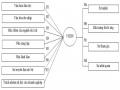
Typically, there are two approaches to the concept of corporate culture: Corporate culture as a metaphor & Corporate culture as an objective entity:
Corporate culture
Metaphor (e.g. Morgan, 1986)
Tangible entities (e.g. Gold, 1982)
Corporate culture is a unified whole.
(e.g., Pacannowsky and O'Donnell-Trujillo, 1982)
A set of characteristic behaviors or traits
(e.g., Schein, 1985a; Eldridge and Crombie, 1974)
Figure 1.1: Classification of VHDN concepts
1.2.2. Concept
1.2.2.1. Metaphor
This approach is often used by some Vietnamese researchers and scholars. Accordingly, the definition is "VHDN is like..."
According to Associate Professor, Dr. Truong Gia Binh, Director of FPT, a company with a strong culture in Vietnam, he himself is one of the very few current leaders in Vietnam who truly understand and have the ability to create corporate culture, "Corporate culture is a component along with 4 other components including Philosophy, Leadership Building (LBleadership Building), Process, Information System, forming a set of Genes and for its part, this set of Genes is the projection of Culture from social space to biological space".
Another metaphorical definition by Dr. Phan Quoc Viet, Chairman and General Director of Tam Viet Group, "To put it simply: If a business is a computer, then corporate culture is the operating system."
Their use of the image of a Gene or a computer operating system, although not fully expressing what corporate culture is, has given an overview and has correctly demonstrated the importance of culture to businesses.
With this approach, it can be said that "If a business is a building, then corporate culture is the foundation of that building" . And clearly, the foundation is the underground part, which we often do not see, but it plays a decisive role in the sustainability and growth of the building.
1.2.2.2. Objective entity
According to this approach, corporate culture is an objective entity. It can be a whole or a set of behaviors and perceptions.
French expert on small and medium enterprises, Mr. Georges de Saite Marie, believes that " Corporate culture is a synthesis of values, symbols, myths, rituals, taboos, philosophical and ethical views that form the deep foundation of an enterprise ". According to another definition of the International Labor Organization ILO (International Labor Organization), " Corporate culture is a special mixture of values, standards, habits and traditions, attitudes and rituals that are all unique to a known organization " .
Or some other definitions of VHDN:
"Corporate culture is the beliefs, attitudes and values that are commonly and relatively stable in an organization." (A.Williams, P.Dobson & M.Walters)
"Corporate culture is a set of beliefs and expectations shared by many members of an organization. These beliefs and expectations will form norms that have the ability to strongly influence the attitudes of individual members and different groups of members in the organization ." (Schwartz & Davis)
According to Pacanowsky and O'DonnellTrujillo, "A business is a culture and all the characteristics of a business including systems, policies, procedures, and processes are components of corporate culture life" .
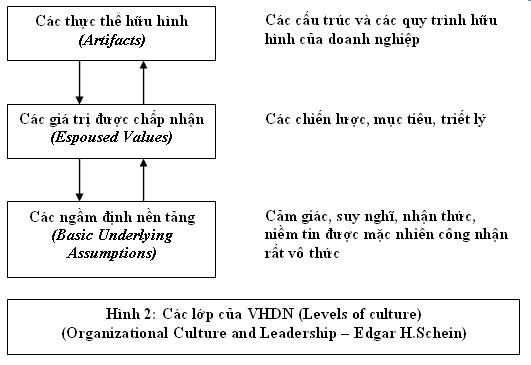
One of the most popular definitions is that of organizational researcher Edgar H. Schein. In his work "corporate culture and leadership", he defined "corporate culture as the set of basic underlying assumptions that members of a company learn in the process of solving internal problems and dealing with problems in the surrounding environment."
In short, from the above definitions, we agree to use the following definition of corporate culture throughout this topic: "Corporate culture is a system of beliefs, values and problem-solving standards built during the formation and development of an enterprise, and expressed in the material and immaterial forms and behaviors of its members".
1.2.3. Components of corporate culture
1.2.3.1. Artifacts
This is the most visible and visible manifestation of corporate culture. It includes all the phenomena that a newcomer can see, hear, and feel when exposed to a company's culture. Some basic tangible entities include: logos and mission statements, corporate architecture and appearance, language, metaphors, stories, anecdotes, celebrations, rituals, ceremonies, behavioral norms, symbols, heroes, etc.
Logo and Mission statement
The two most visible and basic elements of corporate culture are the logo and the mission statement. The logo represents an abstract image but has the most concise and comprehensive meaning about the business. The mission statement defines the long-term vision of the business: what will the business be and who will it serve? The mission statement usually talks about the purpose of the business, the principled goals, the core beliefs and values of the company, how to identify stakeholders, and the ethical principles that govern behavior. Therefore, the mission statement is an excellent source of information about corporate culture.
A mission statement is different from a mission in terms of terminology. A mission is what a business will do over a long period of time to achieve its vision. A mission statement is a document that clearly states the vision, mission, and core values of a business.
One thing to note is that there is a huge gap between what is written in the mission statement and what the business actually has or is experiencing.
Architecture & Identity
Nowadays, many businesses pay attention to their appearance. This is a fairly easy superficial identification feature of the business. The appearance and architecture of the business also reflect the ideology of the leaders, the tradition or modernity, as well as the financial capacity of the business. In modern society, businesses often use this factor to assert their prestige before competitors, partners and the consumer community.
Language
Everyday language is not simply a tool for communication, it is also a fundamental element in understanding the world. The idea that words create understanding has application value in the study of corporate culture. It helps to identify approaches that define how businesses work.
Metaphors
Metaphors are words that are not used literally to describe things or events. Metaphors have a powerful effect on conveying ideas and are commonly used in business.
Stories
Storytelling is an indispensable feature in the life of a business. Members want to tell stories not only because they are interesting, but also to influence the thinking of others in that situation or event, to illustrate their deep knowledge of corporate culture. It is also to show that they are loyal members of the business. Stories play a very important role: helping to recall information from the past; tending to create trust; encouraging commitment to the values of the business. However, it is also necessary to be careful about stories because each storyteller will have a relatively different version.
Myths
Anecdotes are passed down in business as narratives (oral) and are often indistinguishable from stories except that the events are described humorously. Anecdotes are thus unexplained beliefs,
often embedded in stories that influence how business members understand and respond to business situations.
Ceremony, Ettiquette
Action patterns are a feature of corporate life. Of these elements, celebrations are the most vivid and memorable for corporate members. Celebrations are often seen as a celebration of corporate culture, collective cultural activities that help recall and reinforce cultural values. Rituals and ceremonies can be defined as a set of unified activities that are arranged in a relatively elaborate and impressive way to reinforce cultural expressions in specific events. These events are often organized through social activities to bring benefits to the audience.
Norms of behaviour
Standards are rules of conduct that specify what employee behavior is appropriate or inappropriate in specific situations. These standards are developed over time through negotiations between individuals to reach common consensus on how to solve specific business problems.
Symbol
Symbols are words, objects, states, actions, or personal characteristics that make meaningful distinctions for individuals and groups. There are three types of symbols: words, actions, and objects, which perform three functions in the enterprise: description, control of capacity, and maintenance of the system.
Hero
In the early 1980s, authors began to identify corporate heroes. These people play a key role in the success of the business. According to Deal and Kennedy 1 : “ The corporate hero is a great motivator. Like a magician to whom people turn when things get tough. Heroism is a part of leadership that modern managers are neglecting .” Corporate heroes are often
1 Deal and Kennedy, The Rites and Rituals of Copporate Life,
Founders and their functions: creating belief in victory for each individual, motivating employees, being a role model for others to follow, maintaining and promoting corporate culture values.
However, there are some potential pitfalls to creating corporate heroes. In collectivist cultures, where cooperation and teamwork are valued over individuality, creating a hero is difficult. Moreover, corporate heroes are often a group of individuals. The process of creating corporate heroes requires careful consideration. It is dangerous to choose the wrong person to create a corporate hero.
In short , the most important point of the "tangible entity" layer is that it is easy to observe but very difficult to interpret. One must be careful when inferring the implications of a business from observing tangible entities. In reality, there are still such wrong approaches. Because when only observing the surface to infer the capabilities, prospects or culture of a business, a problem will arise that many businesses only invest in what is superficial: rooms, slogans, uniforms... and consider it a comprehensive investment to build corporate culture without paying attention to the deeper layers of corporate culture.
1.2.3.2. Espoused Value
The second layer is the accepted values. Values determine what is thought to be done, what is considered right or wrong. Values are divided into two types. The first type is the values that exist in the enterprise objectively and are formed spontaneously. The second type is the values that leaders want their enterprise to have and build step by step.
Accepted values are principles and values that are publicly announced and that members strive to achieve, such as: vision, mission, core values...
Vision
The first step in setting goals and priorities is to clearly define what the organization will look like at some point in the future, which is setting a vision.
Vision is a future state that an organization strives to achieve. Vision for a common purpose leads to unified action. The term "vision" refers to an image, a vision of the future of the organization in the medium or long term, usually 10, 20 or even 50 years with a vision that affects the entire organization.
The vision of the enterprise must be established first and communicated to all members of the enterprise. The departments of the enterprise will then specify the goals, ways and means to achieve the vision.
Gami company's vision: " Our cars return home with a loud sound. With so much happiness and laughter ... Houses are built brightly ... With Gami we go into the future " excerpt from Gami song. 2
FPT's vision : " As a pioneer in FPT's globalization, FPT wishes to grow quickly and strongly so that in the near future, on the World Intellectual Map, there will be the name Vietnam, the name FPT " 3
Mission
A mission explains why an organization exists: What is the purpose of the organization? Why? What do we do? Who do we serve? How?
The mission of an organization is to find the paths and stages to realize the vision that the organization has determined. Determining the mission is a very important job in order to:
(1) Orientation of human resource strength
(2) No conflict of pursuit goals
(3) Establishing open boundaries of responsibility
(4) Create a basis for organizational goals
2 Methods to build a strong culture Gami - Statistical Publishing House - 2005
3 FPT History