
adhere to the business philosophy, consistent with the predetermined values of the enterprise. In fact, the intention to study the relationship between organizational culture and internal communication comes from the importance of internal communication in the organization, especially in establishing relationships with employees (Gillis, 2011; Miller, 2012).
Hypothesis H6.a: Internal communication has a positive effect on Involvement Hypothesis H6.b: Internal communication has a positive effect on Consistency Hypothesis H6.c: Internal communication has a positive effect on Adaptability Hypothesis H6.d: Internal communication has a positive effect on Mission
2.2.7. Corporate social responsibility (CSR) has a positive impact on the building and development of corporate culture.
Tracey & Odenwelder (2015) research confirmed the relationship between organizational culture and CSR efforts, both of which have a large and positive impact (+) on each other. CSR efforts have changed organizational culture and underlying assumptions. These changes have greatly influenced corporate culture in the way members and the surrounding community treat and communicate with each other. This study is about the impact of CSR on organizational culture, but in non-profit or non-governmental organizations, where CSR is clearly expressed and is a top priority. In business companies, profits and shareholder benefits are often the biggest goals of the business, sustainable development or stakeholder benefits are important but occupy a lower level of importance. In Vietnam, the promotion of CSR is starting to grow strongly thanks to the long-term benefits it brings. CSR research in Vietnam is quite abundant in many fields such as: animal feed industry, textile industry, hotel services, but there are still few studies that delve into the impact of CSR on the cultural characteristics of businesses, especially businesses providing tourism services.
CRS is more social than responsibility. CRS activities are mainly aimed at community development, bringing common benefits to the collective instead of individuals or small groups. Encouraging participation in CSR activities is a way to promote humanity, collective behavior of employees in the enterprise, and encourage proactive participation of employees. Not only that, more and more companies are making CSR an important activity, even a foundation, in their business philosophy. Therefore, promoting CSR is promoting the mission of the enterprise.
business. To survive sustainably over the long term, there needs to be consistency in all corporate principles and strategies. How to adapt well to changing circumstances while still maintaining its own stance and identity is a problem that every business needs to consider when promoting CSR activities to strengthen corporate culture.
Therefore, the author proposes to study the hypothesis:
Hypothesis H7.a: CSR has a positive effect on Involvement Hypothesis H7.b: CSR has a positive effect on Consistency Hypothesis H7.c: CSR has a positive effect on Adaptability Hypothesis H7.d: CSR has a positive effect on Mission
2.3. Research model
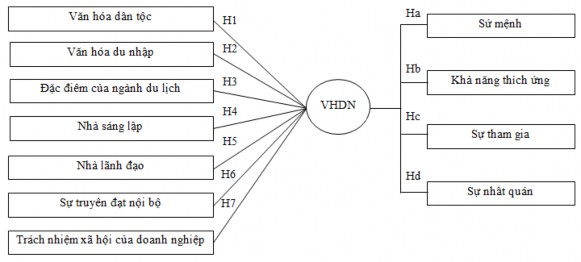
Figure 2.2: Research model
Source: Author's synthesis
Based on the analysis of the current state of corporate culture of tourism companies, the theoretical foundations of corporate culture, based on previous research models as presented in section 1.2.5 of Chapter 1 and interviews with experts who are researchers and leaders of Vietnamese tourism companies, the author proposes to study 7 factors including both objective and subjective factors that have the most positive impact on the corporate culture of these 3 companies, including: (1) National culture, (2) Imported culture, (3) Characteristics of the tourism industry, (4) Founder, (5) Leader, (6) Internal communication, (7) Corporate social responsibility. These are the factors that have been mentioned many times.
in the authors' studies on this content and are also the factors that experts and businesses interviewed in this study agreed on. All variables and the relationships between variables are specifically described in Figure 2.2.
Along with this research model, the author would like to summarize the research hypotheses stated in Chapter 1 of the thesis to clarify and explain more clearly about the model.
Table 2.1: Research hypotheses on factors affecting the construction and development of corporate culture
Fake
theory
Content | Afternoon impact | Source | |
H1 | H1.a: National culture has a positive influence on Participation H1.b: National culture has a positive influence on Consistency H1.c: National culture has a positive influence on Adaptability H1.d: National culture has a positive influence on Mission. | + | Hofstede (1991), Essounga (2009) |
H2 | H2.a: Imported culture has a positive influence on Participation H2.b: Imported culture has a positive effect on Consistency H2.c: Imported culture has a positive effect on Adaptability H2.d: Imported culture has a positive influence on Mission. | + | Vadini (2014) |
H3 | H3.a: Characteristics of the tourism industry have a positive influence on Involvement H3.b: Tourism industry characteristics have a positive influence on Consistency H3.c: Characteristics of the tourism industry have a positive influence on Adaptability H3.d: Characteristics of the tourism industry have a positive impact extreme to Mission. | + | Gordon (1991), Jennifer and Karen (1994) |
H4 | H4.a: Founder has a positive influence on Involvement H4.b: Founder has a positive influence on Personality | + | Boeker (1989), Schein, |
Maybe you are interested!
-
 The relationship between social responsibility, green marketing strategy, corporate reputation and business performance - Research on tourism and travel businesses in Ho Chi Minh City - 24
 -
 The relationship between social responsibility, green marketing strategy, corporate reputation and business performance: a study of tourism and travel businesses in Ho Chi Minh City - 20
 -
 Enhancing the social responsibility of Vietnamese enterprises in commercial business activities - 1
 -
 Key Points to Focus on Promoting Social Responsibility in Business
 -
 Factors Affecting Corporate Social Responsibility
consistent H4.c: Founder has a positive influence on Adaptability H4.d: The Founder has a positive influence on the Mission. | (1985), Andish and partner (2013) | ||
H5 | H5.a: Leader has a positive influence on Participation H5.b: Leader has a positive influence on Consistency H5.c: Leaders have a positive influence on Adaptability H5.d: Leaders have a positive influence on Mission destiny | + | Schein (1985), Szczepańska and Kosiorek (2017) |
H6 | H6.a: Internal communication has a positive effect on Involvement H6.b: Internal communication has a positive effect on Consistency H6.c: Internal communication has a positive effect on Adaptability H6.d: Internal communication has a positive effect on Mission. | + | Gillis (2011), Miller (2012) |
H7 | H7.a: CSR has a positive effect on Involvement H7.b: CSR has a positive effect on Consistency H7.c: CSR has a positive effect on Adaptability H7.d: CSR has a positive impact on Mission. | + | Danner & Odenwelder (2015) |
Source: Author's synthesis
2.4. Research methods
2.4.1. Qualitative research methods
In this thesis, the author will use qualitative methods to study the current status of building and developing corporate culture at Vietnamese tourism companies and the current corporate culture results of these companies.
2.4.1.1. Description of research methods
Corporate culture includes tangible and intangible elements, so both qualitative and quantitative methods have advantages and disadvantages; therefore, using a combination of methods will give a more comprehensive view of corporate culture. Talking about qualitative methods, many researchers
Research suggests that qualitative methods will help to study the constituent elements of corporate culture better. For example, Cameron and Quinn (2006) argue that using qualitative methods over a long period of time will help to understand the elements of corporate culture better. Or Ott (1989) and Schein (1990) assert that only in-depth interviews and detailed observations can help to study the deepest layers of corporate culture; quantitative methods cannot do this. In addition, many authors, O'Reilly (1993), Denison (1990), Cameron and Freeman (1991) argue that using this method will yield information that is easier to analyze.
The topic uses visual observation methods, collects internal publications and reports data to obtain information about the tangible elements of corporate culture. According to Schein (1985, 2001), this is an important method to collect information and have a basic view of corporate culture and especially tangible elements such as logos, slogans, uniforms, characteristic architecture, ceremonies, cultural publications and declared values. This model has been widely applied in many countries and many fields. In particular, Zhao (2007) applied the model to compare corporate culture of different companies from many countries or with branches in many countries including Asia and Southeast Asia, with companies in the service sector and showed the reliability of the model when studying corporate culture of companies in this field. Along with that, the topic uses online and direct survey methods at companies based on questionnaires to collect information on the work of building and developing corporate culture of Vietnamese tourism companies.
2.4.1.2. Survey subjects
The survey subjects of the research topic are leaders currently working at Vietnamese tourism companies, specifically those holding senior management positions in Vietnamese tourism companies. As presented in the previous chapter, leaders play an important role in the work of building and developing corporate culture of companies in general and Vietnamese tourism companies in particular. Therefore, when surveying and collecting information from them, it will show a view of the current situation of building and developing corporate culture of Vietnamese tourism companies, what they have directly experienced, along with the advantages and difficulties in this work.
2.4.1.3. Survey design
The questionnaire was designed based on theoretical foundations and through the process of collecting and synthesizing documents, published scientific products, theories on corporate culture as well as building and developing corporate culture. In particular, the questionnaire makes maximum use of the theory of 3 levels of corporate culture by Schein (1990) and the 11-step process of building corporate culture proposed by two authors Heifetz and Hagberg (2000) as mentioned in the previous chapter. Along with that, the author also asked for opinions from experts Dr. Nguyen Le Hang and Dr. Nguyen Thi Thu Trang (Foreign Trade University) and from the leaders of some Vietnamese tourism companies including Ms. Pham Thi Hang (Director of Sun Travel Company), Mr. Nguyen Tien Dat (General Director of AZA Travel Company) to test the questions, find more specific questions or explanations, easier to understand, more closely related to the practices of Vietnamese tourism companies.
The survey consists of two main parts: information about the individuals and businesses participating in the survey, and information about the work of building and developing corporate culture. The total number of questions in the survey is 25, of which 7 questions are related to the respondents and the travel company they are working for and managing, including basic information such as age, gender, education level, name of the company they are currently working for, year of establishment of that unit, current working position, and seniority. The remaining 18 questions assess the opinions of the survey participants about the current status of building and developing corporate culture of the company. The author used closed and open questions to be able to exploit more information from the respondents, serving the research of this topic (Appendix No. 1).
2.4.2. Quantitative research methods
In this thesis, the author uses quantitative methods to collect information, evaluate the current status of corporate culture of Vietnamese tourism companies and study the factors affecting the construction and development of corporate culture of Vietnamese tourism companies.
First, to collect information and evaluate the current status of corporate culture of Vietnamese tourism companies, the author used Denison's corporate culture assessment method (1990), this model was also mentioned in the previous chapter. In the method
In this study, Denison asked questions to survey 12 elements of corporate culture in 4 groups of aspects to measure. To answer the questions, there will be levels from 1 to 5, corresponding to the level from "strongly disagree" to "strongly agree" (Appendix 2). The score of each element will show the strength and weakness of corporate culture. Specifically: - 84-100 points (4.2-5.0): strength of corporate culture; - 74-83 points (3.70-4.19): at an acceptable level; - <73 points (1-3.69): weakness of corporate culture.
The reason the author uses this model is because of its popularity in studies on corporate culture in many countries and many different industries, along with the reliability and validity of this model, the elements in this model have been confirmed through previous studies (Denison, 1990, 1998, 2003; Fey and Denison, 2003; Coffey, 2010). In particular, the model has been used in a number of Asian countries and in businesses in the service sector, specifically China (Mobley et al., 2005), Hong Kong (Coffey, 2010), Asian countries (Denison et al., 2003), African countries (Davidson et al., 2007), the author himself has also applied this model to study a Vietnamese business in his master's thesis. Therefore, the model has been applied in many countries and studied the current status of corporate culture of many companies in many different fields and also enterprises in fields related to this topic; the studies have confirmed the reliability of the model, providing detailed results with specific characteristics of corporate culture and having a scale of scores to evaluate the strength and weakness, easy to visualize and monitor.
The elements of corporate culture proposed in this model include four groups of aspects: mission, involvement, adaptability and consistency. The use of these groups of aspects of corporate culture is because these groups of aspects have an impact on the business performance of the enterprise with indicators such as profit, revenue growth, market share, innovation and product development, product and service quality, employee satisfaction (Denison and Neale, 1996). These groups of aspects are also typical because when studying other similar models of groups of aspects of corporate culture such as the OCI model of Cooke and Lafferty (1987), there are similar groups of aspects such as power (corresponding to the empowerment factor in the group of aspects of Denison's model), connectedness (corresponding to the cooperation and integration factor in the group of aspects of Denison's model), success (corresponding to the group of aspects of consistency),
achievement/result (corresponding to the goal factor in the mission aspect group of the Denison model), defense/risk avoidance (corresponding to the proactive innovation factor in the adaptability aspect group of the Denison model). However, this model of Cooke and Lafferty (1987) has the disadvantage of having overlap in the aspect groups when referring to the characteristics of corporate culture (Cooke and Szumal, 1993). In another model that also divides the aspects of corporate culture into groups for research, the OCP Model of O'Reilly et al. (1991), the author also found similarities in the groups of aspects, specifically innovation (corresponding to the proactive innovation factor in the adaptability aspect group of the Denison model), output results corresponding to the goal factor in the mission aspect group of the Denison model), team orientation (corresponding to the teamwork orientation factor in the participation aspect group of the Denison model). This model also has the disadvantage that the questions and propositions given to the groups of aspects do not really provide rich information (Fidock and Talbot, 2008). Therefore, although the names are different and have their own details, these models all provide groups of aspects that are similar to reflect the characteristics of corporate culture when researching. Denison's model has more questions and statements to collect information and does not have the disadvantages of the remaining models (Adalsteisson and Gudlaugsson, 2007). Therefore, the author chose to use Denison's model with the above groups of aspects to represent the groups of factors that have been mentioned by other models and there is no overlap of aspects, the number of questions and statements can bring a lot of information for the research.
The author also translated this questionnaire from English to Vietnamese and consulted with experts and participants to make the sentences easy to understand and reasonable for respondents to state the current situation of corporate culture at the company they work for. The survey participants of this model are members of the enterprise, which can include both leaders and employees, because corporate culture affects the way all members of that enterprise think, feel and act, not just a certain subject.
Next, from studying this situation, the author conducts further research on factors affecting the construction and development of corporate culture of Vietnamese tourism companies. According to Schein (1985, 2002), Denison (1990, 2003) and a