
Public information agencies hang banners, flags and slogans, among them
Red bands, 3 meters long, 80 cm wide, with a five-pointed yellow star in the middle; these bands are not considered national flags. Also not considered national flags are drawings that look like the national flag printed on walls, on means of transport, on pants, shirts, hats, caps, faces, noses... these drawings are just images, not the national flag, so they are not the subject of the crime of insulting the national flag.
Flag hanging
at the pillar
Maybe you are interested!
-
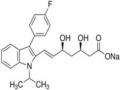
 Draw the Frame or General Formula of Each Drug Group (If Any); Structural Formula of Substances in the Chapter.
 -
 Chemical study and identification of some groups of substances in the red-top tree (cratoxylum prunifolium kurtz) - 14
 -
 Chemical study and identification of some groups of substances in the red-top tree (cratoxylum prunifolium kurtz) - 12
 -
 P. Results of Treatment of Organic Substances in Leachate by Perozone with the Effect of Ph in 60 Minute Reaction Time
 -
 Some Examples of Pharmaceutical Substances Containing Sulfate Groups to Increase Solubility
agencies, organizations,
in public
must comply with state regulations.
A national emblem is a symbol of a country, a symbol representing a
The national emblem of the Socialist Republic of Vietnam is circular in shape, with a red background, in the middle is a five-pointed yellow star, surrounded by rice ears, below is half a cogwheel and the words: "Socialist Republic of Vietnam".
The national emblem is usually only hung in agencies representing the government.
State forces such as: National Assembly, Government
Owner
President, Government, People's Council
People's Committee, People's Court, headquarters of diplomatic agencies of the Socialist Republic of Vietnam abroad...
3. Objective signs of crime
a. Objective behavior
The law only regulates one objective act of insulting the national flag and national emblem. However, because the subject of this crime is the national flag and national emblem, the person who commits the insult is different from the person who commits the insult against an agency, organization or individual.
Insulting the national flag or national emblem is an act of directly affecting the national flag or national emblem in order to thereby damage the national honor, not with the aim of damaging an agency, organization or individual.
which. Hurts the honor
of the body
official, organization
organization or individual,
Offenders may not be verbal, but must be by specific actions such as: tearing, smearing, piercing, stepping on, trampling, or crushing the national flag; smearing, destroying, or damaging the national emblem; writing or drawing unhealthy content on the national flag or emblem, or performing other actions that distort the national flag or emblem.
b. Consequences
Although consequences are not a determining factor in a crime, normally acts of insulting the national flag or national emblem always cause serious, even very serious or especially serious consequences, because this act violates national honor.
c. Other objective signs
For this crime, the legislator also does not stipulate other objective signs as factors in determining the crime or determining the penalty, but to determine whether the act of insulting the national flag or national emblem is a crime or not, it must be based on the State's regulations on the national flag, national emblem and the use of the national flag and national emblem.
4. Subjective signs of crime
The person who committed this crime did so intentionally, that is, he was aware that insulting the national flag and emblem was a violation of national honor, but still did it.
It can be affirmed that motive and purpose are mandatory signs for this crime, because if the offender commits an act of insulting the national flag or national emblem for the motive and purpose of opposing the State government, then depending on the case, the offender must be prosecuted for criminal responsibility for the crime of treason.
treason, crime of activities aimed at overthrowing the people's government, crime of propaganda
propaganda against the Socialist Republic of Vietnam...
B. SPECIFIC CRIMINAL CASES
For this crime, the legislator only provides for one case.
committing a crime and that is also the basic element of a crime. The offender may be subject to a warning, non-custodial reform for up to three years or imprisonment from six months to three years, which is a less serious crime.
If the offender has many mitigating circumstances as prescribed in Article 46 of the Penal Code, without aggravating circumstances, he/she may be given a warning or non-custodial reform; if the offender has many aggravating circumstances as prescribed in Article 48 of the Penal Code, without mitigating circumstances or if they exist but the degree of mitigating circumstances is insignificant, he/she may be sentenced to imprisonment for up to three years. If the conditions prescribed in Article 60 of the Penal Code are met, the offender may be given a suspended sentence.
PART TWO
ENVIRONMENTAL CRIMES
INTRODUCTION
The environment includes natural elements and man-made physical elements.
relationship
intimately connected, surrounding people, having
affect life
life, production, existence, development of human and nature.
The environment is of special importance to human life, living things and the economic, cultural and social development of the country, nation and humanity.
Environmental protection is keeping the environment clean, beautiful and healthy.
ensure ecological balance, prevent and overcome the consequences caused by humans and nature to the environment.
bad because of me
The environmental situation in our country as well as in the world is being polluted.
Pollution mainly caused by humans such as: releasing smoke, dust, toxic substances or other toxic elements into the air; emitting radiation and radioactivity exceeding the permitted standards; discharging into water sources grease, toxic chemicals, radioactive substances exceeding the permitted standards, waste, carcasses of animals, plants, bacteria, viruses, harmful and disease-causing parasites or other toxic elements; burying or discharging into the ground toxic substances exceeding the permitted standards; using toxic substances, explosives, other chemicals, electric current to exploit aquatic resources or destroy aquatic resources; exploiting aquatic resources during the breeding season, exploiting rare aquatic species;
residential destruction
reside
of aquatic species
rare products; hunting animals
rare wildlife; violation of regime
protect
for nature reserves
natural, natural monuments, national parks, etc.
Although our government has taken many measures to protect the environment,
environmental protection, combining propaganda and education for people to be aware of environmental protection with administrative handling measures, but due to many reasons, in recent times, environmental violations have occurred quite commonly and in some places and at times very seriously; handling has not been timely and strict.
At the fourth session, on December 27, 1993, the 9th National Assembly passed the Law on Environmental Protection; the Government also issued many documents.
guidelines and regulations for protection
environment such as: Decree
number
175-CP dated October 18, 1994 guiding the implementation of the Law on Environmental Protection;
Resolution
number
26/CP dated April 26, 1996 of the Government on handling
penalty
administrative sanctions on environmental protection; to implement this Decree, the Ministry of Science, Technology and Environment issued Circular No. 2433/TT-KCM dated October 30, 1996 guiding the implementation of Decree No. 26/CP dated April 26, 1996 of the Government regulating the sanctioning of administrative violations in environmental protection, etc. This is a very important legal basis to enhance the effectiveness of State management and the responsibility of authorities at all levels, State agencies, economic organizations, social organizations, people's armed forces units and all individuals in environmental protection.
The 1985 Penal Code only stipulates one environmental crime, which is the crime of: "violating environmental protection regulations causing serious consequences".
important" (Article 195) but the Ministry
criminal law
1999 has prescribed a
Chapter XVII consists of 10 articles (from Article 182 to Article 191) corresponding to 10 environmental crimes, including 9 new crimes and one crime separating the act of destroying forests from the crime of violating regulations on forest management and protection prescribed in Article 181 of the 1985 Penal Code to form the crime of "destroying forests" and consider the act of destroying forests as an environmental crime. However, the issue of prosecuting criminal liability for violations of regulations on environmental protection in our country is a new field, so lawmakers build crime components mainly based on education, only prosecuting criminal liability for cases that have been
be punished
administrative violations and consequences
serious, very
serious or especially serious. It has been more than 5 years since the 1999 Penal Code was implemented, but the prosecuting agencies have only prosecuted
criminal liability for some cases of forest destruction or violations of the
regulations on
protect
rare wildlife, and acts of pollution
Infections and diseases that spread to humans, animals and plants are mainly handled by administrative measures. This is also an issue that needs to be considered to amend and supplement the Law on Environmental Protection as well as the 1999 Penal Code to suit the reality of the fight against environmental violations.
SPECIFIC CRIMES
1. CRIME OF CAUSING AIR POLLUTION
Article 182. Crime of causing air pollution
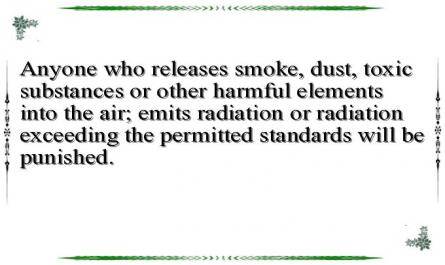
1. Anyone who releases smoke, dust, toxic substances or other harmful elements into the air; emits radiation or radioactivity exceeding the permitted standards, has been administratively sanctioned but deliberately fails to take remedial measures.
comply with the decision of the agency
competent authority causing consequences
serious
In case of serious violation, the offender shall be subject to a fine of from ten million to one hundred million dong, non-custodial reform for up to three years or imprisonment from six months to three years.
2. Crimes with very serious consequences shall be punished by imprisonment from two to seven years.
3. Crimes with particularly serious consequences shall be punishable by imprisonment from five to ten years.
4. The offender may also be fined from five million to fifty million VND, banned from holding positions, practicing a profession or doing certain jobs from one to five years.
Definition : Air pollution is the act of releasing smoke, dust, toxic substances or other harmful elements into the air; emitting radiation and radioactivity beyond the permissible standards .
A. BASIC SIGNS OF CRIME
1. Signs belonging to the subject of the crime
The subject of this crime is not a special subject, only a person with the capacity to bear criminal responsibility and reaching a certain age according to the law.
regulations of this Ministry.
Criminal law can all become the subject of crime.
According to the provisions of Article 12 of the Penal Code and the structure of the article on this crime, a person aged 14 or older but under 16 years old shall only bear criminal responsibility for this crime in the case specified in Clause 3 of the article; a person aged 16 or older shall bear criminal responsibility.
criminal for this crime regardless of the case specified in
which clause of the law.
Offenders will only be prosecuted for criminal liability if the act of causing air pollution they have committed has been administratively sanctioned but they deliberately fail to take remedial measures according to the decision of the competent authority. If the decision to impose an administrative penalty has been over one year (the administrative penalty decision has been deleted), it is not considered to have been administratively sanctioned to determine criminal liability for the person who caused environmental pollution.
Although the law does not stipulate that this act has been administratively punished and is still violated, because the legislator stipulates that it has been administratively punished, he intentionally does not take remedial measures according to the decision.
of the competent authority, it must be understood that the offender must be
person who was sentenced
administrative penalty on
air pollution behavior, but
no other behavior.
2. Signs belonging to the object of the crime
The crime of air pollution is a crime that violates state regulations on air (atmosphere) protection.
Air pollution is the change of air, violating air standards such as: reducing the amount of oxygen, increasing the amount of carbon dioxide.
State regulations on
protect
regulated air
in legal documents such as: Law on environmental protection; Decree No. 175/CP dated October 18, 1994 of the Government guiding the implementation of the Law on environmental protection
environment; Decree
26/CP dated April 26, 1996 of the Government
rules of conduct
administrative penalties for environmental protection; Circular No. 2433/TT-KCM dated 3-
10-1996 of the Ministry
science and technology
and the implementation environment
Resolution
Decree 26/CP dated April 26, 1996 of the Government
rules of conduct
punish
environmental protection
The object of this crime is air (atmosphere).
3. Objective signs of crime
a. Objective behavior
The offender may commit one or more of the following acts:
Emitting into the air smoke, dust, toxins or other toxic elements exceeding the permissible standards.
The act of releasing smoke, toxic substances or other harmful elements into the air exceeding permissible standards is mainly committed by those responsible in factories, enterprises, motor vehicles and waste treatment.
The act of emitting dust into the air exceeding the permitted standards is mainly caused by those responsible for construction works, exploitation, and transportation of construction materials.
The act of releasing toxic substances or other harmful elements into the air is due to the person responsible for production, processing, and experimentation in the field of biochemistry not having measures to handle it, thus releasing toxic substances into the air such as SO2, NO2, CO, lead...
Types of smoke, dust, toxic substances or other harmful elements allowed to be released into the air must be regulated by competent State agencies such as: ambient air quality standards (TCVN 5937-1995); industrial emission standards for dust and inorganic substances (TCVN 5939-1995) issued with Decision No. 229-QD/TDC dated March 25, 1995 of the Minister of Science, Technology and Environment.
Radiation emission, radiation exceeding the permissible standard.
Emitting radiation and radioactivity is the act of changing the quality and quantity of air components, causing negative effects on human life and nature by emitting radiation and radioactivity.
Radiation includes ionizing and non-ionizing radiation that, when applied to living organisms at doses exceeding the permissible limit, can cause damage and be dangerous to the body, such as X-rays, X-rays, laser radiation, sound waves, and infrasound.
and ultrasound; radioactive
is substance
in body
solid, liquid or gas with activity
specific radiation greater than 7 kilo Becquerels per kg (70kBq/kg)13
b. Consequences
Consequences are a mandatory sign of the composition of this crime. If the act of causing air pollution has not caused serious consequences, the perpetrator
13 Dictionary of legal terms. People's Police Publishing House H 2000, pp. 142,143
Currently, that behavior is not criminally responsible for this crime, but depending on
their case
maybe
be punished
administrative penalty and if already punished
punish
Only those who deliberately fail to take remedial measures as decided by competent authorities and cause serious consequences will be prosecuted for criminal liability. This is also a provision limiting criminalization. If in other crimes, the legislator stipulates that or has been administratively sanctioned but still violates or causes serious consequences, it is considered a crime, but for environmental crimes in general and for this crime in particular, the legislator stipulates that has been administratively sanctioned and caused consequences.
seriousness are two necessary and sufficient factors to determine the criminal behavior of
polluter
As
for some
other crimes, agencies
competent authority
uninstructed rights
what consequences
serious due to polluting behavior
air pollution can cause
Refer to Circular
No. 02/TTLT-
TANDTC-VKSNDTC-BCA-BTP dated December 25, 2001 of the Supreme People's Court, the Supreme People's Procuracy, the Ministry of Public Security and the Ministry of Justice guiding the application of a number of provisions in Chapter XIV of the 1999 Penal Code to determine serious consequences caused by acts of air pollution.
c. Other objective signs
For this crime, in addition to the objective acts and consequences, the legislator also stipulates other objective signs, which are: the standards for allowing smoke, dust, toxic substances or other toxic elements; radiation, radioactivity in the air. Exceeding the permitted standards constitutes a crime. Therefore, when determining whether an act of air pollution constitutes a crime or not, in addition to other signs, it is necessary to base on the standards for allowing smoke, dust, toxic substances or other toxic elements; radiation, radioactivity in the air as prescribed by the State. These standards are issued under Decision No. 229-QD/TDC dated March 25, 1995 of the Minister of Science and Technology.
Science, Technology and Environment. If necessary, the agencies conducting the proceedings
must consult a professional expert.
In addition to the above signs, the law also stipulates signs of failure to implement remedial measures according to the decision of the competent authority. If after being administratively sanctioned, the person causing environmental pollution implements remedial measures according to the decision of the competent authority, it does not constitute a crime.