
INDEX
Maybe you are interested!
-
 Chemical study and identification of some groups of substances in the red-top tree (cratoxylum prunifolium kurtz) - 12
 -
 Study on botanical characteristics, chemical composition and acetylcholinesterase enzyme inhibitory effects of two species Piper thomsonii (C. DC.) Hook. f. var. thomsonii and Piper hymenophyllum Miq., Piperaceae family - 24
 -
 Study on chemical composition, toxicity and some biological effects supporting the treatment of gastric and duodenal ulcers of Sanchezia nobilis Hook.F. leaves - 2
 -
 Study on botanical characteristics, chemical composition and acetylcholinesterase enzyme inhibitory effects of two species Piper thomsonii (C. DC.) Hook. f. var. thomsonii and Piper hymenophyllum Miq., Piperaceae family - 23
 -
 Study on botanical characteristics, chemical composition and acetylcholinesterase enzyme inhibitory effects of two species Piper thomsonii (C. DC.) Hook. f. var. thomsonii and Piper hymenophyllum Miq., Piperaceae family - 21
INTRODUCTION 1
Chapter 1. OVERVIEW 3
1.1. Plant description 3
1.2. Some uses of the genus Cratoxylum 4
1.3. Status of phytochemical research on genus Cratoxylum 7
1.3.1. Compounds with triterpene framework 7
1.3.2. Organic acids 8
1.3.3. Substances with xanthone framework 9
1.3.4. Some representatives of the anthraquinone framework 15
1.3.5. Some representatives of the flavonoid framework 16
1.4. Phytochemical studies on Cratoxylum prunifolium 17
Chapter 2. EXPERIMENTAL SECTION 19
2.1. Research objects and methods 19
2.1.1. Collect plant samples, determine scientific names and treatment methods
sample 19
2.1.2. Method of isolating compounds from extracts 19
2.1.3. Methods of surveying and determining the chemical structure of
Compound 20
2.2. Tools, chemicals and research equipment 20
2.2.1. Tools and chemicals 20
2.2.2. Research equipment 21
2.3. Extracts from Cratoxylum prunifolium Kurtz 21
2.3.1. Extracts 21
2.3.2. Qualitative survey of extracts 23
2.3.3. Biological activity test 23
2.4. Extraction, isolation and purification of substances from red top 25 plant
2.4.1. Chloroform extract 26
2.4.1.1. Taraxeron (Friendoolean - 14- en-3-on) (DC 1 ) 26
2.4.1.2. Stigmast- 5,22- diene-24R-3β-ol 27
2.4.1.3. β-Sitosterol 27
2.4.2. Extract in ethylacetate (DE) 28
Chapter 3. DISCUSSION OF RESEARCH RESULTS 29
3.1. General principles 29
3.2. Qualitative analysis and detection of groups of substances 30
3.3. Isolation and identification of compounds in other extracts
red top tree 30
3.3.1. Taraxeron (or Frendoolean-14-en-3-on) (DC-1) 30
3.3.2. Stingmast -5,22-dien-24R-3β-ol (DC-2) 38
3.3.3. β-sitosterol (DC-3) 44
3.3.4. Gallic acid (DE-1) 50
3.4. Biological activity test 56
CONCLUSION 57
PROPOSAL 57
REFERENCES 58
LIST OF TABLES
Table 2.1. Total mass of substances extracted from each leaf segment
red tip ( Cratoxylum prunifolium Kurtz ) 22
Table 2.2. Detection of groups of substances in red top 23 plants
Table 2.3. Results of biological activity testing of crude extract from red leaves
Cratoxylum prunifolium 25
Table 3.1. 13 C-NMR and 1 H-NMR spectra of taraxeron (DC-1) from red leaf tip 33
Table 3.2. 13 C-NMR spectra of DC-2 and stingmasterol [16] 39
Table 3.3. 13 C-NMR spectra of DC-3 and β-sitosterol [16] 45
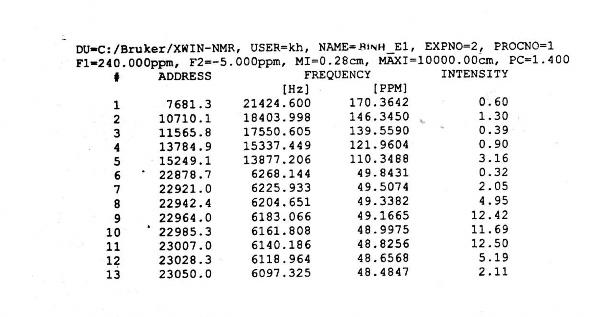
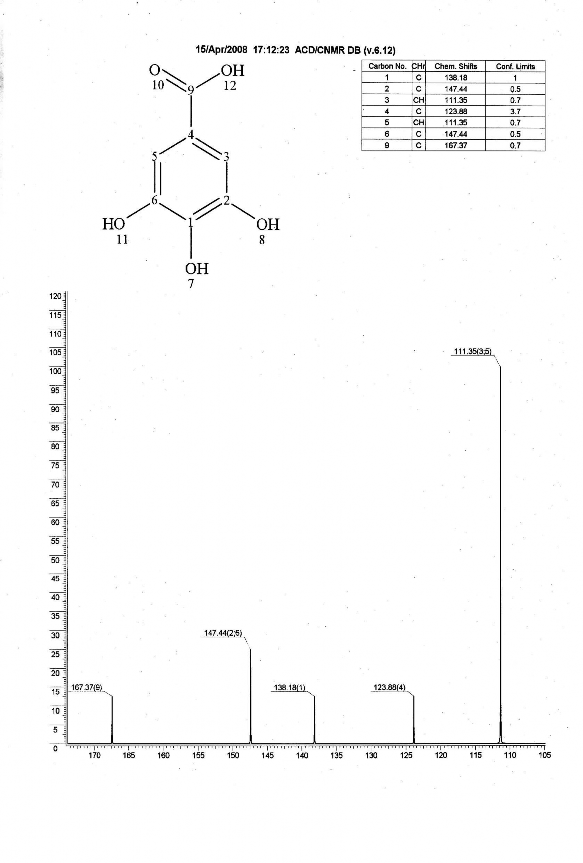
Table 3.4. NMR spectral data of DE-1 and NMR spectral data in the section
ACD/NMR of gallic acid 50
LIST OF FIGURES
Figure 1.1. Image of red-top tree ( Cratoxylum Prunifolium Kurt, Hypericaceae ) ... 4 Figure 2.1. Image of inhibition around the 24-well agar
Figure 3.1 34
Figure 3.2 35
Figure 3.3 36
Figure 3.4 37
Figure 3.5 40
Figure 3.6 41
Figure 3.7 42
Figure 3.8 43
Figure 3.9 46
Figure 3.10 47
Figure 3.11 48
Figure 3.12 49
Figure 3.13 52
Figure 3.14 53
Figure 3.15. 1 H-NMR spectrum of gallic acid 54
Figure 3.16. 13 C-NMR spectrum of gallic acid 55
LIST OF DIAGRAM
Diagram 2.1. Extraction process 22