
On March 7, 1913, Phuc Yen province changed to Phuc Yen agency, under Vinh Yen province.
On March 31, 1923, the Governor of Tonkin issued a decree to re-establish Phuc Yen province, including two prefectures (Da Phuc, Yen Lang) and two districts of Kim Anh and Dong Anh - This was the smallest province in Tonkin at that time.
* Vinh Phuc province was established on February 12, 1950, on the basis of merging Vinh Yen and Phuc Yen provinces. At that time, Vinh Phuc had an area of 1,715 km 2 and a population of 470,000 people.
(source http://vinhphuc.gov.vn// )
Maybe you are interested!
-
 Orientation for developing traditional craft villages in Tra Vinh province to serve tourism in the integration period - 1
 -
 Hai Phong traditional craft villages with tourism development - 7
 -
 Quang Nam Province's Experience in Restoring and Developing Traditional Craft Villages Associated with Modern Tourism Development Trends
 -
 Conditions for Developing Traditional Craft Village Tourism
 -
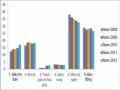 Traditional Craft Villages Serving Tourism in Thua Thien Hue Province in the Period 2008-2012
2.1.3 Population and administrative structure
* Population.
In 1997, when Vinh Phuc province was re-established, the whole province had 1,103,810 people, of which Kinh people were the majority, ethnic minorities accounted for only 2.7% distributed as follows:
Vinh Yen town: 35,529 people. Lap Thach: 227,960 people.
Tam Duong + Binh Xuyen: 254,570 people. Vinh Tuong: 190,459 people.
Yen Lac: 146,645 people. Me Linh: 248,584 people.
In 2005, the whole Vinh Phuc province had 1,169,067 people distributed: Vinh Yen: 81,537 people.
Phuc Yen: 86,650 people. Lap Thach: 211,776 people. Tam Duong: 94,305 people. Tam Dao: 67,591 people.
Binh Xuyen: 105,755 people. Me Linh: 182,036 people.
Yen Lac: 145,890 people. Vinh Tuong: 193,257 people.
* Administrative organization:
As of December 2006, after many changes in administrative boundaries, Vinh Phuc province has 9 administrative units including Vinh Yen city, Phuc Yen town and 7 districts: Lap Thach, Tam Duong, Vinh Tuong, Yen Lac, Binh Xuyen, Tam Dao and Me Linh.
2.2 Typical traditional craft villages in Vinh Phuc
During the research process, Vinh Phuc has many traditional craft villages that still exist today such as Bich Chu carpentry village, Ly Nhan blacksmith village, Tam Dong pot casting village... but these craft villages have little significance for tourism activities, so I have delved into some typical traditional craft villages below:
2.2.1 Huong Canh Pottery Village
2.2.1.1 Huong Canh pottery craft
In the past, whenever the people of Huong Canh village talked about the founder of the traditional pottery craft in their region, they often mentioned two people: one was Do Quang, the other was Dao Noi (also known as Mr. Noi or Noi Hau). "The Legend of Hung Vuong" (published by Vinh Phu Literature and Arts Association in 1981) on pages 106 and 107, there is a story about Mr. Noi. The story goes that in Huong Canh village - Tam Canh commune (now Binh Xuyen district, Vinh Phuc) there was a poor family who made a living by making pots and pans. The couple had a rare son, named Noi. The older Noi grew, the more intelligent he became, he was good at drawing and wrestling, and was appointed by An Duong Vuong to be a general to command the soldiers of Au Lac. Mr. Noi married an orphan girl from Chiem Trach village near the capital of Co Loa, and had two sons, named Dong and Vuc. Mr. Noi's three sons repeatedly made the invading army of Trieu Da go crazy. When Trieu Da used a dangerous plan to send his son Trong Thuy to propose to Princess My Chau, the three father and sons went to the court to dissuade him, but King Thuc did not listen. Mr. Noi and his two sons asked to resign and return to Chiem Trach to farm and make pots. Trieu Da's army captured Loa Thanh, Trieu Da sent someone to persuade the three father and sons to become officials. Seeing that he did not listen, Trieu Da ordered his army to surround them.
besieged Chiem Trach. His whole family broke out of the siege and fled to his hometown, Huong Canh. The enemy surrounded Huong Canh, he returned to Chiem Trach, it was midnight, the villagers had closed the gate. The enemy chased him, he and his wife pulled out knives and committed suicide. Dong and Vuc ran to the place, saw their parents dead, and committed suicide too. The villagers buried them on the mound at the edge of the village. Later, people called it "Go Thanh Hoa". The people of Ngoc Chi and Vinh Thanh villages (now Dong Anh, Hanoi) built temples to worship them, and in Huong Canh, the people also built temples to worship Mr. Noi and his three sons.
“Legend of the Gods of Hanoi” (Culture and Information Publishing House, 1984) pages 50 and 51 recounts: Once upon a time, there was a man from Huong Canh (Vinh Phuc) who made pots and pans. The couple had a son named Pot…
In the book "Traditional Vietnamese Crafts and Craft Ancestors" compiled by Professor Tran Quoc Vuong and Associate Professor Do Thi Hao (Publishing House - National Culture 1996), in the pottery section, pages 92, 93, 94, it is stated:
“Dao Noi, son of Dao Hoang, was originally from Tuyen Quang, his 4th generation ancestor moved to Huong Canh village (Vinh Phuc) to make a living by making pots and pans. Continuing his family's business, Dao Noi became famous throughout the region as an outstanding and talented craftsman. He married a woman named Duong, from Chiem Trach village (now Dong Anh - Hanoi), who was also a skilled pot maker. The couple had 2 children named Dong and Vuc. Dao Noi was not only good at his job but also proficient in martial arts. He was appointed an official by Thuc An Duong Vuong and given the title of Marquis, so he was also called Noi Hau. Trieu Da defeated the Thuc king, surrounded Chiem Trach village and captured Noi Hau. His family fled to his hometown Huong Canh. The enemy surrounded Canh village, so he brought his wife and children back to Chiem Trach. Before the village gate could be opened, the enemy arrived. He and his wife pulled out knives and committed suicide, and their two sons also died. The villagers mourned and admired him, and buried his family in a mound called Thanh Hoa's tomb (in Vinh Thanh village, Vinh Ngoc commune, Dong Anh). At the same time, they built a temple to remember the man who was both the founder of the profession and had integrity, and could not stand under the same sky with the invaders.
Huong Canh village in Tam Canh commune (Binh Xuyen, Vinh Phuc) has a long-standing tradition of making jars and ceramic urns. According to folklore, there were three craftsmen who were very good at pottery. They were very close to each other and also very attached to the craft. They wanted their descendants to follow their fathers' footsteps, so they split up: One went to Thanh Hoa, one went to Bac Ninh and one went to Huong Canh. The ancestor in Huong Canh was named Do Quang. His life story has not been passed down, but the temple and statue still exist (currently in the middle of Cang hamlet). It is not known when the temple was built, but in the year Canh Hung (King Le Hien Tong 1740 - 1786), it was renovated. Every year, the villagers celebrate the ancestor's death anniversary on the 6th of January, the day the ancestor passed away.
Conducting a survey of the Cang hamlet (old), archaeologists discovered at a depth of 2 meters many pieces of ancient pottery, including: tile tips, jar preparations, pots, lids, etc. (according to documents of Dr. Nguyen Anh Tuan).
Thus, from folk legends, to the temple to worship the founder of the craft and archaeological sites, we can confirm that Huong Canh pottery has existed for a long time, and in Huong Canh there are two founders of the pottery profession: Mr. Dao Noi, or Noi Hau, is the founder of the pot pottery profession, and Mr. Do Quang is the founder of the jar pottery profession. Whether or not there was a temple to worship the founder of the craft Dao Noi - Noi Hau, in our opinion, is not very important, as long as until now he still exists in the consciousness of Huong Canh people along with the legends about the talented and heroic potter.
Some people keep trying to prove that there is no Dao Noi in Huong Canh.
- Mr. Noi - Noi Hau, I think we should also look at other pottery regions in the country. In fact, through archaeology, not every pottery village that was born developed and expanded forever. Many famous pottery mounds are now only ruins. Their descendants will no longer know about the pottery profession in their homeland, if anything, it will only be a memory (for example, the craft of making pots and pans is no longer seen in Huong Canh, but only jars, urns, etc., and bricks and tiles remain).
But this is a sure affirmation: in Huong Canh, the traditional pottery craft has developed for many centuries, is famous everywhere, and is deeply rooted in the subconscious of the people. Traditional items in Huong Canh are very diverse and rich: jars, pots, kettles, teapots... and earthenware urns. Huong Canh pottery developed not in the direction of porcelain but in the direction of earthenware, with beautiful designs, high firing temperature, hardness and water resistance, to serve the essential needs of the people.
2.2.1.2 Huong Canh pottery craft past and present
“Huong Canh pottery, Bat Trang bricks, Nam Dinh silk, Ha Dong village silk”
(Folk song)
Huong Canh pottery, after 3 centuries of development, has brought a prosperous and abundant life, creating a bustling residential area. Like Bat Trang pottery, Huong Canh has become a famous place for producing ceramic pottery nationwide.
Through the ups and downs of historical periods, Huong Canh still maintains its quality craft, techniques, and aesthetics are always improved, and customers still love Huong Canh pottery.
After the August Revolution in 1945 and in 1958, implementing the collective economic policy of the Party and the State, ceramic production establishments in the province also established the Huong Canh ceramic cooperative. Under the subsidy mechanism at that time, the cooperatives prospered, the production establishments were expanded, the number of kilns in Huong Canh alone increased to dozens, each kiln had a large capacity. The State also sent people to friendly countries such as Czechoslovakia to study and acquire science and technology in building the Huong Canh cooperative and other places where ceramic production in Vinh Phuc was prosperous during this period, the lives of cooperative members were improved.
By 1986, after the Party and State abolished the subsidy regime, they opened a new regime, the market mechanism. Being used to the subsidy mechanism, now switching to the new mechanism is full of difficulties and challenges. The manager is not talented enough.
Looking far ahead, daring to think and act, not boldly changing products and organizing production to suit the open market. Prices and designs arise in the market, that is why science and technology are applied and innovated a lot in the production of consumer goods and all other goods. Particularly ceramic products, from construction ceramics to household containers and decorative ceramics... are also often replaced by other materials that are cheap, beautiful, and durable. More importantly, the issue of new technology is always replaced in this field, creating quality, aesthetics, and attractive prices.
From here, Huong Canh pottery entered a dead end, the cooperative gave up and went to dissolution.
After the cooperative was dissolved, most of Huong Canh switched to making tiles. Huong Canh potters were facing difficulties, making tiles was a new lifeline for them. The whole Huong Canh village had hundreds, thousands of tile kilns springing up. In the early years, due to the demand for tiles in rural areas in basic construction, tile consumption was too strong. Huong Canh tiles were almost a monopoly in the Northern region. Making tiles was hard work but it also solved the immediate life, so everyone rushed to make tiles, no one thought of ceramics. But not long after, the technology for producing roofing sheets was born. Once again, Huong Canh was at a dead end.
Regarding the craft, Huong Canh currently has only 04 production households, only Mr. Nguyen Van Thanh is the one who has been interested in reviving the pottery craft since 1995. Until now, it still exists and develops thanks to the help, advice, and technical and artistic experts of agencies such as the People's Committee and the Department of Labor. Mr. Thanh has known how to change the product line, absorb fine art pottery technology to create new ceramic products (fine art pottery).
Since 1995, his pottery business has been stable and growing well. Currently, there are a number of families following his way of doing things and they are trying to revive their pottery profession.
2.2.1.3 Traditional products of Huong Canh pottery
In the past, Huong Canh pottery village in Binh Xuyen district was very famous, known by many people and was mentioned in poetry:
"Whoever comes back to buy a jar of Huong Canh, I will send it to you and her."
When it was first established, the craft village mainly produced utensils that functioned to preserve family food. The main products were jars, pots for storing rice, corn, and rice, then people stored water, soy sauce, wine, clay pots, teapots, and earthenware urns. All were very primitive containers, simple in both design and decoration, so the price was also very low. Gradually, due to the need to build houses, people switched to making tiles. Huong Canh tiles were favored in many places, the tiles had beautiful colors, cool roofs, and were relatively durable. Huong Canh ceramic products were made entirely from primitive ceramic materials, not depending much on the glaze like Bat Trang ceramics, but only on the amount of heat generated in the kiln. Although the products were not as soft and smooth as Bat Trang, Quang Tay ceramics, they had a rustic simplicity that was very unique. It is the wild, antique-like texture of Huong Canh fine art pottery that creates its own attractive uniqueness.
2.2.1.4 Management organization, production process and production activities
Management organization.
In 2003, the Department of Industry of Vinh Phuc province established a plan for the development of Vinh Phuc handicraft village industrial clusters for the period 2005 - 2010, approved by the Provincial People's Committee in Decision No. 2943/QD-UB dated July 2, 2003. According to the approved plan, by 2010, 28 handicraft clusters will be formed, including the Huong Canh pottery village cluster.
The Huong Canh craft village cluster was approved by the Provincial People's Committee for detailed planning in Decision No. 970/QD - UBND dated May 8, 2005 with a total planning area of 11.5 hectares and a total investment capital of 31.5 billion VND, but construction investment has not yet been implemented.
build infrastructure
According to this decision, after land clearance and infrastructure construction, households still practicing traditional crafts in Huong Canh will move to the craft village cluster, creating favorable conditions for preserving the craft and strongly developing production.
With the help of Vinh Phuc province, Huong Canh town People's Committee and the American charity organization MCC have also implemented a project to restore and create jobs for Huong Canh's traditional craft. On September 26, 2001, Huong Canh town People's Committee decided to establish a "Pottery Association" consisting of 17 members. The association has set out the association's operating regulations and implemented activities according to the proposed plan, helping each other in production, business, and marketing. The association has initially started to implement. In addition, the town People's Committee has also opened pottery classes, trained the next generation of artisans and brought new hope to Huong Canh pottery.
In recent years, the People's Committee of Huong Canh town has coordinated with the Department of Culture - Sports - Tourism to conduct research on the potential for tourism development in craft villages, contributing significantly to promoting craft villages to friends near and far.
Production process.
During my field trip to Lo Cang hamlet, I had the opportunity to meet artisan Nguyen Nhan, one of the people who still keeps the flame of Huong Canh pottery alive. He is the director of Thanh Nhan Company Limited, but he looks honest, simple, and approachable. He can't remember how many products he has created with his own hands. After talking, he let me witness the steps to make a Huong Canh pottery product. Including 4 steps:
Step one: prepare the soil. There are two methods: Method one: prepare soil for household pottery.
Soil is taken from the village and stored in the warehouse. When used, it is brought to the land preparation site.