
abortion up to 7 weeks; VIA/VILI test; Pap smear; obstetric and gynecological ultrasound; hemoglobin test [19].
4.1.6. Opinions of health workers on collection and payment of fees for reproductive health services at
Commune Health Center
In the past, many services were provided free of charge for family planning services such as IUD placement, abortion, condoms, contraceptives, tetanus vaccination, prenatal and postnatal check-ups. However, in recent times, the provision of reproductive health services has changed due to improved socio-economic conditions. Previously free reproductive health services now collect a service fee, and the state also pays a part. In addition, many disadvantaged areas, ethnic minorities and the poor are still supported by the state. According to the results of some recent studies, service fees for the same technique are collected differently between provinces/cities [33], [44]. The hospital fee framework also has a rigid framework of the Ministry of Health but is subject to change according to the decision of the People's Council of the province/city. The basis for the People's Council of the province/city to decide on service prices depends entirely on the socio-economic situation of the locality.
Maybe you are interested!
-
 Satisfaction with the Spirit, Service Attitude, and Expertise of Medical Staff
 -
 Medical Ethics Education in the Training Process of Medical Staff
 -
 Assessing Patient Satisfaction with Communication Channels, Providing Medical Information and Health Education Used by Social Work Staff.
 -
 Identify Rating Levels and Rating Scales
zt2i3t4l5ee
zt2a3gstourism,quan lan,quang ninh,ecology,ecotourism,minh chau,van don,geography,geographical basis,tourism development,science
zt2a3ge
zc2o3n4t5e6n7ts
of the islanders. Therefore, this indicator will be divided into two sub-indicators:
a1. Natural tourism attractiveness a2. Cultural tourism attractiveness
b. Tourist capacity
The two island communes in Quan Lan have different capacities to receive tourists. Minh Chau Commune is home to many standard hotels and resorts, attracting high-income domestic and international tourists. Meanwhile, Quan Lan Commune has many motels mainly built and operated by local people, so the scale and quality are not high, and will be suitable for ordinary tourists such as students.
c. Time of exploitation of Quan Lan Island Commune:
Quan Lan tourism is seasonal due to weather and climate conditions and festivals only take place on certain days of the year, specifically in spring. In Quan Lan commune, the period from April to June and from September to November is considered the best time to visit Quan Lan because the cultural tourism activities are mainly associated with festivals taking place during this time.
Minh Chau island commune:
Tourism exploitation time is all year round, because this is a place with a number of tourist attractions with diverse ecosystems such as Bai Tu Long National Park Research Center, Tram forest, Turtle Laying Beach, so besides coming to the beach for tourism and vacation in the summer, Minh Chau will attract research groups to come for tourism combined with research at other times of the year.
d. Sustainability
The sustainability of ecotourism sites in Quan Lan and Minh Chau communes depends on the sensitivity of the ecosystems to climate changes.
landscape. In general, these tourist destinations have a fairly high level of sustainability, because they are natural ecosystems, planned and protected. However, if a large number of tourists gather at certain times, it can exceed the carrying capacity and affect the sustainability of the environment (polluted beaches, damaged trees, animals moving away from their habitats, etc.), then the sustainability of the above ecosystems (natural ecosystems, human ecosystems) will also be affected and become less sustainable.
e. Location and accessibility
Both island communes have ports to take tourists to visit from Van Don wharf:
- Quan Lan – Van Don traffic route:
Phuc Thinh – Viet Anh high-speed boat and Quang Minh high-speed boat, depart at 8am and 2pm from Van Don to Quan Lan, and at 7am and 1pm from Quan Lan to Van Don. There are also wooden boats departing at 7am and 1pm.
- Van Don - Minh Chau traffic route:
Chung Huong high-speed train, Minh Chau train, morning 7:30 and afternoon 13:30 from Van Don to Minh Chau, morning 6:30 and afternoon 13:00 from Minh Chau to Van Don.
f. Infrastructure
Despite receiving investment attention, the issue of infrastructure and technical facilities for tourism on Quan Lan Island is still an issue that needs to be resolved because it has a direct impact on the implementation of ecotourism activities. The minimum conditions for serving tourists such as accommodation, electricity, water, communication, especially medical services, and security work need to be given top priority. Ecotourism spots in Minh Chau commune are assessed to have better infrastructure and technical facilities for tourism because there are quite complete and synchronous conditions for serving tourists, meeting many needs of domestic and foreign tourists.
3.2.1.4. Determine assessment levels and assessment scales
Corresponding to the levels of each criterion, the index is the score of those levels in the order of 4, 3, 2, 1 decreasing according to the standard of each level: very attractive (4), attractive (3), average (2), less attractive (1).
3.2.1.5. Determining the coefficients of the criteria
For the assessment of DLST in the two communes of Quan Lan and Minh Chau islands, the students added evaluation coefficients to show the importance of the criteria and indicators as follows:
Coefficient 3 with criteria: Attractiveness, Exploitation time. These are the 2 most important criteria for attracting tourists to tourism in general and eco-tourism in particular, so they have the highest coefficient.
Coefficient 2 with criteria: Capacity, Infrastructure, Location and accessibility . Because the assessment area is an island commune of Van Don district, the above criteria are selected by the author with appropriate coefficients at the average level.
Coefficient 1 with criteria: Sustainability. Quan Lan has natural and human-made ecotourism sites, with high biodiversity and little impact from local human factors. Most of the ecotourism sites are still wild, so they are highly sustainable.
3.2.1.6. Results of DLST assessment on Quan Lan island
a. Assessment of the potential for natural tourism development
For Minh Chau commune:
+ Natural tourism attractiveness is determined to be very attractive (4 points) and the most important coefficient (coefficient 3), so the score of the Attractiveness criterion is 4 x 3 = 12.
+ Capacity is determined as average (2 points) and the coefficient is quite important (coefficient 2), then the score of Capacity criterion is 2 x 2 = 4.
+ Exploitation time is long (4 points), the most important coefficient (coefficient 3) so the score of the Exploitation time criterion is 4 x 3 = 12.
+ Sustainability is determined as sustainable (4 points), the important coefficient is the average coefficient (coefficient 1), so the score of the Sustainability criterion is 4 x 1 = 4 points
+ Location and accessibility are determined to be quite favorable (2 points), the coefficient is quite important (coefficient 2), the criterion score is 2 x 2 = 4 points.
+ Infrastructure is assessed as good (3 points), the coefficient is quite important (coefficient 2), then the score of the Infrastructure criterion is 3 x 2 = 6 points.
The total score for evaluating DLST in Minh Chau commune according to 6 evaluation criteria is determined as: 12 + 4 + 12 + 4 + 4 + 6 = 42 points
Similar assessment for Quan Lan commune, we have the following table:
Table 3.3: Assessment of the potential for natural ecotourism development in Quan Lan and Minh Chau communes
Attractiveness of self-tourismof course
Capacity
Mining time
Sustainability
Location and accessibility
Infrastructure
Result
Point
DarkMulti
Point
DarkMulti
Point
DarkMulti
Point
DarkMulti
Point
DarkMulti
Point
DarkMulti
CommuneMinh Chau
12
12
4
8
12
12
4
4
4
8
6
8
42/52
Quan CommuneLan
6
12
6
8
9
12
4
4
4
8
4
8
33/52
b. Assessment of the potential for humanistic tourism development
For Quan Lan commune:
+ The attractiveness of human tourism is determined to be very attractive (4 points) and the most important coefficient (coefficient 3), so the score of the Attractiveness criterion is 4 x 3 = 12.
+ Capacity is determined to be large (3 points) and the coefficient is quite important (coefficient 2), then the score of the Capacity criterion is 3 x 2 = 6.
+ Mining time is average (3 points), the most important coefficient (coefficient 3) so the score of the Mining time criterion is 3 x 3 = 9.
+ Sustainability is determined as sustainable (4 points), the important coefficient is the average coefficient (coefficient 1), so the score of the Sustainability criterion is 4 x 1 = 4 points.
+ Location and accessibility are determined to be quite favorable (2 points), the coefficient is quite important (coefficient 2), the criterion score is 2 x 2 = 4 points.
+ Infrastructure is rated as average (2 points), the coefficient is quite important (coefficient 2), then the score of the Infrastructure criterion is 2 x 2 = 4 points.
The total score for evaluating DLST in Quan Lan commune according to 6 evaluation criteria is determined as: 12 + 6 + 6 + 4 + 4 + 4 = 36 points.
Similar assessment with Minh Chau commune we have the following table:
Table 3.4: Assessment of the potential for developing humanistic eco-tourism in Quan Lan and Minh Chau communes
Attractiveness of human tourismliterature
Capacity
Mining time
Sustainability
Location and accessibility
Infrastructure
Result
Point
DarkMulti
Point
DarkMulti
Point
DarkMulti
Point
DarkMulti
Point
DarkMulti
Point
DarkMulti
Quan CommuneLan
12
12
6
8
9
12
4
4
4
8
4
8
39/52
Minh CommuneChau
6
12
4
8
12
12
4
4
4
8
6
8
36/52
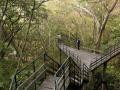
Basically, both Minh Chau and Quan Lan localities have quite favorable conditions for developing ecotourism. However, Quan Lan commune has more advantages to develop ecotourism in a humanistic direction, because this is an area with many famous historical relics such as Quan Lan Communal House, Quan Lan Pagoda, Temple worshiping the hero Tran Khanh Du, ... along with local festivals held annually such as the wind praying ceremony (March 15), Quan Lan festival (June 10-19); due to its location near the port and long exploitation time, the beaches in Quan Lan commune (especially Quan Lan beach) are no longer hygienic and clean to ensure the needs of tourists coming to relax and swim; this is also an area with many beautiful landscapes such as Got Beo wind pass, Ong Phong head, Voi Voi cave, but the ability to access these places is still very limited (dirt hill road, lots of gravel and rocks), especially during rainy and windy times; In addition, other natural resources such as mangrove forests and sea worms have not been really exploited for tourism purposes and ecotourism development. On the contrary, Minh Chau commune has more advantages in developing ecotourism in the direction of natural tourism, this is an area with diverse ecosystems such as at Rua De Beach, Bai Tu Long National Park Conservation Center...; Minh Chau beach is highly appreciated for its natural beauty and cleanliness, ranked in the top ten most beautiful beaches in Vietnam; Minh Chau commune is also home to Tram forest with a large area and a purity of up to 90%, suitable for building bridges through the forest (a very effective type of natural ecotourism currently applied by many countries) for tourists to sightsee, as well as for the purpose of studying and researching.
Figure 3.1: Thenmala Forest Bridge (India) Source: https://www.thenmalaecotourism.com/(August 21, 2019)
3.2.2. Using SWOT matrix to evaluate Quan Lan island tourism
General assessment of current tourism activities of Quan Lan island is shown through the following SWOT matrix:
Table 3.5: SWOT matrix evaluating tourism activities on Quan Lan island
Internal agent
Strengths- There is a lot of potential for tourism development, especially natural ecotourism and humanistic ecotourism.- The unskilled labor force is relatively abundant.- resource environmentunpolluted, still
Weaknesses- Poorly developed infrastructure, especially traffic routes to tourist destinations on the island.- The team of professional staff is still weak.- Tourism products in general
quite wild, originalintact
general and DLST in particularalone is monotonous.
External agents
Opportunity- Tourism is a key industry in the socio-economic development strategy of the province and Van Don economic zone.- Quan Lan was selected as a pilot area for eco-tourism development within the framework of the green growth project between Quang Ninh province and the Japanese organization JICA.- The flow of tourists and especially ecotourism in the world tends toincreasing
Challenge- Weather and climate change abnormally.- Competition in tourism products is increasingly fierce, especially with other localities in the province such as Ha Long, Mong Cai...- Awareness of tourists, especially domestic tourists, about ecotourism and nature conservation is not high.
Through summary analysis using SWOT matrix we see that:
To exploit strengths and take advantage of opportunities, it is necessary to:
- Diversify products and service types (build more tourism routes aimed at specific needs of tourists: experiential tourism immersed in nature, spiritual cultural tourism...)
- Effective exploitation of resources and differentiated products (natural resources and human resources)
div.maincontent .p { color: black; font-family:"Times New Roman", serif; font-style: normal; font-weight: normal; text-decoration: none; font-size: 14pt; margin:0pt; } div.maincontent p { color: black; font-family:"Times New Roman", serif; font-style: normal; font-weight: normal; text-decoration: none; font-size: 14pt; margin:0pt; } div.maincontent .s1 { color: black; font-family:"Times New Roman", serif; font-style: normal; font-weight: normal; text-decoration: none; font-size: 13pt; } div.maincontent .s2 { color: black; font-family:"Times New Roman", serif; font-style: normal; font-weight: normal; text-decoration: none; font-size: 13pt; } div.maincontent .s3 { color: #0D0D0D; font-family:"Times New Roman", serif; font-style: normal; font-weight: bold; text-decoration: none; font-size: 14pt; } div.maincontent .s4 { color: black; font-family:"Times New Roman", serif; font-style: italic; font-weight: normal; text-decoration: none; font-size: 14pt; } div.maincontent .s5 { color: black; font-family:"Times New Roman", serif; font-style: italic; font-weight: bold; text-decoration: none; font-size: 14pt; } div.maincontent .s6 { color: black; font-family:"Times New Roman", serif; font-style: italic; font-weight: normal; text-decoration: none; font-size: 14pt; vertical-align: -3pt; } div.maincontent .s7 { color: black; font-family:"Times New Roman", serif; font-style: italic; font-weight: normal; text-decoration: none; font-size: 14pt; vertical-align: -2pt; } div.maincontent .s8 { color: black; font-family:"Times New Roman", serif; font-style: italic; font-weight: normal; text-decoration: none; font-size: 14pt; vertical-align: -1pt; } div.maincontent .s9 { color: black; font-family:"Times New Roman", serif; font-style: normal; font-weight: normal; text-decoration: none; font-size: 14pt; } div.maincontent .s10 { color: black; font-family:"Times New Roman", serif; font-style: normal; font-weight: bold; text-decoration: none; font-size: 14pt; } div.maincontent .s11 { color: black; font-family:"Times New Roman", serif; font-style: normal; font-weight: normal; text-decoration: none; font-size: 14pt; } div.maincontent .s12 { color: black; font-family:Symbol, serif; font-style: normal; font-weight: normal; text-decoration: none; font-size: 14pt; } div.maincontent .s13 { color: black; font-family:Wingdings; font-style: normal; font-weight: normal; text-decoration: none; font-size: 14pt; } div.maincontent .s14 { color: black; font-family:"Times New Roman", serif; font-style: normal; font-weight: normal; text-decoration: none; font-size: 9pt; vertical-align: 5pt; } div.maincontent .s15 { color: black; font-family:"Times New Roman", serif; font-style: normal; font-weight: normal; text-decoration: none; font-size: 9pt; vertical-align: 5pt; } div.maincontent .s16 { color: black; font-family:Cambria, serif; font-style: italic; font-weight: normal; text-decoration: none; font-size: 14pt; } div.maincontent .s17 { color: #080808; font-family:"Times New Roman", serif; font-style: normal; font-weight: bold; text-decoration: none; font-size: 14pt; } div.maincontent .s18 { color: #080808; font-family:"Times New Roman", serif; font-style: normal; font-weight: normal; text-decoration: none; font-size: 14pt; } div.maincontent .s19 { color: black; font-family:"Times New Roman", serif; font-style: normal; font-weight: normal; text-decoration: none; font-size: 11pt; } div.maincontent .s20 { color: black; font-family:"Times New Roman", serif; font-style: normal; font-weight: normal; text-decoration: none; font-size: 10pt; } div.maincontent .s21 { color: black; font-family:"Times New Roman", serif; font-style: normal; font-weight: bold; text-decoration: none; font-size: 11pt; } div.maincontent .s22 { color: black; font-family:"Times New Roman", serif; font-style: normal; font-weight: normal; text-decoration: none; font-size: 11pt; } div.maincontent .s23 { color: black; font-family:"Times New Roman", serif; font-style: italic; font-weight: normal; text-decoration: none; font-size: 14pt; } div.maincontent .s24 { color: #212121; font-family:"Times New Roman", serif; font-style: normal; font-weight: normal; tex
Identify Rating Levels and Rating Scales
zt2i3t4l5ee
zt2a3gstourism,quan lan,quang ninh,ecology,ecotourism,minh chau,van don,geography,geographical basis,tourism development,science
zt2a3ge
zc2o3n4t5e6n7ts
of the islanders. Therefore, this indicator will be divided into two sub-indicators:
a1. Natural tourism attractiveness a2. Cultural tourism attractiveness
b. Tourist capacity
The two island communes in Quan Lan have different capacities to receive tourists. Minh Chau Commune is home to many standard hotels and resorts, attracting high-income domestic and international tourists. Meanwhile, Quan Lan Commune has many motels mainly built and operated by local people, so the scale and quality are not high, and will be suitable for ordinary tourists such as students.
c. Time of exploitation of Quan Lan Island Commune:
Quan Lan tourism is seasonal due to weather and climate conditions and festivals only take place on certain days of the year, specifically in spring. In Quan Lan commune, the period from April to June and from September to November is considered the best time to visit Quan Lan because the cultural tourism activities are mainly associated with festivals taking place during this time.
Minh Chau island commune:
Tourism exploitation time is all year round, because this is a place with a number of tourist attractions with diverse ecosystems such as Bai Tu Long National Park Research Center, Tram forest, Turtle Laying Beach, so besides coming to the beach for tourism and vacation in the summer, Minh Chau will attract research groups to come for tourism combined with research at other times of the year.
d. Sustainability
The sustainability of ecotourism sites in Quan Lan and Minh Chau communes depends on the sensitivity of the ecosystems to climate changes.
landscape. In general, these tourist destinations have a fairly high level of sustainability, because they are natural ecosystems, planned and protected. However, if a large number of tourists gather at certain times, it can exceed the carrying capacity and affect the sustainability of the environment (polluted beaches, damaged trees, animals moving away from their habitats, etc.), then the sustainability of the above ecosystems (natural ecosystems, human ecosystems) will also be affected and become less sustainable.
e. Location and accessibility
Both island communes have ports to take tourists to visit from Van Don wharf:
- Quan Lan – Van Don traffic route:
Phuc Thinh – Viet Anh high-speed boat and Quang Minh high-speed boat, depart at 8am and 2pm from Van Don to Quan Lan, and at 7am and 1pm from Quan Lan to Van Don. There are also wooden boats departing at 7am and 1pm.
- Van Don - Minh Chau traffic route:
Chung Huong high-speed train, Minh Chau train, morning 7:30 and afternoon 13:30 from Van Don to Minh Chau, morning 6:30 and afternoon 13:00 from Minh Chau to Van Don.
f. Infrastructure
Despite receiving investment attention, the issue of infrastructure and technical facilities for tourism on Quan Lan Island is still an issue that needs to be resolved because it has a direct impact on the implementation of ecotourism activities. The minimum conditions for serving tourists such as accommodation, electricity, water, communication, especially medical services, and security work need to be given top priority. Ecotourism spots in Minh Chau commune are assessed to have better infrastructure and technical facilities for tourism because there are quite complete and synchronous conditions for serving tourists, meeting many needs of domestic and foreign tourists.
3.2.1.4. Determine assessment levels and assessment scales
Corresponding to the levels of each criterion, the index is the score of those levels in the order of 4, 3, 2, 1 decreasing according to the standard of each level: very attractive (4), attractive (3), average (2), less attractive (1).
3.2.1.5. Determining the coefficients of the criteria
For the assessment of DLST in the two communes of Quan Lan and Minh Chau islands, the students added evaluation coefficients to show the importance of the criteria and indicators as follows:
Coefficient 3 with criteria: Attractiveness, Exploitation time. These are the 2 most important criteria for attracting tourists to tourism in general and eco-tourism in particular, so they have the highest coefficient.
Coefficient 2 with criteria: Capacity, Infrastructure, Location and accessibility . Because the assessment area is an island commune of Van Don district, the above criteria are selected by the author with appropriate coefficients at the average level.
Coefficient 1 with criteria: Sustainability. Quan Lan has natural and human-made ecotourism sites, with high biodiversity and little impact from local human factors. Most of the ecotourism sites are still wild, so they are highly sustainable.
3.2.1.6. Results of DLST assessment on Quan Lan island
a. Assessment of the potential for natural tourism development
For Minh Chau commune:
+ Natural tourism attractiveness is determined to be very attractive (4 points) and the most important coefficient (coefficient 3), so the score of the Attractiveness criterion is 4 x 3 = 12.
+ Capacity is determined as average (2 points) and the coefficient is quite important (coefficient 2), then the score of Capacity criterion is 2 x 2 = 4.
+ Exploitation time is long (4 points), the most important coefficient (coefficient 3) so the score of the Exploitation time criterion is 4 x 3 = 12.
+ Sustainability is determined as sustainable (4 points), the important coefficient is the average coefficient (coefficient 1), so the score of the Sustainability criterion is 4 x 1 = 4 points
+ Location and accessibility are determined to be quite favorable (2 points), the coefficient is quite important (coefficient 2), the criterion score is 2 x 2 = 4 points.
+ Infrastructure is assessed as good (3 points), the coefficient is quite important (coefficient 2), then the score of the Infrastructure criterion is 3 x 2 = 6 points.
The total score for evaluating DLST in Minh Chau commune according to 6 evaluation criteria is determined as: 12 + 4 + 12 + 4 + 4 + 6 = 42 points
Similar assessment for Quan Lan commune, we have the following table:
Table 3.3: Assessment of the potential for natural ecotourism development in Quan Lan and Minh Chau communes
Attractiveness of self-tourismof course
Capacity
Mining time
Sustainability
Location and accessibility
Infrastructure
Result
Point
DarkMulti
Point
DarkMulti
Point
DarkMulti
Point
DarkMulti
Point
DarkMulti
Point
DarkMulti
CommuneMinh Chau
12
12
4
8
12
12
4
4
4
8
6
8
42/52
Quan CommuneLan
6
12
6
8
9
12
4
4
4
8
4
8
33/52
b. Assessment of the potential for humanistic tourism development
For Quan Lan commune:
+ The attractiveness of human tourism is determined to be very attractive (4 points) and the most important coefficient (coefficient 3), so the score of the Attractiveness criterion is 4 x 3 = 12.
+ Capacity is determined to be large (3 points) and the coefficient is quite important (coefficient 2), then the score of the Capacity criterion is 3 x 2 = 6.
+ Mining time is average (3 points), the most important coefficient (coefficient 3) so the score of the Mining time criterion is 3 x 3 = 9.
+ Sustainability is determined as sustainable (4 points), the important coefficient is the average coefficient (coefficient 1), so the score of the Sustainability criterion is 4 x 1 = 4 points.
+ Location and accessibility are determined to be quite favorable (2 points), the coefficient is quite important (coefficient 2), the criterion score is 2 x 2 = 4 points.
+ Infrastructure is rated as average (2 points), the coefficient is quite important (coefficient 2), then the score of the Infrastructure criterion is 2 x 2 = 4 points.
The total score for evaluating DLST in Quan Lan commune according to 6 evaluation criteria is determined as: 12 + 6 + 6 + 4 + 4 + 4 = 36 points.
Similar assessment with Minh Chau commune we have the following table:
Table 3.4: Assessment of the potential for developing humanistic eco-tourism in Quan Lan and Minh Chau communes
Attractiveness of human tourismliterature
Capacity
Mining time
Sustainability
Location and accessibility
Infrastructure
Result
Point
DarkMulti
Point
DarkMulti
Point
DarkMulti
Point
DarkMulti
Point
DarkMulti
Point
DarkMulti
Quan CommuneLan
12
12
6
8
9
12
4
4
4
8
4
8
39/52
Minh CommuneChau
6
12
4
8
12
12
4
4
4
8
6
8
36/52
Basically, both Minh Chau and Quan Lan localities have quite favorable conditions for developing ecotourism. However, Quan Lan commune has more advantages to develop ecotourism in a humanistic direction, because this is an area with many famous historical relics such as Quan Lan Communal House, Quan Lan Pagoda, Temple worshiping the hero Tran Khanh Du, ... along with local festivals held annually such as the wind praying ceremony (March 15), Quan Lan festival (June 10-19); due to its location near the port and long exploitation time, the beaches in Quan Lan commune (especially Quan Lan beach) are no longer hygienic and clean to ensure the needs of tourists coming to relax and swim; this is also an area with many beautiful landscapes such as Got Beo wind pass, Ong Phong head, Voi Voi cave, but the ability to access these places is still very limited (dirt hill road, lots of gravel and rocks), especially during rainy and windy times; In addition, other natural resources such as mangrove forests and sea worms have not been really exploited for tourism purposes and ecotourism development. On the contrary, Minh Chau commune has more advantages in developing ecotourism in the direction of natural tourism, this is an area with diverse ecosystems such as at Rua De Beach, Bai Tu Long National Park Conservation Center...; Minh Chau beach is highly appreciated for its natural beauty and cleanliness, ranked in the top ten most beautiful beaches in Vietnam; Minh Chau commune is also home to Tram forest with a large area and a purity of up to 90%, suitable for building bridges through the forest (a very effective type of natural ecotourism currently applied by many countries) for tourists to sightsee, as well as for the purpose of studying and researching.
Figure 3.1: Thenmala Forest Bridge (India) Source: https://www.thenmalaecotourism.com/(August 21, 2019)
3.2.2. Using SWOT matrix to evaluate Quan Lan island tourism
General assessment of current tourism activities of Quan Lan island is shown through the following SWOT matrix:
Table 3.5: SWOT matrix evaluating tourism activities on Quan Lan island
Internal agent
Strengths- There is a lot of potential for tourism development, especially natural ecotourism and humanistic ecotourism.- The unskilled labor force is relatively abundant.- resource environmentunpolluted, still
Weaknesses- Poorly developed infrastructure, especially traffic routes to tourist destinations on the island.- The team of professional staff is still weak.- Tourism products in general
quite wild, originalintact
general and DLST in particularalone is monotonous.
External agents
Opportunity- Tourism is a key industry in the socio-economic development strategy of the province and Van Don economic zone.- Quan Lan was selected as a pilot area for eco-tourism development within the framework of the green growth project between Quang Ninh province and the Japanese organization JICA.- The flow of tourists and especially ecotourism in the world tends toincreasing
Challenge- Weather and climate change abnormally.- Competition in tourism products is increasingly fierce, especially with other localities in the province such as Ha Long, Mong Cai...- Awareness of tourists, especially domestic tourists, about ecotourism and nature conservation is not high.
Through summary analysis using SWOT matrix we see that:
To exploit strengths and take advantage of opportunities, it is necessary to:
- Diversify products and service types (build more tourism routes aimed at specific needs of tourists: experiential tourism immersed in nature, spiritual cultural tourism...)
- Effective exploitation of resources and differentiated products (natural resources and human resources)
div.maincontent .p { color: black; font-family:"Times New Roman", serif; font-style: normal; font-weight: normal; text-decoration: none; font-size: 14pt; margin:0pt; } div.maincontent p { color: black; font-family:"Times New Roman", serif; font-style: normal; font-weight: normal; text-decoration: none; font-size: 14pt; margin:0pt; } div.maincontent .s1 { color: black; font-family:"Times New Roman", serif; font-style: normal; font-weight: normal; text-decoration: none; font-size: 13pt; } div.maincontent .s2 { color: black; font-family:"Times New Roman", serif; font-style: normal; font-weight: normal; text-decoration: none; font-size: 13pt; } div.maincontent .s3 { color: #0D0D0D; font-family:"Times New Roman", serif; font-style: normal; font-weight: bold; text-decoration: none; font-size: 14pt; } div.maincontent .s4 { color: black; font-family:"Times New Roman", serif; font-style: italic; font-weight: normal; text-decoration: none; font-size: 14pt; } div.maincontent .s5 { color: black; font-family:"Times New Roman", serif; font-style: italic; font-weight: bold; text-decoration: none; font-size: 14pt; } div.maincontent .s6 { color: black; font-family:"Times New Roman", serif; font-style: italic; font-weight: normal; text-decoration: none; font-size: 14pt; vertical-align: -3pt; } div.maincontent .s7 { color: black; font-family:"Times New Roman", serif; font-style: italic; font-weight: normal; text-decoration: none; font-size: 14pt; vertical-align: -2pt; } div.maincontent .s8 { color: black; font-family:"Times New Roman", serif; font-style: italic; font-weight: normal; text-decoration: none; font-size: 14pt; vertical-align: -1pt; } div.maincontent .s9 { color: black; font-family:"Times New Roman", serif; font-style: normal; font-weight: normal; text-decoration: none; font-size: 14pt; } div.maincontent .s10 { color: black; font-family:"Times New Roman", serif; font-style: normal; font-weight: bold; text-decoration: none; font-size: 14pt; } div.maincontent .s11 { color: black; font-family:"Times New Roman", serif; font-style: normal; font-weight: normal; text-decoration: none; font-size: 14pt; } div.maincontent .s12 { color: black; font-family:Symbol, serif; font-style: normal; font-weight: normal; text-decoration: none; font-size: 14pt; } div.maincontent .s13 { color: black; font-family:Wingdings; font-style: normal; font-weight: normal; text-decoration: none; font-size: 14pt; } div.maincontent .s14 { color: black; font-family:"Times New Roman", serif; font-style: normal; font-weight: normal; text-decoration: none; font-size: 9pt; vertical-align: 5pt; } div.maincontent .s15 { color: black; font-family:"Times New Roman", serif; font-style: normal; font-weight: normal; text-decoration: none; font-size: 9pt; vertical-align: 5pt; } div.maincontent .s16 { color: black; font-family:Cambria, serif; font-style: italic; font-weight: normal; text-decoration: none; font-size: 14pt; } div.maincontent .s17 { color: #080808; font-family:"Times New Roman", serif; font-style: normal; font-weight: bold; text-decoration: none; font-size: 14pt; } div.maincontent .s18 { color: #080808; font-family:"Times New Roman", serif; font-style: normal; font-weight: normal; text-decoration: none; font-size: 14pt; } div.maincontent .s19 { color: black; font-family:"Times New Roman", serif; font-style: normal; font-weight: normal; text-decoration: none; font-size: 11pt; } div.maincontent .s20 { color: black; font-family:"Times New Roman", serif; font-style: normal; font-weight: normal; text-decoration: none; font-size: 10pt; } div.maincontent .s21 { color: black; font-family:"Times New Roman", serif; font-style: normal; font-weight: bold; text-decoration: none; font-size: 11pt; } div.maincontent .s22 { color: black; font-family:"Times New Roman", serif; font-style: normal; font-weight: normal; text-decoration: none; font-size: 11pt; } div.maincontent .s23 { color: black; font-family:"Times New Roman", serif; font-style: italic; font-weight: normal; text-decoration: none; font-size: 14pt; } div.maincontent .s24 { color: #212121; font-family:"Times New Roman", serif; font-style: normal; font-weight: normal; tex -
 Organizing Capacity Training to Develop School Education Programs According to the New General Education Program for Management and Teaching Staff
According to the 2013 Health Statistics Yearbook, expenditure on the health budget is over 120,000 billion VND [8]. Although the annual health budget increases by about 20,000 billion VND (from 80,000 billion in 2011 to
100,000 billion in 2012 and 120,000 billion in 2013 [8]. However, the health budget is spent on many areas. Compared to other countries in the region such as Thailand, Malaysia or some more developed countries such as Korea and Singapore, the health expenditure/capita is many times lower [8]. Therefore, the cost for health care in general and for reproductive health care/family planning in particular is not enough and the state has to compensate.

To ensure the quality of health care service provision, financial resources are very important, especially at the commune level. This source of funding is used to pay for upgrading equipment, medicines and other consumables. Service fees may affect people's use of services in the early stages but can be overcome in the later stages. Some studies on the desire to pay and the ability to pay for health care services show that a significant portion of people want and are able to pay for health care services [32], [42], [43].
A recent study in 2016 in Vinh Phuc by Nguyen Khac Lap showed that the cost of medical examination and treatment at Vinh Yen town hospital is currently much lower than the actual price [44]. The actual price is much lower than the actual cost and thus creates a financial burden for the state budget. Based on Joint Circular No. 37/2015/TTLB-BYT-BTC dated October 29, 2015 regulating the unified price of medical examination and treatment, this study also proposed the need to calculate the correct price of medical services.
4.1.7. People's ability to pay for some social health services
Our research results show that the proportion of people who think they cannot afford to pay is 26.8%, people who are used to being subsidized is 32.3% and if there is a fee, people will use the reproductive health care services at the upper level is 40.9%. Our research also shows that the free form for reproductive health care activities accounts for a high proportion (40.8%), health insurance (34.4%) and self-payment (24.8%). This is completely appropriate because reproductive health care services often have a high proportion of prevention, so the state still partially subsidizes these services. According to the Health Sector Overview Report, ensuring the budget to implement health insurance card issuance programs for the poor, ethnic minorities, children under 6 years old and policy beneficiaries, along with mobilizing government bonds for implementation
A series of investment projects to upgrade the local health network have significantly increased the state budget expenditure for health. On the roadmap to implement universal health insurance, the health insurance coverage rate has increased over the years, reaching 60% of the population in 2010 [5]. The expansion of target groups has been carried out on schedule according to the provisions of the Health Insurance Law and sub-law documents [1], [18], [29]. In terms of costs, the proportion of expenditure from the social insurance fund for health in total health expenditure increased from 13% in 2006 to 18.4% in 2009 [5]. Of the total number of people participating in health insurance, the group fully supported by the state budget (including the poor and children under 6 years old) accounts for 42.7% [5]. The health sector has prioritized the allocation of the state budget for preventive medicine, primary health care, mountainous, remote and isolated areas, and support for social policy beneficiaries, achieving the goal of equity in health care. The ratio of expenditure for preventive medicine to the state budget for health exceeds 30%. Investment criteria and regular expenditure norms all prioritize primary health care and mountainous, remote and isolated areas. Implementing the Law on Health Insurance, the state's support policy for the poor, near-poor and children under 6 years old with health insurance in localities nationwide are all guaranteed funding from the state budget [29].
The study also showed that only 34.9% of women were able to pay for their own health care services. This result is completely consistent with the study of Hoang Van Minh et al. The authors showed that only 30% of women wanted to pay for vaccination at a price of 350 USD for the total dose and 68% wanted to pay at a price of 6 USD for the total dose [102]. Another study also showed that only 48.4% of the study subjects responded that they wanted to buy health insurance [103]. According to this study, people only wanted to buy health insurance for 51,000 VND/year (equivalent to 2.5 USD) [76]. Factors affecting the ability to pay include gender (men want to pay more than women), education level, household economy and people with chronic diseases [102]. Desired cost of health care
The average health insurance premium ranges from 13 million to 20 million VND in Ba Vi district, Hanoi city [90]. The 2012 study results also showed that the burden of health care costs for Vietnamese people is too high, they have to pay 50-70% of health care costs from their own pockets [90]. Therefore, the Vietnamese government needs to have the right policy to mobilize resources from the people for health insurance.
4.2. Effective solutions to ensure the provision of reproductive health services at commune health stations
4.2.1. Efficiency in service provision at commune health stations
In Vietnam, with about 20 million women of childbearing age, reproductive health care is increasingly important in public health care and is one of the most important contents of the National Strategy on Reproductive Health Care for the period 2001–2010 approved by the Prime Minister on November 28, 2000 [24]. To successfully implement the reproductive health goals of the strategy, on November 5, 2003, the Minister of Health signed Decision 5792/2003/QD-BYT approving the "National Plan on Safe Motherhood in Vietnam for the period 2003–2010" , with the goal of ensuring the quality of obstetric care, the quality of maternal and newborn health care, achieving 3 targets by 2010: Reducing maternal mortality by 50%; Reducing perinatal mortality by 20%; Reduce the rate of low birth weight by 25%. However, the implementation of the strategy is still very limited due to very limited resources.
To ensure successful implementation of the strategy, two successful models of Save the Children USA and UNFPA on reducing maternal and neonatal mortality have also been implemented. One is continuous maternal and newborn care from home to health facilities and the other is safe motherhood. The projects provide services to pregnant women at home or health facilities and reproductive health care, including referral services if necessary. These two models are considered effective in improving service quality.
CSSKBMTE, increasing access, understanding and practice for mothers, families and communities [59], [112], [125].
Our research results show that the effectiveness of the intervention at 21 commune health stations in terms of infrastructure, equipment and reproductive health services has increased significantly compared to before the intervention, and at the same time, people use reproductive health services at commune health stations more and are more satisfied with the quality of reproductive health services. Some recent studies at home and abroad show that due to the current conditions of insufficient and poor quality resources at commune health stations, the intervention has improved the quality quite quickly and effectively. In 2010, the Ministry of Health and UNFPA conducted an assessment in 7 provinces and in 2012, Save the Children International also conducted an assessment of the intervention results in 3 provinces with similar results [112], [125]. At commune health stations and obstetrics and pediatrics departments of district hospitals, reproductive health services have been improved in both quantity and quality. The rate of people going to the commune health station and district hospital for medical examination and treatment increased while the number of patients being referred to higher levels decreased compared to before the intervention. The results of the qualitative study by Luong Ngoc Truong (2008) on "Knowledge and practice of maternal and newborn care in Ngoc Lac and Nhu Thanh districts, Thanh Hoa province" also showed that people trust the services at the commune and district levels more and at the same time, the staff at the commune health station and district hospital were also excited and their professional qualifications improved a lot [60].
The results of our study show the effectiveness of the intervention in ensuring human resources at commune health stations for reproductive health care according to the National Guidelines on Reproductive Health Care. The rate of commune health stations with enough general medical staff to perform reproductive health care increased from 81% before the intervention to 95.2% after the intervention with CSHQ, an increase of 17.7%. The rate of commune health stations with enough obstetricians and pediatricians to perform reproductive health care increased from 59.5% before the intervention to 81% after the intervention with CSHQ, an increase of 36.1%. The rate
The number of commune health stations with enough college and high school midwives increased from 71.4 before the intervention to 85.7 after the intervention with CSHQ increasing by 20%. A study in a mountainous province east of the capital Vientiane, Laos in 2013 also showed similar results [40]. Despite many difficulties in human resources, when discussing with the district and provincial health sectors, commune health stations actively trained and sent staff right at the commune health stations to attend professional training, and at the same time, the district and provincial health sectors promptly supplemented a number of medical staff for commune health stations. Upon receiving feedback from the commune health stations, the district health sector promptly reviewed the ratio of each type of medical staff according to the commune population and from there had a plan to supplement promptly. In addition, there were also commune People's Committees that mobilized and signed contracts with a number of retired medical staff to supplement the force for commune health stations. These are novelties of the intervention and the initiative can be shared elsewhere.
Not only the quantity and quality of health workers were improved, but the effectiveness of interventions to ensure the quantity and quality of basic equipment for reproductive health care according to the National Guidelines was also improved in the intervention communes. The rate of commune health stations with 3 full delivery sets increased from 23.8% before the intervention to 76.2% after the intervention with CSHQ, an increase of 220.2%; the rate of commune health stations with 2 full sets of episiotomy sutures increased from 4.8% before the intervention to 47.6% after the intervention with CSHQ, an increase of 891.7%; the rate of commune health stations with 2 full sets of cervical examinations increased from 4.8% before the intervention to 9.5% after the intervention with CSHQ, an increase of 97.9%; the rate of commune health stations with neonatal resuscitation kits increased from 71.4% before the intervention to 83.3% after the intervention with CSHQ, an increase of 16.7%. The rate of commune health stations with 3 or more sets of IUD insertion and removal equipment increased from 9.5% before intervention to 47.6% after intervention with CSHQ, an increase of 401.1%; the rate of commune health stations with 3 or more sets of gynecological examination equipment increased from 47.6% before intervention to 83.3% after intervention with CSHQ, an increase of 70%; the rate of commune health stations with a one-hand valve vacuum aspiration device increased from 9.5% before intervention to 47.6% after intervention with CSHQ, an increase of 401%. Research by UNFPA and Save the Children International in 2010
and 2012 also gave similar results [112], [125]. Like the initiatives of these two organizations, very little new equipment was purchased, but the district health sector adjusted medical equipment from commune health stations, from places with surplus to places with shortage, and had funding to repair damaged medical equipment.
Our research results show that at commune health stations, service departments are also more ready to serve customers. The rate of commune health stations with antenatal clinics increased from 90.5% before intervention to 95.2% after intervention with CSHQ, an increase of 5.2%; the rate of commune health stations with gynecological clinics increased from 90.5% before intervention to 100% after intervention with CSHQ, an increase of 10.5%; the rate of commune health stations with family planning technical rooms increased from 90.5% before intervention to 100% after intervention with CSHQ, an increase of 10.5%; the rate of commune health stations with delivery rooms increased from 85.7% before intervention to 100% after intervention with CSHQ, an increase of 16.7%. The rate of commune health stations with maternity rooms increased from 90.5% before intervention to 95.2% after intervention with CSHQ, an increase of 5.2%. The rate of commune health stations with communication rooms/corners increased from 45.2% before the intervention to 97.6% after the intervention with CSHQ, an increase of 110.6%. The rate of commune health stations with clean and hygienic service rooms increased from 90.5% before the intervention to 100% after the intervention with CSHQ, an increase of 10.5%, the rate of commune health stations with hygienic waste containers increased from 90.5% before the intervention to 100% after the intervention with CSHQ, an increase of 10.5%. During the intervention, with the guidance of district health staff and graduate students, commune health stations reviewed the use of rooms, rearranged service provision rooms at the stations to be reasonable, not meaning having to build new or add more CSSKSR service rooms. This is also the implementation of the motto of promoting local resources to achieve the lowest cost for the highest efficiency. The results of intervention studies at two projects of UNFPA and Save the Children International as well as research in Laos also showed similar results [43], [112], [125].
Essential drugs for reproductive health care are a very important component in health facilities. According to the national guidelines on reproductive health care of the Ministry of Health, commune health stations must have sufficient types and quantities of essential drugs and, more importantly, the expiry dates of these drugs. In our study, before the intervention, only 3 commune health stations (14.2%) had enough essential drugs for reproductive health care according to Decision No. 05/2008/QD-BYT dated February 1, 2008 of the Ministry of Health, but after the intervention, 20 commune health stations (95.2%) had enough essential drugs and 01 commune was completing procedures with suppliers. Through the study, we also found that although according to the national guidelines on reproductive health care, essential drugs at commune health stations are required to be sufficient in terms of quantity, types and quality. However, in reality, when interviewing in-depth many health stations, they said that there are many types of drugs that are bought and then left to expire without being used, which is a waste, so they should be reduced or not replenished every year. In order to ensure that essential drugs are implemented seriously and in accordance with regulations, it is recommended that the leaders of the district health centers strengthen the inspection and supervision of the purchase, use and preservation of essential drugs in general and essential drugs for reproductive health care in particular at commune health stations on a regular basis and promptly replenish them monthly and annually. Our research is also consistent with the research of Le Van Thanh, among the commune health stations surveyed, at most only about 50-60% of the stations have enough drugs and drugs that are still valid, and only in the following four groups: antispasmodics, uterine contraction drugs, sedatives and infusions (other drug groups). It is noteworthy that antibiotics, antiseptics/disinfectants and vitamins/minerals have sufficient quantities and are still valid in only less than 10% of commune health stations [50].
The results of the study at district hospitals and commune health stations in Dak Lak province from 2013 to 2016 showed that the effectiveness of improving infrastructure, equipment and essential drugs for CSSS was greatly improved. When district hospitals and commune health stations were upgraded with infrastructure, equipment and essential drugs, the rate of