
With thousands of square meters of livestock and crop farms , providing thousands of tons of agricultural products to the market inside and outside the district every year, many products have become famous brands, Van Giang's agricultural sector after the process of urbanization has developed in the direction of commodity agricultural production.
* Innovation to improve the operational efficiency of agricultural service cooperatives
The agricultural production cooperative model is no longer a model that has been focused on development in recent years. However, with the need for agricultural development and the goal of industrialization and modernization of rural agriculture in the district, the activities of agricultural service cooperatives are increasingly important. The district has issued timely instructions to change the activities of agricultural cooperatives according to the content of the revised Law on Agricultural Cooperatives. Resolution No. 12 - NQ/HU " On continuing to consolidate, innovate and improve the quality and efficiency of agricultural service cooperatives " dated May 31, 2001 clearly identified the goals and orientations for the development of agricultural service cooperatives in the district. In general, these cooperatives, after implementing the organizational reform and conducting activities according to the new Law on Cooperatives, have demonstrated a certain role in agricultural production.
Agricultural service cooperatives undertake the general stages of the agricultural production process under the direction of the district and the Department of Agriculture. The main services such as irrigation, electricity, and plant protection are effectively undertaken by cooperatives in most communes. The activities of cooperatives are to ensure that agricultural production is carried out smoothly, on time, and according to technical procedures, effectively supporting the production process of farming households. Each commune in the district has built a model of service cooperatives to serve the production of the people in the commune.
2.2.3. The emergence of highly effective economic models
Along with the process of land concentration, policies to encourage economic development, promote rural industrialization and modernization of the district and the dynamism in production and business of the people, have created conditions for the birth of highly effective economic models. These are models of agricultural production, services, handicrafts, processing industry... on an individual, household or collective scale.
* Farm economic model in agriculture:
This is the most popular economic model in Van Giang, especially after the urbanization process. Since the early 90s of the 20th century, some households have boldly invested capital to develop the VAC farm economic model, but the scale is still small and the number is still small. After the urbanization, the most important condition is that land is concentrated in one place, combined with support policies on seeds, capital, techniques, and output for products of the district, many households in Van Giang have shifted from small-scale agricultural production to concentrated, large-scale production, supplying goods to the market.
On June 8, 2001, Van Giang District People's Committee issued Resolution No. 13 - NQ/HU on promoting the transformation of crop and livestock structure on agricultural land , clearly identifying the goals and tasks of Van Giang's agricultural sector as gradually shifting to modern agricultural commodity production. In particular, focusing on promoting and expanding the economic model of crop and livestock farms, combined with the land use planning work of the People's Committee, and specific planning of production areas. According to statistics of the District Department of Agriculture, the number of household farms has increased rapidly after 10 years.
Table 2.13 : Data on crop and livestock farms in the area
Year
2000 | 2003 | 2005 | 2008 | |
Integrated Farm (VAC) | 76 | 98 | 135 | 151 |
Farm growing all kinds of trees | 21 | 30 | 58 | 68 |
Livestock and poultry farms | 18 | 35 | 50 | 98 |
Aquaculture farm | 17 | 30 | 38 | 54 |
Number of households providing seeds, animals and animal feed | 31 | 38 | 45 | 51 |
Total | 163 | 231 | 326 | 422 |
Maybe you are interested!
-
 Identify Rating Levels and Rating Scales
zt2i3t4l5ee
zt2a3gstourism,quan lan,quang ninh,ecology,ecotourism,minh chau,van don,geography,geographical basis,tourism development,science
zt2a3ge
zc2o3n4t5e6n7ts
of the islanders. Therefore, this indicator will be divided into two sub-indicators:
a1. Natural tourism attractiveness a2. Cultural tourism attractiveness
b. Tourist capacity
The two island communes in Quan Lan have different capacities to receive tourists. Minh Chau Commune is home to many standard hotels and resorts, attracting high-income domestic and international tourists. Meanwhile, Quan Lan Commune has many motels mainly built and operated by local people, so the scale and quality are not high, and will be suitable for ordinary tourists such as students.
c. Time of exploitation of Quan Lan Island Commune:
Quan Lan tourism is seasonal due to weather and climate conditions and festivals only take place on certain days of the year, specifically in spring. In Quan Lan commune, the period from April to June and from September to November is considered the best time to visit Quan Lan because the cultural tourism activities are mainly associated with festivals taking place during this time.
Minh Chau island commune:
Tourism exploitation time is all year round, because this is a place with a number of tourist attractions with diverse ecosystems such as Bai Tu Long National Park Research Center, Tram forest, Turtle Laying Beach, so besides coming to the beach for tourism and vacation in the summer, Minh Chau will attract research groups to come for tourism combined with research at other times of the year.
d. Sustainability
The sustainability of ecotourism sites in Quan Lan and Minh Chau communes depends on the sensitivity of the ecosystems to climate changes.
landscape. In general, these tourist destinations have a fairly high level of sustainability, because they are natural ecosystems, planned and protected. However, if a large number of tourists gather at certain times, it can exceed the carrying capacity and affect the sustainability of the environment (polluted beaches, damaged trees, animals moving away from their habitats, etc.), then the sustainability of the above ecosystems (natural ecosystems, human ecosystems) will also be affected and become less sustainable.
e. Location and accessibility
Both island communes have ports to take tourists to visit from Van Don wharf:
- Quan Lan – Van Don traffic route:
Phuc Thinh – Viet Anh high-speed boat and Quang Minh high-speed boat, depart at 8am and 2pm from Van Don to Quan Lan, and at 7am and 1pm from Quan Lan to Van Don. There are also wooden boats departing at 7am and 1pm.
- Van Don - Minh Chau traffic route:
Chung Huong high-speed train, Minh Chau train, morning 7:30 and afternoon 13:30 from Van Don to Minh Chau, morning 6:30 and afternoon 13:00 from Minh Chau to Van Don.
f. Infrastructure
Despite receiving investment attention, the issue of infrastructure and technical facilities for tourism on Quan Lan Island is still an issue that needs to be resolved because it has a direct impact on the implementation of ecotourism activities. The minimum conditions for serving tourists such as accommodation, electricity, water, communication, especially medical services, and security work need to be given top priority. Ecotourism spots in Minh Chau commune are assessed to have better infrastructure and technical facilities for tourism because there are quite complete and synchronous conditions for serving tourists, meeting many needs of domestic and foreign tourists.
3.2.1.4. Determine assessment levels and assessment scales
Corresponding to the levels of each criterion, the index is the score of those levels in the order of 4, 3, 2, 1 decreasing according to the standard of each level: very attractive (4), attractive (3), average (2), less attractive (1).
3.2.1.5. Determining the coefficients of the criteria
For the assessment of DLST in the two communes of Quan Lan and Minh Chau islands, the students added evaluation coefficients to show the importance of the criteria and indicators as follows:
Coefficient 3 with criteria: Attractiveness, Exploitation time. These are the 2 most important criteria for attracting tourists to tourism in general and eco-tourism in particular, so they have the highest coefficient.
Coefficient 2 with criteria: Capacity, Infrastructure, Location and accessibility . Because the assessment area is an island commune of Van Don district, the above criteria are selected by the author with appropriate coefficients at the average level.
Coefficient 1 with criteria: Sustainability. Quan Lan has natural and human-made ecotourism sites, with high biodiversity and little impact from local human factors. Most of the ecotourism sites are still wild, so they are highly sustainable.
3.2.1.6. Results of DLST assessment on Quan Lan island
a. Assessment of the potential for natural tourism development
For Minh Chau commune:
+ Natural tourism attractiveness is determined to be very attractive (4 points) and the most important coefficient (coefficient 3), so the score of the Attractiveness criterion is 4 x 3 = 12.
+ Capacity is determined as average (2 points) and the coefficient is quite important (coefficient 2), then the score of Capacity criterion is 2 x 2 = 4.
+ Exploitation time is long (4 points), the most important coefficient (coefficient 3) so the score of the Exploitation time criterion is 4 x 3 = 12.
+ Sustainability is determined as sustainable (4 points), the important coefficient is the average coefficient (coefficient 1), so the score of the Sustainability criterion is 4 x 1 = 4 points
+ Location and accessibility are determined to be quite favorable (2 points), the coefficient is quite important (coefficient 2), the criterion score is 2 x 2 = 4 points.
+ Infrastructure is assessed as good (3 points), the coefficient is quite important (coefficient 2), then the score of the Infrastructure criterion is 3 x 2 = 6 points.
The total score for evaluating DLST in Minh Chau commune according to 6 evaluation criteria is determined as: 12 + 4 + 12 + 4 + 4 + 6 = 42 points
Similar assessment for Quan Lan commune, we have the following table:
Table 3.3: Assessment of the potential for natural ecotourism development in Quan Lan and Minh Chau communes
Attractiveness of self-tourismof course
Capacity
Mining time
Sustainability
Location and accessibility
Infrastructure
Result
Point
DarkMulti
Point
DarkMulti
Point
DarkMulti
Point
DarkMulti
Point
DarkMulti
Point
DarkMulti
CommuneMinh Chau
12
12
4
8
12
12
4
4
4
8
6
8
42/52
Quan CommuneLan
6
12
6
8
9
12
4
4
4
8
4
8
33/52
b. Assessment of the potential for humanistic tourism development
For Quan Lan commune:
+ The attractiveness of human tourism is determined to be very attractive (4 points) and the most important coefficient (coefficient 3), so the score of the Attractiveness criterion is 4 x 3 = 12.
+ Capacity is determined to be large (3 points) and the coefficient is quite important (coefficient 2), then the score of the Capacity criterion is 3 x 2 = 6.
+ Mining time is average (3 points), the most important coefficient (coefficient 3) so the score of the Mining time criterion is 3 x 3 = 9.
+ Sustainability is determined as sustainable (4 points), the important coefficient is the average coefficient (coefficient 1), so the score of the Sustainability criterion is 4 x 1 = 4 points.
+ Location and accessibility are determined to be quite favorable (2 points), the coefficient is quite important (coefficient 2), the criterion score is 2 x 2 = 4 points.
+ Infrastructure is rated as average (2 points), the coefficient is quite important (coefficient 2), then the score of the Infrastructure criterion is 2 x 2 = 4 points.
The total score for evaluating DLST in Quan Lan commune according to 6 evaluation criteria is determined as: 12 + 6 + 6 + 4 + 4 + 4 = 36 points.
Similar assessment with Minh Chau commune we have the following table:
Table 3.4: Assessment of the potential for developing humanistic eco-tourism in Quan Lan and Minh Chau communes
Attractiveness of human tourismliterature
Capacity
Mining time
Sustainability
Location and accessibility
Infrastructure
Result
Point
DarkMulti
Point
DarkMulti
Point
DarkMulti
Point
DarkMulti
Point
DarkMulti
Point
DarkMulti
Quan CommuneLan
12
12
6
8
9
12
4
4
4
8
4
8
39/52
Minh CommuneChau
6
12
4
8
12
12
4
4
4
8
6
8
36/52
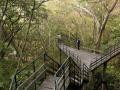
Basically, both Minh Chau and Quan Lan localities have quite favorable conditions for developing ecotourism. However, Quan Lan commune has more advantages to develop ecotourism in a humanistic direction, because this is an area with many famous historical relics such as Quan Lan Communal House, Quan Lan Pagoda, Temple worshiping the hero Tran Khanh Du, ... along with local festivals held annually such as the wind praying ceremony (March 15), Quan Lan festival (June 10-19); due to its location near the port and long exploitation time, the beaches in Quan Lan commune (especially Quan Lan beach) are no longer hygienic and clean to ensure the needs of tourists coming to relax and swim; this is also an area with many beautiful landscapes such as Got Beo wind pass, Ong Phong head, Voi Voi cave, but the ability to access these places is still very limited (dirt hill road, lots of gravel and rocks), especially during rainy and windy times; In addition, other natural resources such as mangrove forests and sea worms have not been really exploited for tourism purposes and ecotourism development. On the contrary, Minh Chau commune has more advantages in developing ecotourism in the direction of natural tourism, this is an area with diverse ecosystems such as at Rua De Beach, Bai Tu Long National Park Conservation Center...; Minh Chau beach is highly appreciated for its natural beauty and cleanliness, ranked in the top ten most beautiful beaches in Vietnam; Minh Chau commune is also home to Tram forest with a large area and a purity of up to 90%, suitable for building bridges through the forest (a very effective type of natural ecotourism currently applied by many countries) for tourists to sightsee, as well as for the purpose of studying and researching.
Figure 3.1: Thenmala Forest Bridge (India) Source: https://www.thenmalaecotourism.com/(August 21, 2019)
3.2.2. Using SWOT matrix to evaluate Quan Lan island tourism
General assessment of current tourism activities of Quan Lan island is shown through the following SWOT matrix:
Table 3.5: SWOT matrix evaluating tourism activities on Quan Lan island
Internal agent
Strengths- There is a lot of potential for tourism development, especially natural ecotourism and humanistic ecotourism.- The unskilled labor force is relatively abundant.- resource environmentunpolluted, still
Weaknesses- Poorly developed infrastructure, especially traffic routes to tourist destinations on the island.- The team of professional staff is still weak.- Tourism products in general
quite wild, originalintact
general and DLST in particularalone is monotonous.
External agents
Opportunity- Tourism is a key industry in the socio-economic development strategy of the province and Van Don economic zone.- Quan Lan was selected as a pilot area for eco-tourism development within the framework of the green growth project between Quang Ninh province and the Japanese organization JICA.- The flow of tourists and especially ecotourism in the world tends toincreasing
Challenge- Weather and climate change abnormally.- Competition in tourism products is increasingly fierce, especially with other localities in the province such as Ha Long, Mong Cai...- Awareness of tourists, especially domestic tourists, about ecotourism and nature conservation is not high.
Through summary analysis using SWOT matrix we see that:
To exploit strengths and take advantage of opportunities, it is necessary to:
- Diversify products and service types (build more tourism routes aimed at specific needs of tourists: experiential tourism immersed in nature, spiritual cultural tourism...)
- Effective exploitation of resources and differentiated products (natural resources and human resources)
div.maincontent .p { color: black; font-family:"Times New Roman", serif; font-style: normal; font-weight: normal; text-decoration: none; font-size: 14pt; margin:0pt; } div.maincontent p { color: black; font-family:"Times New Roman", serif; font-style: normal; font-weight: normal; text-decoration: none; font-size: 14pt; margin:0pt; } div.maincontent .s1 { color: black; font-family:"Times New Roman", serif; font-style: normal; font-weight: normal; text-decoration: none; font-size: 13pt; } div.maincontent .s2 { color: black; font-family:"Times New Roman", serif; font-style: normal; font-weight: normal; text-decoration: none; font-size: 13pt; } div.maincontent .s3 { color: #0D0D0D; font-family:"Times New Roman", serif; font-style: normal; font-weight: bold; text-decoration: none; font-size: 14pt; } div.maincontent .s4 { color: black; font-family:"Times New Roman", serif; font-style: italic; font-weight: normal; text-decoration: none; font-size: 14pt; } div.maincontent .s5 { color: black; font-family:"Times New Roman", serif; font-style: italic; font-weight: bold; text-decoration: none; font-size: 14pt; } div.maincontent .s6 { color: black; font-family:"Times New Roman", serif; font-style: italic; font-weight: normal; text-decoration: none; font-size: 14pt; vertical-align: -3pt; } div.maincontent .s7 { color: black; font-family:"Times New Roman", serif; font-style: italic; font-weight: normal; text-decoration: none; font-size: 14pt; vertical-align: -2pt; } div.maincontent .s8 { color: black; font-family:"Times New Roman", serif; font-style: italic; font-weight: normal; text-decoration: none; font-size: 14pt; vertical-align: -1pt; } div.maincontent .s9 { color: black; font-family:"Times New Roman", serif; font-style: normal; font-weight: normal; text-decoration: none; font-size: 14pt; } div.maincontent .s10 { color: black; font-family:"Times New Roman", serif; font-style: normal; font-weight: bold; text-decoration: none; font-size: 14pt; } div.maincontent .s11 { color: black; font-family:"Times New Roman", serif; font-style: normal; font-weight: normal; text-decoration: none; font-size: 14pt; } div.maincontent .s12 { color: black; font-family:Symbol, serif; font-style: normal; font-weight: normal; text-decoration: none; font-size: 14pt; } div.maincontent .s13 { color: black; font-family:Wingdings; font-style: normal; font-weight: normal; text-decoration: none; font-size: 14pt; } div.maincontent .s14 { color: black; font-family:"Times New Roman", serif; font-style: normal; font-weight: normal; text-decoration: none; font-size: 9pt; vertical-align: 5pt; } div.maincontent .s15 { color: black; font-family:"Times New Roman", serif; font-style: normal; font-weight: normal; text-decoration: none; font-size: 9pt; vertical-align: 5pt; } div.maincontent .s16 { color: black; font-family:Cambria, serif; font-style: italic; font-weight: normal; text-decoration: none; font-size: 14pt; } div.maincontent .s17 { color: #080808; font-family:"Times New Roman", serif; font-style: normal; font-weight: bold; text-decoration: none; font-size: 14pt; } div.maincontent .s18 { color: #080808; font-family:"Times New Roman", serif; font-style: normal; font-weight: normal; text-decoration: none; font-size: 14pt; } div.maincontent .s19 { color: black; font-family:"Times New Roman", serif; font-style: normal; font-weight: normal; text-decoration: none; font-size: 11pt; } div.maincontent .s20 { color: black; font-family:"Times New Roman", serif; font-style: normal; font-weight: normal; text-decoration: none; font-size: 10pt; } div.maincontent .s21 { color: black; font-family:"Times New Roman", serif; font-style: normal; font-weight: bold; text-decoration: none; font-size: 11pt; } div.maincontent .s22 { color: black; font-family:"Times New Roman", serif; font-style: normal; font-weight: normal; text-decoration: none; font-size: 11pt; } div.maincontent .s23 { color: black; font-family:"Times New Roman", serif; font-style: italic; font-weight: normal; text-decoration: none; font-size: 14pt; } div.maincontent .s24 { color: #212121; font-family:"Times New Roman", serif; font-style: normal; font-weight: normal; tex
Identify Rating Levels and Rating Scales
zt2i3t4l5ee
zt2a3gstourism,quan lan,quang ninh,ecology,ecotourism,minh chau,van don,geography,geographical basis,tourism development,science
zt2a3ge
zc2o3n4t5e6n7ts
of the islanders. Therefore, this indicator will be divided into two sub-indicators:
a1. Natural tourism attractiveness a2. Cultural tourism attractiveness
b. Tourist capacity
The two island communes in Quan Lan have different capacities to receive tourists. Minh Chau Commune is home to many standard hotels and resorts, attracting high-income domestic and international tourists. Meanwhile, Quan Lan Commune has many motels mainly built and operated by local people, so the scale and quality are not high, and will be suitable for ordinary tourists such as students.
c. Time of exploitation of Quan Lan Island Commune:
Quan Lan tourism is seasonal due to weather and climate conditions and festivals only take place on certain days of the year, specifically in spring. In Quan Lan commune, the period from April to June and from September to November is considered the best time to visit Quan Lan because the cultural tourism activities are mainly associated with festivals taking place during this time.
Minh Chau island commune:
Tourism exploitation time is all year round, because this is a place with a number of tourist attractions with diverse ecosystems such as Bai Tu Long National Park Research Center, Tram forest, Turtle Laying Beach, so besides coming to the beach for tourism and vacation in the summer, Minh Chau will attract research groups to come for tourism combined with research at other times of the year.
d. Sustainability
The sustainability of ecotourism sites in Quan Lan and Minh Chau communes depends on the sensitivity of the ecosystems to climate changes.
landscape. In general, these tourist destinations have a fairly high level of sustainability, because they are natural ecosystems, planned and protected. However, if a large number of tourists gather at certain times, it can exceed the carrying capacity and affect the sustainability of the environment (polluted beaches, damaged trees, animals moving away from their habitats, etc.), then the sustainability of the above ecosystems (natural ecosystems, human ecosystems) will also be affected and become less sustainable.
e. Location and accessibility
Both island communes have ports to take tourists to visit from Van Don wharf:
- Quan Lan – Van Don traffic route:
Phuc Thinh – Viet Anh high-speed boat and Quang Minh high-speed boat, depart at 8am and 2pm from Van Don to Quan Lan, and at 7am and 1pm from Quan Lan to Van Don. There are also wooden boats departing at 7am and 1pm.
- Van Don - Minh Chau traffic route:
Chung Huong high-speed train, Minh Chau train, morning 7:30 and afternoon 13:30 from Van Don to Minh Chau, morning 6:30 and afternoon 13:00 from Minh Chau to Van Don.
f. Infrastructure
Despite receiving investment attention, the issue of infrastructure and technical facilities for tourism on Quan Lan Island is still an issue that needs to be resolved because it has a direct impact on the implementation of ecotourism activities. The minimum conditions for serving tourists such as accommodation, electricity, water, communication, especially medical services, and security work need to be given top priority. Ecotourism spots in Minh Chau commune are assessed to have better infrastructure and technical facilities for tourism because there are quite complete and synchronous conditions for serving tourists, meeting many needs of domestic and foreign tourists.
3.2.1.4. Determine assessment levels and assessment scales
Corresponding to the levels of each criterion, the index is the score of those levels in the order of 4, 3, 2, 1 decreasing according to the standard of each level: very attractive (4), attractive (3), average (2), less attractive (1).
3.2.1.5. Determining the coefficients of the criteria
For the assessment of DLST in the two communes of Quan Lan and Minh Chau islands, the students added evaluation coefficients to show the importance of the criteria and indicators as follows:
Coefficient 3 with criteria: Attractiveness, Exploitation time. These are the 2 most important criteria for attracting tourists to tourism in general and eco-tourism in particular, so they have the highest coefficient.
Coefficient 2 with criteria: Capacity, Infrastructure, Location and accessibility . Because the assessment area is an island commune of Van Don district, the above criteria are selected by the author with appropriate coefficients at the average level.
Coefficient 1 with criteria: Sustainability. Quan Lan has natural and human-made ecotourism sites, with high biodiversity and little impact from local human factors. Most of the ecotourism sites are still wild, so they are highly sustainable.
3.2.1.6. Results of DLST assessment on Quan Lan island
a. Assessment of the potential for natural tourism development
For Minh Chau commune:
+ Natural tourism attractiveness is determined to be very attractive (4 points) and the most important coefficient (coefficient 3), so the score of the Attractiveness criterion is 4 x 3 = 12.
+ Capacity is determined as average (2 points) and the coefficient is quite important (coefficient 2), then the score of Capacity criterion is 2 x 2 = 4.
+ Exploitation time is long (4 points), the most important coefficient (coefficient 3) so the score of the Exploitation time criterion is 4 x 3 = 12.
+ Sustainability is determined as sustainable (4 points), the important coefficient is the average coefficient (coefficient 1), so the score of the Sustainability criterion is 4 x 1 = 4 points
+ Location and accessibility are determined to be quite favorable (2 points), the coefficient is quite important (coefficient 2), the criterion score is 2 x 2 = 4 points.
+ Infrastructure is assessed as good (3 points), the coefficient is quite important (coefficient 2), then the score of the Infrastructure criterion is 3 x 2 = 6 points.
The total score for evaluating DLST in Minh Chau commune according to 6 evaluation criteria is determined as: 12 + 4 + 12 + 4 + 4 + 6 = 42 points
Similar assessment for Quan Lan commune, we have the following table:
Table 3.3: Assessment of the potential for natural ecotourism development in Quan Lan and Minh Chau communes
Attractiveness of self-tourismof course
Capacity
Mining time
Sustainability
Location and accessibility
Infrastructure
Result
Point
DarkMulti
Point
DarkMulti
Point
DarkMulti
Point
DarkMulti
Point
DarkMulti
Point
DarkMulti
CommuneMinh Chau
12
12
4
8
12
12
4
4
4
8
6
8
42/52
Quan CommuneLan
6
12
6
8
9
12
4
4
4
8
4
8
33/52
b. Assessment of the potential for humanistic tourism development
For Quan Lan commune:
+ The attractiveness of human tourism is determined to be very attractive (4 points) and the most important coefficient (coefficient 3), so the score of the Attractiveness criterion is 4 x 3 = 12.
+ Capacity is determined to be large (3 points) and the coefficient is quite important (coefficient 2), then the score of the Capacity criterion is 3 x 2 = 6.
+ Mining time is average (3 points), the most important coefficient (coefficient 3) so the score of the Mining time criterion is 3 x 3 = 9.
+ Sustainability is determined as sustainable (4 points), the important coefficient is the average coefficient (coefficient 1), so the score of the Sustainability criterion is 4 x 1 = 4 points.
+ Location and accessibility are determined to be quite favorable (2 points), the coefficient is quite important (coefficient 2), the criterion score is 2 x 2 = 4 points.
+ Infrastructure is rated as average (2 points), the coefficient is quite important (coefficient 2), then the score of the Infrastructure criterion is 2 x 2 = 4 points.
The total score for evaluating DLST in Quan Lan commune according to 6 evaluation criteria is determined as: 12 + 6 + 6 + 4 + 4 + 4 = 36 points.
Similar assessment with Minh Chau commune we have the following table:
Table 3.4: Assessment of the potential for developing humanistic eco-tourism in Quan Lan and Minh Chau communes
Attractiveness of human tourismliterature
Capacity
Mining time
Sustainability
Location and accessibility
Infrastructure
Result
Point
DarkMulti
Point
DarkMulti
Point
DarkMulti
Point
DarkMulti
Point
DarkMulti
Point
DarkMulti
Quan CommuneLan
12
12
6
8
9
12
4
4
4
8
4
8
39/52
Minh CommuneChau
6
12
4
8
12
12
4
4
4
8
6
8
36/52
Basically, both Minh Chau and Quan Lan localities have quite favorable conditions for developing ecotourism. However, Quan Lan commune has more advantages to develop ecotourism in a humanistic direction, because this is an area with many famous historical relics such as Quan Lan Communal House, Quan Lan Pagoda, Temple worshiping the hero Tran Khanh Du, ... along with local festivals held annually such as the wind praying ceremony (March 15), Quan Lan festival (June 10-19); due to its location near the port and long exploitation time, the beaches in Quan Lan commune (especially Quan Lan beach) are no longer hygienic and clean to ensure the needs of tourists coming to relax and swim; this is also an area with many beautiful landscapes such as Got Beo wind pass, Ong Phong head, Voi Voi cave, but the ability to access these places is still very limited (dirt hill road, lots of gravel and rocks), especially during rainy and windy times; In addition, other natural resources such as mangrove forests and sea worms have not been really exploited for tourism purposes and ecotourism development. On the contrary, Minh Chau commune has more advantages in developing ecotourism in the direction of natural tourism, this is an area with diverse ecosystems such as at Rua De Beach, Bai Tu Long National Park Conservation Center...; Minh Chau beach is highly appreciated for its natural beauty and cleanliness, ranked in the top ten most beautiful beaches in Vietnam; Minh Chau commune is also home to Tram forest with a large area and a purity of up to 90%, suitable for building bridges through the forest (a very effective type of natural ecotourism currently applied by many countries) for tourists to sightsee, as well as for the purpose of studying and researching.
Figure 3.1: Thenmala Forest Bridge (India) Source: https://www.thenmalaecotourism.com/(August 21, 2019)
3.2.2. Using SWOT matrix to evaluate Quan Lan island tourism
General assessment of current tourism activities of Quan Lan island is shown through the following SWOT matrix:
Table 3.5: SWOT matrix evaluating tourism activities on Quan Lan island
Internal agent
Strengths- There is a lot of potential for tourism development, especially natural ecotourism and humanistic ecotourism.- The unskilled labor force is relatively abundant.- resource environmentunpolluted, still
Weaknesses- Poorly developed infrastructure, especially traffic routes to tourist destinations on the island.- The team of professional staff is still weak.- Tourism products in general
quite wild, originalintact
general and DLST in particularalone is monotonous.
External agents
Opportunity- Tourism is a key industry in the socio-economic development strategy of the province and Van Don economic zone.- Quan Lan was selected as a pilot area for eco-tourism development within the framework of the green growth project between Quang Ninh province and the Japanese organization JICA.- The flow of tourists and especially ecotourism in the world tends toincreasing
Challenge- Weather and climate change abnormally.- Competition in tourism products is increasingly fierce, especially with other localities in the province such as Ha Long, Mong Cai...- Awareness of tourists, especially domestic tourists, about ecotourism and nature conservation is not high.
Through summary analysis using SWOT matrix we see that:
To exploit strengths and take advantage of opportunities, it is necessary to:
- Diversify products and service types (build more tourism routes aimed at specific needs of tourists: experiential tourism immersed in nature, spiritual cultural tourism...)
- Effective exploitation of resources and differentiated products (natural resources and human resources)
div.maincontent .p { color: black; font-family:"Times New Roman", serif; font-style: normal; font-weight: normal; text-decoration: none; font-size: 14pt; margin:0pt; } div.maincontent p { color: black; font-family:"Times New Roman", serif; font-style: normal; font-weight: normal; text-decoration: none; font-size: 14pt; margin:0pt; } div.maincontent .s1 { color: black; font-family:"Times New Roman", serif; font-style: normal; font-weight: normal; text-decoration: none; font-size: 13pt; } div.maincontent .s2 { color: black; font-family:"Times New Roman", serif; font-style: normal; font-weight: normal; text-decoration: none; font-size: 13pt; } div.maincontent .s3 { color: #0D0D0D; font-family:"Times New Roman", serif; font-style: normal; font-weight: bold; text-decoration: none; font-size: 14pt; } div.maincontent .s4 { color: black; font-family:"Times New Roman", serif; font-style: italic; font-weight: normal; text-decoration: none; font-size: 14pt; } div.maincontent .s5 { color: black; font-family:"Times New Roman", serif; font-style: italic; font-weight: bold; text-decoration: none; font-size: 14pt; } div.maincontent .s6 { color: black; font-family:"Times New Roman", serif; font-style: italic; font-weight: normal; text-decoration: none; font-size: 14pt; vertical-align: -3pt; } div.maincontent .s7 { color: black; font-family:"Times New Roman", serif; font-style: italic; font-weight: normal; text-decoration: none; font-size: 14pt; vertical-align: -2pt; } div.maincontent .s8 { color: black; font-family:"Times New Roman", serif; font-style: italic; font-weight: normal; text-decoration: none; font-size: 14pt; vertical-align: -1pt; } div.maincontent .s9 { color: black; font-family:"Times New Roman", serif; font-style: normal; font-weight: normal; text-decoration: none; font-size: 14pt; } div.maincontent .s10 { color: black; font-family:"Times New Roman", serif; font-style: normal; font-weight: bold; text-decoration: none; font-size: 14pt; } div.maincontent .s11 { color: black; font-family:"Times New Roman", serif; font-style: normal; font-weight: normal; text-decoration: none; font-size: 14pt; } div.maincontent .s12 { color: black; font-family:Symbol, serif; font-style: normal; font-weight: normal; text-decoration: none; font-size: 14pt; } div.maincontent .s13 { color: black; font-family:Wingdings; font-style: normal; font-weight: normal; text-decoration: none; font-size: 14pt; } div.maincontent .s14 { color: black; font-family:"Times New Roman", serif; font-style: normal; font-weight: normal; text-decoration: none; font-size: 9pt; vertical-align: 5pt; } div.maincontent .s15 { color: black; font-family:"Times New Roman", serif; font-style: normal; font-weight: normal; text-decoration: none; font-size: 9pt; vertical-align: 5pt; } div.maincontent .s16 { color: black; font-family:Cambria, serif; font-style: italic; font-weight: normal; text-decoration: none; font-size: 14pt; } div.maincontent .s17 { color: #080808; font-family:"Times New Roman", serif; font-style: normal; font-weight: bold; text-decoration: none; font-size: 14pt; } div.maincontent .s18 { color: #080808; font-family:"Times New Roman", serif; font-style: normal; font-weight: normal; text-decoration: none; font-size: 14pt; } div.maincontent .s19 { color: black; font-family:"Times New Roman", serif; font-style: normal; font-weight: normal; text-decoration: none; font-size: 11pt; } div.maincontent .s20 { color: black; font-family:"Times New Roman", serif; font-style: normal; font-weight: normal; text-decoration: none; font-size: 10pt; } div.maincontent .s21 { color: black; font-family:"Times New Roman", serif; font-style: normal; font-weight: bold; text-decoration: none; font-size: 11pt; } div.maincontent .s22 { color: black; font-family:"Times New Roman", serif; font-style: normal; font-weight: normal; text-decoration: none; font-size: 11pt; } div.maincontent .s23 { color: black; font-family:"Times New Roman", serif; font-style: italic; font-weight: normal; text-decoration: none; font-size: 14pt; } div.maincontent .s24 { color: #212121; font-family:"Times New Roman", serif; font-style: normal; font-weight: normal; tex -
 Some Theoretical Models on Economic Sector Structure Shift
 -
 The Method of Using the CL Method in Building Economic Models
 -
 Studies of Some Economic Efficiency Evaluation Models
 -
 Models of Economic Growth Inequality
Source: Report of Van Giang District Department of Agriculture
Looking at the summary table above, it can be seen that from 2000 to 2008, the number of farms in the district increased 2.6 times. From 163 farms to 422. The smallest farm size is calculated to be from 5 Northern Sao or more. Of which, the number of farms following the VAC model still accounts for a high proportion and has increased the most. In 2000, the number of VAC farms was 76, accounting for 46.6%, by 2003 it was 98 farms, accounting for 42.4% and by 2008 it increased to 151, accounting for 35.8%. Although the proportion has decreased, it has increased rapidly in terms of quantity and value of contribution to the district's economy. With a small and medium scale, about 1 hectare of Northern Vietnam, this is still the most effective agricultural production model for Van Giang, both taking advantage of the land and promoting existing strengths. Among these types of farms, there are examples of effective farmers such as the farm of Mr. Do Van Mau's family in Van Giang town with an area of 3600m2 raising
Combining freshwater aquaculture, raising pigs, chickens, ducks, bananas, oranges, grapefruits, annually brings in an income of 40-50 million VND. Mr. Vu Van Tru's family in Me So has a VAC farm with an area of dozens of hectares combining cultivation and livestock raising, each year bringing in a profit of several hundred million VND.
After the district had a specific plan for 3 specialized production areas: fruit trees, specialties, ornamental plants, high-quality rice, livestock and fish farming, the number of households switching to concentrated farms in the direction of producing only one crop or livestock product also increased significantly and accounted for an increasingly large proportion. These are also models
farms for high economic efficiency by focusing on developing a type of tree with good yield and quality. The number of farms growing various types of trees increased from 21 farms (12.9%) in 2000 to 68 farms (16%) in 2008. The number of farms raising livestock and poultry increased sharply from 18 farms in 2000 (11%) to 98 farms in 2008 (23.3%). Among these, the farms raising pigs for meat, breeding pigs and dairy cows increased the most. The highly effective pig farms are the farms of Mr. Dao Tat Hiep's family in Me So commune, raising sows and commercial pigs on
Area 7000m2 for average profit 150 million VND/year... Farm
Mr. Do Van Hung's dairy farm in Van Giang Town, Mr. Nguyen Van Xay's chicken and duck farm in Long Hung... are farms with an income of around 100 million VND/year.
Freshwater aquaculture farms also increased threefold from 17 farms in 2000 to 54 in 2008. These farms are concentrated in low-lying communes with agricultural land prone to flooding such as Long Hung, Tan Tien, Nghia Tru, Vinh Khuc, Xuan Quan. The main products are freshwater shrimp and fish, not only providing food for the people in the district, most of the products from these farms are exported to Hanoi and neighboring districts and provinces.
The model of specialized tree farms is increasing in the planning of the district's key tree growing areas. A typical example is Mr. Chu Van Hung's farm in Lien Nghia commune. This is a tree growing model that has brought high economic value for many years in Lien Nghia. Although he is 41 years old this year, Mr. Hung has 15 years of experience in growing kumquat and orange trees. With an area of 6 hectares, he grows 2,000 kumquat and orange trees and thousands of orange trees, rare ornamental trees. Mr. Hung said that in addition to applying techniques to plant and care for trees, soil improvement is very important. Usually, after harvesting at the end of the year, he invests
tens of millions of dong on land improvement. This helps improve the efficiency of cultivation. Every year, his family estimates that they harvest 10 tons of oranges, kumquats and hundreds of ornamental plants of all kinds. In 2008, his garden brought in an income of nearly 500 million dong .
Depending on their specific conditions, each locality builds its own fields worth 50 million VND/ha/year or more in its own way. With the formula of growing 2 crops of glutinous corn + summer-autumn and autumn-winter vegetables each year on a 121-hectare field, farmers in Thang Loi commune (Van Giang) earn over 70 million VND/ha.
The flower and ornamental plant growing model in Lien Nghia, Me So and Phung Cong communes brings in an income of 80 - 130 million VND/ha/year.
This is the most visible change in rural Van Giang after the land reform. When the land was concentrated into large plots, some families continued to voluntarily consolidate and exchange their land with other families or buy and rent more land from adjacent plots to expand the scale of the farm, then put into cultivation plants and animals with high economic value, which are in the planning of local agricultural products and have guaranteed output for the products. Plants and animals often put into cultivation are: Bananas, grapefruit, oranges, tangerines, apples, ornamental plants, medicinal plants, vegetables of all kinds, pigs, dairy cows, beef cattle, poultry, freshwater shrimp and fish...
As the number of family farms increases, the number of households specializing in providing plants, breeds, animal feed, pesticides, and veterinary medicines increases sharply to meet local needs. The number of households providing plants, breeds, and animal feed in the whole district increased from 31 households in 2000 to 45 households in 2005 and 51 households in 2008. On average, each commune in the district has 4.6 establishments providing plants, breeds, animal feed, pesticides, and veterinary medicines, which relatively ensures the demand for animal feed for the communes. This is also a way to get rich for a few farming households.
The people are quick to respond to the economic development in the locality. Most of these households have rented out their land to focus on agricultural services.
* Small-scale handicraft production facility model
The urbanization work in Van Giang not only creates conditions for some farming households to develop their economy according to the farm model, but also creates conditions for some farming households to escape agriculture to focus on developing the handicraft economy. The urbanization process and the thematic resolution " On the development of industry, small-scale industry, and craft villages in the period of 2003"
- 2010 ” created a strong change in the handicraft industry in Van Giang. The scale of these handicraft production establishments, although still quite small, has initially contributed to the local budget, developed the family economy and created changes in the economic structure of the district. The number of handicraft production establishments in Van Giang increased rapidly after 2003.
Table 2.14 : Number of handicraft production establishments in Van Giang over the years
Year
2000 | 2003 | 2005 | 2008 | |
Total | 1031 | 1048 | 1224 | 2158 |
I. Classification by economic sector | 1031 | 1048 | 1224 | 2158 |
State economic sector | ||||
Non-state economic sector | 1031 | 1047 | 1223 | 2517 |
Collective, cooperative | 4 | 4 | 4 | 1 |
Individual, organization | 1021 | 1036 | 1212 | 2145 |
Private economy | 6 | 6 | 7 | 11 |
Foreign investment economic zone | 0 | 1 | 1 | 1 |
II. Classification by industry | 1031 | 1048 | 1224 | 2158 |
Food and beverage production | 506 | 573 | 586 | 664 |
Garment manufacturing | 60 | 106 | 130 | 132 |
Leather products manufacturing | 13 | 22 | 32 | 889 |
Manufacture of products from wood, bamboo and rattan. | 59 | 37 | 70 | 153 |
Manufacture of paper and paper products | 5 | 3 | 1 | 44 |
Manufacture of products from non-metallic mineral substances | 224 | 186 | 122 | 71 |
Manufacture of metal products | 60 | 59 | 161 | 164 |
Manufacture of electrical and electronic equipment | 1 | 1 | ||
Production of beds, cabinets, tables and chairs | 84 | 57 | 118 | 33 |
Production of chemicals and chemical products | 4 | 3 | 3 | 3 |
Production and distribution of electricity and water | 2 |
Source: Statistical yearbook of Van Giang district 2000 - 2008
The total number of establishments producing industrial and handicraft products increased from 1031 establishments in 2000 to 1048 in 2003. After the land reform, this number was 1224 in 2005 and 2158 in 2008. This means that the number of households doing pure agriculture has decreased, some households and some villages have completely switched to handicraft production. The number of handicraft production establishments in the form of individuals and private individuals clearly shows this change. From 1021 individual and private handicraft production establishments in 2000, the number increased to 1036 establishments in 2003 and 2145 establishments in 2008. In the production structure by industry, the food and beverage production industry accounted for a high proportion of 49.07% in 2000 and 30.76% in 2008, the leather product production industry increased sharply from 13 establishments in 2000 to 22 establishments in 2003 and skyrocketed to 889 establishments in 2008, accounting for 41.2% of the number of handicraft establishments. The handicraft industries producing products from wood, bamboo, rattan and metal products also increased sharply.
The production scale of these handicraft establishments is still small compared to the actual needs and requirements of industrialization. Most of these production establishments are family and individual handicrafts. After the land reform, some households transferred or leased their land, focusing on handicraft production to get rich. Van Giang's handicraft production is concentrated in the communes: Xuan Quan, Van Giang Town, Nghia Tru, Vinh Khuc, Me So, Lien Nghia, Long Hung.
But Van Giang still does not have any traditional handicraft village with professional characteristics. Most handicraft households still do business spontaneously. There are still many households that do both handicraft and agricultural production.
* Commercial, hotel, restaurant business model:
Besides the models of family and private handicraft production, service business is also an emerging form of economic development in Vietnam.
Van Giang after 2003, met the local service needs. The number of service establishments, hotels, restaurants increased sharply over the years, contributing to the growth in production value of the service sector in the general economic structure. The increase in the number of households doing service business was partly due to the increased demand for local services, and partly due to the fact that after the urbanization, some households in the planning areas of industrial parks, clusters, urban areas... no longer had land for production, so they switched to service business. The number of surplus laborers from agriculture looking for motor vehicle maintenance and repair services, wholesale and retail of consumer goods also increased rapidly. This model also opened up a new direction for economic development in Van Giang during the industrialization and urbanization process.
Table 2.15 : Number of households engaged in commerce, hotels, restaurants, tourism and individual services
Year
2000 | 2003 | 2005 | 2008 | |
Total | 456 | 1616 | 1937 | 2372 |
1. Trade, repair of motor vehicles, personal and household goods | 392 | 1342 | 1604 | 2040 |
1.1 Sale, maintenance and repair of motor vehicles | 20 | 78 | 97 | 125 |
1.2 Wholesale and agency sales | 12 | 103 | 122 | 150 |
1.3. Retail and repair of personal and household goods | 360 | 1161 | 1385 | 1587 |
2. Services | 26 | 97 | 150 | 75 |
3. Hotels, restaurants | 38 | 177 | 183 | 257 |
Source: Statistical yearbook of Van Giang district 2000 - 2008
The number of households participating in commercial and service activities in Van Giang has increased sharply over the years, especially after the 2003 DDDT. From 456 households in 2000, it increased to 1,616 households in 2003 and 2,372 in 2008. The number of households participating in commercial activities, repairing motor vehicles and personal belongings has increased the most. In 2000, there were 392 households, but by 2008, it had increased to 2,040 households, 5.2 times more. Hotel and restaurant services in the district have also increased according to market demand. The number of service business households increased in 2003 (97 households) and 2005 (150 households) and then suddenly decreased sharply.