
In short, although spring rolls are available in many different regions across the country, the flavors of each place are different, representing the unique cultures and people of each region.
2.2.4. Bau Da Wine
Authentic Bau Da wine is mainly brewed from Cu Lam village, Nhon Loc commune, An Nhon town, Binh Dinh province.
Bau Da wine was recognized as one of the Top 10 famous wine specialties of Vietnam in 2012 (According to the Vietnam Record Organization - Vietkings, 2012). Bau Da wine is very "heavy" from 50 0 to more than 54 0 , because the wine is so strong, it makes you drunk very quickly, but especially when sober, you do not have a headache (Truong Dang, 2011). Another special point is that Bau Da wine also has the effect of treating back pain, aches and pains, making the body feel comfortable, strengthening the digestive system, blood circulation,
blood circulation when we use moderately about 2 to 3 glasses per day (According to Vietnam Record Organization - Vietkings, 2012).
The name Bau Da used today has two explanations as follows: The first explanation is that in the past, the water source used to distill wine was taken from a common water tank for the whole village called Bau Da, so this name was used to name the finished wine. The second explanation is that according to legend, in ancient times, there was a woman named Dau from Tay Son district (Binh Dinh), who married a man in Bau Da village and brought with her the family wine-making profession (People's Committee of An Nhon Town, 2012). To have good wine, she had to use water stored in her family's tank to make wine, so the wine was delicious and had a very unique aroma, completely different from other types of wine. After she passed away, she left the family wine-making recipe to the villagers. To commemorate her merit, the people of Bau Da village used her name to name this excellent wine, but to avoid taboo, they changed it to Bau Da (Mrs. Dau).
Bau Da wine includes 3 types: rice wine, sticky rice wine and green bean wine depending on the ingredients used for cooking. The wine making profession is also very elaborate with many meticulous steps, with 1 cooking pot taking up to 6 days to produce 1 batch of wine. For example
As with rice wine, each batch uses 7.2 kg of good rice to cook into rice, the rice mixed with yeast is put into a plastic bucket to ferment. Villagers do not use industrial yeast or Chinese yeast, but use traditional yeast (Y Nhac, 2010), usually Truong Dinh yeast (Binh Hoa commune, Tay Son district, Binh Dinh), Ba Canh yeast (Dap Da ward, An Nhon town, Binh Dinh). The mixture of rice mixed with yeast is incubated for 03 days to give off a fragrant smell, then add 16 liters of well water taken from the village to cover the mixture of rice mixed with yeast, this well water must be taken from a well made of terracotta or a well made of laterite, not from a well made of soil or a cement well (Y Nhac, 2010). This mixture is incubated for another 02 days so that when the lid of the plastic bucket containing the rice is opened, the fragrant smell of the cooked rice wine is smelled. Then, put the rice wine mixture into a copper pot to cook, cover the pot with a clay pot lid, the wine is distilled with a hollowed-out bamboo tube from the cooking pot to the condensing pot. During the cooking time, people usually just keep the fire low, however, they still have to constantly listen to the speed of the wine drops to add or reduce the fire because too much fire will make the rice wine stick to the pot, the wine will be burnt; too little fire will make the finished wine not delicious (Truong Dang, 2011). Because of this careful cooking method, Bau Da wine has a very pure and rich flavor.
Table 2.3. Feelings when enjoying Bau Da wine
Wine name
Sense
Bau Da | |
Taste | - A little sweet, a little bitter. - High alcohol content but when drinking it does not cause a burning sensation, it only lasts for a few seconds and then goes away. |
Vision | - Look clear. - Shaking the bottle of wine will cause bubbles to rise to the top, stick to the bottle wall and then quickly dissipate, the wine will remain clear as usual. - Pour wine into a full glass, the wine will sparkle and then dissipate quickly. |
Sense of smell | - Characteristic strong aroma. |
Tactile | - The wine bottle feels cool to the touch. |
Hearing | - Pour wine into a jackfruit seed glass and listen to the clear, sweet sound. |
Maybe you are interested!
-
 Regional connectivity in sustainable tourism development in Quang Binh province - 2
 -
 Tourism potential and solutions for sustainable tourism development in Phong Nha - Ke Bang National Park, Quang Binh - 2
 -
 Tourism potential and solutions for sustainable tourism development in Phong Nha - Ke Bang National Park, Quang Binh - 12
 -
 Lessons Learned for Sustainable Tourism Development in Quang Binh
 -
 Potential and Development of Binh Dinh Tourism 2.2.1- Humanistic Tourism Resources
Source: Bau Da Nam Phuong, 2017
2.2.5. Banh it la gai
According to Mai Thin (2005), when coming to Binh Dinh, visitors will taste the sweet flavor of Banh It La Gai, a simple and rustic cake, very familiar to the people of Binh Dinh. On the days of worship and death anniversaries, there may not be fish or meat, but Banh It La Gai is indispensable. This type of cake is often made on these occasions for children to show their filial piety to their deceased parents and ancestors, because although making Banh It does not cost much, it is very labor-intensive. Before the day of worship and death anniversaries, neighbors gather together to help make the cake, making and chatting, creating a warm family atmosphere. After the worship and death anniversaries are finished, Banh It La Gai is served on the tray as a dessert for everyone and as a gift for children and people at home. In wedding customs, the Banh It La Gai tray also shows the ingenuity of women.
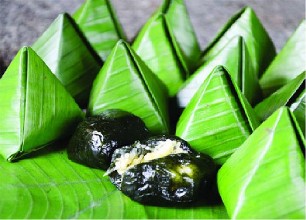
In Binh Dinh, every time the bride returns to her in-laws after three days of marriage, she prepares a cake containing banh it (rice cake) made by herself to worship her ancestors and give to her parents as a gift to show her filial piety. The gift is "small", but it is "a small gift from the heart".
many", there it also has
sweat, perseverance, skillful hands,
Figure 2.3. Banh it la gai
Source: Photographer Nguyen Dung
and especially the filial piety of the girl who left her parents to marry a foreigner. Even though during the three days of the wedding, busy with so many happiness and worries, the girl still did not forget her parents, still took the time to make fragrant cakes waiting for the day she returned home to bring them as gifts for her parents. That is a long-standing traditional culture that deserves to be respected and preserved by the people of Binh Dinh.
The ingredients to make Banh It La Gai are very cheap and easy to find: Gai leaves, sticky rice flour, peanut oil, coconut, and mung beans, but to make a delicious cake requires many steps along with a skillful and hard-working baker.
Banh it la gai is very chewy, but it does not stick to your teeth, and you can eat a lot without worrying about stomachache because the gai leaves have medicinal properties that treat stomachache. When you take a bite of the cake, the sweetness of the sugar, the fat of peanut oil and coconut rice, the aroma of sticky rice, the richness of mung beans, and the spicy aroma of ginger create a truly delicious feeling.
2.2.6. Pink cake
Pink cake is a famous cake of Binh Dinh. Pink cake is a popular dish at parties in the martial arts land. After finishing the savory feast, people often invite guests to dessert with pink cake. Especially, in the countryside of Xu Nau, when you hear someone ask: "When can we eat pink cake?", it means when will you get married (Duyen Moi, 2013). Couples choose pink cake to entrust their dreams of a lasting love like the strong bond of sweet ingredients that make up the pink cake with the elegant sweetness of sugar, the softness of sticky rice flour, and the fatty crunchiness of fresh coconut meat.
The main ingredients to make pink cake are sticky rice, sugar and fresh coconut meat. The sticky rice must be royal sticky rice or new sticky rice. First, people soak the sticky rice until it is soft and then grind it into flour. Next, the dough is kneaded to drain the water and then poured onto a tray. Next, the worker will boil water and then put each piece of dough that has been rolled into small blocks into the water to boil. It can be said that the boiling stage is the most important. If the dough is too cooked and the cake is stirred for too long, the cake will easily become watery, and if the dough is too raw, the cake will be lumpy and the surface of the cake will not be smooth.
When the dough is almost done, it is time to do the next step, which is to melt the sugar. When the dough and sugar are done, the baker quickly scoops the dough into the sugar pan, and also adds the shredded coconut, then stirs quickly and evenly so that the dough and sugar dissolve together. Once the dough has dissolved, lower the heat and continue stirring so that the dough does not stick together. When you touch the dough with your hand and it does not stick to your hand and the cake gives off a fragrant smell, then the cake is done. Take the cake out of the pan, put it in
Put the cake into a mold that has been sprinkled with dry sticky rice flour, use chopsticks to pound the cake until it is about 3 - 4 cm thick, then sprinkle another thin layer of dry sticky rice flour on the surface, wait for the cake to cool before eating. Pink cake is usually opaque white from sticky rice and sugar or light pink (Hanh Hien, 2016).
2.2.7. Coconut rice paper
Rice paper is available in many places in Vietnam, such as Trang Bang - Tay Ninh dried rice paper, Huong Ho - Hue rice paper, and Western milk rice paper. When mentioning Binh Dinh, there is a rustic rice paper that many people remember, which is Tam Quan coconut water rice paper. Tam Quan is a small coastal town in Hoai Nhon district, Binh Dinh province. Coconuts here grow in rows in coastal areas, mainly the Vietnamese coconut variety with large fruits and thick flesh, very suitable for making the specialty coconut water rice paper. Coconut water rice paper is produced from ingredients such as: rice flour, sour-free wheat flour, coconut milk, old coconut meat, purple onion, sesame, pepper, chili and salt. After the rice is ground into flour, it is mixed with a little flour, coconut milk, and the coconut meat that has been squeezed to get the juice is also added; Add sesame, a little peppercorns, crushed red chili, and shallots (thinly sliced) and an indispensable spice that creates the characteristic flavor of Binh Dinh coconut rice paper, which is a little salt (Duyen Moi, 2013). All are mixed well and spread into cakes. Coconut rice paper is usually spread on a large mold (as big as a rice winnowing tray) and spread into a thick layer, only then when baked, the cake will be puffy, crispy, and delicious. After spreading, the cake is dried in the sun, if there is a lot of sun, it only takes one afternoon for the cake to dry (Xuan Khanh, 2015).
Bakeries often stack the dried rice paper into stacks of 10 or 20 and use banana or plastic strings to tie them into a cross shape (locals call it "ràng"), which is very convenient for long-distance transportation (Duyen Moi, 2013).
2.2.8. Vermicelli with snakehead fish
Song Than vermicelli, also known as Song Than vermicelli, is a famous product of the traditional dry vermicelli - rice paper craft village of An Thai located in the north of An Thai village, Nhon Phuc commune, An Nhon town.
The origin of the two names "bun song than" and "bun song than" for the same type of vermicelli is explained by the elders in the craft village as follows:
First of all, the name "song than" is due to the way the product is shaped and packaged. In the past, "song than" noodles were made by workers by weaving double-waved noodles into rectangular sheets, drying them in the sun, then stacking them into stacks of 5 kg/bundle, then people used two "mo nang" sheets to cover both sides and tied them with two parallel hemp ropes into a bundle. Thus, "song than" means two parallel ropes, symbolizing the parallel noodles and parallel packaging ropes (Nguyen Van Thang, 2005).
Next, the name of the song than vermicelli is explained in a spiritual sense: it is said that this product is crystallized from the power of the Earth God and the Fire God. These two gods have a mutual influence and coexist in a unified entity. The vermicelli noodles formed from that power are very precious, so people named them song than vermicelli. This explanation, if compared with the practice of making vermicelli, is also reasonable, because the raw material to make vermicelli noodles is green beans planted in the soil, the process of growth, development, flowering and fruiting and giving seeds is thanks to the source of nutrition from the mother earth and the process of photosynthesis thanks to sunlight (Earth God and Fire God), the green beans are kneaded through the heat from fire and sunlight (Fire God) to form the song than vermicelli product. Song than vermicelli is very precious, delicious and nutritious, so only well-off families at that time could use it regularly; while families with lower living standards only used it on occasions of ancestor worship or parties. When placing the double-souled vermicelli dish to worship ancestors, the homeowner lights incense and prays. They see white smoke rising from an incense stick in pairs. At that time, the homeowner believes that the Earth God and the Fire God are witnessing their sincerity (Nguyen Van Thang, 2005).
Genuine Song Than vermicelli is made from pure green bean starch without any other ingredients (for every 5 kg of fresh green beans, 1.2 kg of starch is obtained, which can be processed into 1 kg of Song Than vermicelli). In addition to being made from green bean flour, Song Than vermicelli can also be made from black beans or white beans.
However, the quality cannot be compared to vermicelli made from pure green bean flour (Nguyen Thi Thuy Hang, 2003). Customers can recognize genuine Song Than vermicelli by their senses because the vermicelli is white, clear, and shiny. When put into boiling water, it does not form a paste. No matter how long the water is boiled, the vermicelli remains chewy and does not fall apart (Nguyen Van Thang, 2005).
2.2.9. Binh Dinh Tre
Travelers traveling for the first time on National Highway 1A, through Tuy Phuoc district, under the administrative boundary of Binh Dinh province, will surely be surprised to see local people hanging small, pretty “broom handles” on roadside stalls. When asked, they found out that they were “tré”, one of the famous specialties in Binh Dinh and some other provinces and cities in the Central region such as Thua Thien.
- Hue, Da Nang, Quang Nam (New Fate, 2014).
The origin of the name tre, according to local elders, is that tre is a dish that appeared during the Tay Son uprising, stuffed into a ceramic jar, buried in the corner of the kitchen to ferment and eat during Tet. After King Quang Trung ascended the throne and established the capital in Phu Xuan, Tay Son officials brought this rustic dish to the capital. From then on, tre was elevated to become a royal dish, with a sophisticated preparation method, sophisticated in both flavor and appearance, no longer stored in a jar but instead wrapped into small rolls. Perhaps the name of the dish was mispronounced from "ché" to "tré" (Bich Van and Duc Anh, 2017).
Ingredients to make tré include pig head meat (pig ears, pig cheeks, pig nose), shredded pig skin, galangal, garlic, roasted rice powder (rice roasted and then ground), roasted sesame seeds, salt, sugar, pepper. Guava leaves, banana leaves and a little straw are indispensable (Duyen Moi, 2014).
When enjoying, we will peel off the outer layers of the tre, use chopsticks to fluff the meat pieces together, then arrange them on a plate. This dish can be rolled with rice paper and raw vegetables (herbs, cucumbers, green bananas, etc.) and dipped in fish sauce, chili, garlic or chili sauce, or served with pickles (papaya, shredded carrots, pickled onions, etc.) as a snack when drinking alcohol. When eating tre, Binh Dinh people often add fresh garlic cloves to make the dish more flavorful.
Table 2.4. Differences between Binh Dinh tre, Quang Nam tre, Da Nang tre, Hue tre
Tre
Pacify
Tre Quang Nam | Tre Danang | Tre Hue | |
Shape | |||
- Bundle into a tree of moderate size and then wrap the outside with a layer of fodder. | - Wrapped like a nem chua, looks square and pretty. | - Wrap into a large tree about the size of a ham tree, wrap the outside with paper layer | |
Main ingredients | |||
- Use the pig's head meat (pig's ears, pig's cheeks, pig's nose), sliced pig's skin fiber | - Use shoulder, rump, and belly meat. | - There is brown beef jerky made from beef, with added pork belly. | |
How to prepare | |||
- The main ingredients are boiled until cooked. | - The main ingredients are boiled until cooked, the rump meat is cooked by roasting. burnt edge | - Fry the pork belly until golden brown, slice and mix with the beef. | |
Leaves to wrap tre | |||
- Guava leaves. | - Sometimes, somewhere to pack with Polyscias fruticosa leaves | ||
Source: author's synthesis, 2017
Although there are many different types of tre, Binh Dinh tre still has its own appeal to diners thanks to its appearance, although it is only covered by rough dry straw fibers, but inside is the special, savory flavor of tre; it seems to represent the simple, plain appearance but deep inside is the warmth and sincerity of the people of the martial arts land.
2.2.10. Jumping shrimp pancake
The reason why it is called jumping shrimp pancake is because when put into the mold to make the cake, the shrimps are still alive, when they encounter hot oil, they immediately jump up and crackle; in addition, when the dough is put into the mold, when it encounters hot oil, the dough cooks and makes a sound.