
Here, you can not only visit and admire the temple but also admire the miracles of Vietnamese Buddhism: the largest bell in Vietnam, the largest bronze statue of Buddha Shakyamuni and the 9-storey Bodhi Tower, the tallest in the current temples.
Although still in the process of completion, Bai Dinh pagoda still welcomes thousands of domestic and foreign tourists every day. With a total area of 2000 hectares, located in the complex of famous tourist areas of Ninh Binh province such as: Hoa Lu Ancient Capital Historical Site, Tam Coc - Bich Dong tourist area, Cuc Phuong National Park, Trang An eco-tourism area has become an attractive historical, cultural, spiritual, ecological tourist destination. The movement and transformation of the earth and sky have created a complex of caves with majestic mountains, blending together. The construction site is still under construction, it is not possible to imagine the beauty as well as the solemnity of a pagoda in the true sense of the word, but its grandeur and magnificence can be felt by anyone who just stops by to look. Important highlights
The most important part of this giant religious structure is still the Tam The Temple and the Phap Chu Temple. The area of these two temples is up to 1,000m2 ( the maximum area of the main temples of traditional pagodas is usually only about 150m2 due to the limitation of the rooms - determined by the length of the wooden beams used as roof beams). The height of the Phap Chu Temple is up to 22m, containing four record-breaking statues inside.
The four statues - three Tam The statues and one Buddha Tathagata statue - are truly the pride of the "owners" of Bai Dinh pagoda. Each Tam The statue weighs up to 50 tons, is 12m high, the Buddha Tathagata statue is 16m high, weighs 100 tons, cast from pure bronze purchased from Russia, cast and installed by famous bronze casting artisans in Y Yen, Nam Dinh.
Maybe you are interested!
-
 Human Resource Development Orientation of Ninh Binh Province's Tourism Industry in the Coming Time
 -
 Viewpoints and Goals of Tourism Development in Ninh Binh Province
 -
 Ninh Binh Provincial Party Committee leads the development of tourism economy 1992 - 2008 - 17
 -
 Evaluation of tourism resources and proposed orientation for ecotourism development on Co To Lon Island, Co To District, Quang Ninh Province - 13
 -
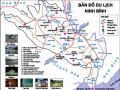 Traditional craft villages and their significance for tourism development in Ninh Binh province - 10
A “great bell” weighing 36 tons was also cast and placed on top of a hill right on the way to the main hall. The bell was so large that it was estimated that if it was to ring, a large wooden pole and four people would be needed to pull the pole to push the bell.
Equally astonishing is the “gathering” of 500 Arhat statues on the hill to the right of the Dharma Palace. The 500 Arhats are 2.3 m tall, carved from Ninh Binh stone.
With the magical beauty of the old Bai Dinh pagoda and the grandeur of the architecture of the new Bai Dinh pagoda, the landscape and natural environment will be an attraction for domestic and foreign tourists. It is a highlight that creates momentum for Ninh Binh tourism to develop according to the world trend.
CHAPTER 3
SOME ASSESSMENTS AND SOLUTIONS
3.1. Orientation on developing Ninh Binh tourism in general and Bai Dinh Pagoda in particular.
Based on the recognition of strengths, especially for tourism development, in recent times, Ninh Binh tourism industry has focused on exploiting both natural tourism to develop eco-tourism and human resources to develop cultural tourism. In addition to exploiting existing resources, Ninh Binh continues to explore and exploit many new resources and well implement the overall and detailed planning into attractive routes and destinations such as Trang An eco-tourism area, Kenh Ga mineral water area, Van Long wetland reserve...
The development orientation of Ninh Binh tourism is not only aimed at exploiting the strengths of tourism resources but also requires a reasonable exploitation process, so the tourism development trend is associated with sustainable development. Nowadays, the sustainable development of economic sectors is an objective requirement. Ninh Binh tourism is one of the key economic sectors that plays an important role in promoting the potential strengths of the province, in order to make investment decisions to shift the economic structure.
Regarding the principles of tourism development, the Tourism Law No. 44/2005/QH11 dated June 14, 2005 of the National Assembly of the Socialist Republic of Vietnam stated: "Develop sustainable tourism, according to planning, plans, ensuring harmony between economy, society and environment. Develop with focus and key points in the direction of cultural - historical tourism, ecological tourism. Preserve and promote the values of tourism resources". This is a more direct and comprehensive legal basis for tourism activities. Many legal documents related to tourism have been newly built and amended, supplemented such as the Investment Law, the Bidding Law, the Immigration Ordinance, the Residence Law, creating a legal corridor for sustainable tourism development.
Thus, "Sustainable tourism is tourism development that meets current needs without compromising the ability to meet future tourism needs."
Sustainable development is an urgent need and an inevitable trend in the process of human social development, so it has been agreed upon by countries around the world to build into an agenda for each period of historical development. On that basis, the World Council on Environment and Development of the United Nations has given the definition (WCED): "Sustainable development is development that meets the requirements of the present, but does not hinder the meeting of the needs of future generations".
The viewpoint of sustainable development was affirmed in Directive 36-CT/TW dated June 12, 1998 of the Politburo on strengthening environmental protection during the period of industrialization and modernization of the country and was reaffirmed once again in the documents of the delegates of the 9th National Congress of the Communist Party of Vietnam and in the socio-economic development strategy 2001-2010 as: "Rapid, effective and sustainable development, economic growth goes hand in hand with the implementation of progress, social justice and environmental protection", and "Socio-economic development is closely linked to environmental protection and improvement, ensuring harmony between the artificial environment and the natural environment, preserving biodiversity". Sustainable development has become the viewpoint and guideline of the Party and the State's policy.
Along with sustainable development, the trend of Ninh Binh industry is to promote ecological development because there is a new ecological environment that creates momentum for sustainable tourism development. In that development trend, Bai Dinh pagoda needs to have its own directions to exploit its resources effectively, limit over-exploitation so that tourism products achieve high quality. Combining with Trang An eco-tourism area to create momentum for its own development means combining sustainable development and eco-tourism to bring the highest efficiency. At the same time, the connection between the two types of ecology and spiritual tourism makes tourism products more diverse. The exploitation of tourism services is continuing to expand in scale, the traffic system is also expanded when the project begins to be organized, in addition to the road from Trang An tourist area to Bai Dinh pagoda mountain area, people are implementing a plan to open an additional waterway. This project will be dredged and put into operation in the near future, connecting the boat dock on the Hoang Long River right in front of the gate of Bai Dinh Tan Tu.
Visitors to Bai Dinh Pagoda can not only visit the pagoda, but also take a boat trip on the gentle river flowing through the fragrant rice fields. Cruise into Long An Cave, one of the longest and most beautiful caves here to explore the hidden wildness of the land above, mountains below and water below. In addition, along this route, visitors can also cruise to visit Trang An Eco-tourism Area. Currently, the main items of the new Bai Dinh Pagoda have almost been shaped. Other items are also being urgently constructed. In the future, Bai Dinh will be a pagoda of the leading scale, not only in Vietnam but also in Southeast Asia.
3.2. Evaluation
3.2.1. Evaluation of the cultural and historical values of Bai Dinh Pagoda
3.2.1.1. Historical value
Assessing the value of this historical land means returning to the national origin, the patriotic traditions of the Vietnamese people from the beginning of the country's founding in the ancient capital of Hoa Lu, the legends and historical figures. Let's explore this issue and we will see its great value and significance.
Bai Dinh Mountain was originally a land that protected the capital from ancient times. According to the late Professor Tran Quoc Vuong, in addition to guards, the Imperial Citadel gate also had gods guarding the four doors, casting spells or performing sacrificial ceremonies. And according to some Confucian scholars in Ninh Binh, when King Dinh built the capital Hoa Lu, he ordered the placement of four protective towers on four sacred mountains in four directions in the region, worshiping the gods as tutelary gods to protect the capital, called "Hoa Lu Tu Tran Son": Bai Dinh Mountain - worshiping Cao Son god - guarding the west of Hoa Lu capital. Thien Ton Mountain - worshiping Huyen Thien Tran Vu god - guarding the north of Hoa Lu capital. Thien Duong Mountain worshiping Cao Son Dai Vuong god - guarding the south of Hoa Lu capital. "According to the history of the Ming Dynasty, among the 21 mountains there is the name An Nam, that mountain is (Thien Duong). In the early Hong Duc period, there was an altar for Giao (worshiping Heaven and Earth), in the third year, an official was sent to worship and draw the shape of the mountain and bring it back" (according to Ninh Binh whole province's geographical records, Sdd, p, 110-111). Dien Si Son (Canh Dieu mountain) - worshiping Quy Minh Dai Vuong - guarded the east of Hoa Lu citadel. In the 10th century - under the Dinh and Tien Le dynasties - Bai Dinh mountain was a military base protecting the western gateway of Hoa Lu citadel with great value.
ruled as a "powerful wooden post blocking the Thuong Dao road", the strategic road into Thanh-Nghe provinces and up to the mountains in the Northwest forest at that time. And this was also the land of "talented people, spiritual land creates prosperity for this place" like the poem "Minh Dinh Danh Lam" by the King, the head of the Tao Dan Association of the Le Dynasty, praised. Later, King Ly Thai To moved the capital to Thang Long and also established "Thang Long Tu Tran", four temples to worship the gods guarding the Thang Long citadel like in the Dinh - Tien Le period in Hoa Lu.
Lying parallel to the Bai Dinh mountain range is the Hoang Long River, which is associated with the legends of Dinh Bo Linh, the place that marks the origin of the Emperor, creating historical legends. The Hoang Long River is the confluence of three rivers (Lang River, Boi River, Le River). The Lang River originates from Hoa Binh, flows through Nho Quan town, flows to meet the Boi River (ancient Kien Phong River), also from Hoa Binh flows to the Kenh Ga junction (Gia Thinh, Gia Vien). The Hoang Long River flows to Le Mountain (Le village, Gia Sinh, Gia Vien) and joins the Le River from Phu Loc, Son Thanh (Nho Quan). In the past, flowing to Phu My (Gia Vuong, Gia Vien), Hoang Long River curved to the Northwest, to Hoang Long village, Duc Hau, An Thai (Gia Trung) flowing to the foot of Bo Dinh mountain (Gia Vuong), Ky Lan (Dai Huu Co, now Gia Phuong commune), then curved around Diem Giang (Gia Thang), Diem Xa (Gia Tien, Gia Vien) forming a water arc embracing Gia Trung, Gia Vuong, Gia Phuong, Gia Thang, Gia Tien communes. This bend is called Dai Hoang River in ancient books. Hoang Long River is just a straight section flowing from Han Nam - Han Bac (Gia Tien) flowing down through Than Thieu, Thien Hoi (Gia Tan) about 8 km to Gian Khau, pouring into Day River (Thanh River). Up to now, in Gia Trung commune, the place name Hoang Long village, near Bo Dinh mountain and Ky Lan mountain, is still preserved. The water arc - winding around the ancient Dai Hoang River formed in front of Bai Dinh mountain (but today it no longer exists). By irrigation, the Dai Hoang Khuc river section from Phu My (Gia Vuong) to Nam Han (Gia Tien) was straightened to drain the flood and cut off the bend of the giant water dragon of this river.
Hoang Long - the river associated with many legends of Dinh Bo Linh during his lifetime with the meaning of "great king", the place where the great hero was born.
Thang Minh - the founder of the glorious Dinh dynasty in history (the remaining trace today is only a small, shallow "inner field" river, located in the middle of the rice fields of Gia Trung, Gia Vuong, Gia Thang, Gia Tien, Gia Phuong communes of Gia Vien district). The ancient Dai Hoang River no longer exists today. The "bend" of the "Water Dragon" Dai Hoang has now lost all traces of the past. Folklore believes that "Dai Hoang's dragon vein has been "broken - blocked" since then.
Today, the river flowing from the Kenh Ga junction is "straightened" from Phu My (Gia Vuong) to the Gia Tien commune pumping station, nearly 6 km long, flowing straight to the Day River in Gian Khau, called Hoang Long River. The ancient Hoang Long River is only the river section from Diem Xa (now Gia Tien commune) to Gian Khau, associated with the legend of the Golden Dragon rising up to save Dinh Bo Linh across the river at Cam Guom mountain (Gia Tien). Today, the Hoang Long River is only a river at the junction of Dong Dinh (Thuong Hoa, Nho Quan) to Gian Khau (Gia Tran, Gia Vien). According to ancient legends, the legend of Dinh Bo Linh is associated with many stories in the Bai Dinh mountain area and the Hoang Long River. The story of the Otter God tells that during the time of Duong Dinh Nghe, there was a couple who had to pack up and return home due to the war. The husband was Dinh Cong Tru, from Hoa Lu cave (now Gia Phuong, Gia Vien), the governor of Hoan Chau (Nghe An), and his wife was Dam Thi. On the way back, due to the long and difficult journey, the couple were very tired and sad. But the saddest thing was that they had been married for decades but had not had a single child to bring joy to the family. They were kind and virtuous, but God still did not show mercy. In no time, they had traveled for nearly a month. When they returned to Bai Linh mountain, the couple rested under an ancient tree near the village. They occasionally heard the sound of fish splashing in the fields. Mrs. Dam Thi told her husband to lean against the tree to relieve his fatigue, while she went down to the field to catch some crabs and fish to cook a bowl of sour soup to relieve her fatigue.
The more Mrs. Dam Thi caught, the more crabs and fish she saw, so she was so absorbed that she soon got far away from her husband's resting place and reached the foot of the mountain at the end of the field. The sun was shining brightly, but suddenly a downpour came, so Mrs. Dam Thi took shelter in a cave in front of her. In front of the cave was a very large and deep pond. She stood in the cave, cupping her hands to catch the shimmering, five-colored raindrops from a stalactite.
down. Drinking strangely, she felt sleepy and closed her eyes. She saw a large rock in the middle of the cave, as hard as a mahogany bed. She lay down and fell asleep without realizing it. The rain had just stopped, and Mrs. Dam Thi had just woken up. She was startled to see a human-shaped Otter, as big as a man, lying next to her, with one leg across her belly. Frightened, she screamed loudly, broke free from the Otter, and ran headlong toward her husband for help. Her husband and the people around heard the screams and rushed toward the mountain cave.
.The man-shaped Otter saw the group of people with knives, sticks, and sickles noisily rushing into the cave, but it still stood on the rock like a statue, not running away. The group of people rushed in and beat the strange Otter. Mr. Dinh Cong Tru, because he arrived later, was only able to get the otter's skeleton and skin, carefully wrapped them up and brought them home to put in the kitchen loft.
Not long after, Mrs. Dam Thi felt nauseous and excited, and knew she was pregnant. She did not know how to tell him about the hypnotic sleep in the mountain cave while taking shelter from the rain. She was hesitant and worried, but in the end, she still hid it from her husband. Mr. Dinh Cong Tru was overjoyed when he saw that his wife was pregnant and said that when the baby was born, he would name the child Bo Linh to commemorate the difficult journey of running away from the war, and resting at noon at the foot of Bai Linh mountain.
After two months of living in the countryside, he suddenly passed away. Mrs. Dam Thi cried bitterly. The villagers all sympathized with her. She lived every day by catching crabs and fish to make a living. She never told anyone that she was pregnant. A year after Mr. Tru died, she still had not given birth. The villagers competed to fabricate stories. Her brother-in-law thought that she was pregnant and chased her away. Mrs. Dam Thi, pregnant, left the village to live in Ky Lan Mountain. There was a temple to the Mountain God in a cave not far from the village.
That day, the sun was shining brightly, suddenly thunder and lightning rumbled, dark clouds swirled. Mrs. Dam Thi went into labor, giving birth to a handsome boy, she counted on her fingers and was fourteen months pregnant. Looking at her healthy and beautiful child, she hugged him with joy until tears welled up in her eyes. The child was very obedient, never fussing or crying, but was very active. Before he was even a month old, the boy was already sitting up as if he were several years old, his eyes were as bright as knives, and his appearance was quite different.