
In general, research on NTFPs in the world focuses on clarifying the concept, role, and principles of NTFPs in different contexts (Wilson et al., 2001; Darău et al., 2010; Su, 2011) or sustainable NTFPs (Blancas et al., 2011) to affirm the importance of NTFPs for the development of rural and national economies. Moreover, domestic research on NTFPs is still limited, mainly focusing on the potential of NTFPs. Therefore, research on NTFPs is still lacking in our country.
2.1.2. Studies on sustainable rural tourism development
2.1.2.1. Sustainable development and sustainable tourism development
Sustainable Development : After the United Nations Earth Summit on Environment and Development held in Rio de Janeiro, Brazil in June 1992 (Rio-
Maybe you are interested!
-
 Identify Rating Levels and Rating Scales
zt2i3t4l5ee
zt2a3gstourism,quan lan,quang ninh,ecology,ecotourism,minh chau,van don,geography,geographical basis,tourism development,science
zt2a3ge
zc2o3n4t5e6n7ts
of the islanders. Therefore, this indicator will be divided into two sub-indicators:
a1. Natural tourism attractiveness a2. Cultural tourism attractiveness
b. Tourist capacity
The two island communes in Quan Lan have different capacities to receive tourists. Minh Chau Commune is home to many standard hotels and resorts, attracting high-income domestic and international tourists. Meanwhile, Quan Lan Commune has many motels mainly built and operated by local people, so the scale and quality are not high, and will be suitable for ordinary tourists such as students.
c. Time of exploitation of Quan Lan Island Commune:
Quan Lan tourism is seasonal due to weather and climate conditions and festivals only take place on certain days of the year, specifically in spring. In Quan Lan commune, the period from April to June and from September to November is considered the best time to visit Quan Lan because the cultural tourism activities are mainly associated with festivals taking place during this time.
Minh Chau island commune:
Tourism exploitation time is all year round, because this is a place with a number of tourist attractions with diverse ecosystems such as Bai Tu Long National Park Research Center, Tram forest, Turtle Laying Beach, so besides coming to the beach for tourism and vacation in the summer, Minh Chau will attract research groups to come for tourism combined with research at other times of the year.
d. Sustainability
The sustainability of ecotourism sites in Quan Lan and Minh Chau communes depends on the sensitivity of the ecosystems to climate changes.
landscape. In general, these tourist destinations have a fairly high level of sustainability, because they are natural ecosystems, planned and protected. However, if a large number of tourists gather at certain times, it can exceed the carrying capacity and affect the sustainability of the environment (polluted beaches, damaged trees, animals moving away from their habitats, etc.), then the sustainability of the above ecosystems (natural ecosystems, human ecosystems) will also be affected and become less sustainable.
e. Location and accessibility
Both island communes have ports to take tourists to visit from Van Don wharf:
- Quan Lan – Van Don traffic route:
Phuc Thinh – Viet Anh high-speed boat and Quang Minh high-speed boat, depart at 8am and 2pm from Van Don to Quan Lan, and at 7am and 1pm from Quan Lan to Van Don. There are also wooden boats departing at 7am and 1pm.
- Van Don - Minh Chau traffic route:
Chung Huong high-speed train, Minh Chau train, morning 7:30 and afternoon 13:30 from Van Don to Minh Chau, morning 6:30 and afternoon 13:00 from Minh Chau to Van Don.
f. Infrastructure
Despite receiving investment attention, the issue of infrastructure and technical facilities for tourism on Quan Lan Island is still an issue that needs to be resolved because it has a direct impact on the implementation of ecotourism activities. The minimum conditions for serving tourists such as accommodation, electricity, water, communication, especially medical services, and security work need to be given top priority. Ecotourism spots in Minh Chau commune are assessed to have better infrastructure and technical facilities for tourism because there are quite complete and synchronous conditions for serving tourists, meeting many needs of domestic and foreign tourists.
3.2.1.4. Determine assessment levels and assessment scales
Corresponding to the levels of each criterion, the index is the score of those levels in the order of 4, 3, 2, 1 decreasing according to the standard of each level: very attractive (4), attractive (3), average (2), less attractive (1).
3.2.1.5. Determining the coefficients of the criteria
For the assessment of DLST in the two communes of Quan Lan and Minh Chau islands, the students added evaluation coefficients to show the importance of the criteria and indicators as follows:
Coefficient 3 with criteria: Attractiveness, Exploitation time. These are the 2 most important criteria for attracting tourists to tourism in general and eco-tourism in particular, so they have the highest coefficient.
Coefficient 2 with criteria: Capacity, Infrastructure, Location and accessibility . Because the assessment area is an island commune of Van Don district, the above criteria are selected by the author with appropriate coefficients at the average level.
Coefficient 1 with criteria: Sustainability. Quan Lan has natural and human-made ecotourism sites, with high biodiversity and little impact from local human factors. Most of the ecotourism sites are still wild, so they are highly sustainable.
3.2.1.6. Results of DLST assessment on Quan Lan island
a. Assessment of the potential for natural tourism development
For Minh Chau commune:
+ Natural tourism attractiveness is determined to be very attractive (4 points) and the most important coefficient (coefficient 3), so the score of the Attractiveness criterion is 4 x 3 = 12.
+ Capacity is determined as average (2 points) and the coefficient is quite important (coefficient 2), then the score of Capacity criterion is 2 x 2 = 4.
+ Exploitation time is long (4 points), the most important coefficient (coefficient 3) so the score of the Exploitation time criterion is 4 x 3 = 12.
+ Sustainability is determined as sustainable (4 points), the important coefficient is the average coefficient (coefficient 1), so the score of the Sustainability criterion is 4 x 1 = 4 points
+ Location and accessibility are determined to be quite favorable (2 points), the coefficient is quite important (coefficient 2), the criterion score is 2 x 2 = 4 points.
+ Infrastructure is assessed as good (3 points), the coefficient is quite important (coefficient 2), then the score of the Infrastructure criterion is 3 x 2 = 6 points.
The total score for evaluating DLST in Minh Chau commune according to 6 evaluation criteria is determined as: 12 + 4 + 12 + 4 + 4 + 6 = 42 points
Similar assessment for Quan Lan commune, we have the following table:
Table 3.3: Assessment of the potential for natural ecotourism development in Quan Lan and Minh Chau communes
Attractiveness of self-tourismof course
Capacity
Mining time
Sustainability
Location and accessibility
Infrastructure
Result
Point
DarkMulti
Point
DarkMulti
Point
DarkMulti
Point
DarkMulti
Point
DarkMulti
Point
DarkMulti
CommuneMinh Chau
12
12
4
8
12
12
4
4
4
8
6
8
42/52
Quan CommuneLan
6
12
6
8
9
12
4
4
4
8
4
8
33/52
b. Assessment of the potential for humanistic tourism development
For Quan Lan commune:
+ The attractiveness of human tourism is determined to be very attractive (4 points) and the most important coefficient (coefficient 3), so the score of the Attractiveness criterion is 4 x 3 = 12.
+ Capacity is determined to be large (3 points) and the coefficient is quite important (coefficient 2), then the score of the Capacity criterion is 3 x 2 = 6.
+ Mining time is average (3 points), the most important coefficient (coefficient 3) so the score of the Mining time criterion is 3 x 3 = 9.
+ Sustainability is determined as sustainable (4 points), the important coefficient is the average coefficient (coefficient 1), so the score of the Sustainability criterion is 4 x 1 = 4 points.
+ Location and accessibility are determined to be quite favorable (2 points), the coefficient is quite important (coefficient 2), the criterion score is 2 x 2 = 4 points.
+ Infrastructure is rated as average (2 points), the coefficient is quite important (coefficient 2), then the score of the Infrastructure criterion is 2 x 2 = 4 points.
The total score for evaluating DLST in Quan Lan commune according to 6 evaluation criteria is determined as: 12 + 6 + 6 + 4 + 4 + 4 = 36 points.
Similar assessment with Minh Chau commune we have the following table:
Table 3.4: Assessment of the potential for developing humanistic eco-tourism in Quan Lan and Minh Chau communes
Attractiveness of human tourismliterature
Capacity
Mining time
Sustainability
Location and accessibility
Infrastructure
Result
Point
DarkMulti
Point
DarkMulti
Point
DarkMulti
Point
DarkMulti
Point
DarkMulti
Point
DarkMulti
Quan CommuneLan
12
12
6
8
9
12
4
4
4
8
4
8
39/52
Minh CommuneChau
6
12
4
8
12
12
4
4
4
8
6
8
36/52
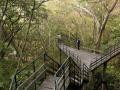
Basically, both Minh Chau and Quan Lan localities have quite favorable conditions for developing ecotourism. However, Quan Lan commune has more advantages to develop ecotourism in a humanistic direction, because this is an area with many famous historical relics such as Quan Lan Communal House, Quan Lan Pagoda, Temple worshiping the hero Tran Khanh Du, ... along with local festivals held annually such as the wind praying ceremony (March 15), Quan Lan festival (June 10-19); due to its location near the port and long exploitation time, the beaches in Quan Lan commune (especially Quan Lan beach) are no longer hygienic and clean to ensure the needs of tourists coming to relax and swim; this is also an area with many beautiful landscapes such as Got Beo wind pass, Ong Phong head, Voi Voi cave, but the ability to access these places is still very limited (dirt hill road, lots of gravel and rocks), especially during rainy and windy times; In addition, other natural resources such as mangrove forests and sea worms have not been really exploited for tourism purposes and ecotourism development. On the contrary, Minh Chau commune has more advantages in developing ecotourism in the direction of natural tourism, this is an area with diverse ecosystems such as at Rua De Beach, Bai Tu Long National Park Conservation Center...; Minh Chau beach is highly appreciated for its natural beauty and cleanliness, ranked in the top ten most beautiful beaches in Vietnam; Minh Chau commune is also home to Tram forest with a large area and a purity of up to 90%, suitable for building bridges through the forest (a very effective type of natural ecotourism currently applied by many countries) for tourists to sightsee, as well as for the purpose of studying and researching.
Figure 3.1: Thenmala Forest Bridge (India) Source: https://www.thenmalaecotourism.com/(August 21, 2019)
3.2.2. Using SWOT matrix to evaluate Quan Lan island tourism
General assessment of current tourism activities of Quan Lan island is shown through the following SWOT matrix:
Table 3.5: SWOT matrix evaluating tourism activities on Quan Lan island
Internal agent
Strengths- There is a lot of potential for tourism development, especially natural ecotourism and humanistic ecotourism.- The unskilled labor force is relatively abundant.- resource environmentunpolluted, still
Weaknesses- Poorly developed infrastructure, especially traffic routes to tourist destinations on the island.- The team of professional staff is still weak.- Tourism products in general
quite wild, originalintact
general and DLST in particularalone is monotonous.
External agents
Opportunity- Tourism is a key industry in the socio-economic development strategy of the province and Van Don economic zone.- Quan Lan was selected as a pilot area for eco-tourism development within the framework of the green growth project between Quang Ninh province and the Japanese organization JICA.- The flow of tourists and especially ecotourism in the world tends toincreasing
Challenge- Weather and climate change abnormally.- Competition in tourism products is increasingly fierce, especially with other localities in the province such as Ha Long, Mong Cai...- Awareness of tourists, especially domestic tourists, about ecotourism and nature conservation is not high.
Through summary analysis using SWOT matrix we see that:
To exploit strengths and take advantage of opportunities, it is necessary to:
- Diversify products and service types (build more tourism routes aimed at specific needs of tourists: experiential tourism immersed in nature, spiritual cultural tourism...)
- Effective exploitation of resources and differentiated products (natural resources and human resources)
div.maincontent .p { color: black; font-family:"Times New Roman", serif; font-style: normal; font-weight: normal; text-decoration: none; font-size: 14pt; margin:0pt; } div.maincontent p { color: black; font-family:"Times New Roman", serif; font-style: normal; font-weight: normal; text-decoration: none; font-size: 14pt; margin:0pt; } div.maincontent .s1 { color: black; font-family:"Times New Roman", serif; font-style: normal; font-weight: normal; text-decoration: none; font-size: 13pt; } div.maincontent .s2 { color: black; font-family:"Times New Roman", serif; font-style: normal; font-weight: normal; text-decoration: none; font-size: 13pt; } div.maincontent .s3 { color: #0D0D0D; font-family:"Times New Roman", serif; font-style: normal; font-weight: bold; text-decoration: none; font-size: 14pt; } div.maincontent .s4 { color: black; font-family:"Times New Roman", serif; font-style: italic; font-weight: normal; text-decoration: none; font-size: 14pt; } div.maincontent .s5 { color: black; font-family:"Times New Roman", serif; font-style: italic; font-weight: bold; text-decoration: none; font-size: 14pt; } div.maincontent .s6 { color: black; font-family:"Times New Roman", serif; font-style: italic; font-weight: normal; text-decoration: none; font-size: 14pt; vertical-align: -3pt; } div.maincontent .s7 { color: black; font-family:"Times New Roman", serif; font-style: italic; font-weight: normal; text-decoration: none; font-size: 14pt; vertical-align: -2pt; } div.maincontent .s8 { color: black; font-family:"Times New Roman", serif; font-style: italic; font-weight: normal; text-decoration: none; font-size: 14pt; vertical-align: -1pt; } div.maincontent .s9 { color: black; font-family:"Times New Roman", serif; font-style: normal; font-weight: normal; text-decoration: none; font-size: 14pt; } div.maincontent .s10 { color: black; font-family:"Times New Roman", serif; font-style: normal; font-weight: bold; text-decoration: none; font-size: 14pt; } div.maincontent .s11 { color: black; font-family:"Times New Roman", serif; font-style: normal; font-weight: normal; text-decoration: none; font-size: 14pt; } div.maincontent .s12 { color: black; font-family:Symbol, serif; font-style: normal; font-weight: normal; text-decoration: none; font-size: 14pt; } div.maincontent .s13 { color: black; font-family:Wingdings; font-style: normal; font-weight: normal; text-decoration: none; font-size: 14pt; } div.maincontent .s14 { color: black; font-family:"Times New Roman", serif; font-style: normal; font-weight: normal; text-decoration: none; font-size: 9pt; vertical-align: 5pt; } div.maincontent .s15 { color: black; font-family:"Times New Roman", serif; font-style: normal; font-weight: normal; text-decoration: none; font-size: 9pt; vertical-align: 5pt; } div.maincontent .s16 { color: black; font-family:Cambria, serif; font-style: italic; font-weight: normal; text-decoration: none; font-size: 14pt; } div.maincontent .s17 { color: #080808; font-family:"Times New Roman", serif; font-style: normal; font-weight: bold; text-decoration: none; font-size: 14pt; } div.maincontent .s18 { color: #080808; font-family:"Times New Roman", serif; font-style: normal; font-weight: normal; text-decoration: none; font-size: 14pt; } div.maincontent .s19 { color: black; font-family:"Times New Roman", serif; font-style: normal; font-weight: normal; text-decoration: none; font-size: 11pt; } div.maincontent .s20 { color: black; font-family:"Times New Roman", serif; font-style: normal; font-weight: normal; text-decoration: none; font-size: 10pt; } div.maincontent .s21 { color: black; font-family:"Times New Roman", serif; font-style: normal; font-weight: bold; text-decoration: none; font-size: 11pt; } div.maincontent .s22 { color: black; font-family:"Times New Roman", serif; font-style: normal; font-weight: normal; text-decoration: none; font-size: 11pt; } div.maincontent .s23 { color: black; font-family:"Times New Roman", serif; font-style: italic; font-weight: normal; text-decoration: none; font-size: 14pt; } div.maincontent .s24 { color: #212121; font-family:"Times New Roman", serif; font-style: normal; font-weight: normal; tex
Identify Rating Levels and Rating Scales
zt2i3t4l5ee
zt2a3gstourism,quan lan,quang ninh,ecology,ecotourism,minh chau,van don,geography,geographical basis,tourism development,science
zt2a3ge
zc2o3n4t5e6n7ts
of the islanders. Therefore, this indicator will be divided into two sub-indicators:
a1. Natural tourism attractiveness a2. Cultural tourism attractiveness
b. Tourist capacity
The two island communes in Quan Lan have different capacities to receive tourists. Minh Chau Commune is home to many standard hotels and resorts, attracting high-income domestic and international tourists. Meanwhile, Quan Lan Commune has many motels mainly built and operated by local people, so the scale and quality are not high, and will be suitable for ordinary tourists such as students.
c. Time of exploitation of Quan Lan Island Commune:
Quan Lan tourism is seasonal due to weather and climate conditions and festivals only take place on certain days of the year, specifically in spring. In Quan Lan commune, the period from April to June and from September to November is considered the best time to visit Quan Lan because the cultural tourism activities are mainly associated with festivals taking place during this time.
Minh Chau island commune:
Tourism exploitation time is all year round, because this is a place with a number of tourist attractions with diverse ecosystems such as Bai Tu Long National Park Research Center, Tram forest, Turtle Laying Beach, so besides coming to the beach for tourism and vacation in the summer, Minh Chau will attract research groups to come for tourism combined with research at other times of the year.
d. Sustainability
The sustainability of ecotourism sites in Quan Lan and Minh Chau communes depends on the sensitivity of the ecosystems to climate changes.
landscape. In general, these tourist destinations have a fairly high level of sustainability, because they are natural ecosystems, planned and protected. However, if a large number of tourists gather at certain times, it can exceed the carrying capacity and affect the sustainability of the environment (polluted beaches, damaged trees, animals moving away from their habitats, etc.), then the sustainability of the above ecosystems (natural ecosystems, human ecosystems) will also be affected and become less sustainable.
e. Location and accessibility
Both island communes have ports to take tourists to visit from Van Don wharf:
- Quan Lan – Van Don traffic route:
Phuc Thinh – Viet Anh high-speed boat and Quang Minh high-speed boat, depart at 8am and 2pm from Van Don to Quan Lan, and at 7am and 1pm from Quan Lan to Van Don. There are also wooden boats departing at 7am and 1pm.
- Van Don - Minh Chau traffic route:
Chung Huong high-speed train, Minh Chau train, morning 7:30 and afternoon 13:30 from Van Don to Minh Chau, morning 6:30 and afternoon 13:00 from Minh Chau to Van Don.
f. Infrastructure
Despite receiving investment attention, the issue of infrastructure and technical facilities for tourism on Quan Lan Island is still an issue that needs to be resolved because it has a direct impact on the implementation of ecotourism activities. The minimum conditions for serving tourists such as accommodation, electricity, water, communication, especially medical services, and security work need to be given top priority. Ecotourism spots in Minh Chau commune are assessed to have better infrastructure and technical facilities for tourism because there are quite complete and synchronous conditions for serving tourists, meeting many needs of domestic and foreign tourists.
3.2.1.4. Determine assessment levels and assessment scales
Corresponding to the levels of each criterion, the index is the score of those levels in the order of 4, 3, 2, 1 decreasing according to the standard of each level: very attractive (4), attractive (3), average (2), less attractive (1).
3.2.1.5. Determining the coefficients of the criteria
For the assessment of DLST in the two communes of Quan Lan and Minh Chau islands, the students added evaluation coefficients to show the importance of the criteria and indicators as follows:
Coefficient 3 with criteria: Attractiveness, Exploitation time. These are the 2 most important criteria for attracting tourists to tourism in general and eco-tourism in particular, so they have the highest coefficient.
Coefficient 2 with criteria: Capacity, Infrastructure, Location and accessibility . Because the assessment area is an island commune of Van Don district, the above criteria are selected by the author with appropriate coefficients at the average level.
Coefficient 1 with criteria: Sustainability. Quan Lan has natural and human-made ecotourism sites, with high biodiversity and little impact from local human factors. Most of the ecotourism sites are still wild, so they are highly sustainable.
3.2.1.6. Results of DLST assessment on Quan Lan island
a. Assessment of the potential for natural tourism development
For Minh Chau commune:
+ Natural tourism attractiveness is determined to be very attractive (4 points) and the most important coefficient (coefficient 3), so the score of the Attractiveness criterion is 4 x 3 = 12.
+ Capacity is determined as average (2 points) and the coefficient is quite important (coefficient 2), then the score of Capacity criterion is 2 x 2 = 4.
+ Exploitation time is long (4 points), the most important coefficient (coefficient 3) so the score of the Exploitation time criterion is 4 x 3 = 12.
+ Sustainability is determined as sustainable (4 points), the important coefficient is the average coefficient (coefficient 1), so the score of the Sustainability criterion is 4 x 1 = 4 points
+ Location and accessibility are determined to be quite favorable (2 points), the coefficient is quite important (coefficient 2), the criterion score is 2 x 2 = 4 points.
+ Infrastructure is assessed as good (3 points), the coefficient is quite important (coefficient 2), then the score of the Infrastructure criterion is 3 x 2 = 6 points.
The total score for evaluating DLST in Minh Chau commune according to 6 evaluation criteria is determined as: 12 + 4 + 12 + 4 + 4 + 6 = 42 points
Similar assessment for Quan Lan commune, we have the following table:
Table 3.3: Assessment of the potential for natural ecotourism development in Quan Lan and Minh Chau communes
Attractiveness of self-tourismof course
Capacity
Mining time
Sustainability
Location and accessibility
Infrastructure
Result
Point
DarkMulti
Point
DarkMulti
Point
DarkMulti
Point
DarkMulti
Point
DarkMulti
Point
DarkMulti
CommuneMinh Chau
12
12
4
8
12
12
4
4
4
8
6
8
42/52
Quan CommuneLan
6
12
6
8
9
12
4
4
4
8
4
8
33/52
b. Assessment of the potential for humanistic tourism development
For Quan Lan commune:
+ The attractiveness of human tourism is determined to be very attractive (4 points) and the most important coefficient (coefficient 3), so the score of the Attractiveness criterion is 4 x 3 = 12.
+ Capacity is determined to be large (3 points) and the coefficient is quite important (coefficient 2), then the score of the Capacity criterion is 3 x 2 = 6.
+ Mining time is average (3 points), the most important coefficient (coefficient 3) so the score of the Mining time criterion is 3 x 3 = 9.
+ Sustainability is determined as sustainable (4 points), the important coefficient is the average coefficient (coefficient 1), so the score of the Sustainability criterion is 4 x 1 = 4 points.
+ Location and accessibility are determined to be quite favorable (2 points), the coefficient is quite important (coefficient 2), the criterion score is 2 x 2 = 4 points.
+ Infrastructure is rated as average (2 points), the coefficient is quite important (coefficient 2), then the score of the Infrastructure criterion is 2 x 2 = 4 points.
The total score for evaluating DLST in Quan Lan commune according to 6 evaluation criteria is determined as: 12 + 6 + 6 + 4 + 4 + 4 = 36 points.
Similar assessment with Minh Chau commune we have the following table:
Table 3.4: Assessment of the potential for developing humanistic eco-tourism in Quan Lan and Minh Chau communes
Attractiveness of human tourismliterature
Capacity
Mining time
Sustainability
Location and accessibility
Infrastructure
Result
Point
DarkMulti
Point
DarkMulti
Point
DarkMulti
Point
DarkMulti
Point
DarkMulti
Point
DarkMulti
Quan CommuneLan
12
12
6
8
9
12
4
4
4
8
4
8
39/52
Minh CommuneChau
6
12
4
8
12
12
4
4
4
8
6
8
36/52
Basically, both Minh Chau and Quan Lan localities have quite favorable conditions for developing ecotourism. However, Quan Lan commune has more advantages to develop ecotourism in a humanistic direction, because this is an area with many famous historical relics such as Quan Lan Communal House, Quan Lan Pagoda, Temple worshiping the hero Tran Khanh Du, ... along with local festivals held annually such as the wind praying ceremony (March 15), Quan Lan festival (June 10-19); due to its location near the port and long exploitation time, the beaches in Quan Lan commune (especially Quan Lan beach) are no longer hygienic and clean to ensure the needs of tourists coming to relax and swim; this is also an area with many beautiful landscapes such as Got Beo wind pass, Ong Phong head, Voi Voi cave, but the ability to access these places is still very limited (dirt hill road, lots of gravel and rocks), especially during rainy and windy times; In addition, other natural resources such as mangrove forests and sea worms have not been really exploited for tourism purposes and ecotourism development. On the contrary, Minh Chau commune has more advantages in developing ecotourism in the direction of natural tourism, this is an area with diverse ecosystems such as at Rua De Beach, Bai Tu Long National Park Conservation Center...; Minh Chau beach is highly appreciated for its natural beauty and cleanliness, ranked in the top ten most beautiful beaches in Vietnam; Minh Chau commune is also home to Tram forest with a large area and a purity of up to 90%, suitable for building bridges through the forest (a very effective type of natural ecotourism currently applied by many countries) for tourists to sightsee, as well as for the purpose of studying and researching.
Figure 3.1: Thenmala Forest Bridge (India) Source: https://www.thenmalaecotourism.com/(August 21, 2019)
3.2.2. Using SWOT matrix to evaluate Quan Lan island tourism
General assessment of current tourism activities of Quan Lan island is shown through the following SWOT matrix:
Table 3.5: SWOT matrix evaluating tourism activities on Quan Lan island
Internal agent
Strengths- There is a lot of potential for tourism development, especially natural ecotourism and humanistic ecotourism.- The unskilled labor force is relatively abundant.- resource environmentunpolluted, still
Weaknesses- Poorly developed infrastructure, especially traffic routes to tourist destinations on the island.- The team of professional staff is still weak.- Tourism products in general
quite wild, originalintact
general and DLST in particularalone is monotonous.
External agents
Opportunity- Tourism is a key industry in the socio-economic development strategy of the province and Van Don economic zone.- Quan Lan was selected as a pilot area for eco-tourism development within the framework of the green growth project between Quang Ninh province and the Japanese organization JICA.- The flow of tourists and especially ecotourism in the world tends toincreasing
Challenge- Weather and climate change abnormally.- Competition in tourism products is increasingly fierce, especially with other localities in the province such as Ha Long, Mong Cai...- Awareness of tourists, especially domestic tourists, about ecotourism and nature conservation is not high.
Through summary analysis using SWOT matrix we see that:
To exploit strengths and take advantage of opportunities, it is necessary to:
- Diversify products and service types (build more tourism routes aimed at specific needs of tourists: experiential tourism immersed in nature, spiritual cultural tourism...)
- Effective exploitation of resources and differentiated products (natural resources and human resources)
div.maincontent .p { color: black; font-family:"Times New Roman", serif; font-style: normal; font-weight: normal; text-decoration: none; font-size: 14pt; margin:0pt; } div.maincontent p { color: black; font-family:"Times New Roman", serif; font-style: normal; font-weight: normal; text-decoration: none; font-size: 14pt; margin:0pt; } div.maincontent .s1 { color: black; font-family:"Times New Roman", serif; font-style: normal; font-weight: normal; text-decoration: none; font-size: 13pt; } div.maincontent .s2 { color: black; font-family:"Times New Roman", serif; font-style: normal; font-weight: normal; text-decoration: none; font-size: 13pt; } div.maincontent .s3 { color: #0D0D0D; font-family:"Times New Roman", serif; font-style: normal; font-weight: bold; text-decoration: none; font-size: 14pt; } div.maincontent .s4 { color: black; font-family:"Times New Roman", serif; font-style: italic; font-weight: normal; text-decoration: none; font-size: 14pt; } div.maincontent .s5 { color: black; font-family:"Times New Roman", serif; font-style: italic; font-weight: bold; text-decoration: none; font-size: 14pt; } div.maincontent .s6 { color: black; font-family:"Times New Roman", serif; font-style: italic; font-weight: normal; text-decoration: none; font-size: 14pt; vertical-align: -3pt; } div.maincontent .s7 { color: black; font-family:"Times New Roman", serif; font-style: italic; font-weight: normal; text-decoration: none; font-size: 14pt; vertical-align: -2pt; } div.maincontent .s8 { color: black; font-family:"Times New Roman", serif; font-style: italic; font-weight: normal; text-decoration: none; font-size: 14pt; vertical-align: -1pt; } div.maincontent .s9 { color: black; font-family:"Times New Roman", serif; font-style: normal; font-weight: normal; text-decoration: none; font-size: 14pt; } div.maincontent .s10 { color: black; font-family:"Times New Roman", serif; font-style: normal; font-weight: bold; text-decoration: none; font-size: 14pt; } div.maincontent .s11 { color: black; font-family:"Times New Roman", serif; font-style: normal; font-weight: normal; text-decoration: none; font-size: 14pt; } div.maincontent .s12 { color: black; font-family:Symbol, serif; font-style: normal; font-weight: normal; text-decoration: none; font-size: 14pt; } div.maincontent .s13 { color: black; font-family:Wingdings; font-style: normal; font-weight: normal; text-decoration: none; font-size: 14pt; } div.maincontent .s14 { color: black; font-family:"Times New Roman", serif; font-style: normal; font-weight: normal; text-decoration: none; font-size: 9pt; vertical-align: 5pt; } div.maincontent .s15 { color: black; font-family:"Times New Roman", serif; font-style: normal; font-weight: normal; text-decoration: none; font-size: 9pt; vertical-align: 5pt; } div.maincontent .s16 { color: black; font-family:Cambria, serif; font-style: italic; font-weight: normal; text-decoration: none; font-size: 14pt; } div.maincontent .s17 { color: #080808; font-family:"Times New Roman", serif; font-style: normal; font-weight: bold; text-decoration: none; font-size: 14pt; } div.maincontent .s18 { color: #080808; font-family:"Times New Roman", serif; font-style: normal; font-weight: normal; text-decoration: none; font-size: 14pt; } div.maincontent .s19 { color: black; font-family:"Times New Roman", serif; font-style: normal; font-weight: normal; text-decoration: none; font-size: 11pt; } div.maincontent .s20 { color: black; font-family:"Times New Roman", serif; font-style: normal; font-weight: normal; text-decoration: none; font-size: 10pt; } div.maincontent .s21 { color: black; font-family:"Times New Roman", serif; font-style: normal; font-weight: bold; text-decoration: none; font-size: 11pt; } div.maincontent .s22 { color: black; font-family:"Times New Roman", serif; font-style: normal; font-weight: normal; text-decoration: none; font-size: 11pt; } div.maincontent .s23 { color: black; font-family:"Times New Roman", serif; font-style: italic; font-weight: normal; text-decoration: none; font-size: 14pt; } div.maincontent .s24 { color: #212121; font-family:"Times New Roman", serif; font-style: normal; font-weight: normal; tex -
 Assessment of the Quality of Sustainable Tourism Development Factors in Nghe An Province from Provincial Tourism Management Officers
 -
 Theoretical and Practical Basis for Sustainable Tourism Development
 -
 Experiences Learned for Sustainable Tourism Development in Ba Ria - Vung Tau
 -
 Solutions for sustainable tourism development in the Central Highlands - 23
92) identified 27 basic principles of sustainable development and 8 millennium development goals (MDGs). In the declaration at the United Nations Millennium Summit (September 2000, New York, USA), many results were achieved after 15 years of implementation and from 2016 were replaced by 17 common goals and 169 specific goals on sustainable development (SDGs) for the next 15 years (2016 - 2030) as the 2030 Agenda for Sustainable Development (Do Phu Hai, 2018). At Agenda 21, sustainable development has become a development strategy in the world. According to the International Union for Conservation of Nature (IUCN, 1980): "Sustainable development must consider the current state of exploitation of renewable and non-renewable resources, the favorable conditions as well as the difficulties in organizing short-term and long-term action plans intertwined". Or according to the United Nations Commission on Environment and Development (UNCED, 1987): "Sustainable development satisfies the needs of the present without reducing the ability to satisfy the needs of future generations". This concept is more comprehensive and shows sustainability.
The sustainable development model was mentioned in the 70s of the 20th century, made up of the sustainability of economic, social and environmental pillars. The model of the World Bank. Sustainable development is understood as socio-economic development to simultaneously achieve economic goals (economic growth, equity in income distribution, high economic efficiency of production), social goals (equality and democracy in social rights and obligations), ecological goals (ensuring ecological balance and preserving natural ecosystems that nurture people). The United Nations Agenda 2030 (UN, 2015) proposed the 5P model of sustainable development (Five P's of Agenda 2030), representing 5 dimensions/components of sustainable development: people, planet, prosperity.
(Prosperity), Peace and Partnership. The main purpose of sustainable development is to develop the three pillars of economy, society and environment in an even and harmonious manner. There have been many systems of indicators, criteria and assessment methods proposed for sustainable development. The United Nations' set of sustainable development indicators is determined by themes in four areas including social, economic, environmental and institutional sustainability with 58 specific indicators for each criterion. The global indicator framework with 232 indicators monitors and supervises the general and specific goals of the 2030 Agenda for Sustainable Development approved by the United Nations Statistical Commission. Sustainable development is the goal of many countries, to achieve sustainable development requires time and efforts of relevant parties.
Sustainable tourism development: Sustainable tourism is becoming a popular trend due to the impacts that the tourism industry creates. Therefore, the understanding of sustainable tourism has been clarified by many organizations and researchers. According to the World Travel and Tourism Council (WTTC) in 1996, "Sustainable tourism is meeting the current needs of tourists and tourist areas while ensuring the ability to meet the needs of future generations of tourists". At the United Nations Conference on Environment and Development in Rio de Janeiro in 1992, the World Tourism Organization (UNWTO) defined: "Sustainable tourism is the development of tourism activities to meet the current needs of tourists and local people while still paying attention to the preservation and enhancement of resources for the development of tourism activities in the future". Sustainable tourism aims to meet economic, social and aesthetic needs while maintaining cultural integrity, biological diversity, and the development of ecosystems and life support systems. This means managing resources in a way that meets economic, social and aesthetic needs at the present time while also maintaining the need to maintain ecosystems and biological diversity, cultural integrity and life support systems. Sustainable tourism focuses on the protection of the environment, cultural resources, and emphasizes the participation of local people and the responsibility of tourists (Wood, 2002).
The Law on Tourism (2017) has clarified sustainable tourism development through the concept of "tourism development that simultaneously meets economic, social and environmental requirements, ensuring harmony of interests of participants in tourism activities, and not harming the ability to meet future tourism needs".
Many authors use tools to assess the sustainability of tourist destinations. Ko (2003) used sustainability metrics, assessment maps, the general method of describing and assessing ecosystems (AMOEBA) or Huiqin and Linchun (2011) assessed through the carrying capacity of the tourism environment, the tourism ecological footprint, and the
Tourism Ecological Capacity. García-Melón et al. (2012) used the Delphi technique and the Analytic Network Process. Meanwhile, Uzun (2015) used a set of criteria to evaluate sustainable tourism through the analytical hierarchy process (AHP). However, many studies still maintain the same viewpoint and use the 3 pillars of PTBV to evaluate the level of sustainability at tourist destinations, this can be seen in the studies of Blancas et al. (2011); Huang et al. (2016).
In 1995, the WTO published Practical Guidance on the Development and Use of Sustainable Tourism Indicators (WTO, 1995) and in 2005, the WTO updated and published the Guidebook on Sustainable Tourism Indicators for Tourism Destinations (WTO, 2005). In 2002, the British Council introduced a set of criteria based on three objectives of sustainable tourism management: (1) to protect and enhance the natural and human environment; (2) to support local communities and their cultural values; and (3) to benefit the economies of tourist destinations. According to Hunter (1997), the sustainable tourism model is established on the principles of protecting and safeguarding tourism environmental resources, including natural, human and cultural resources; meeting local community needs by improving living conditions and quality of life; meet the needs of tourism and the tourism industry, while continuing to attract tourists. These principles emphasize the primacy of meeting the needs of local people and tourists while pursuing the goal of preserving the living environment. Nicholas and Thapa (2010) proposed 11 principles for sustainable tourism development, emphasizing economic, socio-cultural and environmental issues with the participation of stakeholders in tourism development. In his study, Le Chi Cong (2013) pointed out 24 evaluation factors when discussing sustainable and unsustainable tourism development.
In general, authors studying sustainable tourism development focus on economic, socio-cultural and environmental sustainability or unsustainability (Swarbrooke 1999; Choi and Sirakaya, 2005; Jamrozy, 2008; Nicholas and Thapa, 2010; Le Chi Cong, 2013; Nguyen Thi Bich Thuy, 2017). This is important to provide solutions to overcome unsustainability in the tourism development process. In addition, some scholars have pointed out that the attitudes and perceptions of local people, tourists, their support and participation are also focused on sustainable tourism development (Choi and Sirakaya, 2005; Byrd, 2007) or the participation of local authorities in policy making for sustainable tourism development (Teh and Cabanban, 2007; Dwyer and Edwards, 2010). At the same time, scholars also believe that to manage and develop sustainable tourism requires the participation of tourism partners and tourism cooperation.
(Paskaleva, 2003). Because cooperation is confirmed to benefit stakeholders by working together (Hwang et al., 2002).
Thus, the PTDLBV for a destination can be seen to focus on the following 3 factors:
- Economic sustainability: income, number of jobs, income generated for the community, consumption of regional products, etc.
- Cultural and social sustainability: reducing social evils, providing jobs, restoring historical and cultural values, raising awareness about preserving and promoting cultural and heritage values, etc.
- Environmental sustainability: protecting habitats, rare flora and fauna, preventing deforestation, environmental pollution, etc.
This is an important basis for determining criteria for sustainable development of tourism. To achieve sustainable development of tourism requires efforts not of individuals but of the whole collective.
2.1.2.2. Sustainability in rural tourism development
In the field of rural tourism, the concept of sustainable rural tourism development is approached based on the perspective of sustainable development (Sharpley, 2000; Choi and Sirakaya, 2005) and is widely accepted for the purpose of tourism development (Nicholas and Thapa, 2010). According to Lane's (1994) approach, the concept of sustainable rural tourism is approached with many purposes and the sustainability of rural tourism must be reflected in the sustainability of cultural values and rural characteristics; landscape and living environment; sustainability of the rural economy; long-term sustainability of the tourism industry and satisfaction with tourism experiences; enhancing understanding, leadership and vision for policy makers. Lane's (1994) study shows similarities in the approach to sustainable rural tourism development with many of the above authors, the only difference is that the author emphasizes the context of rural tourism destinations. According to Jovanović and Manić (2012), sustainable tourism is understood as an activity that contributes very positively to the economic and social development of rural areas, while not infringing on the natural environment and social environment (cited in Podovac and Tončev, 2012). Sustainable tourism focuses on tourism impacts on rural areas in addition to agricultural production activities and the participation of stakeholders (Kulscar, 2007; Kayat, 2014). Besides positive impacts, tourism also creates negative impacts. Local authorities have to deal with many major challenges that have profound impacts on human living environment such as the decline of tourism resources, lack of visionary planning, and excessive commercialization of cultural values and lifestyles (Ghaderi and Henderson 2012, Zsarnoczky 2017).
To determine the sustainability of PTDL, many studies have pointed out three factors that represent sustainability, including economic, socio-cultural and environmental sustainability (Sharpley, 2002; Garau, 2015; Marzo-Navarroa, 2015). Some studies have proposed adding institutional factors as the fourth factor of PTDL (Blancas et al., 2011). Each factor is set with the most suitable indicators to evaluate and achieve sustainability goals. Park and Yoon (2011) studied the indicators for evaluating sustainable PTDL and used the Delphi technique and the analytical hierarchy process (AHP) method to evaluate the sustainability of PTDL in Korea from the perspective of tourism planning. A total of 33 criteria for 4 factors were identified, including service quality (accessibility and convenience), management system, facilities (accommodation, parking, restaurants, waste treatment system) and PTDLNT outcomes (satisfaction level of residents, tourists, income, employment, number of companies). These indicators are different from previous studies and are based on actual policies in Korea. Among the above factors, it seems that the social factor has not been fully assessed, so the study has not comprehensively assessed the sustainability of PTDLNT in the context of Korea. Partalidou and Lakovidou (2008) identified 17 criteria to evaluate the quality standards for PTDLNT management in Greece. Sustainability indicators were selected from both top-down and bottom-up approaches. Garau (2015) has specified the sustainability of PTDLNT through specific assessment criteria, which are 1) environmental sustainability: preserving landscapes, habitats, ecosystems; promoting the use of renewable resources; introducing or improving environmental management systems; protecting territories, 2) socio-cultural sustainability: raising awareness of goods and services, of PDLNT, protecting cultural heritage and public spaces; improving participation; improving the network of HTCBLQ relations and 3) economic sustainability: developing local commodity markets; promoting investment in applying advanced technology to ensure environmental friendliness. This sustainability is also compatible with the principles of PTDLBV.
However, according to Sharpley (2007), regardless of the destination, DLNT also encounters some of the same difficulties and challenges:
Experiences: Tourists seek experiences in rural areas with natural environments and traditional elements. Therefore, developing and managing rural tourism must maintain and enhance the experiences for tourists associated with rural identity.
Regeneration/development: regenerating rural socio-economy, developing tourism according to rural needs and potentials, seizing opportunities and overcoming limitations.
Ensuring balance: balancing the needs of rural tourism with other needs in rural areas, balancing needs, optimizing benefits among stakeholders.
Environmental sustainability: Rural tourism often focuses on the physical environment to create rural tourism experiences, so development policies must maintain the integrity and attractiveness of the rural environment.
Integration: NTDP plans need to be integrated into rural development strategies and NTDP plans at both local and national levels.
Business development: DLNT businesses face many challenges such as low return on investment, insufficient skills and resources for marketing, lack of training and compatibility with slow service business, seasonality and lack of cooperation with other small local tourism businesses.
Sustainable rural tourism development is a comprehensive approach, suitable for the rural context, not in conflict with rural development. To develop sustainable rural tourism, it is necessary to identify the characteristics of rural areas for tourism development and balance economic, socio-cultural and environmental aspects.
2.1.3. Studies on cooperation between stakeholders
Research on HTCBLQ is a topic that has received the attention of many researchers. For the tourism sector in general and DLNT in particular, research on HTCBLQ has not yet received the full attention of researchers.
Aas et al. (2005) studied the relationship between heritage management and tourism development in Luang Prabang, Laos. The purpose of the study was to examine the collaboration and role of stakeholders in heritage management, heritage tourism development, and the interdependence between heritage conservation and tourism. The study examined a Norwegian Government project that promotes collaboration between heritage conservation and tourism through stakeholder participation. The study results showed that five aspects were explored, including
1) heritage communication channels and tourism groups, 2) generating income for heritage conservation and management, 3) engaging local communities in decision making, 4) Local community participation in tourism activities and assessment levels, and 5) Success of cooperation.
Waayers and Newsome (2012) explored the nature of SBL in the case of Turtle Tourism in Ningaloo, Western Australia. Using a case study approach, key stakeholders of the Ningaloo Turtle Advisory Group were identified using snowball techniques and action research. The framework for exploring the nature of collaboration was developed based on the work of Bramwell and Sharrman (1999) and Mandell (1999). This study asserted that the success of collaboration is due to the building of partnerships and trust, the recognition of interdependence, and the identification of the key stakeholders in the Ningaloo Turtle Advisory Group.
together, building collective vision and goals and commitment among stakeholders in a structured process.
Komppula (2014) studied the role of entrepreneurs in developing the competitiveness of rural tourism destinations. The data included six case studies and nine semi-structured interviews between entrepreneurs and tourism managers at a rural tourism destination in Finland. The results of the study revealed challenges in developing the competitiveness of rural tourism destinations and called for cooperation between small tourism enterprises in enhancing rural destinations. Without entrepreneurs being innovative, committed and taking risks, it will be difficult for any rural tourism destination to develop.
McComb et al. (2016) studied CSR in rural tourism destinations. The study found that CSR is considered to be very important for the success of sustainable tourism. In the context of rural tourism destinations, collaboration can be an advantage to promote problem solving or an obstacle to the success of the destination. The study results showed that simply trying to implement collaboration is not enough for the success of rural tourism destinations, but instead, many different components need to be incorporated in the implementation process, especially building trust among different stakeholders.
Jiang and Ritchie (2017) studied BLM in the context of tourism disasters and tourism threats from Cyclone Marcia in Queensland, Australia. This study focused on investigating: 1) stakeholder motivations for collaborative disaster management, 2) factors that facilitate or hinder the development of BLM, and 3) success factors and challenges for effective collaboration. The results were drawn from in-depth interviews with key stakeholders directly involved in tourism disaster management. The motivations for building collaboration were identified as related to resources and relationships. Past experiences and relationships can influence the development of collaboration after a disaster. Consistent communication and trust are two key elements of effective collaboration, while competing demands and poor relationships are key barriers. The results of this study provide a better understanding of the role of CSR in tourism disaster management.
Saito and Ruhanen (2017) study on the power factor in BLC in tourism, types of power and power holders. BLC is recognized as an important part of planning and implementing tourism destination management. However, not all stakeholders have the same level of power and influence on collaborative activities or decision making, and some groups may have more power to influence the collaborative process. The study identifies and clarifies the different types of power that influence BLC in tourism destination planning and management and identifies which stakeholder groups hold these powers. The study
The case studies were conducted and data were collected from publicly available secondary sources. The results of the study showed that there are four different types of power, including coercive power, legitimate power, managerial power and authoritative power. Coercive power is mainly held by the government and public agencies while destination management organizations and private enterprises possess strong legitimate power. Managerial power is held by the State, local governments, and higher education institutions. Authoritative power is held by consulting firms.
Manaf et al. (2018) study on typical tourism program from practical experience of implementing community-based tourism in Nglanggeran tourist village, Gunungkidul Regency, Yogyakarta, Indonesia, was assessed as successful and sustainable. The main focus of this study was how cooperation and participation of stakeholders among organizations, initiated by local communities, especially youth, contributed to the sustainability of the program. Data and information were collected through in-depth interviews, observations and document research. The results of the study showed that local communities played a key role in implementing the program, which the study affirmed as the key to success and sustainability.
Towner’s (2018) study of HTCBLQ in the surf tourism industry in the Mentawai Islands, Indonesia, through exploratory research using in-depth interviews with local stakeholders, found that despite enthusiasm for participation and collaboration in tourism planning, collaboration between stakeholder groups was limited or largely avoided in practice. Corruption, distrust of government, and the lack of an organized collaborative initiative were identified as major barriers to effective collaboration in the Mentawai Islands surf tourism industry.
Wondirad et al. (2020) study on CSR in sustainable ecotourism development in Southern Ethiopia. This study has shown that CSR is a fundamental factor for sustainable ecotourism development. Qualitative method was used because the topic of CSR was limited in the past. The interviewed stakeholders were those who have deep experience in the field of ecotourism in the region and are familiar with the research context. Therefore, the interviewed stakeholders included local and regional government, local communities. Private ecotourism organizations and NGOs. A total of 25 stakeholders participated in the interview. This study is based on stakeholder theory, collaborative theory and the Triple Bottom Line principle to study the contributions of CSR to sustainable ecotourism. The study found poor interaction and cooperation among tourism stakeholders.