
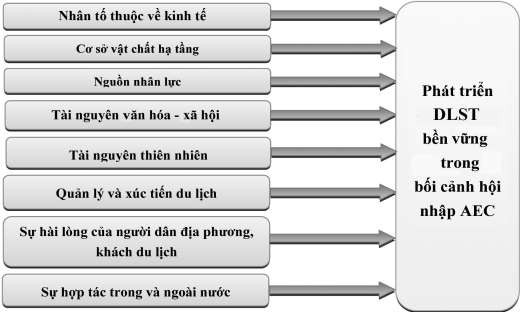
Figure 1.3 Proposed research model
Source: Bui Thanh Toan (2018)
After synthesizing the research situation in our country in recent times, the thesis draws the following conclusions:
Maybe you are interested!
-
 Theoretical Basis and Practical Experience on Sustainable Tourism Development of a Provincial Locality
 -
 Theoretical and Practical Basis of Tourism and Agricultural Tourism Development
 -
 The Research Topic Has Contributed to Systematizing the Theoretical and Practical Basis of Organizational Forms of Tea Production Territory in the Direction of Development
 -
 Theoretical Basis of Tourism and the Role of Tourism in Economic Development
 -
 Theoretical Basis of Human Resource Development in Tourism Industry Chapter 2: Current Status of Human Resource Development in Tourism Industry
- Tourism is an important industry, the center of economic development of many countries and of the national economic system. Therefore, many individuals (scientists, managers, people) and organizations are interested in research. In Vietnam, the topic of sustainable development in general and tourism in particular began to be studied since the 90s, and has become quite popular until now. Not only that, after opening up and integrating with the world since the 90s, Vietnam tourism is an attractive topic of many domestic and foreign research topics in the scientific community. Developing tourism in a sustainable direction is not only the direction of research and development in the world but also the focus of research of domestic scientists. Currently, research projects on sustainable tourism development in Vietnam are quite diverse from tourism products, tourist destinations, conservation areas, and tourist regions.
- Research works on tourism and tourism development solve many problems from general tourism theory to practical knowledge about the tourism market and from there have tourism development directions suitable for Vietnam.
- Domestic and foreign research all state that the content of sustainable tourism development revolves around 3 aspects: Economy, society, environment. Each aspect can play a different important role in each stage and period of the development process, in accordance with the guidelines and policies of the country and local tourism.
1.3 General assessment of research works
1.3.1 General assessment
First, identify basic issues about tourism, tourism development, and tourism
Sustainable tourism, content related to tourism development; concept of sustainable tourism, sustainable tourism development, tourism management... There are many different views on this content both domestically and internationally.
Second , the general trend is to develop tourism in a sustainable direction in countries around the world today. There are many different experiences with the goal of developing tourism in a sustainable direction of some localities in Vietnam and other countries around the world.
Third , analyzed and evaluated the systematic and sustainable nature of tourism. The role of sustainable tourism development in the development of the country, region and locality.
Fourth , the current situation of sustainable tourism development in some provinces of Vietnam such as Lao Cai, Phong Nha Ke Bang, Cuc Phuong National Park (Ninh Binh), and the tourist regions of the Northeast, Central Highlands, and North Central regions were studied and analyzed in depth.
Fifth , some solutions for sustainable tourism development are proposed: Planning, managing and organizing the implementation of tourism planning; diversifying tourism products; investing in tourism development; policies and mechanisms to attract and improve the efficiency of investment capital for tourism development; improving the efficiency of using tourism resources.
1.3.2 . Issues that need to be researched
The issue of sustainable tourism development in neighboring provinces such as Ninh Binh, Hai Phong, Quang Ninh, Hanoi has been studied in many works. Each work has a different approach in terms of methods and criteria. In the current conditions, when the provinces have been and are aiming to exploit tourism types to promote the local economy, the strategy and goals for tourism have changed a lot. The exploited tourism potential, along with the changes in the tourism market, tourist objects, and methods of tourism management, should link and cooperate in tourism development, which have been aimed at and implemented by localities in the past time. The assessment of sustainable tourism development in the provinces of Ninh Binh, Nam Dinh, Thai Binh is based on criteria and influencing factors that have not been proposed by any work. Based on an overview of research works on tourism development and PTDLBV, the thesis focuses on the following issues:
Firstly, clarifying the theoretical issues of tourism development and sustainable tourism development in the domestic and international context. Evaluation criteria and factors affecting sustainable tourism development.
Second , experience in sustainable tourism development in some regions, territories and countries around the world, and at the same time draw some lessons in sustainable tourism development for the southern provinces of the Red River Delta.
Third , build and evaluate according to criteria for sustainable tourism development.
stable for the provinces
Fourth , research the current situation and evaluate the factors affecting sustainable tourism. Draw out the achievements, limitations, and causes of the problems, from which to focus on research and propose specific solutions to develop tourism for the region in a sustainable direction; in accordance with the United Nations Charter for the Protection of World Heritage.
With such issues, the researcher will determine the context, orientation and solutions to develop tourism in the southern provinces of the Red River Delta in a sustainable manner, contributing to the socio-economic development of the Red River Delta in particular and the Northern coastal economic region in general.
Chapter 1 Summary
- Tourism development is a topic of interest to many scientists, managers, and organizations in the world as well as in our country.
- There are many research works related to tourism, tourism development and sustainable tourism development and it is determined that sustainable tourism development is a trend in countries around the world today.
- Many concepts and criteria to evaluate sustainable development from which tourism development solutions are proposed: Planning, management and implementation of tourism planning; diversifying tourism products; investing in tourism development; policies and mechanisms to attract and improve the efficiency of investment capital for tourism development; improving the efficiency of using tourism resources. And all solutions aim at the goal of sustainable development, creating jobs for people, protecting environmental resources and preserving cultural and social values.
CHAPTER 2: THEORETICAL AND PRACTICAL BASIS OF SUSTAINABLE TOURISM DEVELOPMENT
2.1 Theoretical basis of tourism
2.1.1 Concept
In their lives, everyone has certain needs. Those needs can be met right at their place of residence (or residence), but there are also many needs that can only be satisfied outside of their place of residence through different ways of organization. One of those ways is that a person or a group of people go on trips. But since the 19th century, tourism has been considered for the wealthy and aristocratic classes. At that time, people viewed tourism as a social phenomenon that enriches people's lives and awareness.
Tourism began to appear in ancient Egypt and Greece through the meetings and trading trips of politicians and merchants. Those trips were organized spontaneously due to economic needs and personal interests. During the Roman civilization, the need for tourism became more purposeful and famous temples were the destination of the Romans when they organized trips for leisure or work. Their destinations were the Pyramids in Egypt, or the temples in the Mediterranean. During the feudal period, when festivals and entertainment facilities were organized and built in large numbers, people's work was always focused on activities organized during the month and year. The royal class, mandarins, and landlords preferred festivals, sightseeing, entertainment, and going to areas with healing and health-restoring values; while the working people preferred to organize and participate in folk festivals and sacrifices for the harvest. Entering the modern period, the period of prosperity and wealth of the capitalists and the aristocracy, most of the tourism market is to meet their needs. And the tourism business has basically formed but mainly in countries with developed economies. With that development, today tourism has become an inevitable, popular trend and is the leading economic sector in many countries, many countries and territories have become rich and changed thanks to tourism development.
Through studying the definitions of tourism from the past to the present, it can be seen that each definition of tourism is associated with a historical period that represents the level of development of the industry at that period. "The development of productive forces and the division of labor made tourism an economic activity. Tourism as a real economic sector appeared in the middle of the 19th century." [10] . However, currently, the content of tourism is still understood in many different ways both domestically and internationally. The following are some concepts of tourism:
The first definition of tourism in 1811 in England was as follows: “Tourism is the harmonious combination of theory and practice of journey(s) with the aim of
entertainment purposes. Here entertainment is the main motive” [10, p13].
In June 1991, the definition of tourism "Tourism is the activity of a person traveling to a place outside his/her usual environment (normal residence), for a period of time less than the period specified by the tourism organization, the purpose of the trip is not to conduct activities earning money within the area visited" [10, p15] was given at the international conference on tourism statistics held in Ottawa (Canada).
According to American economist Michael Coltma, "Tourism is the combination and interaction of four groups of factors in the process of serving tourists, including: tourists, service providers, local residents and the government of the place receiving tourists" [10, p15].
After researching and collecting opinions on tourism, the definition of tourism in the tourism economics textbook of the National Economics University serving the tourism business major is as follows: "Tourism is a set of active human activities to carry out a type of journey, an industry linked to satisfy the needs of tourists...Tourism is a journey in which one side is the person departing with a pre-selected purpose and the other side is the tools to satisfy their needs." [10, p. 14].
Some other views on tourism “Tourism is a business sector that includes activities of organizing guidance, production, exchange of goods and services of enterprises, aiming to meet the needs of travel, accommodation, food and drink... and other needs of tourists. Those activities must bring practical political, economic and social benefits to the country doing tourism and to the enterprise itself.”[9, page 17]. Article 3 - Vietnam Tourism Law 2017 [33] “Tourism is activities related to human trips outside the place of permanent residence for a period of no more than 01 consecutive year to meet the needs of sightseeing, relaxation, entertainment, learning, exploring tourism resources or combined with other legitimate purposes”.
From the above concepts, it can be seen that tourism is a diverse and specific activity, involving many subjects such as tourists, means of transport, ... and many other socio-economic fields to bring economic, political and social benefits to countries and localities. However, the impact of tourism activities on localities, territories and countries also depends on many factors such as: tourism development policy mechanisms, tourism types, tourism products and tourism resources of each region.
2.1.2 Tourism characteristics
Firstly, tourism is an industry that depends on tourism resources. Any tourist, with any motive and form of tourism, has a common requirement to be able to visit, have fun, learn and enjoy the natural, historical, cultural, social values of a country. These are sunny beaches, waterfalls, mountains, caves, rare species of flora and fauna.
rare, castles, temples with many ancient architectures and festivals; large economic and cultural centers; national forests, relic sites...
Tourism resources are created by nature, but also by the historical development of many generations of humans. This is the objective basis for forming tourist routes and destinations to orient and develop tourism in each region and each country.
Second, tourism is a comprehensive business serving the diverse consumption needs of tourists. Tourists, regardless of their group or personal or collective financial resources, often spend more during their travel than the average consumption of the majority of the population. Not to mention that a large part of international tourists are upper class: wealthy merchants, businessmen, intellectuals, politicians, etc. Therefore, the tourism industry must be a comprehensive business serving the needs of rest, travel, food, sightseeing, entertainment, shopping and other services of tourists in a way that is convenient, safe, luxurious, polite and capable of meeting high-level service needs.
Third, tourism is an industry that, in addition to business and services, must also ensure security, political security and social order and safety for tourists, for localities and countries receiving tourists. Each tourist destination needs to mobilize many forces and facilities to serve from ensuring accommodation, food hygiene and safety to security and social order. Therefore, it is necessary to have synchronous investment and inter-sectoral coordination in a smooth and effective manner.
Fourth, tourism is an economic - social - service sector whose mission is to serve the needs of sightseeing, entertainment, and rest, with or without combining with medical activities, sports, scientific research, and other types of needs. Thus, this is a special sector with many characteristics and properties mixed together to form a very complex whole. The activities of the tourism sector have the characteristics of both an economic sector and a cultural - social sector.
2.2 Developing tourism in a sustainable direction
2.2.1 Sustainable development
In 1987, the issue of the relationship between environment and development was officially mentioned by the WCED conference. Economist Brundtland issued a report called Our Common Future, which showed the awareness and viewpoints on the role of the environment in economic development and social issues of each country and territory. In the process of accelerating the economy, each country has the biggest goal of improving the quality of life (both material and spiritual) for the people. However, to do that, it is necessary to strongly promote economic development activities, but in exchange, natural resources are increasingly depleted, the environment is polluted, and the ecosystem is destroyed. The natural resources we have are limited, if exploited indiscriminately, unscientifically, and without organization, it will cause
depletion and more dangerously, it causes serious damage to the living environment. And the people who are directly affected are our future generations, our children. From that awareness, the concept of sustainable development appeared and is an increasingly hot topic in the current trend of integration and globalization. The topic of sustainable development is of interest to all countries in the world, from developed countries to developing countries, and is a guiding principle for development in the country's development plans and policies.
With different approaches, there are many concepts of sustainable development proposed by researchers and managers. According to IUCN in 1980, sustainable development must consider the current status of exploitation of renewable and non-renewable resources, favorable conditions as well as difficulties in organizing short-term and long-term action plans. This concept focuses on the exploitation and use of resources but does not provide a complete view of sustainable development. The concept proposed by UNCED in 1987 is more commonly used, sustainable development satisfies the needs of the present but does not reduce the ability to satisfy the needs of future generations.
In Rio de Janeiro (Brazil) in 1992, the United Nations summit on sustainable development was held, the concept of sustainable development was mentioned, in 1997 scientists added more concepts of sustainable development. Accordingly, sustainable development is formed in the integration, interweaving and compromise of three interactive systems: the natural system, the economic system and the socio-cultural system. According to this point of view, sustainable development is the impact and mutual dependence of three factors: economic, socio-cultural and natural environment. The correlation between these three systems requires balance, "not because of the priority of development of one system that causes degradation and destruction to another system" [55]. The message of the conference: Sustainable development not only prioritizes economic growth but has the fulcrum of sustainability in terms of environment - nature, culture - society. Sustainable development is like a tripod, these three legs are specifically:
- Economic sustainability: Creating growth and prosperity for the community and economic enterprises to achieve high results and efficiency. The core issue is the existence and development of stable and long-term economic units.
- Cultural and social sustainability: individuals, ethnic groups and religions are always respected and equal. Rights are guaranteed fairly, poverty reduction is focused on. Respect for the cultural values of each ethnic group and each region. Monuments are preserved, maintained and maintained at their true value.
- Environmental sustainability: resources are exploited, allocated and used properly; environmental pollution is minimized, biodiversity and other natural assets are preserved.
The World Summit on Sustainable Development took place in the following years, each time it was held, it reiterated and defined the goals that Sustainable Development was aiming for. Specifically, in 2002, the World Summit on Sustainable Development reiterated the social and environmental goals that were
reflected in the “Millennium Development Goals and Agenda 21” (Agenda). In 2012, the United Nations High-Level Conference on Sustainable Development addressed the political issues affecting sustainable development, setting out the sustainable development goals that need to be built for all countries. Starting from September 2013, the sustainable development goals began to be implemented through negotiations between governments on the new Agenda for use from 2015 with a set of 17 goals and 169 sustainable development targets. At the 70th session in September 2015, 154 member states of the United Nations General Assembly adopted the sustainable development agenda to 2030. The program includes 17 sustainable development goals, including a number of important goals such as eradicating poverty, protecting the planet, and ensuring shared prosperity for all. The 2030 Agenda builds on the 21st Agenda on Sustainable Development and the “Millennium Development Goals” (MDGs).
2.2.2 Developing tourism in a sustainable direction
2.2.2.1 Concept of sustainable tourism development
PTDLBV and PTBV have a close relationship, complementing each other. Both concepts of PTBV and PTDLBV are related to resources - environment... The environment here is understood very broadly including from nature, economy, culture, to politics and society, so it is a special factor in tourism development. From the tourism environment, each locality can create unique and distinct tourism products suitable to the culture and development history of the locality. Therefore, environmental protection is to ensure sustainable development, ensuring core values to help success. Tourism development is associated with preserving and conserving resources; preserving and protecting the environment. Therefore, developing tourism in a sustainable direction is an inevitable development trend and is close to the general trend of the world.
In addition to developing tourism that is close to and friendly to the environment, the concept of sustainable tourism development also includes the role of local residents; how to manage, attract, and use labor, and the expectation of maximizing the economic benefits of tourism for local people and labor. In other words, sustainable tourism, in addition to environmental issues, also aims to stabilize and ensure long-term economic development and equitable social benefits. Sustainable tourism cannot be separated from sustainable tourism.
In Rio de Janeiro (Brazil) in 1992, the United Nations held a conference on environment and development, where UNWTO defined: “Sustainable tourism is the development of tourism activities to meet the current needs of tourists and local people while still paying attention to the conservation and enhancement of resources for the development of tourism activities in the future. Sustainable tourism will have a plan to manage resources to satisfy the economic, social and aesthetic needs of people, while maintaining cultural integrity, biodiversity, the development of ecosystems and systems that support human life”.