
According to Nguyen Dinh Giao et al . (1997), the number of flowers/m2 is the factor that contributes the most to rice yield. The number of flowers can contribute 74% to yield, while the number of grains and grain weight contribute 26%. When considering the relationship between source and capacity, the number of flowers/m2 affects economic yield with a very high correlation coefficient of r = 0.91 (Pham Van Chuong, 2002).
When analyzing the correlation between the Path coefficient and yield components, it shows that the number of panicles/m2 increases when the sowing density increases (Tran Thi Ngoc Huan et al ., 1999). However, under conditions of high sowing density, the number of panicles/m2 increases moderately . If the density is increased too high, it will cause the phenomenon of hoppers, pests and diseases to easily break out and the number of grains per panicle will decrease significantly (Yosida, 1981).
According to Vu Van Hien and Nguyen Van Hoan (1999), the number of flowers per unit area is determined by two factors: sowing density and tillering rate. Sowing density is the basis for the formation of the number of flowers. In intensive farming conditions, appropriate sowing density is required depending on the variety, land, fertilizer, season, etc.
In general, for short-term, short-planted, low-blooming rice varieties, poor soil, and lots of sunlight, dense planting is recommended to increase the number of flowers per unit area. On the contrary, on soil rich in organic matter, good weather, high fertilizer (especially nitrogen) and suitable water retention, strong bush-blooming rice can be planted more sparsely. Improved low-planted rice varieties have an average number of flowers/m2 of 500-600 flowers for direct-sown rice or 350-450 flowers for transplanted rice to achieve high yield (Pham Si Tan, 2008).
In summary, the number of panicles/m2 is a productivity component that contributes significantly to
Maybe you are interested!
-
 The effect of sowing density on the yield of rice variety OM4218 in the Summer-Autumn crop of 2012 in Vinh Thuan Tay commune, Vi Thuy district, Hau Giang province - 2
 -
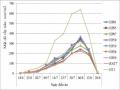 Changes in Brown Planthopper Density on Planthopper Resistant Rice Varieties in Phu Vang in Summer-Autumn Crop 2011
 -
 Studies on Mthfr Rs1801133 Correlation with Bone Density
 -
 Model of Some Related Studies.
 -
 Foreign Studies on Improving Competitiveness for Tourism Development
The number of effective shoots is the direct factor determining the number of flowers/ m2 .
1.2.2 Number of seeds/flower

Number of grains/flower is also an important factor in determining yield. Number of grains/flower is mainly determined by the genetic factors of the variety. However, it is also affected by external factors due to its impact on the flower differentiation process. Number of grains/flower depends on the number of spikes, the number of differentiated flowers as well as the number of spikes and degenerated flowers. Number of grains/flower = Number of differentiated flowers - Number of degenerated flowers (Nguyen Thi Nga, 2011).
The number of grains per panicle is determined from the time the panicle emerges until 5 days before flowering, but the most important period is the period of flower differentiation and active reduction. At this stage,
The number of grains per panicle has a positive effect on rice yield due to its effect on the number of differentiated flowers. After this stage, the number of grains per panicle that has formed may degenerate, which has a negative effect (Vo Thi Lang et al. , 2008).
The number of grains per flower depends on the number of spikelets and differentiated flowers as well as the number of degenerated spikelets and flowers. These processes are in the reproductive growth period from panicle initiation to flowering (Nguyen Dinh Giao et al ., 1997).
The number of grains/panicle is influenced by many factors. Cultivation factors: in open field cultivation conditions, rice plants grow poorly, the number of grains/panicle can be increased by increasing the sowing density to a moderate level and increasing the amount of nitrogen fertilizer applied to the plant. Growth characteristics factors: if the rice plant has poor tillering characteristics, it requires a high sowing density, varieties with a short growth period and in conditions with little nitrogen fertilizer require a higher sowing density to achieve a constant number of grains per unit area (Le Huu Toan, 2009).
In general, the number of grains per panicle depends on the number of differentiated flowers and the number of degenerated flowers, these two factors are influenced by the rice variety, cultivation techniques and weather conditions. For rice varieties with large panicles, good cultivation techniques, adequate fertilization, proper care, and favorable weather, the number of differentiated flowers will be high, the number of degenerated flowers will be low, so the final number of grains per panicle will be high. In improved rice varieties, the number of grains from 80 - 100 grains for direct seeding or 100 - 120 grains for transplanted rice is good in the conditions of the Mekong Delta (Nguyen Ngoc De, 2008). Thus, the number of grains per panicle is a decisive factor due to the difference between the number of differentiated flowers and the number of degenerated flowers, this yield component is influenced by the characteristics of the variety and external conditions.
1.2.3 Ratio of solid grains
The rate of firm grain is determined from the beginning of panicle differentiation until the rice is firm, but the most important are the periods of meiosis, flowering, color exposure, pollination, fertilization and firming. The rate of firm grain depends on the number of flowers per panicle, the physiological characteristics of the rice plant and is greatly influenced by external conditions. Usually, too many flowers per panicle will lead to a low rate of firm grain. Rice varieties with the ability to photosynthesize, accumulate and translocate substances, combined with a solid mechanical tissue structure that does not fall early, and blooms and forms grains in good weather conditions with adequate nutrition will have a high rate of firm grain and vice versa. To have high yield, the rate of firm grain must be over 80% (Nguyen Xuan Truong, 2004).
The cause of empty seeds is due to unfavorable pollination and fertilization process, when flowering occurs, it is too cold or too hot, the air humidity is too low or too high, causing the pollen to lose its ability to germinate or before that, the stamen and pistil did not develop completely, the pollen mother cell was damaged... (Nguyen Dinh Giao et al ., 1997).
When considering the relationship between source and capacity, the number of full grains per panicle affects the actual yield (Pham Van Chuong, 2002). The results of the analysis of the correlation coefficient Path yield and yield components show that when the sowing density increases, the number of full grains per panicle decreases and reduces the percentage of full grains (Tran Thi Ngoc Huan et al . , 1999).
Nguyen Thanh Hoi (2003) said that late-planted Summer-Autumn rice will face many disadvantages in terms of weather conditions when the rice is blooming, because at this time there is heavy rain, high rainfall, prolonged rain and especially it often rains in the morning, making it difficult for the rice flowers to pollinate and fertilize, and the grains are often empty. In unfavorable weather conditions, such as low and high temperatures during the meiosis and flower-flowering stages, it can cause sterility. Unfavorable weather conditions at ripening can inhibit the direct growth of some flower spikes, resulting in empty flower spikes (Bui Huy Dap, 1980).
The rate of solid grain is affected by many factors such as fertilizer, temperature, rain, wind and drought. Each variety requires a certain amount of fertilizer. Temperatures above 20 0 C if maintained continuously from the time the rice starts to flower or high temperatures above 35 0 C after the rice has finished flowering will reduce the rate of solid grain. Wind, rain and storms affect the pollination and fertilization process and cause lodging, affecting the rate of solid grain. In addition, drought causing lack of irrigation water in some areas also reduces the rate of solid grain, especially when the rice has just finished flowering and begins to absorb milk (Le Huu Toan, 2009). The rate of solid grain is the result of the pollination and fertilization process in the environment. And this component is affected by many environmental factors during the time before, during and after flowering.
1.2.4 Weight of 1000 seeds
Grain weight is determined from the period of flower differentiation until the rice ripens, but the most important are the periods of active reduction and fullness. Grain weight depends on the grain size and fullness (fullness) of the rice grain. For rice, people often express grain weight by the weight of 1000 grains with the unit of gram. In most rice varieties, the weight of 1000 grains often fluctuates in the range of 20 - 30 grams (Nguyen Ngoc De, 2008).
The weight of 1000 grains is less affected by the environment and has a high genetic coefficient. It depends entirely on the variety. The weight of 1000 grains of a variety remains stable, which does not mean that each grain has the same mass, they vary within a certain limit but have a stable average value. The weight of 1000 grains is composed of two components, the weight of the husk and the weight of the rice grain. The weight of the husk usually accounts for 20% and the weight of the rice grain accounts for 80% of the total weight of the grain. To have a high weight of rice grains, both of these factors must be affected (Nguyen Dinh Giao et al ., 1997).
When considering the relationship between source and capacity, it shows that 1000-grain weight affects actual yield (Pham Van Chuong, 2002). The results of the correlation analysis of Path coefficient of yield and yield components show that 1000-grain weight is a characteristic of the variety and is the second factor (after the number of full grains/panicle) in determining rice yield (Tran Thi Ngoc Huan et al ., 1999).
Nguyen Dinh Giao et al . (1997) stated that rice grains are determined by the size of the two husks that create the capacity for the grain and the next factor is the amount of dry matter accumulated to form the rice grain. Therefore, the photosynthesis process during the ripening stage of the rice plant will affect the supply of carbohydrates to the grain. In addition, if lodging occurs, it will prevent the translocation of photosynthesis products, causing the rice grain to be very flat. Grain weight is mainly determined by the genetic characteristics of the variety, environmental conditions have a partial influence on the period of reduction (18 days before flowering) on the grain size, until the time of fullness (15 - 25 days after flowering) on the fullness of the grain (Nguyen Ngoc De, 2008).
Thus, the weight of 1000 grains is greatly influenced by the characteristics of the variety, the impact of natural conditions and cultivation techniques can also change the weight of small grains, the products of photosynthesis after flowering are the decisive factor in the weight of 1000 grains.
1.3 SOWING METHOD
There are many methods for sowing. However, the appropriate sowing method should be selected based on soil and irrigation conditions. Areas with a proactive source of irrigation water and relatively flat land often apply the wet sowing method. Currently, most of the rice growing areas in the Mekong Delta are high-yield rice and the wet sowing method is most widely applied (Nguyen Thanh Hoi, 2010).
1.3.1 Broadcast method
The characteristics of this sowing method are that the rice plant tillers early, has a large number of panicles, and the yield is closely related to the number of panicles. However, the disadvantages of this method are that the density is often uneven, the root system is shallow, easily damaged by birds and mice, and the rice often falls over during the rainy season (Nguyen Dinh Giao et al ., 1997).
The broadcast method has been applied by farmers since the beginning of high-yield rice cultivation to replace low-yield seasonal rice. This method has shown to have outstanding advantages compared to the broadcast or transplanting method of seasonal rice in terms of the ability to increase the number of panicles/m2 , uniformity in height and the ability to receive light (Tran Duc Vien, 2007).
Currently, the recommended amount of short-term high-yield seeds for broadcast sowing is 150 kg/ha (Nguyen Thanh Hoi, 2010). However, in actual production, people often grow rice according to traditional practices with high density, the amount of seeds sown is from 200 - 300 kg/ha (Nguyen Van Luat, 2001). With such a large amount of seeds sown, it will greatly affect the light reception of each rice plant in the rice field population, the nutritional needs of the soil and create favorable conditions for pests to develop. Scientists have proven that the most positive factors causing diseases are when plants have to live in a narrow population with a lack of light for the lower leaves, making the rice plants weak and susceptible to pests and diseases (Nguyen Kim Chung and Nguyen Ngoc De, 2005).
1.3.2 Row sowing method
Currently, row seeding in the Mekong Delta has shown many advantages compared to traditional broadcast seeding such as: saving materials, mainly seeds and fertilizers, creating favorable conditions for intensive farming, reducing damage caused by pests and diseases, increasing productivity compared to broadcast seeding and combining fish farming or duck farming to grow quickly (Nguyen Van Luat, 2001).
The application of the row seeder technique was improved from the “drum seeder” of the International Rice Research Institute (IRRI) and has been implemented in the Mekong Delta since 1990 until now (Bui Chi Buu and Nguyen Thi Lang, 2009). It can be seen that the row sowing method is more effective than the traditional broadcast sowing. However, the application of this technique also faces some obstacles such as golden apple snails, small areas that are difficult to apply, and uneven land (Le Truong Giang, 2005).
With this method, rice plants are distributed in suitable rice fields, so they can utilize solar energy for photosynthesis to create productivity and reduce damage caused by external factors (Nguyen Van Luat, 2001). According to many research results, the appropriate amount of seed for this technique in the Mekong Delta is about 70-100 kg of seed/ha (Bui Chi Buu and Nguyen Thi Lang, 2009). Under good field management conditions, a sowing density of 100 kg of seed/ha is recommended to obtain good quality rice yield, as well as to meet the number of panicles/m2 for synchronous ripening in the wet-seeded rice cultivation system (Tran Thi Ngoc Huan et al ., 1999).
Compared with the traditional broadcast method, the row sowing method can reduce the amount of seeds used by 50-75%, the amount of seeds reduced by about 100-150 kg/ha (Nguyen Van Luat et al ., 1999). Thus, the row sowing method has many advantages over the broadcast method such as: reducing the amount of seeds to be sown, reducing pests and diseases and increasing productivity.
1.4 STUDIES ON SOWING DENSITY
According to Nguyen Van Hoan (1995), depending on the rice variety, the appropriate density should be chosen because it is necessary to consider the distance wide enough to make the rice rows airy, the rice bushes do not overlap. The arrangement of rice bushes in a rectangular shape is the most suitable because this way the planting density is ensured but also creates ventilation in the population, increases the ability to photosynthesize, good disease resistance and creates an edge effect that will give higher productivity.
Appropriate planting density, the rice population will use water and nutrients well to produce the highest yield, the seed production density ensures the production of 400-500 flowers/m2 , which means 70-100 seedlings/m2 is best. Low density will increase the ability to tiller and can cause large fluctuations in the uniform maturity of flowers affecting seed quality, low density increases weeds which also reduces seed quality. Too high planting density reduces yield and seed quality due to competition for water and nutrients, mutual shading, easy to fall and reduced seed size (Nguyen Thi Nga, 2011).
According to Tang Thi Hanh (2003), different planting densities affect the tillering ability of rice plants. The leaf area index increases when the density increases from
25-165 buds/m2 , if the same number of buds/bush when the density increases in the two stages, but in the milk ripening stage, the dry matter mass will decrease if the density continues to increase. The sparse planting formula (25-30 bushes/m2 ) has high photosynthetic efficiency but the leaf area index is lower, so the dry matter mass synthesized over the periods is less than the dense planting formula. Appropriate density also limits the prolonged tillering process, limits ineffective branches, and wastes nutrients. When planting densely, the plants still compete for nutrients and light, the rice plants will grow tall, the leaves will be dense, affecting the pure photosynthetic efficiency, pests and diseases will develop a lot, the plants will have poor resistance and the final yield will not be high. The seeds will not ripen evenly, the pathogens of pests and diseases on the seeds can increase due to the rapid increase in seed moisture during storage... significantly affecting the quality of the seeds (Nguyen Thi Nga, 2011).
Density is one of the measures affecting rice yield because the planting density determines the leaf area and population structure, the light regime and the accumulation of dry matter in the rice field most strongly (Nguyen Van Hoan, 2003). Commenting on the relationship between nutritional area and tillering, Bui Huy Dap (1980) said that tillering of rice is related to nutritional area. If the nutritional area is larger, the tillering time will be longer. Conversely, the smaller the nutritional area, the shorter the tillering time. Planting densely at high density, rice will not tiller and some mother plants will gradually wither. For transplanted rice, the absolute number of tillers changes a lot through the densities, but the effective tillering ratio between the densities does not change much. According to the author, not all tillers of rice plants give yield, but only those that reach a certain growth period and number of leaves will form flowers (Nguyen Thi Nga, 2011).
There have been many studies on pest resistance by many authors and they all have the same opinion that: planting at high density will create a suitable environment for pests to develop because the rice field population is not airy, the leaves are hidden from each other so many die (Bui Huy Dap, 1980).
Thus, density is a technique to increase photosynthesis of individuals and populations of rice fields, due to the ability to receive light, create a suitable number of leaves and leaf area index for individuals and populations of rice fields, affecting the ability to tiller and the number of branches.
effectiveness/dust, pest resistance, etc., which strongly affect rice yield.
Based on the analysis of the relationship between yield components, Bui Huy Dap (1999) argued that yield components are closely related to each other, and that to achieve high yield, all factors must be fully utilized without affecting each other. If the number of panicles increases to a range where the number of grains/puff and the percentage of filled grains decrease slightly, yield will be high, but if the number of panicles increases too much, the number of grains/puff and the percentage of filled grains decrease greatly, yield will be low. Of the three yield components: number of panicles/m2 , number of filled grains/puff and 1000-grain weight, the first two play an important role and change according to the population structure, while the weight of 1000 grains of each variety fluctuates little. Therefore, yield will increase when the planting density is within a certain range. This range depends on many characteristics of the variety, soil, fertilizer and weather. To increase the number of flowers/unit planting area, the planting density or the number of bushes can be increased.
According to Nguyen Van Hoan (1995), to have the same number of flowers per unit area, it is better to plant fewer buds and more clumps than to plant fewer clumps and more buds. Do not plant too many buds because then the rice plant will produce many branches that are too small and weak, the effective flower ratio is low, the number of grains/flower is low, leading to unsatisfactory yield.
1.5 FACTORS AFFECTING PRODUCTIVITY
1.5.1 Temperature
Temperature has a decisive effect on the growth rate of rice plants, fast or slow, good or bad. Within the limited range (20-30 o C), the higher the temperature, the stronger the rice plants grow. Temperatures above 40 o C or below 17 o C slow down the growth of rice plants. Below 13 o C, rice plants stop growing, if it lasts more than a week, the rice plants will die (Nguyen Ngoc De, 2008).
High temperature increases leaf growth rate and produces more shoots. High temperature shortens the filling stage, frequent cloudy weather is harmful to seed filling. Temperatures higher than 35 o C when flowering can cause high percentage of sterility (Dinh The Loc, 2006).