
4.1. CONCLUSION 35
4.2. PROPOSAL 35
REFERENCES 36
LIST OF TABLES
Maybe you are interested!
-
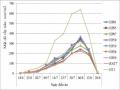
 Changes in Brown Planthopper Density on Planthopper Resistant Rice Varieties in Phu Vang in Summer-Autumn Crop 2011
 -
 Effect of Nitrogen Dosage and Planting Density on Corn Yield Component
 -
 Evaluation of the effect of DH fertilizer on growth, yield and quality of some fruit trees at Thai Nguyen University of Agriculture and Forestry - 2
 -
 Evaluation of the effect of DH fertilizer on growth, yield and quality of some fruit trees at Thai Nguyen University of Agriculture and Forestry - 1
 -
 Correlation Between Riek and Sugarcane Yield - Sugarcane Crop 2
Table 2.1 Experimental layout diagram 18
Table 3.1 Overview of experimental results of OM4218 rice variety sown at different densities in Vi Thuy district, Hau Giang province, Summer-Autumn crop 2012 22
Table 3.2 Yield components of rice variety OM4218 tested at different densities in Vinh Thuan Tay commune, Vi Thuy district, Hau Giang province, Summer-Autumn crop 2012 28
Table 3.3 Theoretical yield and actual yield of OM4218 rice variety tested at different densities in Vinh Thuan Tay commune, Vi Thuy district, Hau Giang province, Summer-Autumn crop 2012 32
Table 3.4 Economic efficiency analysis 34
LIST OF IMAGES
Figure 2.1 Administrative map of Vi Thuy district, Hau Giang province 16
Figure 3.1: Effect of sowing density on the height of OM4218 rice variety in Summer-Autumn crop 2012 in Vi Thuy district, Hau Giang province 23
Figure 3.2: Effect of sowing density on the number of shoots/m2 of rice variety OM4218 crop
Summer and Fall 2012 in Vi Thuy district, Hau Giang province 25
Figure 3.3: Effect of sowing density on panicle length of OM4218 rice variety in Summer-Autumn crop 2012 in Vi Thuy district, Hau Giang province 27
INTRODUCTION
There are many studies in the world that demonstrate the correlation between planting density and rice yield, concluding that rice yield does not actually change between the two planting distances of 10 and 100 bushes/m 2 . These results also demonstrate that rice has the ability to adapt widely to planting density by self-adjusting the number of panicles, the number of tillers/panicle and the percentage of full grains depending on environmental conditions (Takeda and Hirota, 1971; cited by Nguyen Huu Huan 2011).
In our country, rice cultivation has existed for a long time and rice productivity has increased, partly due to the important contribution of rice breeding, using traditional methods, pedigree selection, sexual hybridization, and the application of biotechnology such as creating mutations, tissue culture, and genetic modification. Thanks to the policy of innovation and science and technology in breeding and selecting rice varieties at institutes, schools, centers, and individuals nationwide, over the years, many high-yield, short-term rice varieties have been created, suitable for the climate and soil conditions of each locality.
Because people have a traditional practice of sowing at a high density of about 200 kg/ha, but in reality, rice is a plant that can self-regulate in the population. If the density is too high, the rice plant will produce few or no tillers, the rate of ineffective shoots will be high, and the plant will even die due to competition for survival. In addition, applying too much nitrogen fertilizer will cause pests to develop strongly and reduce productivity (Nguyen Truong Giang, 2010). On a unit area, the higher the density, the more flowers there will be. Within a certain limit, increasing the number of flowers does not reduce the number of grains/flower and the weight of thousands of grains, but if it exceeds a certain limit, the number of grains/flower will gradually decrease and the weight of thousands of grains will gradually decrease due to competition for nutrients and light, so planting too densely will seriously reduce productivity. However, if the density is too sparse for varieties with a short growing period, it will be difficult to achieve the optimal number of flowers. Therefore, choosing the appropriate density is the most optimal method to achieve the largest number of solid grains per unit of sowing area (Nguyen Thi Nga, 2011). Therefore, the topic " Effect of sowing density on the yield of OM4218 rice variety in the Summer-Autumn crop in 2012 in Vinh Thuan Tay commune, Vi Thuy district,
Hau Giang " was carried out to find the appropriate sowing density to increase productivity and economic efficiency.
CHAPTER 1
LITERATURE REVIEW
1.1 GROWTH PERIOD OF RICE PLANT
In terms of agronomy, people divide the life of a rice plant into three main stages (Nguyen Ngoc De, 2008).
1.1.1 Growth stage
This stage of the rice plant starts from the time the seed germinates until the beginning of panicle differentiation. The time spent in this stage varies depending on the growth period of each rice variety. For varieties with a growth period of 120 days grown in tropical countries, this stage takes 60 days (Yosida, 1981). For the Mekong Delta region, rice varieties with a growth period of 90 days, this stage takes about 30 days.
During this stage, the plant develops its stems and leaves, its height gradually increases and it produces many new shoots. The plant produces more and more leaves and their size increases, helping the rice plant receive more sunlight for photosynthesis, absorb nutrients, increase height, bloom and prepare for the following stages. Under conditions of adequate nutrients, light and favorable weather, the rice plant can begin to bloom when it has the 5th or 6th leaf (Nguyen Ngoc De, 2008). The length of the rice plant's growth period is mainly due to the length of this growth period (Nguyen Thanh Hoi, 2010).
Thanks to the simultaneous development of roots and leaves, it promotes the strong development of the main stem and the process of tillering occurs regularly, gradually increasing the number of branches on a rice bush. The tillering process of rice plants only takes place in a certain period of time, called the tillering period, and this period ends when the rice plant reaches the maximum number of shoots per unit area. The sparse sowing density has a longer tillering period than the dense sowing (Nguyen Dinh Giao et al ., 1997). Differences in varieties, seasons and cultivation techniques will change the tillering period of rice plants.
During this stage, the branches formed have only two possibilities, (1) to form effective branches (branches that will form flowers) and (2) to form shoot branches.
null (branch that does not form flowers). Usually, early-growing branches produce flowers, while late-growing branches may or may not produce flowers (Yosida, 1981).
The growth duration of long-duration and short-duration rice varieties is mainly determined by the length of the growth phase. Very short-duration and short-duration rice varieties usually have a short growth phase and panicle initiation may occur before or just after the maximum number of tillers has been reached. In contrast, long-duration rice varieties (over 4 months) usually reach their maximum number of tillers before panicle initiation. Typically, the number of tillers forming the panicle (effective or useful) is lower than the maximum number of tillers and stabilizes about 10 days before the maximum number of tillers is reached. The shoots that appear later will usually wither away without producing flowers, because the shoots are small and weak and cannot compete for nutrients and light with other shoots. These are called ineffective shoots. In cultivation, people limit the production of these ineffective shoots to the lowest level by creating conditions for the rice to bloom as soon as possible and controlling the growth of additional shoots from about 7 days before panicle differentiation onwards, to concentrate nutrients on effective shoots (Nguyen Ngoc De, 2008).
1.1.2 Reproductive stage
This stage starts from panicle differentiation until rice flowering, this stage lasts about 27 - 35 days, on average 30 days, long-term or short-term rice varieties are usually not much different, at this time the number of ineffective shoots decreases rapidly, the height begins to increase significantly due to the elongation of the top 5 internodes. The rice panicle forms and develops through many stages and finally emerges from the flag leaf sheath: rice flowering (Nguyen Ngoc De, 2008).
In the life of rice plants, this stage is characterized by the phenomenon of the main stem of the rice growing rapidly, increasing the height of the plant, rapidly reducing the number of ineffective branches, the appearance of flag leaves, good elongation and finally flowering (Nguyen Thanh Hoi, 2003).
During this stage, the most important thing is the formation and development of the rice panicle, panicle differentiation usually takes place after the rice plant reaches the maximum number of shoots. This is the period that signals the rice plant to move from the vegetative phase to the reproductive phase. The first sign is the elongation of the first internode and then the process of
Rice panicle formation. The development of rice panicles goes through many processes of cell division and meiosis. According to Nguyen Xuan Truong (2004), this process goes through nine steps, after the panicle is completely formed, thanks to the elongation of the two upper internodes, the rice panicle breaks out of the flag leaf sheath (cited by Nguyen Dinh Giao et al ., 1997).
At this stage, the rice plant is provided with adequate nutrition, suitable water level, plenty of light, no pests and favorable weather, the rice flowers will form more and the husk will reach the largest size of the variety (Nguyen Ngoc De, 2008).
Thus, this stage is characterized by the differentiation and formation of panicles of the rice plant. This process will determine the number of flowers differentiated on the rice panicle, thus affecting the formation of the number of grains/panicle, the number of full grains/panicle and the percentage of full grains of the rice plant (Nguyen Truong Giang, 2010).
1.1.3 Ripening stage
This stage is calculated from when the rice plant flowers until harvest. The time for this stage is about 30 days for most rice varieties. However, if the rice field has a lot of water, lacks phosphorus, has too much nitrogen, is rainy and humid, and has little sunshine during this stage, the ripening time will be longer and vice versa (Le Van Hoa et al ., 2001).
During this period, the rice leaves will age and the rice grains will gradually grow larger, the rice grains will grow strongly in both fresh and dry weight during this period. However, before ripening, the dry weight increases slowly, while the fresh weight decreases rapidly due to dehydration. Based on the changes in shape, color, reserve substances and grain weight, the ripening process of rice grains is divided into the stages of milky ripeness, waxy ripeness, yellow ripeness and full ripeness (Nguyen Ngoc De, 2008).
The most important of this stage is the milky ripening period. During the milky ripening process, the reserves in the stem and leaves and the products of photosynthesis are transferred into the grain. More than 80% of the dry matter accumulated in the grain is provided by the photosynthesis process after flowering. Therefore, the nutritional conditions, growth and development status of the rice plant and the weather from the post-flowering stage onwards are extremely important for the process of forming rice yield, the size and weight of the rice grain gradually increase to fill the husk (Nguyen Bao Ve, 2003).
Thus, in this stage, the milky ripening period is the most important, due to the accumulation of dry matter in the grain increasing under conditions of adequate light and nutrition. This is a process that greatly affects the weight of the grain.
1.2 PRODUCTIVITY COMPONENTS
According to Nguyen Ngoc De (2008), productivity is formed and influenced by four factors called four productivity components: number of panicles per unit area, number of grains per panicle, percentage of filled grains and weight of 1000 grains. Rice productivity is calculated according to the formula:
Y = N x F xwx 10 -5 In which:
Y: Yield (tons/ha) N: number of grains/m 2
F: solid grain ratio
w: weight of 1000 seeds (g)
Productivity is a composite indicator of all factors that make up productivity. In fact, the factors that make up productivity are very closely related to each other. To increase rice productivity, we must not only affect each factor separately but also have a combined effect (Nguyen Thi Nga, 2011).
1.2.1 Number of flowers/m 2
The number of flowers/m2 is the most important factor determining rice yield. With different sowing densities, the number of flowers/m2 is different (Nguyen Thi Nga, 2011). The number of flowers per unit area is determined in the initial growth stage of the rice plant (growth stage), but mainly from the time of transplanting to about 10 days before maximum shoots appear, the number of flowers per unit area depends on the sowing density and the ability of the rice to bloom. The sowing density and the ability of the rice to bloom vary depending on the rice variety, soil conditions, weather, amount of fertilizer, especially nitrogen fertilizer, and water regime. The number of flowers per unit area has a positive effect on rice yield (Nguyen Ngoc De, 2008).