
of short running, learning low starts, learning other athletics techniques, educating the psychological qualities of athletes.
Initial specialized training phase: from 16 to 18 years old and lasting for 3 years, each week training from 6 to 8 sessions, 1.5 to 2 hours/session. Mainly developing and enhancing professional qualities in short running, improving and enhancing basic techniques in other athletics to form many rich skills and abilities. At this time, specialized short running training is provided, improving and enhancing running techniques of each stage, the whole distance. In-depth study of short running techniques cultivates psychology and will.
Intensive specialized training phase: age 19 - 21 (male), 19 - 20 (female) practice 7 - 9 sessions per week, 2 hours/session. The task of this phase is to determine the main distance of the individual, focus on developing speed, speed endurance, acceleration ability and other qualities. Train techniques, professional capacity and gradually improve technical stability. Gradually foster specialization and stabilize competition psychology.
Sports improvement stage: men 22 years old, women 21 years old, 7-9 training sessions per week, 2-2.5 hours/session. Sports improvement stage is the time to improve sports performance to the highest level, lasting from 3-5 years, mainly to improve speed, speed endurance, technical tactics, will and stable competition mentality. The main purpose of training 100m runners in the sports improvement stage is to achieve a state of fitness and maintain that state for a long time. The task is to improve competition techniques and tactics, improve personal qualities and competition ability, stabilize competition mentality, and participate in many competitions a year.
Maybe you are interested!
-

 Research Works Related to the Current Status of Transformation of Socialist Production Relations in the Renovation Period in Vietnam
 -
 Research Works Related to the Use of Electronic Evidence
 -
 Overview of Research Works Related to the Topic
 -
 Research Works Abroad and Domestically Related to Thesis Topic
 -
 Theoretical Research Method: Collecting Documents Related to the Thesis, Analyzing, Synthesizing to Build a Theoretical Framework
In summary: Athletes who want to reach a high level must undergo many years of training. When they achieve high results, they need to maintain it for a long time and endure a large amount of professional exercise. Because the characteristics of this stage are to improve sports performance and maintain good athletic fitness.
1.5. Some related research works
Regarding the research problem of the thesis, many authors have mentioned it from different perspectives.
According to the document: " Standards for assessing training level in sports selection and training " by Nguyen The Truyen, Nguyen Kim Minh, Tran Quoc Tuan, Sports and Physical Training Publishing House (2002), the criteria for assessing physical fitness level for male athletes running 100m are determined as follows: 30m TDC run, 30m XPT run (s), 60m XPT (s), 150m run (s), 300m run (s), on-the-spot long jump (cm), 5-step long jump without momentum (m), 10-step long jump on the spot. [49]
According to the "Athletics" textbook for students of the University of Physical Education and Sports, Ho Chi Minh City National University Publishing House (2016), it is necessary to regularly test young athletes running short distances according to the following criteria: 30m XPT run (s), 60m XPT run (s), 150m run (s), 200m run (s), 300m run (s), long jump in place (cm), 5-step long jump without momentum (m), 10-step long jump in place. [54]
According to authors Bui Trong Toai and Dang Ha Viet, the book "Strength training curriculum for students majoring in sports training" has provided scientific training bases, built strength training programs and tested strength assessment as follows: long jump in place (cm), 3-step long jump (cm), high jump in place (cm), variation of high jump in place (cm), high speed run 30m (s), 1-legged jump 25 (s), low start run 5m (s), direction change run (s), leg strength (1 RM weight) (kg).[45]
According to authors Pham Xuan Nga and Nguyen Kim Minh in the document: "Some issues in selecting and training young athletes", the following tests were used to assess physical fitness: 30m XPC run, 60m and 100m XPT run, 300m run, 1000m run, 600m run, 20-minute run, 5-minute run, on-the-spot long jump, 100m run, 800m run, 1500m run, 3000m run, 5000m run. [30]
Research works on training level of some sports, including the authors: Nguyen Tien Tien (2000), Research on assessing the training level of table tennis athletes at the age of 12-15 , Doctoral thesis in education [43]; Nguyen Kim Xuan (2001), Research on assessing the training level of gymnastics athletes at the initial training stage (6-8 years old) , Doctoral thesis in education [56]; Nguyen Hoai Thuong (2015), "Research on assessing the training level of running athletes
Short distance youth track and field team at Can Tho national sports training center after one year of training", Master's thesis in education [42]...
Research works on the model of high-level athletes in some sports, including the authors: Huynh Thuc Phong (2016), Research on building a model of high-level male volleyball athletes in Vietnam, PhD thesis in educational sciences [32]; Nguyen Thi Ly (2018), Research on the model of high-level female gymnastics athletes in Vietnam, PhD thesis in Educational Sciences [25] and Pham Thi Hien (2018), Research on determining the model of high-level male shooting athletes in Vietnam: 10m air pistol content, PhD thesis in Educational Sciences [15].
Research projects, whether they are scientific research topics at all levels or master's theses, doctoral theses, from the perspective of assessing training levels or high-level athlete models in some sports, all have structures that include multi-component factors and have a number of specific indicators. However, there has not been any research project that has conducted in-depth and comprehensive research on the model of high-level female 100m runners in Vietnam.
Chapter 1 Conclusion:
Athletics is a sport with a very rich content. In each content, there are many specific subjects that are distinguished by distance or by movement characteristics. According to the nature of the activity, walking and running are cyclical activities. Short-distance running is an important sub-discipline in athletics. To achieve peak performance in athletics, athletes must go through different training stages of a multi-year training process. In the process of planning multi-year training, it is necessary to take into account the time needed to achieve the highest sports performance. Athletes with sports talent will achieve their first high performance after 4-6 years and achieve their highest performance after 7-9 years of training. For short-distance runners, to achieve their best performance, they need 8.2-9.4 years (BITabatrik, 1984). Planning multi-year sports training goals is extremely important to control the training process effectively, it is necessary to build a training organization model drafted based on the latest scientific data. Based on the model characteristics, the coach can objectively evaluate and predict the ability of the athlete.
The athlete model is a synthesis of important characteristics that directly affect the purposeful training process. One of the basic factors of this characteristic is the system of exercises and the ability to perform with a high level of skill of the athlete in a competition environment with the aim of achieving the highest results. To achieve this, physical factors, physiological functions, psychology, techniques - tactics... are the chains of links that create a unified block that makes up sports achievements. The components and parameters of the model are divided along the time axis, which is the guideline for the coaching staff and athletes in the training stages.
The characteristics of the high-level athlete model are a diagram of indicators suitable for the profession, factors affecting sports performance, it is necessary to conduct a comprehensive survey of high-level athletes, measure specific indicators of morphology, function, physical strength, psychology... High-level athletes are athletes who have been trained to participate in the Provincial, City or national team, are athletes who have trained through the stage of sports perfection, are sports masters.
Determining characteristics means determining the requirements that high-level athletes in a number of sports must meet. The model is a synthesis of different parameters that determine a certain level of sports talent and sports performance. The component indicators in the model are considered characteristics (or properties) of the model. To determine the characteristics of the model, surveys are conducted on high-level athletes. The purpose of these surveys is to find out the physical qualities that determine high performance in sports competitions, in specific sports. In order to be able to select athletes for each discipline in athletics accurately and scientifically, it is necessary to first build a model of an ideal high-level athlete. Find out the main factors that make up the high level of competition of this ideal model.
In the research works from the perspective of assessing training level or high-level athlete models in some sports, there has not been any research work that has deeply and comprehensively researched the model of high-level female 100m runners in Vietnam. This is the issue that will be researched and clarified in the thesis topic.
CHAPTER 2
SUBJECTS, METHODS AND RESEARCH ORGANIZATION
2.1. Research subjects
2.1.1. Research subjects
Model of Vietnamese high-level female 100m runner.
2.1.2. Research object
The thesis is based on the model of 4 high-level female short-distance runners gathered at the National Sports Training Center in Ho Chi Minh City, namely LTC, DTQ, VTNT and Le Thi Mong Tuyen.
The interviewees included 15 scientific experts and trainers.
2.2. Research method
2.2.1. Method of document analysis and synthesis
This is a widely used method throughout the research process. Using this method aims to systematize documents related to the research problem, form a theoretical basis, build scientific assumptions, determine research tasks, create conditions for the right direction in the research, and verify the results during the implementation of the topic. In addition, the topic also uses this research method to support the expert interview method to collect information and data to select indicators and tests to determine the model of high-level female badminton athletes in Vietnam. The professional documents are taken from different sources with the number of documents collected being 116. Of which, there are 56 Vietnamese documents, 52 English documents and 08 websites.
2.2.2. Interview method
Conduct interviews with 15 coaches, teachers, experts, and scientists with experience in training and coaching short-distance runners to understand the current status of use and selection of tests to evaluate the morphological structure and function of CLN runners. Indirect interview method using
Questionnaire. The study conducted 2 interviews, the second time was one month apart from the first. The interview form was built according to 3 levels: Regular use, use and not use, corresponding to the scores of 3, 2, 1. Then the study used the Wilcoxon test to assess the consistency between the 2 interviews.
2.2.3. Biomedical testing methods
2.2.3.1. Anthropometric testing method
This is a method used to determine the specific morphology of athletes during the selection process as well as to evaluate the physical development of athletes during training [25], [43].
The main research content is about short distance running, so only the following test contents are selected:
Measuring tools: As with experimental research, the accuracy of the research results largely depends on the tools we use. Each morphological dimension, weight, length, width, girth, etc. uses a number of tools to measure.
- Martin type anthropometric ruler:
- Medical scale with accuracy up to 100gr
- Tape measure divided into millimeters.
Martin-type anthropometric measuring tape: This tape is used to determine height and length of the body. The tape is made of metal and consists of 4 detachable sections. The length of the tape is 2000mm, starting from the number "0" at the bottom section. The upper end has two horizontal tubes, the upper tube is fixed, the lower tube is movable and is used to install the horizontal tape sections. The lower tube must be moved when measuring.
Tape measure: Divided into mm, this type is usually a metal tape measure or a regular tailor's cloth measure. The tape measure is used to measure the circumference of body segments such as: chest circumference, arm circumference, thigh circumference, ankle circumference.
Medical scale: With an accuracy of 100 grams, usually use a scale with a dial that displays metal numbers. To ensure the accuracy of the scale, it needs to be checked regularly.
Regularly, you can use a 20kg weight that has been prepared to check the accuracy of the scale after each measurement, and when weighing, make sure the person being weighed stands in the middle of the scale.
Measurement landmarks: Anthropometric measurements are often collected from dimensions: Length, width, circumference... To get these numbers accurately, people rely on the peaks, bone spurs, joints, natural folds such as the buttocks, structural points such as nipples, navel...
H: Foot length measurement mark HB: Foot length measurement mark AC: Foot length measurement mark BA: Foot length measurement mark C
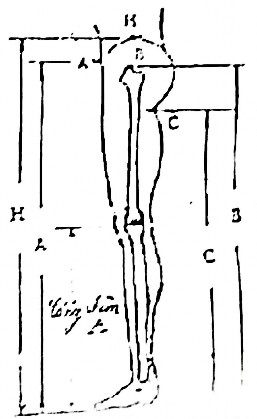
Measurement method: While taking data, it is necessary to ensure the reliability of the measurements. The person measuring stands to the right of the person being measured, holding the ruler with the right hand and finding the measuring point with the left hand. Once the measuring point has been found, the ruler must be adjusted to the correct measuring point.
Meanwhile, the ruler is always kept vertical, all measuring points must be measured uniformly from top to bottom. Meanwhile, the measured person, male, wears shorts, female, wears pants and tank top, stands naturally and firmly. The measurement time must be fixed, the next time must be repeated exactly as the previous time, should not be prolonged, the deviation between measurements must not exceed 2 - 3mm.
Standing height (cm): Is a highly heritable indicator, depending on genetic factors, race and family. Height grows rapidly during puberty, athlete height is an advantage in many sports, elite athletes in the world have heights far exceeding the average of ordinary people, height is an important indicator for the formation and development of sports talent.
Weight (kg):
- Purpose : Determine body weight to calculate the ratio between height and weight...
- Equipment : Health scale using international standards, specially designed for athletes to easily perform.
- Measurement method: Have the athlete sit on a chair, lift both legs up, place them gently on the scale, slowly stand up straight and stand still, then the athlete sits down on the chair and lifts both legs out and leaves the weighing area.
Body mass index BMI (kg/m 2 ):
BMI is an index calculated by the ratio of weight (kg) to the square of height (cm). BMI reflects the interaction between environmental factors (weight) and genetic factors during the growth and development process. BMI that is too large or too small reflects abnormal development, being too fat or too thin, which is unfavorable for the formation and development of motor skills. BMI results are evaluated based on table 2.1.
Formula for calculating BMI: