
- Hypothesis H6 states that : Structural relationship marketing has a positive impact on customer satisfaction. The results of parameter estimates in Table 5.16 show that the impact of structural relationship marketing (RM-CAUTRUC) on satisfaction has a standardized regression weight of 0.095 with p = 0.066 < 0.1. Therefore, hypothesis H6 is accepted. Thus, the statistical test results show the relationship between RB-CAUTRUC and customer satisfaction. The above results are consistent with the research of Chen, Y. et al. (2009), Gu, R. et al. (2016) in the online field, the research shows that the relationship between structural relationship marketing has a direct and positive impact on satisfaction.
- Hypothesis H7 states that: Satisfaction has a positive impact on customer loyalty. The results of estimating the parameters in Table 5.16 show that the impact of satisfaction on customer loyalty has a standardized regression weight of 0.119 with p = 0.046 < 0.1. Therefore, hypothesis H7 is accepted . Thus, satisfaction has a direct and positive impact on customer loyalty. Hypothesis H7 is accepted in accordance with the studies of Hennig-Thurau T. et al. (2002); Ndubisi, EC et al. (2015); Ngo, Vu M. et al. (2016) in the banking industry in Vietnam.
- Hypothesis H8 states that: Switching costs have a positive impact on customer loyalty . The results of estimating the parameters in Table 5.16 show that the impact of switching costs on customer loyalty has a standardized regression weight of 0.369 with p = 0.000 < 0.1. Therefore, hypothesis H8 is accepted . Thus, switching costs have a direct and positive impact on customer loyalty. Hypothesis H8 is accepted in accordance with the studies of Ndubisi, EC et al. (2015). In addition, the study of Yang, Z. et al. (2004) shows that the direct effects of switching costs increase customer loyalty.
5.4.3. Testing theoretical model estimates using Bootstrap
This test helps to assess the reliability of the estimates in the evaluation model. By testing whether the regression coefficients in the SEM model are well estimated.
This study used the bootstrap method with the number of replicate samples N.
= 1000. The estimated results from 1,000 samples are averaged (averaged regression weights) with standard deviations presented in Table 5.17. Determination principle: If |CR| = |Bias/ SE-Bias| > 2, bias appears and vice versa. (See Appendix 6.4 for detailed estimation results of the model). The smaller the absolute value of these biases, the less statistically significant they are, the better.
Table 5.17. Bootstrap estimation results with N = 1,000
Parameter
SE | SE- SE | Mean | Bias | SE- Bias | CR | |||
SUTINTUONG | <--- | RBXAHOI | .067 | .001 | .146 | -.003 | .002 | -1.5 |
SUTINTUONG | <--- | RBTAICHINH | .048 | .001 | .223 | -.001 | .002 | -0.5 |
SUHAILONG | <--- | RBTAICHINH | .050 | .001 | .513 | .000 | .002 | 0 |
SUHAILONG | <--- | RBXAHOI | .050 | .001 | .150 | .000 | .002 | 0 |
SUTINTUONG | <--- | RBCAUTRUC | .074 | .002 | .150 | .001 | .002 | 0.5 |
LONGTRUNGTHANH | <--- | SUTINTUONG | .055 | .001 | .146 | -.003 | .002 | 1 |
LONGTRUNGTHANH | <--- | SUHAILONG | .052 | .001 | .235 | .000 | .002 | -1.5 |
LONGTRUNGTHANH | <--- | CHIPHICHUYENDO | .051 | .001 | .413 | .000 | .002 | 0 |
Maybe you are interested!
-
 Relationship Between Research Variables in the Model
 -
 Theoretical Basis of Customer Satisfaction and Proposed Research Model
 -
 Sem Results Of Theoretical Model After Calibration (Standardization)
 -
 Testing the Model's Predictive Accuracy
 -
 Some Theoretical Issues Related to the Aida Model in Performance Evaluation

Note: SE: standard deviation; SE-SE: standard deviation of standard deviation; Bias: bias; SE-Bias: standard deviation of bias.
(Source: Data analysis results)
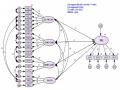
The estimation results presented in Table 5.17 show that most of the biases are not statistically significant, the remaining columns are calculated from the Bootstrap method. The Mean column gives the average of the Bootstrap estimates. The CR column is calculated automatically by Excel by dividing the Bias column by the SE-Bias column. The absolute value of CR is very small compared to 2, so it can be said that the bias is very small, not statistically significant at the 95% confidence level. Thus, we can conclude that the estimates in the model (as in Figure 5.5) can be trusted.
5.5. Chapter 5 Summary
Chapter 5 presents the results of testing the research model. The results of testing the measurement model show that all measurement concepts achieve reliability, discriminant validity and convergent validity. The results of testing the linear structural model show that there is a direct and positive relationship between social relationship marketing and structural relationship marketing on customer loyalty in the banking industry. On the other hand, the study also shows the impact of all three components of relationship marketing on satisfaction and thereby enhancing loyalty. In addition, the results of testing also show the significant role of switching costs on customer loyalty, demonstrated by its positive and direct impact on loyalty.
CHAPTER 6: CONCLUSION, IMPLICATIONS AND IMPLICATIONS
6.1. Introduction
This study was conducted with the aim of identifying the components of the relationship marketing concept to suit the relationship between banks and customers in Quang Ngai. The study also examined the factors that constitute relationship marketing and variable costs that directly affect customer loyalty. In addition, the study examined the direct relationship between the components of relationship marketing and customer satisfaction. And finally, the study examined satisfaction as a mediator in the relationship between relationship marketing and customer loyalty. Based on the theory of relationship marketing, the theory of measurement and measurement evaluation, a theoretical model was proposed for research and testing. The research method used to test the measurement model and the research model includes two main steps: preliminary research and formal research.
In order to summarize the main results and draw conclusions from the study, Chapter 6 consists of three parts: (1) summarizes the main results and theoretical and methodological contributions along with their implications for managers and researchers, (2) proposes solutions to improve relationship marketing activities in the banking industry and (3) limitations and future research directions.
6.2. Main results and contributions of the study
6.2.1. Research results
The research results of the thesis show the conformity between the theoretical model and market data, as well as the acceptance of the hypotheses proposed in this research model, indicating practical implications for many different subjects. Specifically, including the subjects: (1) Vietnamese commercial banks in Quang Ngai province, (2) individual customers using banking services in Quang Ngai province and (3) academic researchers in the marketing industry (relationship marketing field).
The thesis discovered that relationship marketing is a multidimensional structure consisting of 16 indicators with 3 factors: financial relationship marketing, social relationship marketing and structural relationship marketing.
The results of the thesis show that social relationship marketing has the strongest impact on loyalty compared to structural marketing, while financial relationship marketing has no impact on loyalty.
In addition, the thesis results also confirm that all components of relationship marketing including financial relationship marketing, social relationship marketing and structural relationship marketing have positive impacts on customer satisfaction. In which, the strongest impact on customer satisfaction is financial relationship marketing.
At the same time, the thesis also affirms that customer satisfaction has a positive and direct impact on customer loyalty.
In addition, the thesis also demonstrates that switching costs have a direct and positive impact on customer loyalty.
As is known, a customer base with loyal customers is the leading competitive advantage of banks in a competitive environment. Through the research results, the direct results obtained from banks using relationship marketing for customers is to directly increase customer loyalty, as well as enhance satisfaction to thereby increase customer loyalty is the ultimate goal of this research. Through the research model, understanding the factors that constitute relationship marketing, how switching costs play a role in increasing customer loyalty, thereby banks strengthen activities related to relationship marketing, satisfaction, switching costs and customer loyalty, which will promise to enhance their competitive position in the market. This is a key factor for banks to maintain their sustainable development.
On the other hand, in Vietnam there has not been any empirical research on the relationship marketing model ( relational bonds ) including relationship marketing components.
financial bonds , social relationship marketing and structural relationship marketing . The author hopes that this will be a serious research result that contributes to the comments of previous international authors, as well as a demonstration of the impact of relationship marketing on maintaining customer loyalty in the banking industry in Quang Ngai in particular and Vietnam in general.
6.2.2. Research contributions
Contributions to the elements of relationship marketing
Yu, Tsu-Wei et al., (2013) argued that the concept of relationship marketing is a unidimensional concept that includes financial, social and structural relationship marketing. Meanwhile, Nath, P. et al. (2012) argued that relationship marketing only includes two separate variables: structural and social relationship marketing; while De Wulf, K. et al. (2001, 2003) in their study argued that relationship marketing only includes two factors: financial relationship marketing and social relationship marketing. This study once again confirms that the structure of relationship marketing including all three factors: financial, social and structural is appropriate. A recent study by Huang, Chao-Chin et al. (2014) showed that the main components contributing to relationship marketing also include: financial relationship marketing, social relationship marketing and structural relationship marketing. This shows that the content of relationship marketing in the banking industry of a transitional economy like Vietnam and in a strongly developing economic sector like the banking industry also includes the basic components as affirmed in developed economies.
However, as presented above, the basic components of relationship marketing in this study are a concept measured by a multidimensional scale, including three factors of financial, social and structural relationship marketing. This suggests an important management orientation in the banking industry that it is necessary to have appropriate efforts to selectively implement financial, social and structural relationship marketing types so that customers have good feelings about their relationship with the bank, thereby increasing their loyalty.
Contribution to the results of relationship marketing between banks and individual customers
In previous studies that have been synthesized and analyzed, the author found that there are very few studies on relationship marketing (relational bonds) with its constituent components including financial relationship marketing (financial bonds) , social relationship marketing (social bonds) and structural relationship marketing (structural bonds) , in which each individual component directly affects customer loyalty, and each of these components also directly affects satisfaction and thereby enhances customer loyalty. Therefore, with this study, the author hopes that the results of the thesis will serve as a basis for additional research in the field of relationship marketing.
- The results of the thesis have shown that customer loyalty is both a direct and an indirect result of relationship marketing. Specifically, relationship marketing can directly increase loyalty, it can also increase customer loyalty through customer satisfaction. This confirms the research results of many previous researchers on the direct results of relationship marketing are loyalty and satisfaction, in addition, through satisfaction to increase customer loyalty is also completely true for the banking industry in Vietnam. In this study, SEM model analysis was used and the test results showed that the data were suitable. Thus, this is also an important affirmation of the generality and popularity of the relationship marketing model when applied to a transitional economy and a specific business sector in Vietnam. Specifically:
- Research shows that financial relationship marketing does not directly impact customer loyalty but can enhance customer loyalty in the banking industry through satisfaction. Specifically:
+ The research results of the thesis show that there is no direct relationship between financial relationship marketing and loyalty. This result is consistent with the research of researchers in developed economies, such as the research of
Shammout, AB (2011, 2018) and Lima, M. et al. (2015) found that the relationship between financial relationship marketing and loyalty was not statistically significant. This suggests that for the banking sector in a developing economy like Vietnam, financial relationship marketing may not really make customers loyal to the bank, because different banks have competitive financial policies for customers, which makes it easy for customers to switch from one bank to another in search of greater benefits, leading to financial relationship marketing activities not being able to retain them.
+ However, the thesis has shown that financial relationship marketing has a direct impact on customer satisfaction. This result is consistent with many studies such as the study of Salleh, M. (2016) and Gu, R. et al. (2016). And through satisfaction to enhance customer loyalty in the banking industry.
The above research results show that in the Vietnamese banking industry, although financial relationship marketing does not directly increase customer loyalty, it can, through customer satisfaction, increase their loyalty.
- In addition, the important discovery of the thesis is to prove that social relationship marketing has a direct impact on customer loyalty as well as a direct impact on satisfaction, thereby enhancing loyalty. Specifically:
+ The research results of the thesis have shown that there is a positive relationship between social relationship marketing and loyalty. This result is consistent with the research results of Wang, W. et al. (2006) in the information service industry. Moreover, the research results of the thesis have provided further evidence for the assertion of Lin, N. et al. (2003) and Wang, W. et al. (2006) that social relationship marketing is considered the core of relationship marketing to foster customer loyalty.