
The stream is designed to flow partly into West Lake and partly into To Lich River.
(4) The Northwest area of West Lake includes Xuan La Ward, Nhat Tan. This is a newly upgraded ward, so compared to other areas around the lake, the road and drainage system is not complete. In addition, the system in the ward has not yet met the general development trend.
Xuan La culvert is the largest culvert of West Lake, so whenever it rains heavily and the lake is full of water, Xuan La becomes the lake's wastewater bag. Most households living near the lake also discharge waste directly into the lake, seriously affecting the general environmental quality of the area.
(5) The eastern area of West Lake belongs to Quang An ward. This area has a high and airy terrain. This area has long been heavily invested in, becoming the entertainment center of Hanoi people (Quang Ba motel, Thang Loi hotel). Compared to other areas, this place has all the infrastructure conditions such as traffic, construction, electricity and water, swimming pool, cultural house... In addition, around West Lake there are many items such as railings, lighting systems, electric poles... along the corridor around the lake (Table 3.2 and Figure 3.1).
Table 3.2. Infrastructure around West Lake
TT
Category | Current Status | ||
1 | Road | Length of road around West Lake | 18.9 km |
2 | Walking path | Sidewalk | 6,3257 ha |
Walk in the flower garden | 0.9 ha | ||
3 | Green lawn | Stone bench | 345 pieces |
Lawn | 16,339.31 m2 | ||
Seasonal flowers | 1,151.14 m2 | ||
Border plant | 1,047.82 m2 | ||
Ornamental plants | 1,117 clumps | ||
Bonsai planted with creeping stems | 1,556.38 m2 | ||
Vertical array ornamental plants | 292.39 m2 | ||
Bonsai pot (enamel pot) | 89 pots | ||
Single tree | 121 trees | ||
Shade trees > 5 years old | 2,422 trees | ||
Maybe you are interested!
-
 Research on the functions of West Lake wetland ecosystem and the impacts of urban development on those functions - 13
 -
 Environmental impact assessment of Thanh Minh industrial cluster infrastructure investment project, Phu Tho town, Phu Tho Province - 2
 -
 Some Pictures of the Transformation of Traditional Culture of Thai People in Mai Chau
 -
 Situation of Tourism Facilities and Infrastructure in Co To District
 -
 Proposing Solutions for West Lake Ecosystem Management
Source: West Lake Management Board, 2011
1000th Anniversary of Thang Long Stele | Lake embankment |
| |
KS Seraton | Iron railing |
|
|
Belt road section Thuy Khue | Thuy Khue Street |
|
|
Green trees shade the lake | |
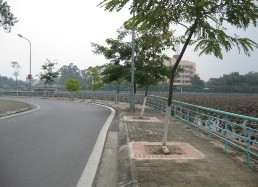
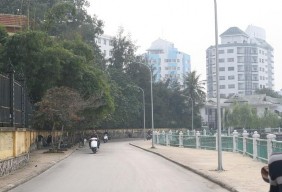
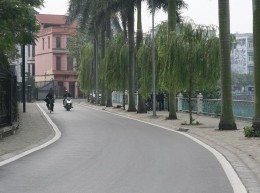
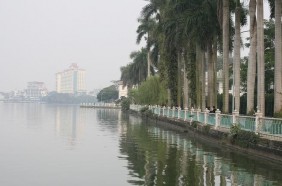
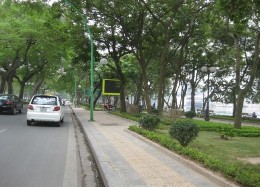
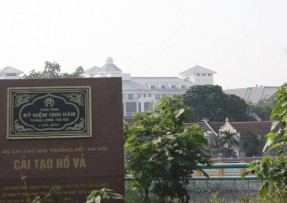
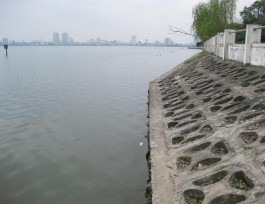
Figure 3.1. Some images of the infrastructure around the lake
3.2. Current environmental status and ecosystem characteristics of West Lake
3.2.1. Current environmental status of West Lake
a. Hydrological parameters
According to the most recent research and investigation by the Institute of Ecology and Biological Resources in the project "Investigation and assessment of the current status of water pollution and ecosystem of West Lake; proposing solutions to reduce pollution and rationally exploit and use West Lake" , the hydrological parameters of West Lake are as follows:
Temperature: Water temperature in West Lake ranges from 25 † 34 0 C. The temperature at the bottom layer is usually lower than at the surface layer. The temperature in surface water changes seasonally, with the rainy season having a higher water temperature than the dry season.
pH: pH ranges from 6.9 † 9.8 and is highest in the rainy months (August). The average pH in the surface and bottom layers has little difference, usually ranging from 7.5 † 8.5. At the sluice gates, the pH tends to be more neutral. The pH meets the allowable standards A1 and A2 according to QCVN08:2008/BTNMT.
Dissolved oxygen content (DO): DO content generally changes seasonally, the rainy season has a higher DO content than the dry season, the DO of the surface layer of West Lake fluctuates from 0.4 to 2.3 mg/l (average 5.57 mg/l). DO content of the bottom layer fluctuates from 0.4 to 8.6 mg/l (average 4.79 mg/l), DO is the amount of dissolved oxygen in water necessary for the respiration of aquatic animals... The average DO value of the surface layer at the end of the dry season, the beginning of the rainy season (during April and November) fluctuates from 4.92 to 5.55 mg/l, lower than the DO content in August (rainy season) of 5.97 mg/l. DO content at the discharge points is often very low compared to the permitted standard. The average value of dissolved oxygen in the surface layer is stable and higher than that in the bottom layer and has exceeded the standard. Particularly at large sewer points, DO content does not meet B1 standard (DO content is very low, below the allowable standard in many sewer areas with anaerobic phenomena, DO content is only 0.4 mg/l) according to QCVN08:2008/BTNMT. At the bottom water layer, DO content is lower than the surface layer, all sewer water areas have low DO content below the allowable level according to both B1 and A2 according to QCVN08:2008/BTNMT.
Salinity: Salinity is the total content in grams of all minerals in water. The salinity in the surface layer of West Lake is usually < 0.2%. The salinity does not change much, but in the sluice gate areas, the salinity is much higher and fluctuates erratically, possibly due to the influence of surrounding wastewater into West Lake. The salt content in the bottom layer varies greatly with the seasons: the rainy season (August) has the lowest salt content and is even among the survey points; in the dry season (early May and November), the salt content is much higher.
Conductivity (EC): The electrical conductivity of water is correlated with salinity, which is related to the presence of ions in the water. These ions are usually metal salts such as NaCl, KCl, SO 2 , NO 3 - , PO 4 3 - etc. The pollution impact of water with high electrical conductivity is often related to the toxicity of ions dissolved in the water. To determine electrical conductivity, people often use resistance or current meters. Conductivity is often high and varies greatly in the sewer area.
Turbidity (NTU): Turbidity in water is caused by suspended solids that are not visible to the naked eye. Turbidity in water is caused by mud, silicic acid, organic matter, microorganisms and phytoplankton. Turbidity limits the amount of light in the water, making it difficult for some plants to grow, and also affects animals that depend on these plants. During the rainy season, the turbidity of West Lake water is often higher than in the dry season, and the turbidity at the bottom is often higher than at the surface.
b. Hydrochemical parameters
The hydrochemical parameters at West Lake have been evaluated by the Institute of Ecology and Biological Resources in the project "Investigation and assessment of the current status of water pollution and ecosystem of West Lake; proposing solutions to reduce pollution and rationally exploit and use West Lake". The hydrochemical parameters at West Lake are as follows:
Suspended solids (SS) in water: The suspended solids content in the West Lake area ranges from 8.6 † 147.3 mg/l. During the dry season and early dry season (April and May), the SS content is usually low, ranging from 8.6 † 48.5 mg/l, lower than the allowable limit for surface water QCVN08:2008/BTNMT column B2. During the rainy season (August), the suspended solids content increases dramatically, and is always higher than the standard for surface water and
fluctuates from 74.1 mg/l † 147.3 mg/l. The reason for this sudden change is that during the rainy season, waste from the lake shore flows into the lake with rainwater, disturbing and promoting the metabolic process in the lake's water body.
In the sewer area, the suspended solids content is similar to the change in surface water quality of West Lake. The water quality in the sewers in the dry season (April and May) also does not change much and is all lower than the allowable standard for domestic wastewater (QCVN 14: 2008/BTNMT), ranging from 9.8 mg/l to 31 mg/l. The suspended solids content in the sewers in the rainy season (August) is very high, ranging from 83.16 mg/l † 168.47 mg/l, higher than the allowable standard QCVN 14: 2008/BTNMT, level B (maximum allowable in domestic wastewater when discharged into water sources not used for domestic water supply purposes).
BOD5 content : BOD5 content in West Lake is quite high, ranging from 11 † 187 mg/l. At points far from the sewer, this content compared to the surface water standard QCVN 08:/BTNMT with levels A2 and B1 both exceeds and is 2 † 3 times higher. At the points where the sewer discharges into the lake: BOD5 content compared to the domestic wastewater standard QCVN 14:2008/BTNMT level B (B < 50) also exceeds 2 † 4 times. If compared with previous research results, the BOD5 content at the present time is much higher in both minimum and maximum values.
COD content: Fluctuates from 29 † 370 mg/l, the average value in batches from 30-250 mg/l is higher than the previous research results: 45 † 110 mg/l (Nguyen Quoc Hung 2001). Compared with the allowable limit QCVN 08: A2, B1 at the survey points all exceed the allowable limit. At the sewer points, COD exceeds the allowable limit B2 up to 7 times.
Ammonium NH4 + content : The NH4 + content in West Lake in recent surveys ranges from 0.01 † 2 mg/l, often at high levels and exceeding the allowable limit (QCVN 08:2008/BTNMT), especially in the early dry season (April), with a tendency to decrease during the rainy months. Measurement points at the sewers have very high ammonium content, exceeding the allowable limit many times (some sewers sometimes exceed 40 † 50 times when calculated at the average value level).
Nitrite content NO 2 - : Nitrite content during the survey was also very high, often exceeding the allowable limit, not only at the discharge points but also at other points in the lake reaching very high values.
Nitrate content NO 3 - : NO 3 - content fluctuates over time, highest in April (end of dry season, beginning of rainy season) and gradually decreases and is lowest in the rainy season, then tends to increase gradually in the dry season.
Total Nitrogen (TN) content : At West Lake, the average value of Total N is about 4.07 mg/l, varying from 0.491 † 72.75 mg/l. Compared to the allowable limit of Denmark, the total N content at points on the lake exceeds 4 times, the average value of this content exceeds 40 times and at the discharge points is even higher. The total nitrogen content also fluctuates over time, highest in April (end of dry season, beginning of rainy season) and gradually decreases and is lowest in the rainy season, beginning of dry season.
Phosphate content (PO 4 2- ) and total phosphorus (TP): Phosphorus is a nutrient in water sources originating from the process of biomass growth in aquatic ecosystems. The analytical results of PO 4 2- content in West Lake water fluctuated from 0.111 to 0.673 mg/l. In general, the phosphate salt content in the water areas in the middle of the lake was below the allowable level. In the discharge sluice area, the phosphate content exceeded the allowable level. The phosphate content PO 4 2- also fluctuated over time, highest in April (end of dry season, beginning of rainy season) and gradually decreased and lowest in the rainy season, beginning of dry season.
According to the Danish Water Quality Institute, when water is eutrophic, the Total P content > 0.15 mg/l. In West Lake, the Total P content has an average value of about 1.06 mg/l, varying between 0.18 † 24.2 mg/l, which proves that the water in West Lake is eutrophic. The total phosphorus content also fluctuates over time, being highest in April (end of dry season, beginning of rainy season) and gradually decreasing and lowest in the rainy season, beginning of dry season.
Silica salt content (SiO 3 2- ): Silica nutrient salt content of West Lake ranges from 10 † 42 mg/l. In the dry season (November), the Silica salt content is higher than in the rainy season. The Silica content at the sluice gate is often higher than in the middle of the lake.
Grease content in water: Grease is a liquid that is difficult to dissolve in water, the toxicity and ecological impact of grease depends on each type of oil. Most plants and animals are affected by grease, aquatic species and submerged plants are easily killed because grease prevents respiration, photosynthesis and nutrient supply.
The oil and grease content in West Lake water has little change according to the season of the year. The oil and grease content varies from 0.048 † 0.085 mg/l in the first months of the dry season. The analysis shows that at points on the lake surface, this content reaches the allowable limit at level A2, at the discharge points, although this content is higher, it still reaches the allowable limit at level B1.
In most areas of the lake, the oil content is lower than the GHCP of surface water (0.02 mg/l). However, at discharge points, the oil content is very high, exceeding the allowable limit by 3 to 4 times, the water is polluted with oil and grease, and the oil and grease content in the water around the lake tends to increase. This is also a cause of mass fish deaths at some points in West Lake in recent times.
Cyanide and Phenol content: West Lake is not polluted with phenol and cyanide, the cyanide and phenol content in the lake water is much lower than the permissible limit.
Pesticides: The main pesticide groups in West Lake water are HCB, DDE and DDT, all of which have very small concentrations compared to the permitted standards. Although the DDT concentration in the water is quite large compared to other groups, it is still very small compared to the permitted standards. Therefore, it can be concluded that West Lake water is not contaminated by pesticides.
3.2.2. Characteristics of West Lake ecosystem
a. Species composition characteristics
(1) Floating plants
Floating plants in West Lake have a very rich number of microalgae species up to 72 species with 5 phyla: 15 species of Cyanobacteria, 19 species of Green algae, 21 species of Silic algae, 14 species of Eye algae and 3 species of Diptera. In general, the number of plant species is not different.
many over the study period, however, the composition changes seasonally. In the species composition, the Silic algae phylum has the largest number of species (21 species), with dominant genera such as Melosira, Synedra, Navicula, Nitzschia, followed by the Green algae phylum (19 species) with different genera Scenedesmus, Pediastrum, Chlorella.... in which Scenedesmus algae is present with 5 species. Cyanobacteria have been discovered 15 species over time, but Cyanobacteria dominate the floating phytoplankton community, especially toxic Cyanobacteria such as Microcystis aeruginosa (Appendix 5).
(2) Floating animals
According to the results of a 2011 survey at West Lake by the Institute of Ecology and Ecology: 37 species and groups of plankton belonging to 27 genera and 17 families were identified in the groups Rotatoria, Copepoda, Cladocera, Ostracoda, insect larvae and crustacean larvae. In terms of species composition, the dominant number of species belongs to the Rotatoria group with 17 species (accounting for 45.9%), Copepoda with 5 species (accounting for 13.5%), Cladocera with 12 species (32.4%), 3 groups of species belonging to crustacean larvae, Ostracoda and insect larvae (8.1%).
The recorded zooplankton species are common, widely distributed, and often occur year-round, especially in organic-rich water bodies in the delta. Some species with high frequency of occurrence are Mesocyclops leuckarti, Microcyclops varicans, (Copepoda), Bosmina longirostris, Diaphanosoma leuchtenbergianum, Moina dubia (Cladocera), Asplanchna sieboldi, Brachionus calyciflorus, Trichocerca spp., Filinia longiseta (Rotatoria).
The limiting characteristic of the zooplankton species composition of West Lake is the low diversity in composition, most of the recorded species are species adapted to the environment rich in organic nutrients, often appearing in polluted water bodies. The rotifers in the organic filter-feeding group thrive, along with some species in the Copepoda group, Cladocera often dominate in density such as Rotaria spp., Brachionus spp., Asplanchna sieboldi, Trichocerca spp., Filinia longiseta, Tetramastix opoliensis .... The appearance and dominance in species composition of groups of species that prefer nutrient-rich environments shows the eutrophication level of West Lake.