
MINISTRY OF EDUCATION AND TRAINING
HO CHI MINH CITY UNIVERSITY OF EDUCATION - SCHOOL OF EDUCATION MANAGEMENT II
DOAN THI GAI
Maybe you are interested!
-
 Socialization of educational activities in Ninh Thuan province - Current situation and solutions - 2
 -
 Research to enhance socialization in tourism activities in Hai Phong city - 2
 -
 Management of training in organizing extracurricular educational activities for primary school teachers in Ha Long city, Quang Ninh - 1
 -
 Principles of Socialization of Tourism Activities.
 -
 Managing cultural activities at the Center for Culture, Sports and Tourism of Phu Ninh district, Phu Tho province - 1
SOCIALIZATION OF EDUCATIONAL ACTIVITIES IN NINH THUAN PROVINCE - CURRENT SITUATION AND SOLUTIONS
MASTER'S THESIS IN EDUCATIONAL SCIENCE
MAJOR "MANAGEMENT AND ORGANIZATION OF CULTURAL AND EDUCATIONAL WORK"
CODE: 5.07.03
SCIENTIFIC INSTRUCTOR: DR . DAO QUANG TRUNG
HO CHI MINH CITY - 2003
INDEX
0TABLE OF CONTENTS0T 2
0THANKS0T 6
0TAbbreviations0T 7
0TPART 1- INTRODUCTION0T 8
0T1. REASONS FOR CHOOSING THE TOPIC AND HISTORY OF THE RESEARCH PROBLEM0T 8
0T1.1. Reasons for choosing the topic0T 8
0T1.2. History of research problem0T 9
0T2. RESEARCH PURPOSE AND TOPIC LIMITATIONS0T 10
0T2.1.Research purpose0T 10
0T2.2.Topic limit0T 10
0T3. RESEARCH OBJECTS0T 10
0T4.SCIENTIFIC HYPOTHESIS0T 10
0T5. RESEARCH ASSIGNMENT0T 11
0T6. RESEARCH METHODS0T 11
0T7. THESIS STRUCTURE0T 11
0TCHAPTER 1 - THEORETICAL BASIS OF THE PROBLEM OF SOCIALIZATION OF EDUCATIONAL ACTIVITIES0T 12
0T1.1. Concept of socialization, socialization of educational activities0T 12
0T1.1.1. Socialization0T 12
0T1.1.2. Socialization of educational activities (XHHHĐGD)0T 13
0T1.2. Socialization mechanism of GD0T 17
0T1.3. The role of socialization in education and training in general and in the formation of new human personality0T 18
0T1.4. Main content of socialization of educational activities0T 23
0T1.4.1.Social education0T 23
0T1.4.3. Diversify training types0T 25
0T1.4.4.Diversification of investment resources0T 26
0T1.4.5.Institutionalization of Socialism0T 26
0T1.5. The way to implement the XHHHĐGD0T 27
0T1.5.1. Building and strengthening the relationship between schools and social forces in participating in educational work.0T 28
0T1.5.2. Democratization of education0T 29
0T1.5.3. Diversify education0T 31
0T1.5.4. Education congresses at all levels (commune, district, province)0T 32
0TCHAPTER 2: CURRENT STATUS OF SOCIALIZATION OF EDUCATION ACTIVITIES IN NINH THUAN PROVINCE0T 35
0T2.1. Some features of Ninh Thuan province0T 35
0T2.1.1. Geographical location and natural conditions0T 35
0T2.1.2. Population and labor0T 35
0T2.2. Awareness of all levels and sectors in the province about the Socialization of Education.0T 37
0T2.3. Current status of social work for education in Ninh Thuan in recent years0T 40
0T2.3.1.Progress of implementing the Social Policy on Education in Ninh Thuan0T 40
0T2.3.2.Results achieved0T 40
0T2.4. Local solutions in implementing the socialization of educational activities0T 57
0T2.5. Achievements and limitations in implementing the Social Policy on Education in Ninh Thuan0T 59
0T2.5.1. Achievements0T 59
0T2.5.2. Limitations0T 61
0T2.6. Causes of achievements and limitations0T 62
0T2.6.1.Reasons for Achievement0T 62
0T2.6.2.Reasons for limitations0T 63
0TCHAPTER 3 - SOLUTIONS ON SOCIALIZATION OF EDUCATIONAL ACTIVITIES IN NINH THUAN PROVINCE IN THE COMING YEARS0T 65
0T3.1. Directions and goals for developing education in Ninh Thuan in the spirit of the resolution of the 10th Provincial Party Congress (from now until 2010) 0T 65
0T3.2. Goals of socializing educational activities0T 65
0T3.3. Specific solutions for socializing educational activities0T 66
0T3.3.1. Propagating to raise awareness of the leading national policy role of education in socialization of education for all sectors, levels, social forces, people of all classes and teachers, workers, students and trainees in schools0T 67
0T3.3.2. Attracting social forces to participate in educational activities in which schools play a core role0T 69
0T3.3.3. Democratization of education0T 78
0T3.3.4. Perfecting and enhancing the effectiveness of mechanisms and institutionalization of socialization of education0T 80
0T3.4. Testing the urgency and feasibility of the above solutions0T 89
0TPART 3 - CONCLUSION AND RECOMMENDATIONS0T 92
0T GENERAL CONCLUSION 0T 92
0TREQUEST 94
0T❖ For Central0T 94
0T❖ For province0T 95
0T❖ For education and training industry0T 95
0T❖ For schools0T 96
0T LIST OF REFERENCES 0T 97
0TA- DOCUMENTS AND CLASSIC WORKS0T 97
0TB- BOOKS, SCIENTIFIC DOCUMENTS0T 98
0TPENDIX0T 100
0TA-REFERENCE FORM0T 100
0TB- STATISTICS PROOF 0T 104
THANK YOU
With sincere feelings, I would first like to express my deep gratitude to:
- The Graduate Training Council for the major " Management and organization of cultural and educational work " belongs to Ho Chi Minh City University of Education and School of Education and Training Management II.
- The teachers who directly taught and advised me throughout the process of studying and writing my thesis. Especially Dr. Dao Quang Trung - who directly guided me scientifically and wholeheartedly helped me complete this thesis.
At the same time, I would like to sincerely thank:
- Leaders and some functional departments of the Provincial Departments and Branches (Provincial Party Committee's Propaganda Department, Department of Labor - Invalids and Social Affairs...)
- Leaders and functional departments of the Department of Education and Training of Ninh Thuan province.
- Leaders of the Department of Education and Training of districts and towns; Principals of some high schools, middle schools,... in the whole province.
- Some leaders of districts, towns, wards and representatives of the Parents' Association of some schools...
- Family, friends, colleagues... have helped, encouraged and motivated me to complete this thesis.
Although I have tried my best, due to limited ability and time, the thesis certainly cannot avoid shortcomings. I sincerely hope to receive guidance and additional comments from teachers, seniors from previous faculties and all friends.
Ninh Thuat, February 2003
Doan Thi Gai
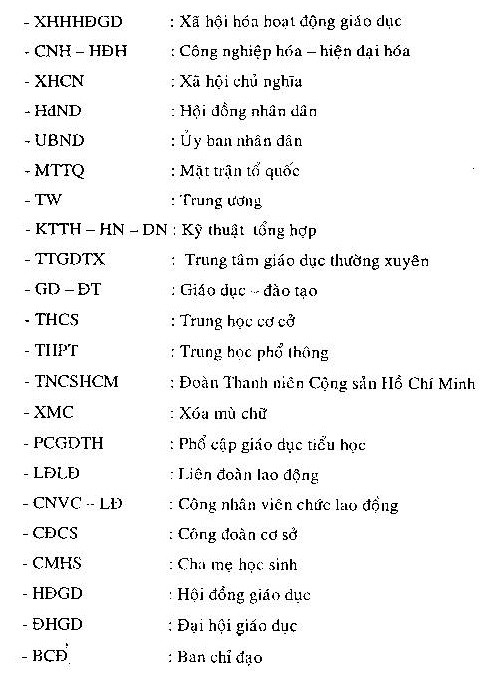
Acronyms
PART 1 - INTRODUCTION
1. REASONS FOR CHOOSING THE TOPIC AND HISTORY OF THE RESEARCH PROBLEM
1.1. Reasons for choosing the topic
Since the appearance of mankind, education as a phenomenon, a social process has arisen, developed and existed forever. Reality shows that education is always governed and regulated by other areas of social life; at the same time, it has had positive impacts and contributions to the development and progress of human society. According to UNESCO's summary over the past 50 years: Education is a factor of development.
Vietnamese people have a tradition of loving learning, respecting teachers, and in any circumstances, they always attach importance to education. "Without a teacher, you cannot succeed." "If you want to cross the bridge, you must build it. If you want your children to be well-educated, you must love and respect their teachers."... and education has been truly linked to the political, cultural, economic, and social activities of the country. It will be difficult for Vietnam to eradicate ignorance, promote universal education, eliminate illiteracy; expand the network of schools, and develop training types if the entire population does not respond to the motto: "Education is the cause of the masses," "The State and the people do education together."... that Uncle Ho and our Party have summarized and popularized for a long time.
In the current period of industrialization and modernization of the country, education plays an increasingly important role and position. Article 35 of the 1992 Constitution: "Education is the top national policy...". Inheriting the spirit of Resolutions VI, VII, VIII, Resolution IX of the Party emphasized: "Developing education and training is one of the important driving forces to promote industrialization and modernization, a condition for promoting human resources - a basic factor for social development, rapid and sustainable economic growth", with the solution: Continue to improve the quality of comprehensive education, innovate teaching and learning methods, school systems and education management systems; implement "Standardization, modernization, socialization". In many strategic solutions that implement "Standardization, modernization, socialization". In many strategic solutions that