
(Campus of Vocational Education and Continuing Education Center of Kim Son district, at hamlet 4, Thuong Kiem commune, Kim Son district, Ninh Binh province)
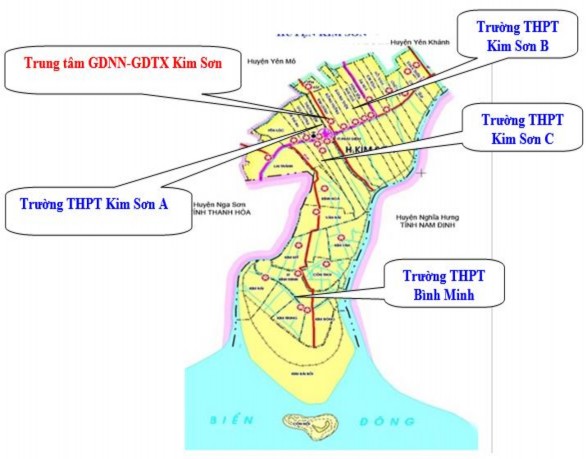
(Education map of Kim Son district, Ninh Binh province)
Since its establishment, Kim Son District Vocational Education and Continuing Education Center has been in operation for a short time, but with the tradition of more than 25 years of construction and development of the two units before the merger, along with the efforts of the Board of Directors, staff, teachers, employees.... The Center has achieved many outstanding achievements, is a bright spot in the Vocational Education and Continuing Education model in the whole province, was awarded a Certificate of Merit by the District People's Committee, and ranked excellent by the Department of Education and Training, Department of Labor, Invalids and Social Affairs...
2.1.2. School scale, government leaders, Party cells, teachers and staff
Since its establishment, Kim Son District Vocational Education and Continuing Education Center, although newly merged, has achieved many outstanding achievements, is a bright spot in the Vocational Education and Continuing Education model in the whole province, and was recognized by the District People's Committee as a cultural standard unit in 2018.
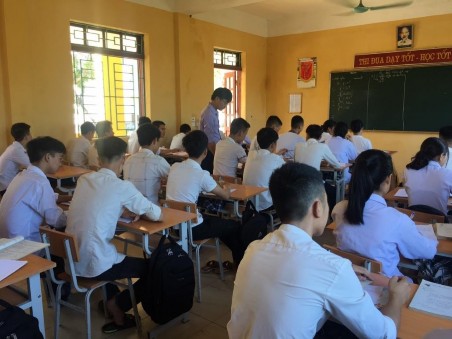
(Class time of teachers and students at Kim Son District Continuing Education Center)
Number of students studying the cultural program of the General Education Program at the high school level as of the end of semester I, school year 2018 - 2019:
Figure 2.1. Number of students studying cultural programs of the General Education Program at high school level as of the end of semester I, school year 2018 - 2019
STT
Block | Number of classes | Number of students | Female student | |
1 | 10 | 08 | 314 | 80 |
2 | 11 | 03 | 119 | 31 |
3 | 12 | 02 | 83 | 22 |
Total | 13 | 516 | 133 | |
Maybe you are interested!
-

 Leadership and Management of Provincial Party Committee and Grassroots Government
 -
 Reliability of the Scale of Implementation Level and Effectiveness of Content Management of Self-Protection Skills Education for Primary School Students
 -
 Organizing Capacity Training to Develop School Education Programs According to the New General Education Program for Management and Teaching Staff
 -
 Managing experiential activities of students at Nam Son Secondary School, Bac Ninh City according to the orientation of the new general education program - 2
 -
 Managing sex education activities for students at Nong Trang secondary school, Viet Tri city, Phu Tho province in the current context - 19
(Source: Vocational Education Center - Continuing Education Center of Kim Son district, Ninh Binh province)
Vocational training links have been expanded: currently the center has 15 vocational intermediate classes, 01 regular preschool intermediate class, 01 college class, 01 university class...
Continue training, fostering and coordinating the organization of exams to grant certificates in IT, foreign languages, short-term agricultural and non-agricultural occupations, and A1, B2 driver's license exams...; consulting, career guidance and labor export activities are focused on.
2.1.3. Current staff, teachers and employees
Total number of teachers: 42: Of which: Teachers: 24, accounting for 57.1
%. Board of Directors: 05 comrades. Staff: 13 comrades. Natural Science Group: 10 teachers. Social Science Group: 10 teachers. Administrative Group: 9 staff. LK & HN Group: 5. Vocational Training Group: 03.
+ Regarding the professional qualifications of the team of teachers and staff:
Total
Master | University | CD | TC | ||||||||||
Total | Male | Female | Total | Female | Total | Male | Female | Total | Male | Female | Total | Male | Female |
42 | 16 | 26 | 10 | 8 | 24 | 9 | 15 | 1 | 1 | 0 | 4 | 1 | 3 |
B1.
+ Computer skills: 100% of teachers and staff have A, B computer certificates
+ Foreign language proficiency: 100% of teachers and staff have foreign language certificate B,
Party cell : 19 party members/42 cadres, teachers, and employees (accounting for the proportion)
45.2%). The Party Cell Committee consists of 05 comrades. The Party Cell Secretary is also the Director of the Center.
- Current advantages and disadvantages.
+ Advantages:
Kim Son District Vocational Training and Continuing Education Center was established on the basis of merging two units: Vocational Training and Employment Support Center and Kim Son District Continuing Education Center according to Decision No. 1088/QD-UBND dated August 21.
2017 of the People's Committee of Ninh Binh province. According to the decentralization of state management, Kim Son Vocational Education and Continuing Education Center is a district-level center, receiving the attention and close direction of the People's Committee of Kim Son district. After the merger, the Center has developed operating regulations issued by the decision of the People's Committee at the district level. The organizational structure and staff are consolidated and improved to suit the new model. In addition, the Center is always coordinated by the Department of Education and Training, the Department of Labor, Invalids and Social Affairs and related departments and branches in professional management and organization of the center's activities.
Since the merger, the conditions of facilities, school grounds, classrooms, offices, and equipment of the center have been renovated, basically ensuring adequate service for teaching and learning.
The staff, teachers and employees were strengthened. In general, the center's operational capacity after the merger and name change was improved and had relatively good conditions to carry out its tasks.
For the high school level GDTX program, in the 2018-2019 school year, the center enrolled 314 10th grade students, reaching 112.0% of the plan. The center proactively and actively cooperated with vocational schools to enroll students in cultural classes combined with vocational secondary education. Vocational secondary, college, university classes, agricultural and non-agricultural vocational training activities were maintained...
+ Difficulty:
Although in the 2018-2019 school year, the Center enrolled 08 classes.
10. However, the biggest difficulty in recent years for the vocational education and continuing education sector in general and Kim Son vocational education and continuing education center in particular is still enrollment. From practice for many years, enrollment at the centers has encountered many difficulties stemming from many causes. That is, the awareness of learners always takes lightly the matter of learning a trade, working as a worker, only wanting to take the entrance exam to public high schools, then go to university and college even though they know that the output
It is not easy in the future. The work of streamlining after secondary school has been actively implemented but still does not meet the actual requirements. Besides, many universities and colleges are "blossoming" in vocational training, with many policies to attract students. In this "race" of enrollment, basically the vocational education and continuing education centers are at a disadvantage...
The center's admission target is not only students who fail the entrance exam to grade 10 at four high schools in the district, but also students who do not meet the requirements for grade 10. The quality of incoming students is very low and uneven, making it difficult to manage and implement educational programs.
The shortcomings in the current operating mechanism have further compounded the difficulties of vocational education and continuing education centers. Like other vocational education and continuing education centers nationwide, Kim Son vocational education and continuing education center is under the vertical professional management of both the Department of Labor, War Invalids and Social Affairs and the Department of Education and Training, so there is no unified focus in direction, while in terms of personnel and finance, the center is under the direct management of Kim Son District People's Committee. Managers and teachers in the continuing education sector are given two months of summer vacation and receive 35% of the teaching allowance according to the regulations of the education and training sector. Meanwhile, vocational teachers are only given one month off and do not receive teaching allowance. That makes it difficult to direct, supervise and assign tasks as well as build emulation and reward regulations of the unit. The ranking of centers has not been implemented, legal documents are still lacking in strictness... causing obstacles to the arrangement of allowances for leadership positions and managers at the center.
Although the center actively implements the program of combining cultural studies with vocational training, the number of students registering for the program is quite high, but the coordination between the center and secondary schools, colleges, and vocational colleges is still lacking.
not strict; some students are not really active in studying while having to study two programs at the same time, which affects the quality of study.
2.2. Current status of teaching and learning activities at the Center for Vocational Education - Continuing Education, Kim Son district, Ninh Binh province
2.2.1. Current status of innovation in teaching methods
Innovation in teaching methods is a major policy of the Party and the State to improve the quality of teaching in general and the quality of teaching in GDTX in particular, so the Director of the Center has paid attention to sending teachers (including guest teachers) to attend training courses organized by the Ministry and the Department of Education and Training. In addition, regular activities of observing lessons, visiting classes, and teaching conferences are organized to gain experience in innovation in teaching methods.
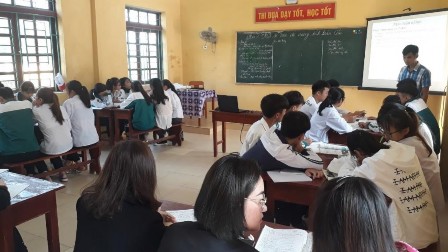
(Group discussion activity of teachers and students at the Center for Continuing Education and Vocational Training of Kim Son district)
The innovation of teaching methods of continuing education, including teaching activities of continuing education at high school level, information technology, foreign languages according to the continuing education program, general vocational training... is carried out in the direction of enhancing cooperation and coordination between teachers and learners, between learners, valuing the existing knowledge and experience of learners and increasing the use of modern teaching aids, especially applications of information technology.
Teachers have been conscious of innovating teaching methods, demonstrated from lesson design to the application of advances in science and technology in classroom teaching.
However, due to the lack of facilities and equipment; limited awareness and qualifications of students, the innovation of teaching methods of teachers at continuing education centers has not achieved the desired results.
2.2.2. Current status of professional group activities
By exercising the right to proactively develop and implement teaching plans, initially, professional groups and teachers have had better awareness and confidence in synchronously innovating content, methods, forms of teaching organization and testing and evaluation. From the 2017-2018 school year up to now, many professional groups have participated in developing and submitting teaching topics on "Connected Schools", thereby demonstrating that schools have seriously implemented the rearrangement of teaching content by topic instead of teaching by lesson/period in textbooks. Many topics have added teaching content related to local production practices. Through the developed topics, it shows that teachers have initially been more proactive and confident in adjusting teaching content, knowing how to overcome overlaps and unreasonable points to apply more practically and effectively active teaching methods and techniques.
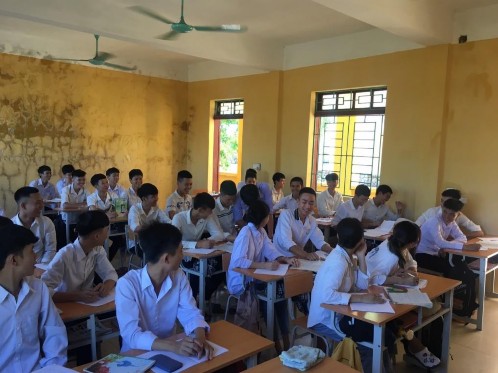
(A class at the Vocational Education and Continuing Education Center of Kim Son district)
The above content also shows the results of innovating professional group/team activities based on lesson research in schools, from innovating the method of building illustrative lessons; objectives and methods of observation when observing lessons; content and process of analyzing and drawing lessons at the Center for Continuing Education - Vocational Education in Kim Son district, Ninh Binh province:
- Building illustrative lessons: Initially, professional groups and teachers have known how to base on teaching objectives to determine the problem as a basis for selecting content to build teaching topics, meeting the requirements of organizing students not only to acquire knowledge but also to create opportunities for students to apply knowledge into practice, thereby contributing to the development of students' capacity. Many illustrative lessons by topic have been built, showing that teachers know how to apply active teaching methods and forms in a more practical and effective way through students' learning activities in class and at home, overcoming the situation of teachers "presenting