
material and spiritual life, helping people to be more aware of preserving natural landscapes, material values and traditional culture to serve tourism.
This project has helped 400 local people to be trained in community tourism and understand the positive impact of tourism on the community. More than 50 villagers directly work for the project and have a stable income of more than 3 million VND per month. In the village, there are 2 Homestay areas with 7 rooms providing overnight services in the village. 01 free English class for children in the village every year. The village's art troupe is maintained. Thousands of international tourists visit Yen Duc village and appreciate the traditional life and culture.
1.4.3. Lessons learned
From the experiences of tourism development of some countries in the world and localities in the country, it shows that for a tourism product to have potential, it is necessary to consider some aspects such as: New tourism products need to attract a significant number of visitors to explore and experience; That product has unique and different points; Has an impact on the local socio-economy; Has the ability to develop and link with other industries and fields in the future. The lessons learned for Lac Duong district are as follows:
Maybe you are interested!
-
 Potential, current status, solutions for tourism development in Tien Lang district, Hai Phong - 1
 -
 Current Status of Exploiting Tran Temple Festival, Thai Binh to Serve Tourism Development.
 -
 Current status of tourism development in Lao Cai province - 1
 -
 Current status and solutions for tourism development in Kim Bang district, Ha Nam province - 6
 -
 Lessons Learned From Community Tourism Development Models
Tourism products need to focus on exploiting local strengths in natural resources, traditional culture, unique customs and practices, and human resources with high skills and technology, contributing significantly to the socio-economic development of the locality.
Strengthening links between localities, businesses; local communities; regional, inter-regional and international links to create attractive tourism products.
It is necessary to research and improve tourism products, taking into account the impacts on the economy and livelihoods of local people.
It is necessary to train skills for local tourism communities, improve infrastructure conditions and technical facilities for tourism.
SUMMARY OF CHAPTER 1.
Nowadays, community-based tourism is receiving attention from management levels and society and is considered a type of tourism in which the local community has control and participates mainly in the areas of tourism development and management, most of the profits from tourism activities are kept for the community. Community-based tourism with the characteristics of the community being the subject of ownership, protection, exploitation of resources, participation in tourism activities and enjoying revenue from tourism. Community-based tourism is essentially a type of sustainable ecological and cultural tourism, but the people participating in tourism activities are people living and settling at tourist destinations or near tourist destinations.
To do that, the principles of tourism development must ensure the sustainability of tourism resources and environment and improve the quality of life, focusing on community development. In addition, community tourism also has a strong impact on the aspects: economy, politics, culture, society, environment in both positive and negative directions. Therefore, members participating in tourism activities such as: local communities, local authorities, organizations, sponsors, non-governmental organizations and governments, travel and service companies; KDL must truly connect and coordinate with each other in implementing community tourism.
Some lessons learned from developing community-based tourism in the country: Ha Giang, Quang Ninh; and abroad: Indonesia, Malaysia have provided highly practical information in exploiting community-based tourism. From the above practical bases, it is shown that community-based tourism develops depending on the political, cultural, and social environment of each region and each country. Therefore, there is no single model suitable for all countries and regions. Therefore, the flexible application of theoretical foundations along with learning from experiences in organizing community-based tourism in the country and around the world will be of great significance in gradually perfecting community-based tourism activities in each locality.
Chapter 2: POTENTIAL AND CURRENT STATUS OF COMMUNITY TOURISM DEVELOPMENT IN LAC DUONG DISTRICT, LAM DONG PROVINCE
2.1. Overview of Lac Duong district, Lam Dong province
Lac Duong is a mountainous district located in the North of Lam Dong province, 12km from the center of Da Lat, with a natural area of 130,963.40 hectares, accounting for 19% of the province's natural area. Lac Duong borders Khanh Son district and Khanh Vinh district (Khanh Hoa province), Ninh Son district (Ninh Thuan province) to the east; Krong Bong district and Lak district (Dak Lak province) to the north; Da Lat city and Don Duong district to the south; Lam Ha district (Lam Dong province) to the west.
Lac Duong District today, before the complete liberation of the South, was an important strategic location in the Southern Central Highlands. Lac Duong used to be the base of the Zone VI Party Committee (1961-1962) and Tuyen Duc Provincial Party Committee (1961-1965); the base commune steadfastly held out and provided a lot of human and material resources for the revolution. During the two resistance wars against the French colonialists and the American imperialists, the ethnic people of Lac Duong sheltered and sheltered many revolutionary cadres of Lam Dong province, transported ammunition, provided food and served in combat to protect the revolutionary base area and protect the provincial headquarters . (Lac Duong District People's Committee)
In the history of fighting to improve nature and fight against foreign invaders, the ethnic people in Lac Duong have always promoted the spirit of diligence, creativity and actively contributed to the struggle for national liberation and the building of a rich and beautiful homeland.
In 1975, after the complete liberation of the South, Lac Duong district was established. The Government Council issued Decision No. 116/CP dated March 14, 1979, re-establishing Lac Duong district. This was an important event for the people of all ethnic groups in the district, opening the period when Lac Duong district was legally formed and actively prepared conditions for the construction of the district.
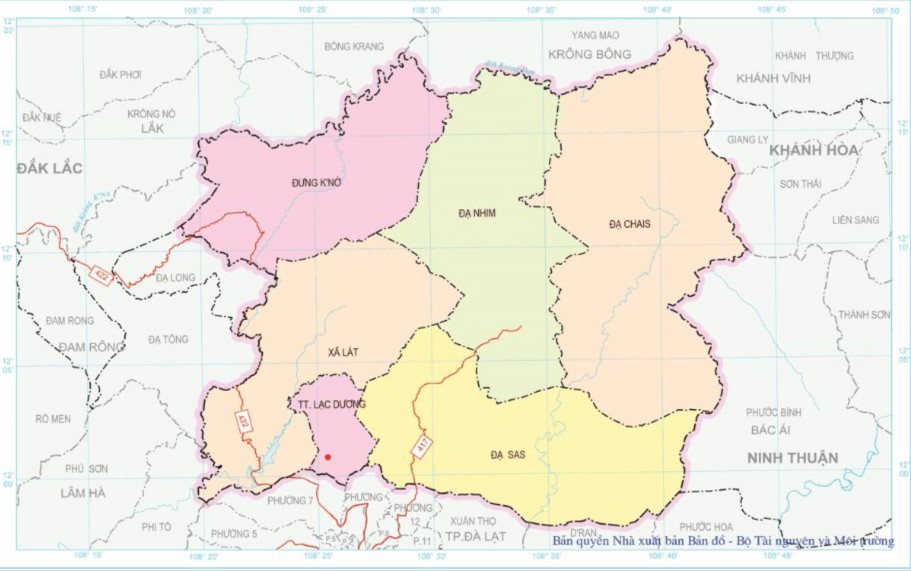
Figure 2.1: Administrative map of Lam Dong province (Source: Map Publishing House - Ministry of Natural Resources and Environment)
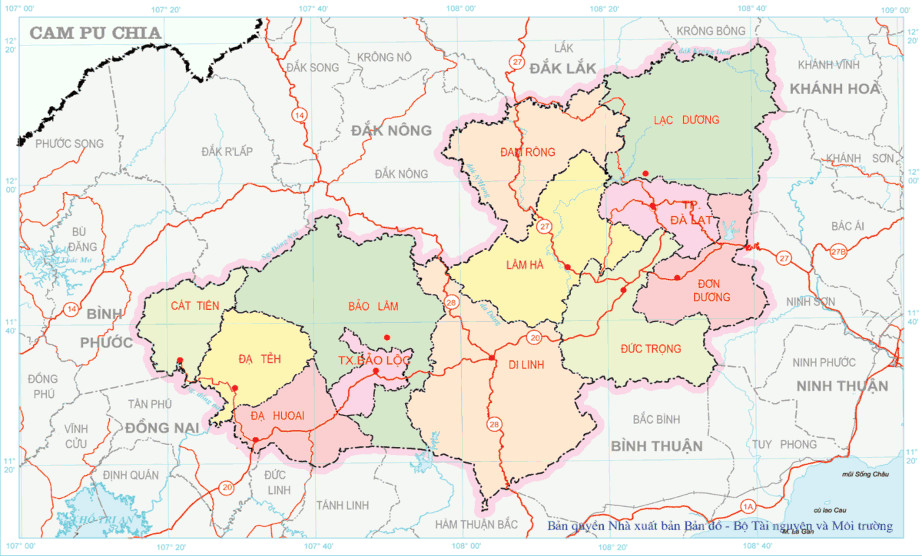
Figure 2.2: Administrative map of Lac Duong district (Source: Map Publishing House - Ministry of Natural Resources and Environment)
After the establishment of Lac Duong District, the state management apparatus system was formed from the District to the grassroots level. Currently, Lac Duong District has 6 administrative units including Lac Duong town, Lat commune, Da Sar commune, Da Nhim commune, Da Chais commune, and Dung K'Noh commune.
Lac Duong district is located on the upper reaches of two major rivers: Dong Nai river (belonging to Dong Nai river basin) in the Northeast and Southeast and K'Rong No river (belonging to Mekong river basin) in the Northwest and Southwest. Majestic high mountains, special-use forests, primeval forests, Dan Kia-Suoi Vang lake, Lang Biang mountain create poetic and magnificent landscapes with more than 40 ethnic minority communities with strong cultural and traditional customs, Lac Duong promises many attractive tourism potentials for visitors.
2.2. Natural conditions
2.2.1. Geology, geomorphology
Lac Duong is a mountainous district with relatively complex terrain, with 3 main types of terrain: high mountains, low to medium hills, and valleys.
High mountain terrain: Areas with steep slopes (over 20 o C), 1,500-2,200m above sea level, mainly of Jurassic-creta intrusive origin (granite-dacite...) or sediments (schist, shale...) accounting for about 80-85% of the district's natural land, most of the area in this terrain is the headwater forest of the Da Nhim river system, so it needs to be strictly protected.
Low or medium mountainous terrain: Low-slope hills or mountains (under 20 degrees) have an average height of 1,500m. In this type of terrain, most of the origin is basalt eruption with red-brown soil accounting for 8-10% of the total land area of the district, distributed mainly in the southern region. Usability depends on the slope and thickness of the layer. Climate and conditions can be converted to perennial industrial crops (such as coffee trees...).
Valley terrain: The area accounts for about 2-3% of the total land area of the district, distributed along large rivers and streams, with an altitude of 850-1,500m above sea level, a common slope of 3-8 degrees, most of the area is of the terrain type
This is alluvial and sloping soil, abundant water resources, creating favorable conditions for growing rice and crops.
2.2.2. Soil
Lac Duong district has 5 main soil groups:
- Ferali soil group: is the main soil type in Lac Duong with an area of 102,500 hectares, accounting for 78.3% of the natural land area.
- Red-yellow soil group: Area is 23,248 ha, accounting for 17.8% of natural land area.
- Accumulating sloping land group: Has an area of 1,710 hectares, accounting for 1.3% of natural land area.
- Acid humus soil group on high mountains: Has an area of 1,455 hectares, accounting for 1.1% of natural land area.
- River and stream alluvial soil group: has an area of 1,282 hectares, accounting for 1% of natural land area.
2.2.3. Climate
Weather and climate are extremely valuable and unique resources for tourism in Da Lat and its surrounding areas. Lac Duong belongs to the sub-equatorial monsoon forest zone with a distinct long dry season. Among the factors that shape the climate here, geographical location and altitude play a special role.
Because of its altitude of 1,500m to 1,600m above sea level, Luoyang has a temperate climate, with an average annual temperature of 16-22 degrees Celsius. January has the lowest average temperature (16.4 degrees Celsius), and May has the highest average temperature (19.7 degrees Celsius). Temperatures are stable throughout the year. The amplitude of fluctuations between day and night is large (9 degrees Celsius), and the temperature amplitude in the dry season decreases to 6-7 degrees Celsius. The rainy season lasts from May to October and the dry season lasts from November to April of the following year, with an average annual rainfall of 1,700-1,800mm. The total number of hours of sunshine per year is 2,335 hours, an average of 6.4 hours per day. Luoyang is influenced by the main wind directions of northeast and southwest with an average wind speed of 2.1-3m/s. In general, the climate in Lac Duong is mild, cool, and fresh all year round, very suitable for tourism development.
2.2.4. Minerals
Lac Duong belongs to the group of districts that are not rich in minerals. The main minerals of Lam Dong province such as gold, tin, bauxite, precious stones, kaolin, and brown coal are not available in Lac Duong district or are available (gold and tin) but in the form of mineral sand with low reserves. However, clay, stone, and sand can be exploited to make bricks, tiles, and construction materials for rural construction needs.
2.2.5. Forest resources
Lac Duong district forests have very high biodiversity with a rich composition of individual species:
- Flora : The flora of Lac Duong district is typical of a closed forest with frequent rain and is quite rich in species. The flora includes 827 species, of which 246 species produce beautiful and precious flowers, 212 species of medicinal plants, 14 species of resin, and 28 species of essential oils.
- Animals: There are 382 species of animals living here, including 61 rare species (25 mammals, 19 birds, 14 reptiles, 3 amphibians), 10 species are threatened with extinction such as: gaur, red-cheeked gibbon, bear, horse... The forest here preserves a large amount of rare animal genes, which are of high value in scientific research, so it needs to be protected...
2.3. Socio-economic conditions
2.3.1. Population and labor
2.3.1.1 Population
The total population of the district in November 2016 was 26,416 people, of which 19,268 were ethnic minorities, accounting for 72.9% of the district's population. Ethnic minorities living in the district are: K'Ho (K'Ho-Cil, K'Ho-Lach), Chu Ru, Thai, Ede, Nung, Tay, Hoa, Cham. Lac Duong is a multi-ethnic and multi-religious district. Indigenous people follow 3 main religions: Catholicism, Protestantism and Buddhism, of which Catholicism and Protestantism have over 17,000 followers, accounting for over 73% of the district's population. There are currently 01 parish, 02 Catholic parishes; 16 branches, churches and 04 Protestant groups.