
(Booking note). When accepting the shipment, the agent will collect the money and issue a shipping note if required.
Shipper required.
Step 6: Contract liquidation
During the shipping process, when the company has received the B/L, it will be sent to the customer for contract settlement. The HR department will manage and be responsible for contract settlement.
2.1.6. Production technology of some main products
Table 2.1: Main machinery and equipment of the Company used in production and business
Unit: Piece
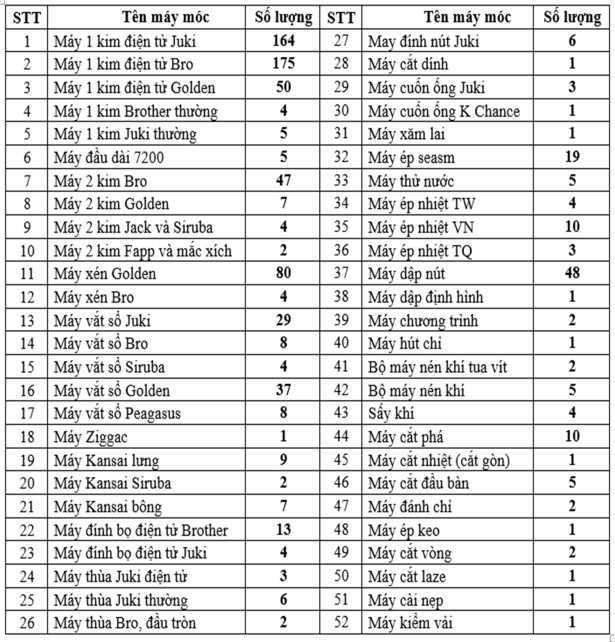
(Source: Planning and Materials Department)
For the production and business process to be effective, an important factor is the selection of appropriate technology for the production activities of each specific product. With the current situation, science and technology are increasingly developing, besides
Competitors entering the garment manufacturing and processing market are increasing, so the Company needs to equip itself with the most advanced and modern equipment, then business efficiency will be continuously improved. The Company's machinery and equipment have been invested in 3 stages and are maintained and serviced every 3 years to ensure the effective operation of the machinery, create stability in production and prolong the depreciation period.
2.1.7. Company's labor structure in the period 2018 - 2020
Truong Giang Garment Joint Stock Company specializes in processing garments for export, so the company's labor structure is closely managed and monitored to ensure the number of employees, complete the set plan, and deliver goods on time to customers. For the convenience of management, TGC classifies labor according to 4 criteria: by gender, production relationship, labor level and age of employees. Currently, the Company's labor structure is determined as follows: (as of December 31, 2018, December 31, 2019 and December 31, 2020).
Graduation thesis Supervisor: Dr. Le Thi Phuong Thanh
Table 2. 2: Company's human resources situation in the period 2018 - 2020
Unit: Labor
Target
2018 | 2019 | 2020 | 2019/2018 | 2020/2019 | ||||||
People | % | People | % | People | % | +/- | % | +/- | % | |
Total number of employees | 470 | 100 | 451 | 100 | 394 | 100 | -19 | -4.04 | -57 | -13 |
Gender breakdown | ||||||||||
Male | 52 | 11.06 | 49 | 10.43 | 45 | 11.42 | -3 | -5.77 | -4 | -8.16 |
Female | 418 | 88.94 | 402 | 85.53 | 349 | 88.58 | -16 | -3.83 | -53 | -13.18 |
Classification by production relations | ||||||||||
Indirect labor | 32 | 6.81 | 32 | 7.10 | 33 | 8.38 | 0 | 0.00 | 1 | 3.13 |
Direct labor | 438 | 93.19 | 419 | 92.90 | 361 | 91.62 | -19 | -4.34 | -58 | -13.84 |
Classified by education level | ||||||||||
University and post-graduate | 7 | 1.49 | 7 | 1.55 | 7 | 1.78 | 0 | 0 | 0 | 0 |
College, secondary school | 17 | 3.62 | 16 | 3.55 | 17 | 4.31 | -1 | -5.88 | 1 | 6.25 |
Popular | 446 | 94.89 | 428 | 94.90 | 370 | 93.91 | -18 | -4.04 | -58 | -14 |
Classified by age | ||||||||||
Age 18 - 25 | 10 | 2.13 | 6 | 1.33 | 4 | 1.02 | -4 | -40.0 | -2 | -33.33 |
Age 26 - 35 | 125 | 26.60 | 100 | 22.17 | 72 | 18.27 | -25 | -20.0 | -28 | -28.00 |
Age 36 - 45 | 239 | 50.85 | 234 | 51.88 | 209 | 53.05 | -5 | -2.09 | -25 | -10.68 |
Over 45 | 96 | 20.43 | 111 | 24.61 | 109 | 27.66 | 15 | 15.63 | -2 | -1.80 |
Maybe you are interested!
-

 Machinery and Equipment of Vietravel Hai Phong Company.
 -
 Research on some solutions to improve the quality of human resources at Khanh An Preschool Education Equipment Production and Trading Company Limited - 1
 -
 Materials management at Industrial and Construction Equipment Joint Stock Company - 1
 -
 The main solution to improve the production and business efficiency of Agricultural and Food Industry Printing Company - 2
 -
 General company of information technology and office equipment trading company - 1
(Source: Organization and Administration Department)
Student: Huynh Thi Ngoc Huyen - K51A KDTM 58
Table 2.2 shows that the Company's labor situation in the period of 2018 - 2020 tends to decrease. We can see that the total number of employees in 2019 was 451 people, a decrease of 19 people compared to 2018, equivalent to 4.04%. In 2020, there were 394 people, a sharp decrease in the number of employees compared to the total number of employees of the Company, specifically a decrease of 57 people compared to 2019, equivalent to 13%. This situation is partly due to the impact of the US-China trade war and the Covid-19 pandemic, causing a recession in the world economy in general and the Vietnamese economy in particular. In particular, in 2020, due to the impact of the Covid-19 pandemic, the number of employees decreased due to the limited number of orders from international partners, leading to a situation where employees were unemployed and even quit their jobs.
Chart 2.1: Labor structure by gender in the period 2018 - 2020
Labor structure by gender
Through table 2.2 and chart 2.1, in the company's labor structure over the past 3 years, women always account for a much higher proportion than men. This is explained by the nature of the work in textile companies requiring workers to be skillful, careful, and diligent, which is suitable for women, so the collected data is appropriate. As for male workers, in addition to
office management department, technical department, and mainly loading and unloading staff, maintenance
maintenance, inspection and repair of machinery.
Specifically, in 2018, female workers accounted for 470 people, accounting for 88.94%, while male workers accounted for only 52 people, accounting for 11.06%. In 2019, the number of female workers decreased to 402, accounting for the majority, accounting for 85.53%, and male workers decreased to 49 people, accounting for 10.43%. In 2020, the number of female workers decreased to 349 workers, accounting for 85.58%, and the number of male workers also decreased to 45 workers, accounting for 22.9%. Although the number of workers decreased, the ratio between male and female workers was relatively stable and almost unchanged. In order to improve and expand the scale of product exports for the company in the following years. The company should increase the number of male and female workers to serve different jobs, increase productivity and efficiency at work. Ensure timely delivery as required in foreign trade contracts. The variation in labor by gender reflects the reality of human resource needs of a business in the fashion garment industry.
Labor structure according to production relations
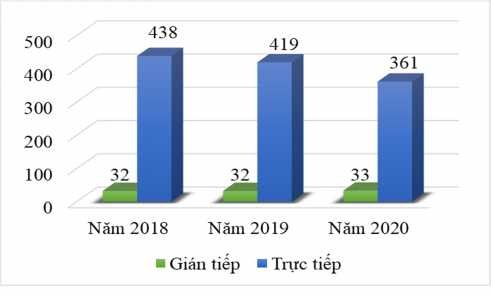
Chart 2.2: Labor structure according to production relations in the period 2018 - 2020
According to the production relations, the number of direct laborers always accounts for a higher proportion than the number of indirect laborers. In which, direct laborers dominate but tend to decrease over the years. The number of indirect laborers accounts for a small proportion and does not change much over the years, because their work is in management departments with qualifications from intermediate to college level and above, these jobs often have a fixed number and do not change much in personnel. Specifically:
In 2018, the number of temporary workers was 438 people, accounting for 93.19%, while the number of temporary workers was 32 people (11.06%). In 2019, the number of temporary workers decreased by 16 people, accounting for 4.34%, while the number of temporary workers remained unchanged. By 2020, there was a clear change compared to 2019. Temporary workers in 2020 decreased sharply to 58 people (13.84%), temporary workers increased by 1 person, accounting for 3.13%. From 2018 to 2020, temporary workers decreased by 77 people, while temporary workers increased by 1 person. It is not too difficult to understand that in industrial parks, the proportion of direct workers creating products accounts for the vast majority. Because the main job at the company is processing export goods, a large number of production and processing workers are needed to complete orders in accordance with the company's requirements.
Labor structure by education level
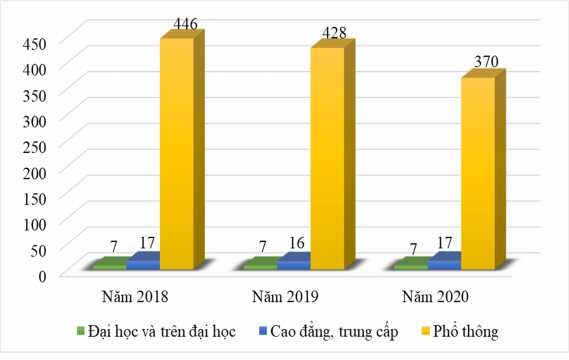
Chart 2.3: Labor structure by education level in the period 2018 - 2020
Through table 2.2 and chart 2.3, we can see that unskilled labor accounts for the highest proportion, while labor with college and university degrees accounts for a very low proportion. The proportion of unskilled labor in 2018, 2019, 2020 is 94.89%, 94.9% and 93.91% respectively. On average, in 3 years, the number of employees with college and university degrees of the company accounts for more than 5% of the total number of employees. This is a highly qualified labor force, most of whom work in leadership and management to develop business strategies for the company. On the other hand, because the industry mainly requires diligence and dexterity, it does not require much in terms of qualifications. The labor structure by level can meet the company's work requirements, depending on the capacity of the employees to arrange work reasonably. However, the company should improve labor skills to improve production and business, by organizing and training employees to improve skills and recruiting highly qualified employees.
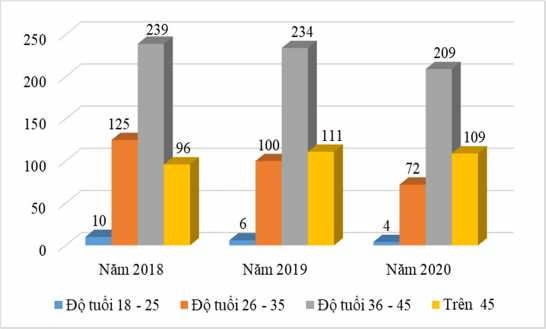
Chart 2.4: Labor structure by age in the period 2018 - 2020
Labor structure by age
Truong Giang Garment Joint Stock Company is a long-standing company with more than 30 years of experience in garment production and processing. Based on the labor structure by age in Table 2.2 and Chart 2.4, it can be seen that the number of employees aged 36 - 45 years old