
-------------------------------------------------- -------------------------------------------------- ------
RANDOM MATE EXERCISES: (FREE MATE, MIXED MATE)
Lesson 1: Which of the following populations is in genetic equilibrium?
A. QTI : 0.32 AA : 0.64 Aa : 0.04 aa. BQT II: 0.04 AA: 0.64 Aa: 0.32 aa. C. QT III: 0.64 AA: 0.04 Aa: 0.32 aa. D. QT IV: 0.64 AA: 0.32 Aa: 0.04
aa
Solution: Use the formula p 2 AA xq 2 aa = ( 2pqAa / 2 ) 2
Consider QTI: 0.32 x 0.04 = ( 0.64 /2 ) 2 0.0128 is not equal to 0.1024
Consider QTII: 0.04 x 0.32 = ( 0.64 /2 ) 2 0.0128 is not equal to 0.1024
Consider QTIII: 0.64 x 0.32 = ( 0.04 /2 ) 2 0.2048 is not equal to 0.0004
Consider QTIV: 0.64 x 0.04 = ( 0.32 /2 ) 2 0.0256 = 0.0256 => Choose D
Lesson 2. A population consists of 120 individuals with genotype AA, 400 individuals with genotype Aa, and 680 individuals with genotype aa. The frequencies of alleles A and a in the above population are respectively:
A.0.265 and 0.735 B.0.27 and 0.73 C.0.25 and 0.75
D.0.3 and 0.7
Solution: Total number of individuals in the population: 120 + 400 + 680 = 1200
Genotype frequency AA = 120 / 1200 = 0.1 : Genotype frequency Aa = 400 / 1200 =
0.33
Genotype frequency aa = 680 / 1200 = 0.57
So: pA = 0.1 + 0.33 / 2 = 0.265; qa = 0.57 + 0.33 / 2 = 0.735 choose A
Lesson 3 : Gene BB determines red flowers, Bb determines pink flowers, bb determines white flowers. A population of 300 red individuals, 400 pink individuals and 300 white individuals conducts random cross-pollination. If there is no influence of evolutionary factors, the genotype composition of the population in F1 is
A) 0.25 BB+0.50Bb+0.25bb=1. B) 0.36 BB+0.48Bb+0.16bb=1
C) 0.81 BB+0.18Bb+0.01bb=1. D) 0.49 BB+0.42Bb+0.09bb=1
Solution: - Total number of individuals in the population at P: 300 + 400 + 300 = 1000
Genotype frequency BB = 300 / 1000 = 0.3; Genotype frequency Bb = 400 / 1000 =
0.4
Genotype frequency bb = 300 / 1000 = 0.3 => pA = 0.3 + 0.4 / 2 = 0.5 ; qa = 0.3 + 0.4 / 2
= 0.5
- So the genotype composition of the population in F 1 is: 0.25 BB + 0.50Bb + 0.25bb = 1.
select A
Lesson 4 : Albinism is caused by a recessive gene located on an autosome. In district A, there are 106 people , 100 of whom have albinism. The probability of encountering a normal person with a heterozygous genotype is:
A)1.98. B)0.198. C)0.0198. D)0.00198
Solution: Let a be the recessive gene that causes albinism Genotype aa: person with albinism We have: q 2 aa = 100 / 1000,000 => qa = 1/100 = 0.01
Which: pA + qa = 1 => pA = 1- qa = 1 – 0.01 = 0.99
2pqAa = 2 x 0.01 x 0.99 = 0.0198 choose C
Lesson 5 : Knowing that allele A determines gray fur is completely dominant over allele a that determines white fur, the alleles are located on autosomes. A mouse population in the initial generation has 1020 homozygous gray fur mice, 510 mice with heterozygous genotype. When the population reaches equilibrium, there are 3600 individuals.
Using the above data answer questions a) and b) below:
a) The relative frequency of each allele is:
A. A: a = 1/6 : 5/6 B. A: a = 5/6 : 1/6 C. A: a = 4/6 : 2/6 DA: a = 0.7 : 0.3
b) Number of mice of each genotype when reaching equilibrium:
A. AA = 1000; Aa = 2500; aa = 100 B. AA = 1000; Aa = 100; aa = 2500
C. AA = 2500; Aa = 100; aa = 1000 D. AA = 2500; Aa = 1000; aa
= 100
Solution: a) The relative frequency of each allele is:
Total number of mice in the population in the starting generation: 1020 + 510 = 1530
=> Genotype frequency AA = 1020 / 1530 = 2 / 3 ; Genotype frequency Aa = 510 / 1530 = 1 / 3
So: The genotype composition in the starting generation is 2/3 AA + 1/3 Aa = 1. The relative frequency of each allele is:
pA = 2/3 + ( 1/3 : 2 ) = 5 / 6 ; qa = 0 + ( 1/3 : 2 ) = 1 / 6 choose B
b) Results of random mating between individuals in generation P:
P: (5/6A: 1/6 a) x (5/6A: 1/6 a) = 25AA: 10Aa: 1aa (or pennett grid) So: Number of mice of each genotype when reaching equilibrium:
Genotype AA = ( 25 : 36 ) 3600 = 2500 ; Genotype Aa = ( 10 : 36 ) 3600 = 1000
Genotype aa = (1:36) 3600 = 100 choose D
Lesson 6: A herd of cows has a balanced genotype composition, with the relative frequency of the allele that determines black fur being 0.6, and the relative frequency of the allele that determines yellow fur being 0.4. What is the phenotypic ratio of this herd of cows?
A) 84% black-haired cows, 16% yellow-haired cows. B) 16% black-haired cows, 84% yellow-haired cows. C) 75% black-haired cows, 25% yellow-haired cows. D) 99% black-haired cows, 1% yellow-haired cows. Solution: Frequency of population AA = 0.36 Frequency of population Aa = 2( 0.6 x 0.4 ) = 0.48; Frequency of population aa = 0.16
The phenotypic ratio of black-haired cows is: 0.36 + 0.48 = 0.84 = 84%
Phenotypic ratio of yellow-haired cows: 0.16 = 16% choose A
Lesson 7: A cross-pollinating population has a balanced genotype composition, with red flowers accounting for 84%. What is the genotype composition of the population (B determines red flowers completely dominant over b determines white flowers)?
A)0.16 BB + 0.48 Bb + 0.36 bb = 1. B)0.36 BB + 0.48 Bb + 0.16 bb = 1. C)0.25 BB + 0.50 Bb + 0.25 bb = 1. D)0.64 BB + 0.32 Bb + 0.04 bb = 1.
Solution: Red flower phenotype ratio: 84% => White flower phenotype ratio: 16% = 0.16
Genotype frequency bb = 0.16 => qb = 0.4
According to Hardy-Weinberg's law: pB + qb = 1 => pB = 1- qb= 1 - 0.4 = 0.6 Genotype frequency BB= 0.36; Genotype frequency Bb = 2( 0.6 x 0.4 ) = 0.48
The genotype composition of the population is: 0.36 BB + 0.48 Bb + 0.16 bb = 1. choose D
Lesson 8: The human population has blood type A accounting for 0.2125; blood type B accounting for 0.4725; blood type AB accounting for 0.2250; blood type O accounting for 0.090. What is the relative frequency of each allele?
A)p(I A ) = 0.25; q(I B ) = 0.45; r(i) = 0.30 B)p(I A ) = 0.35; q(I B ) = 0.35; r(i) = 0.30
C)p(I A ) = 0.15; q(I B ) = 0.55; r(i) = 0.30 D)p(I A ) = 0.45; q(I B ) = 0.25; r(i) = 0.30
Solution: Let p (I A ); q(I B ), r(i) be the relative frequencies of alleles I A , I B , I O, respectively.
We have: p + q + r = 1 ( * ) Blood O accounts for 0.090 => r(i) = 0.30 Ratio of blood A: I A I A + I A I O = 0.2125 => p2 + 2 pr = 0.2125
* p 2 + 2 pr + r 2 = ( p + r ) 2 = 0.2125 + 0.090 = 0, 3025 = ( 0.55 ) 2
( p + r ) 2 = ( 0.55 ) 2 => p + r = 0.55 => p = 0.55 – 0.30 = 0.25 From: ( * ) => q = 1 – ( p + r ) = 1 - ( 0.25 + 0.30 ) = 0.45
So: The relative frequency of each allele is: p(I A ) = 0.25; q(I B ) = 0.45; r(i) = 0.30
select A
Lesson 9: Given the genetic structure of a human population regarding blood groups A, B, AB, O:
0.25 I A I A + 0.20 I A I O + 0.09 I B I B + 0.12 I B I O + 0.30 I A I B + 0.04I O I O = 1
The relative frequency of each allele I A , I B , I O is:
A) 0.3 : 0.5 : 0.2 B) 0.5 : 0.2 : 0.3 C) 0.5 : 0.3 : 0.2 D) 0.2 : 0.5 : 0 ,3
Solution: Relative frequency of allele I A : 0.25 + ( 0.2 : 2 ) + ( 0.3 : 2 ) = 0.5 Relative frequency of allele I B : 0.05 + ( 0.12 : 2 ) + ( 0.3 : 2 ) = 0.5
Relative frequency of allele I O : 1 - ( 0.5 + 0.3 ) = 0.2 choose C
Lesson 10: In Vietnam, the percentage of blood type O is 48.3%, blood type A is 19.4%, blood type B is 27.9%, blood type AB is 4.4%. What is the relative frequency of I A ?
A)0.128. B)0.287. C)0.504. D)0.209.
Solution: Blood type O accounts for 0.483 => r(i) = 0.695
Blood ratio A: I A I A + I A I O = 0.194 => p 2 + 2 pr = 0.194
* p 2 + 2 pr + r 2 = ( p + r ) 2 = 0.194 + 0.483 = 0, 677 = ( 0.823 ) 2
( p + r ) 2 = ( 0.823 ) 2 => p + r = 0.823 => p = 0.823 – 0.695 = 0.128
select A
Lesson 11: About blood groups A, O, B of a human population in genetic equilibrium. Allele frequencies I A = 0.1, I B = 0.7, I o = 0.2. The frequencies of blood groups A, B, AB, O are respectively:
A. 0.3; 0.4; 0.26; 0.04 B. 0.05; 0.7 ; 0.21; 0.04
C. 0.05; 0.77; 0, 14; 0.04 D. 0.05; 0.81; 0.10; 0.04
Solution: Frequency of blood group O: r 2 = ( 0.2) 2 = 0.04
Frequency of blood group A: p 2 + 2pr = ( 0,1) 2 + 2(( 0,1 ) x ( 0,2 )) = 0,05 Frequency of blood group B: q 2 + 2qr = ( 0,7 ) 2 + 2(( 0,7 ) x ( 0,2 )) = 0,77 Frequency of blood group AB: 2pq = 2(( 0,1 ) x ( 0,7 )) = 0,14 choose C
Lesson 12: A population has 4 genes I, II, III. IV; the number of alleles of each gene is respectively: 2, 3, 4, 5. The number of genotypes obtained in the above random mating population is:
A. 2700 B. 370 C. 120
D. 81
Solution: Gene I has: ((2(2+1) : 2 ) 1 = 3 genotypes; Gene II has: ((3(3+1) : 2 ) 1 = 6 genotypes; Gene III has: ((4(4+1) : 2 ) 1 = 10 genotypes; Gene IV has: ((5(5+1) : 2 ) 1 = 15 genotypes
The total number of genotypes obtained in a random mating population is: 3 x 6 x 10 x 15 = 2700
Select A
Lesson 13: A population has the following structure P: 17.34%AA: 59.32%Aa: 23.34%aa. In the above population, after 3 generations of random mating, which of the following results does not appear in F 3 ?
A. Genotype ratio 22.09%AA : 49.82%Aa : 28.09%aa .
B. Relative frequency of A/a = 0.47/0.53 .
C. The rate of heterozygotes decreases and the rate of homozygotes increases compared to P.
D. The frequency of allele A decreases and the frequency of allele a increases compared to P.
Solution: We have: P: 17.34%AA: 59.32%Aa: 23.34%aa.
Frequency of allele A: ( pA) = 0.1734 + ( 0.5932 : 2 ) = 0.47 Frequency of allele a ( qa ) = 0.2334 + ( 0.5932 : 2 ) = 0.53
Through 1 generation of random mating: ( 0.47) 2 AA : 2 x ( 0.47) x ( 0.53 ) : ( 0.53 ) 2 aa
Genotype ratio 22.09%AA : 49.82%Aa : 28.09%aa. After 3 generations of random mating (F 3 ) the genotype ratio is still 22.09%AA : 49.82%Aa :
28.09%aa.
Thus: answers A, B, C are all correct the frequency of allele A decreases and the frequency of allele a increases compared to P
not appear in F 3 . Select D
Lesson 14: In humans, the gene that determines eye color has 2 alleles (A, a), the gene that determines hair type has 2 alleles (B,
b) The gene that determines blood type has 3 alleles (I A . I B , I O). The genes are located on different chromosomes. The number of different genotypes that can be created from the above 3 genes in the human population is: A.54 B.24 C.10 D.64
Solution: The gene that determines eye color has: (2 (2+1) : 2) 1 = 3 genotypes; the gene that determines hair type has: (2 (2+1) : 2) 1 = 3 genotypes; the gene that determines blood type has: (3 (3+1) : 2) 1 = 6 genotypes.
The number of different genotypes in a human population is: 3 x 3 x 6 = 54 Choose A Exercise 15: In an animal population, consider a gene with 3 alleles located on the autosome and a gene with 2 alleles located on the sex chromosome with no corresponding allele on the Y. This population has the maximum number of genotypes for the above 2 genes: A.30 B.60 C. 18
D.32
Solution: 1 gene has 3 alleles located on an autosome: (3(3+1) : 2 ) 1 = 6 types of genotypes.
1 gene has 2 alleles located on the sex chromosome with no corresponding allele on the Y: there are 5 types of genotypes
- The number of genotypes on Y is 2: X A Y, X a Y
- The number of genotypes on X is 3: X A X A , X a X a , X A X a
So: This population has the maximum number of genotypes for the above 2 genes: 6 x 5 = 30 Choose A
Lesson 16: In humans, gene A determines normal color vision, allele a determines red-green color blindness; gene B determines normal blood clotting, allele b determines hemophilia. These genes are located on the X sex chromosome and have no corresponding allele on the Y. Gene D determines right-handedness, allele d determines left-handedness and is located on the autosome. The maximum number of genotypes for the above 3 loci in the human population is:
A.42 B.36 C.39 D.27
Solution: The genes (AaBb) located on the X sex chromosome have no corresponding allele on the Y: there are 14 genotypes.
- The number of genotypes on Y is 4: X A Y, X a Y, X A Y, X a Y
B bb B
- The number of genotypes on X is 10: X A X A , X a X a , X A X a
X A X A , X a
X a , X A
BBBB
X
a
b,
BB, B b B bb
X A X A , X a
X a , X A X a
X A X a
bbbb B b, b B
Genes located on autosomes (D and d) have: (2(2+1) : 2 ) 1 = 3 genotypes
So: The human population has the maximum number of genotypes for the above 3 loci: 14 x 3 = 42 Choose A
Lesson 17: An initial population has the genetic structure: 0.7AA + 0.3Aa. After one generation of random mating, 4000 individuals are obtained in the offspring. Theoretically, the number of individuals with heterozygous genotypes is
The offspring are: A.90 B.2890 C.1020 D.7680
Solution: P. 0.7AA + 0.3Aa => pA = 0.7 + (0.3 / 2 ) = 0.85 ; qa = 0 + (0.3 / 2 ) = 0.15 F 1 .( 0.85 ) 2 AA + ( 2 x 0.85 x 0.15 ) Aa + ( 0.15 ) 2 aa = 1
F 1 . 0.7225 AA + 0.255 Aa + 0.0225 aa = 1.
So: The number of individuals with heterozygous genotype in the offspring (F1 ) is: 0.255 x 4000 = 1020 Choose C Exercise 18: Suppose a population in genetic equilibrium has 10,000 individuals, of which 100 individuals have homozygous recessive genotype (aa), then the number of individuals with heterozygous genotype (Aa) in the population will be:
A. 9900 B. 900 C. 8100 D. 1800
Solution: We have: q 2 aa = 100 / 10000 = 0.01 => qa = 0.1
The population is in genetic equilibrium => pA = 1 - 0.1 = 0.9 ; 2pqAa = 2 x 0.1 x 0.9 = 0.18
So: The number of individuals with heterozygous genotype (Aa) is: 0.18 x 10000 = 1800 Choose D
Lesson 19: In chickens, A determines black feathers incompletely dominant over a determines white feathers, genotype Aa determines spotted feathers. A population of jungle fowl in genetic equilibrium has 10,000 individuals, of which 4,800 are spotted feathers, the number of black feathers and white feathers in the population are respectively
A.3600, 1600. B.400, 4800. C.900, 4300.
D.4900, 300.
Solution: Genotype ratio of spotted chicken (Aa) = 4800 / 10000 = 0.48
Let p: frequency of allele A (black fur), q: frequency of allele a (white fur)
The jungle fowl population is in genetic equilibrium, according to the Hardy-Weinberg law: ( p + q ) = 1 and 2pq = 0.48 p + q = 1 (1) and pq = 0.24 (2)
According to Viet's law (1), (2) we have the equation: X 2 - X + 0.24 = 0. Solving we get: x 1 = 0.6; x 2 = 0.4 ( x 1 is p; x 2 is q ).
Therefore: Genotype frequency AA (black fur): (0.6) 2 = 0.36 Genotype frequency aa (white fur): (0.4) 2 = 0.16
So: Number of black feathered chickens: 0.36 x 10000 = 3600
Number of white feathered chickens: 0.16 x 10000 = 1600 Choose A
Lesson 20: A mating population is in genetic equilibrium. Considering a gene with 2 alleles (A and a), we see that the number of homozygous dominant individuals is 9 times greater than the number of homozygous recessive individuals. The percentage of heterozygous individuals in this population is:
A.37.5 % B.18.75 % C.3.75 % D.56.25 %
Solution : Let p 2 be the frequency of homozygous dominant genotype, q 2 be the frequency of homozygous recessive genotype.
We have: p 2 = 9 q 2 or p = 3q
Population in genetic equilibrium: p + q = 1
So: 3q + q = 1 => q = 1 / 4 = 0.25 and p = 3 x 0.25 = 0.75
So: The percentage of heterozygous individuals in this population is: 2pq = 2 x 0.25 x 0.75 = 0.375 = 37.5 % Choose A
Lesson 21: In a balanced population, consider 2 pairs of alleles AaBb on 2 different pairs of homologous chromosomes. Allele A has a relative frequency of 0.4 and Allele B has a relative frequency of 0.6. The frequency of each type of gamete in this population is:
A. AB = 0.24Ab = 0.36 | aB = 0.16 | ab = 0.24 | |
B. AB = 0.24 | Ab = 0.16 | aB = 0.36 | ab = 0.24 |
Maybe you are interested!
-

 Lesson plan for developing students' capacity in Technology subject for grades 11-20
 -
 Identify Rating Levels and Rating Scales
zt2i3t4l5ee
zt2a3gstourism,quan lan,quang ninh,ecology,ecotourism,minh chau,van don,geography,geographical basis,tourism development,science
zt2a3ge
zc2o3n4t5e6n7ts
of the islanders. Therefore, this indicator will be divided into two sub-indicators:
a1. Natural tourism attractiveness a2. Cultural tourism attractiveness
b. Tourist capacity
The two island communes in Quan Lan have different capacities to receive tourists. Minh Chau Commune is home to many standard hotels and resorts, attracting high-income domestic and international tourists. Meanwhile, Quan Lan Commune has many motels mainly built and operated by local people, so the scale and quality are not high, and will be suitable for ordinary tourists such as students.
c. Time of exploitation of Quan Lan Island Commune:
Quan Lan tourism is seasonal due to weather and climate conditions and festivals only take place on certain days of the year, specifically in spring. In Quan Lan commune, the period from April to June and from September to November is considered the best time to visit Quan Lan because the cultural tourism activities are mainly associated with festivals taking place during this time.
Minh Chau island commune:
Tourism exploitation time is all year round, because this is a place with a number of tourist attractions with diverse ecosystems such as Bai Tu Long National Park Research Center, Tram forest, Turtle Laying Beach, so besides coming to the beach for tourism and vacation in the summer, Minh Chau will attract research groups to come for tourism combined with research at other times of the year.
d. Sustainability
The sustainability of ecotourism sites in Quan Lan and Minh Chau communes depends on the sensitivity of the ecosystems to climate changes.
landscape. In general, these tourist destinations have a fairly high level of sustainability, because they are natural ecosystems, planned and protected. However, if a large number of tourists gather at certain times, it can exceed the carrying capacity and affect the sustainability of the environment (polluted beaches, damaged trees, animals moving away from their habitats, etc.), then the sustainability of the above ecosystems (natural ecosystems, human ecosystems) will also be affected and become less sustainable.
e. Location and accessibility
Both island communes have ports to take tourists to visit from Van Don wharf:
- Quan Lan – Van Don traffic route:
Phuc Thinh – Viet Anh high-speed boat and Quang Minh high-speed boat, depart at 8am and 2pm from Van Don to Quan Lan, and at 7am and 1pm from Quan Lan to Van Don. There are also wooden boats departing at 7am and 1pm.
- Van Don - Minh Chau traffic route:
Chung Huong high-speed train, Minh Chau train, morning 7:30 and afternoon 13:30 from Van Don to Minh Chau, morning 6:30 and afternoon 13:00 from Minh Chau to Van Don.
f. Infrastructure
Despite receiving investment attention, the issue of infrastructure and technical facilities for tourism on Quan Lan Island is still an issue that needs to be resolved because it has a direct impact on the implementation of ecotourism activities. The minimum conditions for serving tourists such as accommodation, electricity, water, communication, especially medical services, and security work need to be given top priority. Ecotourism spots in Minh Chau commune are assessed to have better infrastructure and technical facilities for tourism because there are quite complete and synchronous conditions for serving tourists, meeting many needs of domestic and foreign tourists.
3.2.1.4. Determine assessment levels and assessment scales
Corresponding to the levels of each criterion, the index is the score of those levels in the order of 4, 3, 2, 1 decreasing according to the standard of each level: very attractive (4), attractive (3), average (2), less attractive (1).
3.2.1.5. Determining the coefficients of the criteria
For the assessment of DLST in the two communes of Quan Lan and Minh Chau islands, the students added evaluation coefficients to show the importance of the criteria and indicators as follows:
Coefficient 3 with criteria: Attractiveness, Exploitation time. These are the 2 most important criteria for attracting tourists to tourism in general and eco-tourism in particular, so they have the highest coefficient.
Coefficient 2 with criteria: Capacity, Infrastructure, Location and accessibility . Because the assessment area is an island commune of Van Don district, the above criteria are selected by the author with appropriate coefficients at the average level.
Coefficient 1 with criteria: Sustainability. Quan Lan has natural and human-made ecotourism sites, with high biodiversity and little impact from local human factors. Most of the ecotourism sites are still wild, so they are highly sustainable.
3.2.1.6. Results of DLST assessment on Quan Lan island
a. Assessment of the potential for natural tourism development
For Minh Chau commune:
+ Natural tourism attractiveness is determined to be very attractive (4 points) and the most important coefficient (coefficient 3), so the score of the Attractiveness criterion is 4 x 3 = 12.
+ Capacity is determined as average (2 points) and the coefficient is quite important (coefficient 2), then the score of Capacity criterion is 2 x 2 = 4.
+ Exploitation time is long (4 points), the most important coefficient (coefficient 3) so the score of the Exploitation time criterion is 4 x 3 = 12.
+ Sustainability is determined as sustainable (4 points), the important coefficient is the average coefficient (coefficient 1), so the score of the Sustainability criterion is 4 x 1 = 4 points
+ Location and accessibility are determined to be quite favorable (2 points), the coefficient is quite important (coefficient 2), the criterion score is 2 x 2 = 4 points.
+ Infrastructure is assessed as good (3 points), the coefficient is quite important (coefficient 2), then the score of the Infrastructure criterion is 3 x 2 = 6 points.
The total score for evaluating DLST in Minh Chau commune according to 6 evaluation criteria is determined as: 12 + 4 + 12 + 4 + 4 + 6 = 42 points
Similar assessment for Quan Lan commune, we have the following table:
Table 3.3: Assessment of the potential for natural ecotourism development in Quan Lan and Minh Chau communes
Attractiveness of self-tourismof course
Capacity
Mining time
Sustainability
Location and accessibility
Infrastructure
Result
Point
DarkMulti
Point
DarkMulti
Point
DarkMulti
Point
DarkMulti
Point
DarkMulti
Point
DarkMulti
CommuneMinh Chau
12
12
4
8
12
12
4
4
4
8
6
8
42/52
Quan CommuneLan
6
12
6
8
9
12
4
4
4
8
4
8
33/52
b. Assessment of the potential for humanistic tourism development
For Quan Lan commune:
+ The attractiveness of human tourism is determined to be very attractive (4 points) and the most important coefficient (coefficient 3), so the score of the Attractiveness criterion is 4 x 3 = 12.
+ Capacity is determined to be large (3 points) and the coefficient is quite important (coefficient 2), then the score of the Capacity criterion is 3 x 2 = 6.
+ Mining time is average (3 points), the most important coefficient (coefficient 3) so the score of the Mining time criterion is 3 x 3 = 9.
+ Sustainability is determined as sustainable (4 points), the important coefficient is the average coefficient (coefficient 1), so the score of the Sustainability criterion is 4 x 1 = 4 points.
+ Location and accessibility are determined to be quite favorable (2 points), the coefficient is quite important (coefficient 2), the criterion score is 2 x 2 = 4 points.
+ Infrastructure is rated as average (2 points), the coefficient is quite important (coefficient 2), then the score of the Infrastructure criterion is 2 x 2 = 4 points.
The total score for evaluating DLST in Quan Lan commune according to 6 evaluation criteria is determined as: 12 + 6 + 6 + 4 + 4 + 4 = 36 points.
Similar assessment with Minh Chau commune we have the following table:
Table 3.4: Assessment of the potential for developing humanistic eco-tourism in Quan Lan and Minh Chau communes
Attractiveness of human tourismliterature
Capacity
Mining time
Sustainability
Location and accessibility
Infrastructure
Result
Point
DarkMulti
Point
DarkMulti
Point
DarkMulti
Point
DarkMulti
Point
DarkMulti
Point
DarkMulti
Quan CommuneLan
12
12
6
8
9
12
4
4
4
8
4
8
39/52
Minh CommuneChau
6
12
4
8
12
12
4
4
4
8
6
8
36/52
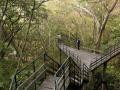
Basically, both Minh Chau and Quan Lan localities have quite favorable conditions for developing ecotourism. However, Quan Lan commune has more advantages to develop ecotourism in a humanistic direction, because this is an area with many famous historical relics such as Quan Lan Communal House, Quan Lan Pagoda, Temple worshiping the hero Tran Khanh Du, ... along with local festivals held annually such as the wind praying ceremony (March 15), Quan Lan festival (June 10-19); due to its location near the port and long exploitation time, the beaches in Quan Lan commune (especially Quan Lan beach) are no longer hygienic and clean to ensure the needs of tourists coming to relax and swim; this is also an area with many beautiful landscapes such as Got Beo wind pass, Ong Phong head, Voi Voi cave, but the ability to access these places is still very limited (dirt hill road, lots of gravel and rocks), especially during rainy and windy times; In addition, other natural resources such as mangrove forests and sea worms have not been really exploited for tourism purposes and ecotourism development. On the contrary, Minh Chau commune has more advantages in developing ecotourism in the direction of natural tourism, this is an area with diverse ecosystems such as at Rua De Beach, Bai Tu Long National Park Conservation Center...; Minh Chau beach is highly appreciated for its natural beauty and cleanliness, ranked in the top ten most beautiful beaches in Vietnam; Minh Chau commune is also home to Tram forest with a large area and a purity of up to 90%, suitable for building bridges through the forest (a very effective type of natural ecotourism currently applied by many countries) for tourists to sightsee, as well as for the purpose of studying and researching.
Figure 3.1: Thenmala Forest Bridge (India) Source: https://www.thenmalaecotourism.com/(August 21, 2019)
3.2.2. Using SWOT matrix to evaluate Quan Lan island tourism
General assessment of current tourism activities of Quan Lan island is shown through the following SWOT matrix:
Table 3.5: SWOT matrix evaluating tourism activities on Quan Lan island
Internal agent
Strengths- There is a lot of potential for tourism development, especially natural ecotourism and humanistic ecotourism.- The unskilled labor force is relatively abundant.- resource environmentunpolluted, still
Weaknesses- Poorly developed infrastructure, especially traffic routes to tourist destinations on the island.- The team of professional staff is still weak.- Tourism products in general
quite wild, originalintact
general and DLST in particularalone is monotonous.
External agents
Opportunity- Tourism is a key industry in the socio-economic development strategy of the province and Van Don economic zone.- Quan Lan was selected as a pilot area for eco-tourism development within the framework of the green growth project between Quang Ninh province and the Japanese organization JICA.- The flow of tourists and especially ecotourism in the world tends toincreasing
Challenge- Weather and climate change abnormally.- Competition in tourism products is increasingly fierce, especially with other localities in the province such as Ha Long, Mong Cai...- Awareness of tourists, especially domestic tourists, about ecotourism and nature conservation is not high.
Through summary analysis using SWOT matrix we see that:
To exploit strengths and take advantage of opportunities, it is necessary to:
- Diversify products and service types (build more tourism routes aimed at specific needs of tourists: experiential tourism immersed in nature, spiritual cultural tourism...)
- Effective exploitation of resources and differentiated products (natural resources and human resources)
div.maincontent .p { color: black; font-family:"Times New Roman", serif; font-style: normal; font-weight: normal; text-decoration: none; font-size: 14pt; margin:0pt; } div.maincontent p { color: black; font-family:"Times New Roman", serif; font-style: normal; font-weight: normal; text-decoration: none; font-size: 14pt; margin:0pt; } div.maincontent .s1 { color: black; font-family:"Times New Roman", serif; font-style: normal; font-weight: normal; text-decoration: none; font-size: 13pt; } div.maincontent .s2 { color: black; font-family:"Times New Roman", serif; font-style: normal; font-weight: normal; text-decoration: none; font-size: 13pt; } div.maincontent .s3 { color: #0D0D0D; font-family:"Times New Roman", serif; font-style: normal; font-weight: bold; text-decoration: none; font-size: 14pt; } div.maincontent .s4 { color: black; font-family:"Times New Roman", serif; font-style: italic; font-weight: normal; text-decoration: none; font-size: 14pt; } div.maincontent .s5 { color: black; font-family:"Times New Roman", serif; font-style: italic; font-weight: bold; text-decoration: none; font-size: 14pt; } div.maincontent .s6 { color: black; font-family:"Times New Roman", serif; font-style: italic; font-weight: normal; text-decoration: none; font-size: 14pt; vertical-align: -3pt; } div.maincontent .s7 { color: black; font-family:"Times New Roman", serif; font-style: italic; font-weight: normal; text-decoration: none; font-size: 14pt; vertical-align: -2pt; } div.maincontent .s8 { color: black; font-family:"Times New Roman", serif; font-style: italic; font-weight: normal; text-decoration: none; font-size: 14pt; vertical-align: -1pt; } div.maincontent .s9 { color: black; font-family:"Times New Roman", serif; font-style: normal; font-weight: normal; text-decoration: none; font-size: 14pt; } div.maincontent .s10 { color: black; font-family:"Times New Roman", serif; font-style: normal; font-weight: bold; text-decoration: none; font-size: 14pt; } div.maincontent .s11 { color: black; font-family:"Times New Roman", serif; font-style: normal; font-weight: normal; text-decoration: none; font-size: 14pt; } div.maincontent .s12 { color: black; font-family:Symbol, serif; font-style: normal; font-weight: normal; text-decoration: none; font-size: 14pt; } div.maincontent .s13 { color: black; font-family:Wingdings; font-style: normal; font-weight: normal; text-decoration: none; font-size: 14pt; } div.maincontent .s14 { color: black; font-family:"Times New Roman", serif; font-style: normal; font-weight: normal; text-decoration: none; font-size: 9pt; vertical-align: 5pt; } div.maincontent .s15 { color: black; font-family:"Times New Roman", serif; font-style: normal; font-weight: normal; text-decoration: none; font-size: 9pt; vertical-align: 5pt; } div.maincontent .s16 { color: black; font-family:Cambria, serif; font-style: italic; font-weight: normal; text-decoration: none; font-size: 14pt; } div.maincontent .s17 { color: #080808; font-family:"Times New Roman", serif; font-style: normal; font-weight: bold; text-decoration: none; font-size: 14pt; } div.maincontent .s18 { color: #080808; font-family:"Times New Roman", serif; font-style: normal; font-weight: normal; text-decoration: none; font-size: 14pt; } div.maincontent .s19 { color: black; font-family:"Times New Roman", serif; font-style: normal; font-weight: normal; text-decoration: none; font-size: 11pt; } div.maincontent .s20 { color: black; font-family:"Times New Roman", serif; font-style: normal; font-weight: normal; text-decoration: none; font-size: 10pt; } div.maincontent .s21 { color: black; font-family:"Times New Roman", serif; font-style: normal; font-weight: bold; text-decoration: none; font-size: 11pt; } div.maincontent .s22 { color: black; font-family:"Times New Roman", serif; font-style: normal; font-weight: normal; text-decoration: none; font-size: 11pt; } div.maincontent .s23 { color: black; font-family:"Times New Roman", serif; font-style: italic; font-weight: normal; text-decoration: none; font-size: 14pt; } div.maincontent .s24 { color: #212121; font-family:"Times New Roman", serif; font-style: normal; font-weight: normal; tex
Identify Rating Levels and Rating Scales
zt2i3t4l5ee
zt2a3gstourism,quan lan,quang ninh,ecology,ecotourism,minh chau,van don,geography,geographical basis,tourism development,science
zt2a3ge
zc2o3n4t5e6n7ts
of the islanders. Therefore, this indicator will be divided into two sub-indicators:
a1. Natural tourism attractiveness a2. Cultural tourism attractiveness
b. Tourist capacity
The two island communes in Quan Lan have different capacities to receive tourists. Minh Chau Commune is home to many standard hotels and resorts, attracting high-income domestic and international tourists. Meanwhile, Quan Lan Commune has many motels mainly built and operated by local people, so the scale and quality are not high, and will be suitable for ordinary tourists such as students.
c. Time of exploitation of Quan Lan Island Commune:
Quan Lan tourism is seasonal due to weather and climate conditions and festivals only take place on certain days of the year, specifically in spring. In Quan Lan commune, the period from April to June and from September to November is considered the best time to visit Quan Lan because the cultural tourism activities are mainly associated with festivals taking place during this time.
Minh Chau island commune:
Tourism exploitation time is all year round, because this is a place with a number of tourist attractions with diverse ecosystems such as Bai Tu Long National Park Research Center, Tram forest, Turtle Laying Beach, so besides coming to the beach for tourism and vacation in the summer, Minh Chau will attract research groups to come for tourism combined with research at other times of the year.
d. Sustainability
The sustainability of ecotourism sites in Quan Lan and Minh Chau communes depends on the sensitivity of the ecosystems to climate changes.
landscape. In general, these tourist destinations have a fairly high level of sustainability, because they are natural ecosystems, planned and protected. However, if a large number of tourists gather at certain times, it can exceed the carrying capacity and affect the sustainability of the environment (polluted beaches, damaged trees, animals moving away from their habitats, etc.), then the sustainability of the above ecosystems (natural ecosystems, human ecosystems) will also be affected and become less sustainable.
e. Location and accessibility
Both island communes have ports to take tourists to visit from Van Don wharf:
- Quan Lan – Van Don traffic route:
Phuc Thinh – Viet Anh high-speed boat and Quang Minh high-speed boat, depart at 8am and 2pm from Van Don to Quan Lan, and at 7am and 1pm from Quan Lan to Van Don. There are also wooden boats departing at 7am and 1pm.
- Van Don - Minh Chau traffic route:
Chung Huong high-speed train, Minh Chau train, morning 7:30 and afternoon 13:30 from Van Don to Minh Chau, morning 6:30 and afternoon 13:00 from Minh Chau to Van Don.
f. Infrastructure
Despite receiving investment attention, the issue of infrastructure and technical facilities for tourism on Quan Lan Island is still an issue that needs to be resolved because it has a direct impact on the implementation of ecotourism activities. The minimum conditions for serving tourists such as accommodation, electricity, water, communication, especially medical services, and security work need to be given top priority. Ecotourism spots in Minh Chau commune are assessed to have better infrastructure and technical facilities for tourism because there are quite complete and synchronous conditions for serving tourists, meeting many needs of domestic and foreign tourists.
3.2.1.4. Determine assessment levels and assessment scales
Corresponding to the levels of each criterion, the index is the score of those levels in the order of 4, 3, 2, 1 decreasing according to the standard of each level: very attractive (4), attractive (3), average (2), less attractive (1).
3.2.1.5. Determining the coefficients of the criteria
For the assessment of DLST in the two communes of Quan Lan and Minh Chau islands, the students added evaluation coefficients to show the importance of the criteria and indicators as follows:
Coefficient 3 with criteria: Attractiveness, Exploitation time. These are the 2 most important criteria for attracting tourists to tourism in general and eco-tourism in particular, so they have the highest coefficient.
Coefficient 2 with criteria: Capacity, Infrastructure, Location and accessibility . Because the assessment area is an island commune of Van Don district, the above criteria are selected by the author with appropriate coefficients at the average level.
Coefficient 1 with criteria: Sustainability. Quan Lan has natural and human-made ecotourism sites, with high biodiversity and little impact from local human factors. Most of the ecotourism sites are still wild, so they are highly sustainable.
3.2.1.6. Results of DLST assessment on Quan Lan island
a. Assessment of the potential for natural tourism development
For Minh Chau commune:
+ Natural tourism attractiveness is determined to be very attractive (4 points) and the most important coefficient (coefficient 3), so the score of the Attractiveness criterion is 4 x 3 = 12.
+ Capacity is determined as average (2 points) and the coefficient is quite important (coefficient 2), then the score of Capacity criterion is 2 x 2 = 4.
+ Exploitation time is long (4 points), the most important coefficient (coefficient 3) so the score of the Exploitation time criterion is 4 x 3 = 12.
+ Sustainability is determined as sustainable (4 points), the important coefficient is the average coefficient (coefficient 1), so the score of the Sustainability criterion is 4 x 1 = 4 points
+ Location and accessibility are determined to be quite favorable (2 points), the coefficient is quite important (coefficient 2), the criterion score is 2 x 2 = 4 points.
+ Infrastructure is assessed as good (3 points), the coefficient is quite important (coefficient 2), then the score of the Infrastructure criterion is 3 x 2 = 6 points.
The total score for evaluating DLST in Minh Chau commune according to 6 evaluation criteria is determined as: 12 + 4 + 12 + 4 + 4 + 6 = 42 points
Similar assessment for Quan Lan commune, we have the following table:
Table 3.3: Assessment of the potential for natural ecotourism development in Quan Lan and Minh Chau communes
Attractiveness of self-tourismof course
Capacity
Mining time
Sustainability
Location and accessibility
Infrastructure
Result
Point
DarkMulti
Point
DarkMulti
Point
DarkMulti
Point
DarkMulti
Point
DarkMulti
Point
DarkMulti
CommuneMinh Chau
12
12
4
8
12
12
4
4
4
8
6
8
42/52
Quan CommuneLan
6
12
6
8
9
12
4
4
4
8
4
8
33/52
b. Assessment of the potential for humanistic tourism development
For Quan Lan commune:
+ The attractiveness of human tourism is determined to be very attractive (4 points) and the most important coefficient (coefficient 3), so the score of the Attractiveness criterion is 4 x 3 = 12.
+ Capacity is determined to be large (3 points) and the coefficient is quite important (coefficient 2), then the score of the Capacity criterion is 3 x 2 = 6.
+ Mining time is average (3 points), the most important coefficient (coefficient 3) so the score of the Mining time criterion is 3 x 3 = 9.
+ Sustainability is determined as sustainable (4 points), the important coefficient is the average coefficient (coefficient 1), so the score of the Sustainability criterion is 4 x 1 = 4 points.
+ Location and accessibility are determined to be quite favorable (2 points), the coefficient is quite important (coefficient 2), the criterion score is 2 x 2 = 4 points.
+ Infrastructure is rated as average (2 points), the coefficient is quite important (coefficient 2), then the score of the Infrastructure criterion is 2 x 2 = 4 points.
The total score for evaluating DLST in Quan Lan commune according to 6 evaluation criteria is determined as: 12 + 6 + 6 + 4 + 4 + 4 = 36 points.
Similar assessment with Minh Chau commune we have the following table:
Table 3.4: Assessment of the potential for developing humanistic eco-tourism in Quan Lan and Minh Chau communes
Attractiveness of human tourismliterature
Capacity
Mining time
Sustainability
Location and accessibility
Infrastructure
Result
Point
DarkMulti
Point
DarkMulti
Point
DarkMulti
Point
DarkMulti
Point
DarkMulti
Point
DarkMulti
Quan CommuneLan
12
12
6
8
9
12
4
4
4
8
4
8
39/52
Minh CommuneChau
6
12
4
8
12
12
4
4
4
8
6
8
36/52
Basically, both Minh Chau and Quan Lan localities have quite favorable conditions for developing ecotourism. However, Quan Lan commune has more advantages to develop ecotourism in a humanistic direction, because this is an area with many famous historical relics such as Quan Lan Communal House, Quan Lan Pagoda, Temple worshiping the hero Tran Khanh Du, ... along with local festivals held annually such as the wind praying ceremony (March 15), Quan Lan festival (June 10-19); due to its location near the port and long exploitation time, the beaches in Quan Lan commune (especially Quan Lan beach) are no longer hygienic and clean to ensure the needs of tourists coming to relax and swim; this is also an area with many beautiful landscapes such as Got Beo wind pass, Ong Phong head, Voi Voi cave, but the ability to access these places is still very limited (dirt hill road, lots of gravel and rocks), especially during rainy and windy times; In addition, other natural resources such as mangrove forests and sea worms have not been really exploited for tourism purposes and ecotourism development. On the contrary, Minh Chau commune has more advantages in developing ecotourism in the direction of natural tourism, this is an area with diverse ecosystems such as at Rua De Beach, Bai Tu Long National Park Conservation Center...; Minh Chau beach is highly appreciated for its natural beauty and cleanliness, ranked in the top ten most beautiful beaches in Vietnam; Minh Chau commune is also home to Tram forest with a large area and a purity of up to 90%, suitable for building bridges through the forest (a very effective type of natural ecotourism currently applied by many countries) for tourists to sightsee, as well as for the purpose of studying and researching.
Figure 3.1: Thenmala Forest Bridge (India) Source: https://www.thenmalaecotourism.com/(August 21, 2019)
3.2.2. Using SWOT matrix to evaluate Quan Lan island tourism
General assessment of current tourism activities of Quan Lan island is shown through the following SWOT matrix:
Table 3.5: SWOT matrix evaluating tourism activities on Quan Lan island
Internal agent
Strengths- There is a lot of potential for tourism development, especially natural ecotourism and humanistic ecotourism.- The unskilled labor force is relatively abundant.- resource environmentunpolluted, still
Weaknesses- Poorly developed infrastructure, especially traffic routes to tourist destinations on the island.- The team of professional staff is still weak.- Tourism products in general
quite wild, originalintact
general and DLST in particularalone is monotonous.
External agents
Opportunity- Tourism is a key industry in the socio-economic development strategy of the province and Van Don economic zone.- Quan Lan was selected as a pilot area for eco-tourism development within the framework of the green growth project between Quang Ninh province and the Japanese organization JICA.- The flow of tourists and especially ecotourism in the world tends toincreasing
Challenge- Weather and climate change abnormally.- Competition in tourism products is increasingly fierce, especially with other localities in the province such as Ha Long, Mong Cai...- Awareness of tourists, especially domestic tourists, about ecotourism and nature conservation is not high.
Through summary analysis using SWOT matrix we see that:
To exploit strengths and take advantage of opportunities, it is necessary to:
- Diversify products and service types (build more tourism routes aimed at specific needs of tourists: experiential tourism immersed in nature, spiritual cultural tourism...)
- Effective exploitation of resources and differentiated products (natural resources and human resources)
div.maincontent .p { color: black; font-family:"Times New Roman", serif; font-style: normal; font-weight: normal; text-decoration: none; font-size: 14pt; margin:0pt; } div.maincontent p { color: black; font-family:"Times New Roman", serif; font-style: normal; font-weight: normal; text-decoration: none; font-size: 14pt; margin:0pt; } div.maincontent .s1 { color: black; font-family:"Times New Roman", serif; font-style: normal; font-weight: normal; text-decoration: none; font-size: 13pt; } div.maincontent .s2 { color: black; font-family:"Times New Roman", serif; font-style: normal; font-weight: normal; text-decoration: none; font-size: 13pt; } div.maincontent .s3 { color: #0D0D0D; font-family:"Times New Roman", serif; font-style: normal; font-weight: bold; text-decoration: none; font-size: 14pt; } div.maincontent .s4 { color: black; font-family:"Times New Roman", serif; font-style: italic; font-weight: normal; text-decoration: none; font-size: 14pt; } div.maincontent .s5 { color: black; font-family:"Times New Roman", serif; font-style: italic; font-weight: bold; text-decoration: none; font-size: 14pt; } div.maincontent .s6 { color: black; font-family:"Times New Roman", serif; font-style: italic; font-weight: normal; text-decoration: none; font-size: 14pt; vertical-align: -3pt; } div.maincontent .s7 { color: black; font-family:"Times New Roman", serif; font-style: italic; font-weight: normal; text-decoration: none; font-size: 14pt; vertical-align: -2pt; } div.maincontent .s8 { color: black; font-family:"Times New Roman", serif; font-style: italic; font-weight: normal; text-decoration: none; font-size: 14pt; vertical-align: -1pt; } div.maincontent .s9 { color: black; font-family:"Times New Roman", serif; font-style: normal; font-weight: normal; text-decoration: none; font-size: 14pt; } div.maincontent .s10 { color: black; font-family:"Times New Roman", serif; font-style: normal; font-weight: bold; text-decoration: none; font-size: 14pt; } div.maincontent .s11 { color: black; font-family:"Times New Roman", serif; font-style: normal; font-weight: normal; text-decoration: none; font-size: 14pt; } div.maincontent .s12 { color: black; font-family:Symbol, serif; font-style: normal; font-weight: normal; text-decoration: none; font-size: 14pt; } div.maincontent .s13 { color: black; font-family:Wingdings; font-style: normal; font-weight: normal; text-decoration: none; font-size: 14pt; } div.maincontent .s14 { color: black; font-family:"Times New Roman", serif; font-style: normal; font-weight: normal; text-decoration: none; font-size: 9pt; vertical-align: 5pt; } div.maincontent .s15 { color: black; font-family:"Times New Roman", serif; font-style: normal; font-weight: normal; text-decoration: none; font-size: 9pt; vertical-align: 5pt; } div.maincontent .s16 { color: black; font-family:Cambria, serif; font-style: italic; font-weight: normal; text-decoration: none; font-size: 14pt; } div.maincontent .s17 { color: #080808; font-family:"Times New Roman", serif; font-style: normal; font-weight: bold; text-decoration: none; font-size: 14pt; } div.maincontent .s18 { color: #080808; font-family:"Times New Roman", serif; font-style: normal; font-weight: normal; text-decoration: none; font-size: 14pt; } div.maincontent .s19 { color: black; font-family:"Times New Roman", serif; font-style: normal; font-weight: normal; text-decoration: none; font-size: 11pt; } div.maincontent .s20 { color: black; font-family:"Times New Roman", serif; font-style: normal; font-weight: normal; text-decoration: none; font-size: 10pt; } div.maincontent .s21 { color: black; font-family:"Times New Roman", serif; font-style: normal; font-weight: bold; text-decoration: none; font-size: 11pt; } div.maincontent .s22 { color: black; font-family:"Times New Roman", serif; font-style: normal; font-weight: normal; text-decoration: none; font-size: 11pt; } div.maincontent .s23 { color: black; font-family:"Times New Roman", serif; font-style: italic; font-weight: normal; text-decoration: none; font-size: 14pt; } div.maincontent .s24 { color: #212121; font-family:"Times New Roman", serif; font-style: normal; font-weight: normal; tex -
 Innovation in English Teaching Assessment in the Direction of Developing Students' Capacity
 -
 Theoretical and Practical Basis for Developing the Capacity to Use Information Technology in Teaching Information Technology for Ethnic Minority Students.
 -
 Developing the capacity to use information and communication technology in teaching Informatics for Ethnic University preparatory students - 1

aB = 0.36 | ab = 0.48 | ||
D. AB = 0.48 | Ab = 0.16 | aB = 0.36 | ab = 0.48 |
C. AB = 0.48
Solution : The population is in genetic equilibrium: p + q = 1
-Allele A: pA = 0.4 => qa = 0.6.
-Allele B: pB = 0.6 => qb = 0.4
So: The frequency of each type of gamete in this population is:
AB = pA x pB = 0.4 x 0.6 = 0.24; Ab = pA x qb = 0.4 x 0.4 = 0.16
aB = qa x pB = 0.6 x 0.6 = 0.36; ab = qa x qb = 0.6 x 0.4 = 0.24 Choose B
Lesson 22: In cats, coat color is determined by the gene located on the X sex chromosome. Red coat color is determined by allele d, black coat: D, heterozygous female cats: Dd have tricolor coat color. When examining 691 cats, the frequency of allele D was determined to be: 89.3%; allele d: 10.7%; the number of tricolor cats counted was 64. Knowing that: determining allele frequency follows the Hardy-Weinberg law. The number of male and female cats with different coat colors in order is:
A.335, 356 B.356, 335 C. 271, 356 D.356,
271
Solution : We have: ( 0.893 ) 2 DD + 2 ( 0.893 x 0.107 ) Dd + ( 0.107 ) 2 dd = 1
2 ( 0.893 x 0.107 ) Dd = 64 => Dd = 64 / 0.191102 = 335 children
Therefore: Number of male cats: 691 – 335 = 356 cats,
Number of female cats with different fur colors: 335 – 64 = 271 cats Choose D
Lesson 23: A population at the time of statistics has the ratio of genotypes as 0.7AA: 0.3aa. Let the population mate randomly for 4 generations, then let it self-mating continuously for 3 generations. What is the ratio of heterozygous individuals in the population? Knowing that there is no mutation, no gene migration, the individuals have the same vitality and fertility:
A. 0.0525 B.0.60 C.0.06 D.0.40
Solution: pA = 0.7; qa = 0.3. Genetic diversity of the population after 4 generations of random mating: 0.49AA; 0.42Aa: 0.09aa
Self-breeding through 3 generations: Aa = (1/2 ) 3 x 0.42 = 0.0525 Choose A
Lesson 24: In humans, A determines black eyes, a: blue eyes, B: curly hair, b: straight hair; related to ABO blood type, there are 4 phenotypes:
- Blood type A is determined by gene I A.
- Blood type B is determined by gene I B.
- Blood type AB corresponds to genotype I A I B .
- Blood type O corresponds to genotype ii.
Knowing that I A and I B are completely dominant over i, the gene pairs that determine the above traits are located on different pairs of autosomes. The number of different possible genotypes (for the above traits) is: A. 32 B. 54 C. 16
D. 24
Prize :
- The gene that determines blood type has 3 alleles: I A , I B , I 0 => Number of genotypes: (3(3+1) : 2) 1 = 6 genotypes
- The gene that determines eye color has 2 alleles: A, a => Number of genotypes: (2(2+1) : 2 ) 1 = 3 genotypes
- The gene that determines hair type has 2 alleles: B, b => Number of genotypes: (2(2+1) : 2 ) 1 = 3 genotypes So: Number of different possible genotypes (for the above traits): 6 x 3 x 3 = 54
Choose B
Chapter IV- GENETIC APPLICATIONS
Lesson 21 - Lesson 18: SELECTING LIVESTOCK AND PLANT BREEDS BASED ON SOURCES OF COMBINATIONAL VARIATIONS
I. Objective:
After completing this lesson, students will be able to:
1. Knowledge
- Explain the mechanism of emergence and the role of combinatorial variation in the process of creating pure lines.
- State the concept of hybrid vigor and present methods of creating hybrids for hybrid vigor.
- Explain why hybrid advantage is usually highest in F1 and gradually decreases in the next generation.
2. Skills
- Develop analytical skills on visual channels, comparison, analysis, generalization and synthesis skills
- Ability to work independently with textbooks
- Improve the skills of analyzing phenomena to understand the nature of the event through selecting new varieties from the source of combined variations.
3. Attitude
- Forming faith in science and human intelligence through achievements in breeding by hybridization methods
4. Capacity development
a/ Knowledge capacity:
- Students can determine what the learning objectives of the topic are .
- Practice and develop analytical and generalizing thinking skills.
- Students can ask many questions about the learning topic/ Life skills:
episode
- Ability to demonstrate confidence when presenting ideas in front of groups, teams, and classes.
- Ability to present thoughts/ideas; collaborate; manage time and assume responsibility, in group activities.
- Ability to search and process information.
- Self-management: Be aware of factors that affect you : impact on
learning process such as friends, learning tools, teachers...
- Correctly identify the rights and obligations of learning the subject...
- Team management : Listening and positive feedback , creating
II. TEACHING METHODS AND TECHNIQUES
1. Teaching methods
- Problem posing and solving methods…
open source
set ...
- Group teaching method, verification method
2. Teaching techniques
-Lightning technique, feedback technique in teaching, brainstorming technique.
III. PREPARATION
1. Teacher:
- Study card.
- Side board/ roki paper
2. HS:
- Rokki paper/side board, felt pen.
- Some pictures of achievements in livestock and plant breeding based on combinatorial variation sources and learning about achievements in applying hybrid advantage in agricultural production in Vietnam.
- Review lesson 34,35 SH9
III- Lesson progress:
1. Review: (5')
a. Question:
Exercise 2 page 73 - Textbook
b. Answer - score:
- The ratio of genotypes of QT is: (2 points)
fAA = 120/1200 = 0.1. fAa = 400/1200 = 0.33. faa = 680/1200 = 0.57.
- Relative frequency of allele pA = 0.1 + 0.33/2 = 0.265. (4 points)