
VI.3.3 Recovery and recycling
Recycling is the activity of recovering from waste components that can be used for processing.
into new products for reuse in daily life and production activities. This is a top priority in the field of waste management and treatment to satisfy two goals: protecting natural resources and minimizing environmental pollution. Recycling also requires costs for collection, transportation, processing and preventing negative impacts on the environment caused by the recycling process. Therefore, if the cost of recycling is higher than the benefit of recycling, then recycling is not considered a useful activity. The diagram of the recovery system of substances and the flow of material resources is shown in the following figure.
Maybe you are interested!
-
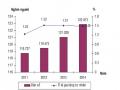
 Divergence of Land Use Criteria in the Planning of Van Yen District in 2014 and Forecast for 2015 (Unit: %)
 -
 Instrumental music composition style of 3 musicians - Quang Hai, Nguyen Van Nam, Ca Le Thuan - 12
 -
 Assessing the impact of ecotourism development on environmental components at My Le ecotourism area - 1
 -
 Socio-economic changes in Van Giang (Hung Yen) after the land consolidation process 1999 - 2008 - 5
 -
 Crime of Importing Technology, Machinery, Equipment, Waste or Substances That Do Not Meet Environmental Protection Standards
Manufacture
Waste
Distribution
Global Environment (Ecosystem)
Consumption
Natural resources
Economic resources
Economic activities "market economy"
Recyclable resources
Reproduction
Recyclable resources
Environmental Impact
Final disposal (landfill)
Intermediate Processing “Better Processing” (Recycling)
Recycle
Environmental impacts
Figure 6.12 Flow of materials
( Source: Tran Hieu Nhue & CSV, 2001 )
VI.4 LEGAL AND POLICY TOOLS IN SOLID WASTE MANAGEMENT
VI.4.1 Legal instruments in solid waste management
Environmental pollution, especially the working environment, is one of the fundamental causes affecting the health, work-related accidents and occupational diseases of workers, and more broadly, affecting the health of the entire community and the environment. Finding solutions to reduce pollution is therefore always a concern for everyone, first of all for social agencies. Handling environmental pollution caused by waste cannot rely on just a few specific measures but must be implemented synchronously: from macro-management solutions such as policy making, laws, regulations, rules, etc., master planning solutions for the entire industrial park to specific solutions on technology and "end-of-pipe" treatment.
In the world, people often use two environmental management tools: legal tools and economic tools. Legal tools are the government's setting of standards, regulations, and policies for environmental management agencies to use as a basis for inspection, appraisal, evaluation, and punishment. Economic tools are the use of policies on fees, taxes, and capital to stimulate or force businesses to implement the Law on Environmental Protection.
VI.4.1.1 Environmental regulations and standards
Environmental standards are policy tools to regulate environmental quality. Environmental standards include the following types of standards: Standards regulating the values of concentration or quantity of liquid, solid or gaseous waste before being discharged into the environment; standards for sampling and analysis; standards for designing treatment equipment... There are national standards (TCVN) and ministerial or sectoral standards. Often, standards are associated with provisions on penalties (fines, closure of production facilities, or even prosecution before the law).
VI.4.1.2 Types of environmental permits
These types of licenses are issued by State management agencies to production establishments, allowing these establishments to operate without causing harm to the environment, for example: environmental assessment certificate, environmental agreement certificate, environmental standard certificate... depending on the type and scale of production, management agencies have different requirements. According to Circular 490/1998/TT-BKHCNMT on guidance and appraisal of environmental impact assessment reports, it is stipulated that:
- Investment projects that have the potential to cause widespread environmental pollution, are prone to environmental incidents, are difficult to control and have environmental standards that are difficult to determine must prepare and submit environmental impact assessment reports for appraisal. The remaining projects will register to meet environmental standards based on their own preparation and analysis of environmental impact assessment reports.
- The certificate of registration of environmental standards is the legal basis for environmental issues for competent State agencies to consider and allow the project to carry out the next steps.
VI.4.1.3 Environmental control
Environmental control is to control pollution, prevent or eliminate hazardous waste at the source, clean up pollution, collect, reuse and treat waste. Environmental control is to control the sources of emissions into the environment: chimneys, wastewater discharge pipes, waste sources. To manage these sources, environmental management agencies must conduct statistics on production facilities and waste streams. The basis for statistics is environmental quality assessment reports. Based on the inventory records of waste sources, it is possible to identify areas at high risk of pollution or environmental incidents, thereby attracting attention or making certain investments in pollution prevention or waste source control.
VI.4.1.4 Environmental inspection
Environmental inspection is a measure to prevent, stop and handle violations of environmental protection, contributing significantly to ensuring the effectiveness of the Law on Environmental Protection is strictly implemented. The legal basis for the establishment of environmental inspection organizations includes: Inspection Ordinance, Law on Environmental Protection, in addition to other documents and regulations such as: environmental standards, environmental protection commitments... These are tools for inspection organizations to assess the level of implementation of the Law on Environmental Protection.
VI.4.1.5 Environmental impact assessment
Environmental impact assessment (EIA) is a process of identifying, describing and evaluating the direct and indirect impacts of a project on human health, animals and plants, the land, water, air environment, the landscape, the socio-economics of the project area, and the measures applied to prevent or control harmful impacts on those factors.
VI.4.1.6 Environmental protection law
The Law on Environmental Protection mentions a number of specific provisions on waste management:
- The location of collection points, storage sites, treatment and transportation sites for waste and environmental pollutants must comply with the regulations of the State management agency on environmental protection (BVMT) and local authorities.
- For wastewater and waste containing toxic substances, sources of disease, flammable and explosive substances, and non-degradable waste, there must be measures to treat them before discharge. The State management agency for environmental protection shall prescribe the list of wastewater and waste types mentioned in this clause and supervise the treatment process before discharge.
Sub-law documents:
Decree No. 175/CP of the Government on guidelines for the implementation of the Law on Environmental Protection:
- All production and business establishments, hospitals, hotels, restaurants... that have solid and liquid wastes must, when necessary, collect and treat them to meet environmental standards before discharging them outside the scope of their management. The technology for treating the above types of solid wastes must be approved by the competent State management agency.
- It is strictly forbidden to export or import waste containing toxins or disease-causing microorganisms that can pollute the environment.
- The Ministry of Science, Technology and Environment is responsible to the Government for organizing and directing the implementation of specialized inspection functions on environmental protection.
- The organization, authority and scope of activities of specialized inspectors on environmental protection are jointly regulated by the Minister of Science, Technology and Environment and the State Inspector General, in accordance with the provisions of the Law on Environmental Protection and the Inspection Ordinance (Article 38).
Solid waste standards in the production process
- Vietnamese Standard – TCVN 6696:2000. Solid waste - Sanitary landfills - General requirements for environmental protection
- Vietnam Standard – TCVN 6705:2000. Non-hazardous solid waste – Classification
- Vietnamese Standard – TCVN 6706:2000. Hazardous waste – Classification
- Vietnamese Standard – TCVN 6707:2000. Hazardous waste – Warning and prevention signs.
- Vietnamese Standard – TCVN ISO 14001:1998. Environmental management system-Regulations
specifications and instructions for use.
VI.4.2 Solid waste management in Vietnam
VI.4.2.1 Building a CTR management strategy
- Forecast of emissions based on production development
- Planning of industrial zones, planning for collection, transportation, and landfill
- Invest in equipment for collecting and transporting CTR
- Choose the right processing technology
- Financial planning for treatment and reuse
- Strengthen education and propaganda work, especially applying clean production strategies.
VI.4.2.2 Organizing collection and classification at source
This is a very important step in the solid waste management system. Good collection will ensure a clean environment and clean landscape. Along with collection is source classification, separating hazardous waste from non-hazardous waste for easy handling: Non-hazardous waste can be buried while hazardous waste must have separate treatment measures, depending on the nature of the waste (Ministry of Natural Resources and Environment, 2002).
VI.4.2.3 Selection of processing technology
- Landfill: is the most popular and cheapest form of solid waste treatment but also takes up the most land area. It is important to choose a suitable landfill site: far from residential areas, entertainment and tourism areas, far from water sources but convenient for transportation. Today, sanitary landfills must include waterproof bottom linings, leachate collection systems, leachate gas collection systems, and regular monitoring systems to monitor groundwater, air, and soil environments.
- Processing organic waste into compost: waste often contains a high amount of organic waste, which is easily decomposed by microorganisms. When composting these types of waste with appropriate regimes, they will be converted into compost, which acts as a filler for the soil, helping to improve the soil very well. This method is not popular in our country, only 2 cities, Hanoi and Ho Chi Minh City, have built this type of factory but the processing capacity is small, mainly household waste.
- Reuse and recycle: CTR from industry can be used in many ways, for example scrap iron and steel can be re-melted, scrap fabric can be used to make blankets and mattresses, recycled plastic... This method is the best way to save materials, reduce landfill area or other forms of treatment. This method should be encouraged.
- Incineration: many hazardous solid wastes cannot be buried and must be incinerated. The advantage of this method is to thoroughly treat sources of infectious diseases such as HIV/AIDS, hepatitis, encephalitis, tuberculosis, typhoid, cholera... or toxic chemicals that, if not buried properly, will pollute groundwater; reducing from 75% to 95% by volume of buried waste. This can save a lot of land area for landfills; can reuse the heat generated by the burning process to heat water, steam and convert it into electricity. The disadvantage is that the initial investment is high, the treatment cost is also high, several times to dozens of times higher than landfilling. In addition, the treatment of exhaust gas must also be careful because the exhaust gas contains dioxins and furans, which are substances with high potential to cause cancer.
-
VI.5 OVERVIEW OF HAZARDOUS WASTE
VI.5.1 Concept of hazardous waste
Hazardous waste is waste that can be generated from industrial, commercial and agricultural activities. Hazardous waste can be solid, liquid, gaseous or viscous. The definition of hazardous waste does not mention domestic solid waste, but in fact it is difficult to distinguish industrial waste from domestic waste in a comprehensive way. Hazardous waste does not include radioactive waste because this type of waste has been separated and managed separately by most countries. The toxicity of hazardous waste varies greatly, some are dangerous to humans such as low-flashpoint combustibles, insecticides, chlorinated materials that decompose slowly, some have smaller impacts but their volume is a big problem such as mine waste, slag, old phosphate plaster or other hydroxides. Waste containing incompatible chemicals can explode or catch fire. Contact with strong acids or alkalis causes skin burns. Skin absorption of some pesticides can cause acute poisoning. Chemical waste containers, if left untreated or left in unprotected areas, can cause serious poisoning accidents (Hodgson, & Levis, 1987).
Usually these are substances that have one of the following properties:
- Flammable
- Explosive
- Poisoning
- Corrosion
- Infectious
Some typical hazardous substances:
- Acid and alkali
- Oxidant
- Heavy metals
- Solvent
- Waste oil residue
- Asbestos
Sources of these substances come from households, industry, commerce, hospitals and pharmaceutical enterprises. In addition, some substances such as some extremely dangerous chemical products such as acetic acid, cyanide, and many pesticides, benzene, creosote, phenol, and toluene. In fact, toxic waste has only been of concern since 1960. Testing for toxic waste is also expensive, but experience in many developed countries shows that treating toxic waste once it has caused pollution is much more expensive and time-consuming, sometimes 10 to 100 times more. Therefore, testing for toxic waste is often only of concern after a disaster or after a threat of environmental disaster. After the death of people from eating fish contaminated with mercury in the seawater in Minamata, Japan was the first country to introduce full testing for toxic waste (1960). In the UK, following public outrage at the discovery of empty barrels containing cyanide salts on wasteland where children had been playing, the Hazardous Waste Control Commission was established and later passed into law. In the US, in 1976 the Hazardous Waste Control System was established due to public outcry over pollution caused by uncontrolled landfills (Le Huy Ba, 2002).
VI.5.1.1 Pollution methods of toxic waste
Hazardous wastes can pollute the environment directly by evaporating chemicals into the atmosphere or can pollute indirectly through transport by wind or surface water. The important issue is not only the location of the waste and the condition of the soil below.
- Contaminated land:
When the land is contaminated with hazardous waste, it will lose its inherent function. In those places, there is almost no vegetation cover, and the land turns black.
Soil organisms almost disappeared (Figure 6.13)
Figure 6.13 Land contaminated by hazardous waste (Le Van Khoa, 2005)
- Surface water pollution:
The outer surface of the water near the waste can receive toxic waste from the flowing surface. Moreover, the soil-water flow of chemicals also brings pollution to the water surface. In the condition of air contact, it will promote the process of chemical and biochemical decomposition of organic compounds. The process of evaporation on the water surface is also easier than on the soil.
- Other pollution routes:
Organic compounds can evaporate into the air, wind can carry toxic waste into the environment, and vegetables grown near waste can absorb the toxins of the waste.
VI.5.1.2 Classification of hazardous waste
Flammable
- Are liquids containing less than 24% alcohol and a flash point below 60 o C.
- Are gases that can burn when compressed.
- Is an oxidizing agent
Corrosive
A waste exhibits corrosive properties if it has any of the following characteristics:
- Is a liquid solution with pH < 2 or pH> 12.5
- Liquid corrodes steel at a rate of > 6.35 mm/year at a test temperature of 55 o C.
Reactants
- Not stable and undergoes violent transformation without explosion.
- Forms potentially explosive mixtures with water
- Is a waste containing cyanide or sulphide, when at pH 2-12.5 can generate gas, vapor, smoke in quantities sufficient to be dangerous to humans and the environment.
Explosive
- Capable of exploding or reacting explosively if exposed to an initiating source or heated under compression.
- Is a prohibited explosive as specified in the transportation safety regulations
- Capable of exploding or decomposing explosively or reacting explosively under standard temperature and pressure conditions
Toxic substance
All substances that are potentially carcinogenic
VI.5.2 Harmful effects of hazardous waste
Environmental impacts are often related to improper landfilling of hazardous waste, which is related to potential impacts on surface water and groundwater. In Vietnam, surface water and groundwater are often used for drinking water and water for agricultural production. Any pollution of these water sources has potential impacts on the health of local people. On the other hand, in our country, the isolation and management of hazardous waste still have many shortcomings. Therefore, the impacts on water sources and the environment are very large. Landfilling hazardous waste is related to the following issues:
- Groundwater pollution is caused by long-term uncontrolled storage of hazardous waste, on-site landfilling, landfilling at landfills, or filling low-lying areas.
- The potentially corrosive nature of toxic substances can destroy sewer systems as well as poison the environment.
- Surface water and groundwater pollution is caused by the discharge of untreated toxic substances.
full, or due to unscientific treatment of industrial waste
In Vietnam, most hazardous wastes are collected together with regular waste and are concentrated in landfills. Most wastes are not isolated at the source. In case the waste is stored for a long time, it will cause too much leakage and create risks and dangers to the health of the surrounding area. Some diagrams below show the movement and transformation of hazardous wastes to the environment.
VI.5.3 Health impacts of hazardous waste
VI.5.3.1 Industrial waste
Industrial air pollution causes huge economic losses, human diseases and vegetation. For example, in Europe, due to air pollution, the green area has been reduced by about 40%. In addition, leakage incidents from chemical or nuclear power plants are always a threat and disaster to humanity.