
- Ci is the output of the ith occupation (tons);
- F i is the number of fishing vessels of the i-th fishing profession (vessel).
- Ai is the number of potential exploitation days of the i-th occupation (days), which is the number of days that the vessel can fish in a month, calculated according to formula 2.3 as follows:
A i = A Di - A 0i (2.3)
In which: A Di is the number of calendar days in the i-th month (usually taking the average value of 30 days/month); A 0i is the number of days the ship does not go to sea in the i-th month;
The number of days the ship is not at sea in a month (A 0i ), depending on the characteristics of each profession and weather conditions in the month, is calculated according to formula 2.4 as follows:
A 0i = B + C (2.4)
In which: B is the number of days off according to the characteristics of the job; C is the number of days not going to sea due to bad weather, holidays, and Lunar New Year holidays.
BAC is the probability coefficient that a fishing vessel can go to sea on any day of the month, called the vessel activity coefficient, calculated according to formula 2.5.
BAC =
( a 1 a 2 a 3 ... a i )
( N 1 N 2 N 3 ... N i )
(2.5)
In which: + a i : number of sample ships operating on day i (ship)
+ Ni : number of sample ships selected for investigation on day i (ship)
The total output of the entire sea area is determined by adding up all the total output of each profession using the following formula (2.6):
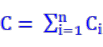 (2.6)
(2.6)
In which: C: is the total output of the entire sea area (tons); Ci : is the output of the i-th profession (tons);
n: is the total number of fishing occupations in the research sea area (n = 1 6).
2.1.3. Some other specific issues
First of all, because the number of boats operating in Quang Nam province's VBVB is often large and extremely complex. The complexity is reflected in the variety of sizes and types of boats.
(<20CV or >20CV); including many different occupations, including prohibited occupations (so they operate secretly); including boats from other provinces (not allowed to operate in the VBVB of Quang Nam province),... Therefore, investigating the entire number of boats, under the conditions of NCS, is impossible. Therefore, the investigation must be carried out according to a certain number of samples, provided that this number of samples must be comprehensive and representative, random for the entire sample. To determine the sample size for the investigation of the current situation, NCS used the Yamane formula (1967 - 1986) [67], with the total number of boats of coastal districts of Quang Nam province operating in the VBVB.
Probability and statistical theory [17] and [51] are used to calculate the number of survey samples for each occupation, capacity group and each locality; and also used to process survey data,...
Using theoretical basis and fishing gear design [23] to classify occupations suitable to local reality as a basis for assessing the current situation.
Using economic theory [18] and [29] to determine economic indicators for each profession (Investment capital, revenue, costs, profits as well as return on capital ratios,...) and evaluate the efficiency of fisheries exploitation in VBNC.
2.2. Research content
2.2.1. Investigation of the current status of exploitation activities at VBVB in Quang Nam province
- Number of vessels by profession, by locality, capacity group; size and characteristics of vessels,... operating in the VBVB of Quang Nam province
- Fishing gear and equipment for fishing in VBNC;
- Number and characteristics of workers on coastal fishing vessels in Quang Nam province;
- Productivity, output, product composition of each profession in each year from 2015-2019.
2.2.2. Investigation of the current status of NLTS protection activities at the VBVB of Quang Nam province
- Current status of local enforcement apparatus for environmental protection work
- Current status of local aquatic resource protection activities at VBNC;
- The current situation of the fleet operating in the VBNC causing harm to aquatic resources
2.2.3. Analysis and evaluation of the effectiveness of KTTS activities at VBNC
- Analysis and evaluation to clarify the exploitation efficiency of each profession achieved.
- At the same time, clarify the level of decline in exploitation efficiency of each profession.
2.2.4. Analysis and evaluation of the effectiveness of aquatic resource protection activities at VBNC
- Analyze and evaluate to clarify the effectiveness of local aquatic resource protection work;
- At the same time, clarify the level of decline in the effectiveness of this work at VBNC.
2.2.5. Proposing solutions to improve the efficiency of exploitation and protection of aquatic resources at VBNC
- Solution to reduce exploitation pressure in VBNC;
- Job conversion solutions to reduce occupational stress that harms human resources;
- Solutions to supplement habitats for aquatic species;
- Solutions to improve the management capacity of local BVNL apparatus.
2.3. Research method
2.3.1. Documents used and secondary data collection
Data collection at the Department of Agriculture and Rural Development, Quang Nam Fisheries Sub-Department, Quang Nam Provincial Agricultural Extension Center, Border Guard stations, Department of Agriculture and Rural Development of districts, towns and cities in the province, including:
- Fisheries planning to 2020 and vision to 2030.
- Annual summary report on exploitation and protection of aquatic resources.
- List of local fishing boats each year.
- Minutes of inspection and examination of vessels operating illegally in fishing activities in VBNC.
- Production situation of fishing boats in the province.
- Minutes and logs of Border Guard stations stationed in Quang Nam province.
2.3.2. Primary data investigation method
2.3.2.1. Method of investigating the actual number of fishing vessels operating KTTS in VBNC
From the preliminary survey, we know the number of fishing vessels in 6 coastal districts and cities of Quang Nam province, namely Nui Thanh, Thang Binh, Duy Xuyen, Dien Ban districts and Tam Ky and Hoi An cities. We found that among these vessels, there are vessels operating in the coastal waters of Quang Nam province, but there are also vessels operating in the offshore waters of other provinces. On the contrary, some vessels from other provinces, such as Quang Ngai, Da Nang, etc., are operating in the coastal waters of Quang Nam province. Determining the exact number of actual fishing vessels operating in the coastal waters of Quang Nam province each year is extremely difficult. To achieve this requirement, we have proceeded through 5 steps as follows:
Step 1:Make a list of fishing vessels of districts and cities in Quang Nam province. Based on the fishing vessel registration book of the Quang Nam provincial fisheries department, there will be statistical data on vessels with engines ≥ 20CV; and the district fishing vessel registration book will have statistical data on vessels with engines < 20CV. In this step, a summary table of the number of fishing vessels operating in the KTTS sector of Quang Nam province, temporarily called the research locality (DPNC) will be created.
Step 2:Prepare a preliminary list of vessels operating in VBNC.
According to Decree 33/2010/ND-CP, in the VBVB, only ships with engines <20CV are allowed to operate, so ships with engines ≥ 20CV are required to register to operate in the coastal or offshore areas. In reality, there are many ships with engines ≥ 20CV but operating in the VBVB. To obtain this data, we conducted a survey using questionnaires from fishing households about the information of which sea areas their ships operate in. For example, we can ask the question: "Where does your ship fish, in the coastal or offshore areas?" to know whether the ship operates in the coastal or offshore areas. Combine the experience and monitoring process of provincial fisheries management officers, officers of districts, communes (wards) to know which ships have engines ≥ 20CV but often operate in the VBVB of Quang Nam province.
Step 3:Identify fishing vessels entering or leaving VBNC
To obtain this information, we relied on the help of border posts and stations stationed in the coastal area of Quang Nam province. The management logs of the border posts and stations all fully recorded the registration numbers, captains' names, etc. entering and leaving VBNC, which is an important basis for us to grasp the number of these boats. The purpose of this work is to add the number to the new column "Other locations" of the preliminary list.
Step 4:Verify the actual operation of ships in VBNC
Based on the logbook and minutes of handling violating vessels of the Inspectorate of the Department of Agriculture and Rural Development of Quang Nam province to re-check the list of vessels that have actually operated in VBNC fisheries. In addition, we rent vessels to organize field trips to VBNC twice a year at appropriate times of the year. The purpose of this work is to conduct a probabilistic check to improve the accuracy of data on actual vessels operating in VBNC fisheries.
Step 5:Make a list of actual vessels operating in VBNC
From the information collected in steps 3 and 4, we proceed to process, remove or add vessels to the preliminary list. From there, we will have the final list "List of actual fishing vessels operating in VBNC" in each year.
2.3.2.2. Determining the number and distribution of survey samples
Based on Yamane formula (1967 - 1986) [67] to calculate sample size for investigation:
1 N . e 2
n(2.7) |
Maybe you are interested!
-

 Assessment of the Current Status of the Policy on Developing Female Human Resources in the People's Public Security Force
 -
 Current Status of Financial Management Mechanism of Financial Resources Mobilized Outside the State Budget for Public Universities
 -
 Current Status of Exploiting Human Resources to Serve Tourism Development in Ho Chi Minh City in the Period 2006 - 2011
 -
 Current Status of Soc Son Protective Forest Resources for Tourism Purposes
 -
 Assessment of the current status of groundwater resources in the inner city of Hanoi - 2
In there:
+ n is the number of samples to be investigated;
+ N is the sample population;
+ e is the allowable error level (in this study we choose e = 5%).
The subjects interviewed were fishing households, ship owners, and captains working in coastal fisheries.
To have the number of survey samples for each profession, capacity group and each locality, the researcher uses the random sample distribution method, proportional to the overall size [17]. Accordingly, the formula for determining the sample size of each locality with fishing vessels in the VBNC (ni) is as formula (2.8):
N i i N ii
nn N f(2.8) |
In which: N is the total sample (total number of actual vessels operating in VBNC), and Ni is the total sample according to the i-th locality; n is the total number of samples to be investigated; ni is the total number of research samples in the i-th locality; i = 1, 2, 3...; fi is the sample ratio; fi = n/N; (N= N1+N2+…+ Ni; n = n1+ n2+…+ ni).
After determining the number of samples for each locality, proceed to allocate the survey sample according to the occupation of each locality (nj) using formula (2.9) as follows:
N j j N ijj
i
nn N f(2.9) |
In which: ni is the total number of samples to be investigated in the i-th locality; nj is the total number of samples to be studied in the jth profession of the i-th locality; Ni is the total sample of the i-th locality; Nj is the total number of samples by the jth profession of the i-th locality; - j = 1,2 3...; fj is the sample ratio, fj = ni/Ni; (N=N1+N2+…+ Nj; n=n1+n2+…+ nj).
After determining the number of survey samples for each occupation in each locality, proceed to allocate the survey samples according to the capacity group for each occupation (n k ) using formula (2.10) as follows:
N j k N kjk
k
nn N f(2.10) |
In which: n k is the total number of samples to be investigated of the kth power group of the jth profession; Nj is the total sample of the jth profession; Nk is the total number of samples of the kth power group according to the jth profession; nj is the total number of samples to be studied of the jth profession; k = 1,2 3...; f k is the sample ratio, f k = n k /N k ; (N=N1+N2+…+ Nj; n = n1+n2+…+ nj).
Because the actual number of fishing vessels operating in Quang Nam province's VBVB did not change much over the years (from 2015-2019), to ensure the representativeness of the research sample and meet the FAO safety survey sample size [58], the researcher kept the same number.
The number of samples needed to be investigated for the entire period. The total number of samples to be investigated is allocated by occupation, locality and capacity group as shown in Table 2.1.
Table 2.1: Distribution of survey sample numbers by locality, occupation and capacity group
TT
Profession | Power group | Total sample | Thanh Mountain | Three periods | Thang Binh | Duy Xuyen | Hoi An | Dien Ban | |
1 | trawl | <20CV | 160 | 46 | 16 | 35 | 15 | 41 | 7 |
20÷ 49CV | 20 | 8 | 1 | 3 | 4 | 4 | 0 | ||
Total 1 | 180 | 54 | 17 | 38 | 19 | 45 | 7 | ||
2 | Sentence | <20CV | 49 | 16 | 2 | 6 | 6 | 16 | 3 |
20÷ 49CV | 17 | 3 | 0 | 2 | 4 | 7 | 1 | ||
Total 2 | 66 | 19 | 2 | 8 | 10 | 23 | 4 | ||
3 | Seine | <20CV | 6 | 3 | 0 | 0 | 0 | 3 | 0 |
20÷ 49CV | 4 | 2 | 0 | 0 | 0 | 2 | 0 | ||
Total 3 | 10 | 5 | 0 | 0 | 0 | 5 | 0 | ||
4 | Seine net | <20CV | 0 | 0 | 0 | 0 | 0 | 0 | 0 |
20÷ 49CV | 10 | 2 | 0 | 0 | 2 | 6 | 0 | ||
Total 4 | 10 | 2 | 0 | 0 | 2 | 6 | 0 | ||
5 | Trap cage | <20CV | 25 | 7 | 5 | 6 | 2 | 5 | 1 |
20÷49CV | 3 | 1 | 0 | 0 | 1 | 0 | 1 | ||
Total 5 | 28 | 8 | 5 | 6 | 3 | 5 | 2 | ||
6 | Other | <20CV | 63 | 35 | 7 | 4 | 2 | 9 | 6 |
20÷49CV | 9 | 6 | 1 | 0 | 0 | 2 | 0 | ||
Total 6 | 72 | 41 | 8 | 4 | 2 | 11 | 6 | ||
7 | Total 1÷6 | <20CV | 303 | 107 | 30 | 50 | 25 | 74 | 17 |
20÷ 49CV | 63 | 22 | 2 | 5 | 11 | 21 | 2 | ||
Total | 366 | 129 | 32 | 55 | 36 | 95 | 19 |
2.3.2.3. Information content and investigation methods
To collect highly accurate data, NCS cooperates with local fisheries management agencies to participate in investigating fishing vessels operating inshore through interviewing fishermen according to a pre-designed survey form (Survey Form No. 1, Appendix 1).
- Collect data on boats and fishing gear by interviewing captains and crew members working on the boat when the boat is docked, including information on: Boat registration number, basic parameters of the boat: length, width, height; main engine capacity; fishing grounds, seasons, number of fishing trips, number of fishing days per month, per year... Then check and confirm the data through the crew registration book managed by the household owner.
- Use a ruler with mm units to measure the length, height of the net, and mesh size (2a) at the fish holder.
- Collect data on species composition, size and output by interviewing and conducting direct surveys at fish landing points (fishing ports, fishing wharves), at purchasing points of wholesalers/warehouses according to invoices or handwritten notes recorded by wholesalers/warehouses for sellers and monitoring the on-site weighing of imported fish.
- Use a tape measure in mm to measure the length of some individuals of bottom trawling, line fishing, and 3-layer gillnets caught in batches at sea.
- Determine the number of potential fishing days of boats in the area based on retrospective interviews with fishermen combined with consultation with management staff of the Fisheries Department and staff in charge of fisheries at the grassroots level.
The person directly investigating data at sea is the captain and crew on the ships that plan to investigate data at sea. The NCS guides the investigator on the content of the investigation and the investigation method according to the pre-printed form. The data collection is conducted directly by weighing and measuring the products for each batch of nets (10 batches per ship) being produced at sea. Specifically:
- After the net is pulled up, the fish are piled up on the deck.
- The sampler uses a bucket (about 10 kg) to scoop a bucket of product where the product sizes and types are distributed fairly evenly.
- Classify products into 2 blocks: The first block includes product species listed in Appendix 7, Circular 02/2006/TT-BTS of the Ministry of Fisheries [7], Circular 62/2008/TT-BNN of the Ministry of Agriculture [2] and the second block includes the remaining species not included in the above regulations.