
For many years, Ben En National Park was under the management of the Ministry of Agriculture and Rural Development; in 2008, the Ministry of Agriculture and Rural Development transferred the management function of Ben En National Park to the People's Committee of Thanh Hoa province and the province assigned the task to the Thanh Hoa Provincial Forest Protection Department to directly manage an area of 14,734.8 hectares.
3.2.2. Current status of land and tourism resources in Ba Vi, Tam Dao and Ben En National Parks
In addition to the function of conserving resources and biodiversity, national parks can exploit their own potentials for ecotourism business. The potentials that can be exploited are land, forest flora and fauna, natural landscapes, air, human tourism resources, etc. These are the potentials and also the advantages of national parks when implementing the policy of leasing forest environment for ecotourism business.
* Current land status of national parks: In order to develop ecotourism, in addition to the potential of resources and landscapes, land scale is an important factor. A sufficiently large area of a national park not only affects the scale of conservation, but also affects the scale of tourism infrastructure such as road systems, rest stops, and facilities serving tourists such as places to eat, stay, and entertainment areas. Through research results, it can be seen that Ba Vi, Tam Dao, and Ben En national parks are all national parks with large land areas (Table 3.1).
Table 3.1. Land area of the studied national parks
T
Soil type | Tam Dao National Park | Ba Vi National Park | Ben En National Park | ||||
Acreage (ha) | Proportion % | Acreage (ha) | Proportion % | Acreage (ha) | Proportion % | ||
I | Total area | 34,995 | 100 | 11,079.5 | 100 | 14,734.80 | 100 |
1 | Forest land | 33,125.07 | 94.66 | 11,079.5 | 100 | 12,275.20 | 83.31 |
a | Forested land | 24,752.17 | 70.73 | 7,095.9 | 64.05 | 10,758.37 | 73.01 |
- | Natural forest land | 21,107.56 | 60.32 | 3,181.1 | 28.71 | 10,700.75 | 72.62 |
- | Forest land | 3,664.61 | 10.41 | 3,914.8 | 35.33 | 57.62 | 0.39 |
b | Land without forest | 8,372.90 | 23.93 | 3,983.6 | 35.95 | 1,516.83 | 10.29 |
2 | Other land | 1,869.93 | 5.34 | 0 | 2,459.60 | 16.69 | |
Maybe you are interested!
-
 Current Status of Soc Son Protective Forest Resources for Tourism Purposes
 -
 Identify Rating Levels and Rating Scales
zt2i3t4l5ee
zt2a3gstourism,quan lan,quang ninh,ecology,ecotourism,minh chau,van don,geography,geographical basis,tourism development,science
zt2a3ge
zc2o3n4t5e6n7ts
of the islanders. Therefore, this indicator will be divided into two sub-indicators:
a1. Natural tourism attractiveness a2. Cultural tourism attractiveness
b. Tourist capacity
The two island communes in Quan Lan have different capacities to receive tourists. Minh Chau Commune is home to many standard hotels and resorts, attracting high-income domestic and international tourists. Meanwhile, Quan Lan Commune has many motels mainly built and operated by local people, so the scale and quality are not high, and will be suitable for ordinary tourists such as students.
c. Time of exploitation of Quan Lan Island Commune:
Quan Lan tourism is seasonal due to weather and climate conditions and festivals only take place on certain days of the year, specifically in spring. In Quan Lan commune, the period from April to June and from September to November is considered the best time to visit Quan Lan because the cultural tourism activities are mainly associated with festivals taking place during this time.
Minh Chau island commune:
Tourism exploitation time is all year round, because this is a place with a number of tourist attractions with diverse ecosystems such as Bai Tu Long National Park Research Center, Tram forest, Turtle Laying Beach, so besides coming to the beach for tourism and vacation in the summer, Minh Chau will attract research groups to come for tourism combined with research at other times of the year.
d. Sustainability
The sustainability of ecotourism sites in Quan Lan and Minh Chau communes depends on the sensitivity of the ecosystems to climate changes.
landscape. In general, these tourist destinations have a fairly high level of sustainability, because they are natural ecosystems, planned and protected. However, if a large number of tourists gather at certain times, it can exceed the carrying capacity and affect the sustainability of the environment (polluted beaches, damaged trees, animals moving away from their habitats, etc.), then the sustainability of the above ecosystems (natural ecosystems, human ecosystems) will also be affected and become less sustainable.
e. Location and accessibility
Both island communes have ports to take tourists to visit from Van Don wharf:
- Quan Lan – Van Don traffic route:
Phuc Thinh – Viet Anh high-speed boat and Quang Minh high-speed boat, depart at 8am and 2pm from Van Don to Quan Lan, and at 7am and 1pm from Quan Lan to Van Don. There are also wooden boats departing at 7am and 1pm.
- Van Don - Minh Chau traffic route:
Chung Huong high-speed train, Minh Chau train, morning 7:30 and afternoon 13:30 from Van Don to Minh Chau, morning 6:30 and afternoon 13:00 from Minh Chau to Van Don.
f. Infrastructure
Despite receiving investment attention, the issue of infrastructure and technical facilities for tourism on Quan Lan Island is still an issue that needs to be resolved because it has a direct impact on the implementation of ecotourism activities. The minimum conditions for serving tourists such as accommodation, electricity, water, communication, especially medical services, and security work need to be given top priority. Ecotourism spots in Minh Chau commune are assessed to have better infrastructure and technical facilities for tourism because there are quite complete and synchronous conditions for serving tourists, meeting many needs of domestic and foreign tourists.
3.2.1.4. Determine assessment levels and assessment scales
Corresponding to the levels of each criterion, the index is the score of those levels in the order of 4, 3, 2, 1 decreasing according to the standard of each level: very attractive (4), attractive (3), average (2), less attractive (1).
3.2.1.5. Determining the coefficients of the criteria
For the assessment of DLST in the two communes of Quan Lan and Minh Chau islands, the students added evaluation coefficients to show the importance of the criteria and indicators as follows:
Coefficient 3 with criteria: Attractiveness, Exploitation time. These are the 2 most important criteria for attracting tourists to tourism in general and eco-tourism in particular, so they have the highest coefficient.
Coefficient 2 with criteria: Capacity, Infrastructure, Location and accessibility . Because the assessment area is an island commune of Van Don district, the above criteria are selected by the author with appropriate coefficients at the average level.
Coefficient 1 with criteria: Sustainability. Quan Lan has natural and human-made ecotourism sites, with high biodiversity and little impact from local human factors. Most of the ecotourism sites are still wild, so they are highly sustainable.
3.2.1.6. Results of DLST assessment on Quan Lan island
a. Assessment of the potential for natural tourism development
For Minh Chau commune:
+ Natural tourism attractiveness is determined to be very attractive (4 points) and the most important coefficient (coefficient 3), so the score of the Attractiveness criterion is 4 x 3 = 12.
+ Capacity is determined as average (2 points) and the coefficient is quite important (coefficient 2), then the score of Capacity criterion is 2 x 2 = 4.
+ Exploitation time is long (4 points), the most important coefficient (coefficient 3) so the score of the Exploitation time criterion is 4 x 3 = 12.
+ Sustainability is determined as sustainable (4 points), the important coefficient is the average coefficient (coefficient 1), so the score of the Sustainability criterion is 4 x 1 = 4 points
+ Location and accessibility are determined to be quite favorable (2 points), the coefficient is quite important (coefficient 2), the criterion score is 2 x 2 = 4 points.
+ Infrastructure is assessed as good (3 points), the coefficient is quite important (coefficient 2), then the score of the Infrastructure criterion is 3 x 2 = 6 points.
The total score for evaluating DLST in Minh Chau commune according to 6 evaluation criteria is determined as: 12 + 4 + 12 + 4 + 4 + 6 = 42 points
Similar assessment for Quan Lan commune, we have the following table:
Table 3.3: Assessment of the potential for natural ecotourism development in Quan Lan and Minh Chau communes
Attractiveness of self-tourismof course
Capacity
Mining time
Sustainability
Location and accessibility
Infrastructure
Result
Point
DarkMulti
Point
DarkMulti
Point
DarkMulti
Point
DarkMulti
Point
DarkMulti
Point
DarkMulti
CommuneMinh Chau
12
12
4
8
12
12
4
4
4
8
6
8
42/52
Quan CommuneLan
6
12
6
8
9
12
4
4
4
8
4
8
33/52
b. Assessment of the potential for humanistic tourism development
For Quan Lan commune:
+ The attractiveness of human tourism is determined to be very attractive (4 points) and the most important coefficient (coefficient 3), so the score of the Attractiveness criterion is 4 x 3 = 12.
+ Capacity is determined to be large (3 points) and the coefficient is quite important (coefficient 2), then the score of the Capacity criterion is 3 x 2 = 6.
+ Mining time is average (3 points), the most important coefficient (coefficient 3) so the score of the Mining time criterion is 3 x 3 = 9.
+ Sustainability is determined as sustainable (4 points), the important coefficient is the average coefficient (coefficient 1), so the score of the Sustainability criterion is 4 x 1 = 4 points.
+ Location and accessibility are determined to be quite favorable (2 points), the coefficient is quite important (coefficient 2), the criterion score is 2 x 2 = 4 points.
+ Infrastructure is rated as average (2 points), the coefficient is quite important (coefficient 2), then the score of the Infrastructure criterion is 2 x 2 = 4 points.
The total score for evaluating DLST in Quan Lan commune according to 6 evaluation criteria is determined as: 12 + 6 + 6 + 4 + 4 + 4 = 36 points.
Similar assessment with Minh Chau commune we have the following table:
Table 3.4: Assessment of the potential for developing humanistic eco-tourism in Quan Lan and Minh Chau communes
Attractiveness of human tourismliterature
Capacity
Mining time
Sustainability
Location and accessibility
Infrastructure
Result
Point
DarkMulti
Point
DarkMulti
Point
DarkMulti
Point
DarkMulti
Point
DarkMulti
Point
DarkMulti
Quan CommuneLan
12
12
6
8
9
12
4
4
4
8
4
8
39/52
Minh CommuneChau
6
12
4
8
12
12
4
4
4
8
6
8
36/52
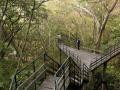
Basically, both Minh Chau and Quan Lan localities have quite favorable conditions for developing ecotourism. However, Quan Lan commune has more advantages to develop ecotourism in a humanistic direction, because this is an area with many famous historical relics such as Quan Lan Communal House, Quan Lan Pagoda, Temple worshiping the hero Tran Khanh Du, ... along with local festivals held annually such as the wind praying ceremony (March 15), Quan Lan festival (June 10-19); due to its location near the port and long exploitation time, the beaches in Quan Lan commune (especially Quan Lan beach) are no longer hygienic and clean to ensure the needs of tourists coming to relax and swim; this is also an area with many beautiful landscapes such as Got Beo wind pass, Ong Phong head, Voi Voi cave, but the ability to access these places is still very limited (dirt hill road, lots of gravel and rocks), especially during rainy and windy times; In addition, other natural resources such as mangrove forests and sea worms have not been really exploited for tourism purposes and ecotourism development. On the contrary, Minh Chau commune has more advantages in developing ecotourism in the direction of natural tourism, this is an area with diverse ecosystems such as at Rua De Beach, Bai Tu Long National Park Conservation Center...; Minh Chau beach is highly appreciated for its natural beauty and cleanliness, ranked in the top ten most beautiful beaches in Vietnam; Minh Chau commune is also home to Tram forest with a large area and a purity of up to 90%, suitable for building bridges through the forest (a very effective type of natural ecotourism currently applied by many countries) for tourists to sightsee, as well as for the purpose of studying and researching.
Figure 3.1: Thenmala Forest Bridge (India) Source: https://www.thenmalaecotourism.com/(August 21, 2019)
3.2.2. Using SWOT matrix to evaluate Quan Lan island tourism
General assessment of current tourism activities of Quan Lan island is shown through the following SWOT matrix:
Table 3.5: SWOT matrix evaluating tourism activities on Quan Lan island
Internal agent
Strengths- There is a lot of potential for tourism development, especially natural ecotourism and humanistic ecotourism.- The unskilled labor force is relatively abundant.- resource environmentunpolluted, still
Weaknesses- Poorly developed infrastructure, especially traffic routes to tourist destinations on the island.- The team of professional staff is still weak.- Tourism products in general
quite wild, originalintact
general and DLST in particularalone is monotonous.
External agents
Opportunity- Tourism is a key industry in the socio-economic development strategy of the province and Van Don economic zone.- Quan Lan was selected as a pilot area for eco-tourism development within the framework of the green growth project between Quang Ninh province and the Japanese organization JICA.- The flow of tourists and especially ecotourism in the world tends toincreasing
Challenge- Weather and climate change abnormally.- Competition in tourism products is increasingly fierce, especially with other localities in the province such as Ha Long, Mong Cai...- Awareness of tourists, especially domestic tourists, about ecotourism and nature conservation is not high.
Through summary analysis using SWOT matrix we see that:
To exploit strengths and take advantage of opportunities, it is necessary to:
- Diversify products and service types (build more tourism routes aimed at specific needs of tourists: experiential tourism immersed in nature, spiritual cultural tourism...)
- Effective exploitation of resources and differentiated products (natural resources and human resources)
div.maincontent .p { color: black; font-family:"Times New Roman", serif; font-style: normal; font-weight: normal; text-decoration: none; font-size: 14pt; margin:0pt; } div.maincontent p { color: black; font-family:"Times New Roman", serif; font-style: normal; font-weight: normal; text-decoration: none; font-size: 14pt; margin:0pt; } div.maincontent .s1 { color: black; font-family:"Times New Roman", serif; font-style: normal; font-weight: normal; text-decoration: none; font-size: 13pt; } div.maincontent .s2 { color: black; font-family:"Times New Roman", serif; font-style: normal; font-weight: normal; text-decoration: none; font-size: 13pt; } div.maincontent .s3 { color: #0D0D0D; font-family:"Times New Roman", serif; font-style: normal; font-weight: bold; text-decoration: none; font-size: 14pt; } div.maincontent .s4 { color: black; font-family:"Times New Roman", serif; font-style: italic; font-weight: normal; text-decoration: none; font-size: 14pt; } div.maincontent .s5 { color: black; font-family:"Times New Roman", serif; font-style: italic; font-weight: bold; text-decoration: none; font-size: 14pt; } div.maincontent .s6 { color: black; font-family:"Times New Roman", serif; font-style: italic; font-weight: normal; text-decoration: none; font-size: 14pt; vertical-align: -3pt; } div.maincontent .s7 { color: black; font-family:"Times New Roman", serif; font-style: italic; font-weight: normal; text-decoration: none; font-size: 14pt; vertical-align: -2pt; } div.maincontent .s8 { color: black; font-family:"Times New Roman", serif; font-style: italic; font-weight: normal; text-decoration: none; font-size: 14pt; vertical-align: -1pt; } div.maincontent .s9 { color: black; font-family:"Times New Roman", serif; font-style: normal; font-weight: normal; text-decoration: none; font-size: 14pt; } div.maincontent .s10 { color: black; font-family:"Times New Roman", serif; font-style: normal; font-weight: bold; text-decoration: none; font-size: 14pt; } div.maincontent .s11 { color: black; font-family:"Times New Roman", serif; font-style: normal; font-weight: normal; text-decoration: none; font-size: 14pt; } div.maincontent .s12 { color: black; font-family:Symbol, serif; font-style: normal; font-weight: normal; text-decoration: none; font-size: 14pt; } div.maincontent .s13 { color: black; font-family:Wingdings; font-style: normal; font-weight: normal; text-decoration: none; font-size: 14pt; } div.maincontent .s14 { color: black; font-family:"Times New Roman", serif; font-style: normal; font-weight: normal; text-decoration: none; font-size: 9pt; vertical-align: 5pt; } div.maincontent .s15 { color: black; font-family:"Times New Roman", serif; font-style: normal; font-weight: normal; text-decoration: none; font-size: 9pt; vertical-align: 5pt; } div.maincontent .s16 { color: black; font-family:Cambria, serif; font-style: italic; font-weight: normal; text-decoration: none; font-size: 14pt; } div.maincontent .s17 { color: #080808; font-family:"Times New Roman", serif; font-style: normal; font-weight: bold; text-decoration: none; font-size: 14pt; } div.maincontent .s18 { color: #080808; font-family:"Times New Roman", serif; font-style: normal; font-weight: normal; text-decoration: none; font-size: 14pt; } div.maincontent .s19 { color: black; font-family:"Times New Roman", serif; font-style: normal; font-weight: normal; text-decoration: none; font-size: 11pt; } div.maincontent .s20 { color: black; font-family:"Times New Roman", serif; font-style: normal; font-weight: normal; text-decoration: none; font-size: 10pt; } div.maincontent .s21 { color: black; font-family:"Times New Roman", serif; font-style: normal; font-weight: bold; text-decoration: none; font-size: 11pt; } div.maincontent .s22 { color: black; font-family:"Times New Roman", serif; font-style: normal; font-weight: normal; text-decoration: none; font-size: 11pt; } div.maincontent .s23 { color: black; font-family:"Times New Roman", serif; font-style: italic; font-weight: normal; text-decoration: none; font-size: 14pt; } div.maincontent .s24 { color: #212121; font-family:"Times New Roman", serif; font-style: normal; font-weight: normal; tex
Identify Rating Levels and Rating Scales
zt2i3t4l5ee
zt2a3gstourism,quan lan,quang ninh,ecology,ecotourism,minh chau,van don,geography,geographical basis,tourism development,science
zt2a3ge
zc2o3n4t5e6n7ts
of the islanders. Therefore, this indicator will be divided into two sub-indicators:
a1. Natural tourism attractiveness a2. Cultural tourism attractiveness
b. Tourist capacity
The two island communes in Quan Lan have different capacities to receive tourists. Minh Chau Commune is home to many standard hotels and resorts, attracting high-income domestic and international tourists. Meanwhile, Quan Lan Commune has many motels mainly built and operated by local people, so the scale and quality are not high, and will be suitable for ordinary tourists such as students.
c. Time of exploitation of Quan Lan Island Commune:
Quan Lan tourism is seasonal due to weather and climate conditions and festivals only take place on certain days of the year, specifically in spring. In Quan Lan commune, the period from April to June and from September to November is considered the best time to visit Quan Lan because the cultural tourism activities are mainly associated with festivals taking place during this time.
Minh Chau island commune:
Tourism exploitation time is all year round, because this is a place with a number of tourist attractions with diverse ecosystems such as Bai Tu Long National Park Research Center, Tram forest, Turtle Laying Beach, so besides coming to the beach for tourism and vacation in the summer, Minh Chau will attract research groups to come for tourism combined with research at other times of the year.
d. Sustainability
The sustainability of ecotourism sites in Quan Lan and Minh Chau communes depends on the sensitivity of the ecosystems to climate changes.
landscape. In general, these tourist destinations have a fairly high level of sustainability, because they are natural ecosystems, planned and protected. However, if a large number of tourists gather at certain times, it can exceed the carrying capacity and affect the sustainability of the environment (polluted beaches, damaged trees, animals moving away from their habitats, etc.), then the sustainability of the above ecosystems (natural ecosystems, human ecosystems) will also be affected and become less sustainable.
e. Location and accessibility
Both island communes have ports to take tourists to visit from Van Don wharf:
- Quan Lan – Van Don traffic route:
Phuc Thinh – Viet Anh high-speed boat and Quang Minh high-speed boat, depart at 8am and 2pm from Van Don to Quan Lan, and at 7am and 1pm from Quan Lan to Van Don. There are also wooden boats departing at 7am and 1pm.
- Van Don - Minh Chau traffic route:
Chung Huong high-speed train, Minh Chau train, morning 7:30 and afternoon 13:30 from Van Don to Minh Chau, morning 6:30 and afternoon 13:00 from Minh Chau to Van Don.
f. Infrastructure
Despite receiving investment attention, the issue of infrastructure and technical facilities for tourism on Quan Lan Island is still an issue that needs to be resolved because it has a direct impact on the implementation of ecotourism activities. The minimum conditions for serving tourists such as accommodation, electricity, water, communication, especially medical services, and security work need to be given top priority. Ecotourism spots in Minh Chau commune are assessed to have better infrastructure and technical facilities for tourism because there are quite complete and synchronous conditions for serving tourists, meeting many needs of domestic and foreign tourists.
3.2.1.4. Determine assessment levels and assessment scales
Corresponding to the levels of each criterion, the index is the score of those levels in the order of 4, 3, 2, 1 decreasing according to the standard of each level: very attractive (4), attractive (3), average (2), less attractive (1).
3.2.1.5. Determining the coefficients of the criteria
For the assessment of DLST in the two communes of Quan Lan and Minh Chau islands, the students added evaluation coefficients to show the importance of the criteria and indicators as follows:
Coefficient 3 with criteria: Attractiveness, Exploitation time. These are the 2 most important criteria for attracting tourists to tourism in general and eco-tourism in particular, so they have the highest coefficient.
Coefficient 2 with criteria: Capacity, Infrastructure, Location and accessibility . Because the assessment area is an island commune of Van Don district, the above criteria are selected by the author with appropriate coefficients at the average level.
Coefficient 1 with criteria: Sustainability. Quan Lan has natural and human-made ecotourism sites, with high biodiversity and little impact from local human factors. Most of the ecotourism sites are still wild, so they are highly sustainable.
3.2.1.6. Results of DLST assessment on Quan Lan island
a. Assessment of the potential for natural tourism development
For Minh Chau commune:
+ Natural tourism attractiveness is determined to be very attractive (4 points) and the most important coefficient (coefficient 3), so the score of the Attractiveness criterion is 4 x 3 = 12.
+ Capacity is determined as average (2 points) and the coefficient is quite important (coefficient 2), then the score of Capacity criterion is 2 x 2 = 4.
+ Exploitation time is long (4 points), the most important coefficient (coefficient 3) so the score of the Exploitation time criterion is 4 x 3 = 12.
+ Sustainability is determined as sustainable (4 points), the important coefficient is the average coefficient (coefficient 1), so the score of the Sustainability criterion is 4 x 1 = 4 points
+ Location and accessibility are determined to be quite favorable (2 points), the coefficient is quite important (coefficient 2), the criterion score is 2 x 2 = 4 points.
+ Infrastructure is assessed as good (3 points), the coefficient is quite important (coefficient 2), then the score of the Infrastructure criterion is 3 x 2 = 6 points.
The total score for evaluating DLST in Minh Chau commune according to 6 evaluation criteria is determined as: 12 + 4 + 12 + 4 + 4 + 6 = 42 points
Similar assessment for Quan Lan commune, we have the following table:
Table 3.3: Assessment of the potential for natural ecotourism development in Quan Lan and Minh Chau communes
Attractiveness of self-tourismof course
Capacity
Mining time
Sustainability
Location and accessibility
Infrastructure
Result
Point
DarkMulti
Point
DarkMulti
Point
DarkMulti
Point
DarkMulti
Point
DarkMulti
Point
DarkMulti
CommuneMinh Chau
12
12
4
8
12
12
4
4
4
8
6
8
42/52
Quan CommuneLan
6
12
6
8
9
12
4
4
4
8
4
8
33/52
b. Assessment of the potential for humanistic tourism development
For Quan Lan commune:
+ The attractiveness of human tourism is determined to be very attractive (4 points) and the most important coefficient (coefficient 3), so the score of the Attractiveness criterion is 4 x 3 = 12.
+ Capacity is determined to be large (3 points) and the coefficient is quite important (coefficient 2), then the score of the Capacity criterion is 3 x 2 = 6.
+ Mining time is average (3 points), the most important coefficient (coefficient 3) so the score of the Mining time criterion is 3 x 3 = 9.
+ Sustainability is determined as sustainable (4 points), the important coefficient is the average coefficient (coefficient 1), so the score of the Sustainability criterion is 4 x 1 = 4 points.
+ Location and accessibility are determined to be quite favorable (2 points), the coefficient is quite important (coefficient 2), the criterion score is 2 x 2 = 4 points.
+ Infrastructure is rated as average (2 points), the coefficient is quite important (coefficient 2), then the score of the Infrastructure criterion is 2 x 2 = 4 points.
The total score for evaluating DLST in Quan Lan commune according to 6 evaluation criteria is determined as: 12 + 6 + 6 + 4 + 4 + 4 = 36 points.
Similar assessment with Minh Chau commune we have the following table:
Table 3.4: Assessment of the potential for developing humanistic eco-tourism in Quan Lan and Minh Chau communes
Attractiveness of human tourismliterature
Capacity
Mining time
Sustainability
Location and accessibility
Infrastructure
Result
Point
DarkMulti
Point
DarkMulti
Point
DarkMulti
Point
DarkMulti
Point
DarkMulti
Point
DarkMulti
Quan CommuneLan
12
12
6
8
9
12
4
4
4
8
4
8
39/52
Minh CommuneChau
6
12
4
8
12
12
4
4
4
8
6
8
36/52
Basically, both Minh Chau and Quan Lan localities have quite favorable conditions for developing ecotourism. However, Quan Lan commune has more advantages to develop ecotourism in a humanistic direction, because this is an area with many famous historical relics such as Quan Lan Communal House, Quan Lan Pagoda, Temple worshiping the hero Tran Khanh Du, ... along with local festivals held annually such as the wind praying ceremony (March 15), Quan Lan festival (June 10-19); due to its location near the port and long exploitation time, the beaches in Quan Lan commune (especially Quan Lan beach) are no longer hygienic and clean to ensure the needs of tourists coming to relax and swim; this is also an area with many beautiful landscapes such as Got Beo wind pass, Ong Phong head, Voi Voi cave, but the ability to access these places is still very limited (dirt hill road, lots of gravel and rocks), especially during rainy and windy times; In addition, other natural resources such as mangrove forests and sea worms have not been really exploited for tourism purposes and ecotourism development. On the contrary, Minh Chau commune has more advantages in developing ecotourism in the direction of natural tourism, this is an area with diverse ecosystems such as at Rua De Beach, Bai Tu Long National Park Conservation Center...; Minh Chau beach is highly appreciated for its natural beauty and cleanliness, ranked in the top ten most beautiful beaches in Vietnam; Minh Chau commune is also home to Tram forest with a large area and a purity of up to 90%, suitable for building bridges through the forest (a very effective type of natural ecotourism currently applied by many countries) for tourists to sightsee, as well as for the purpose of studying and researching.
Figure 3.1: Thenmala Forest Bridge (India) Source: https://www.thenmalaecotourism.com/(August 21, 2019)
3.2.2. Using SWOT matrix to evaluate Quan Lan island tourism
General assessment of current tourism activities of Quan Lan island is shown through the following SWOT matrix:
Table 3.5: SWOT matrix evaluating tourism activities on Quan Lan island
Internal agent
Strengths- There is a lot of potential for tourism development, especially natural ecotourism and humanistic ecotourism.- The unskilled labor force is relatively abundant.- resource environmentunpolluted, still
Weaknesses- Poorly developed infrastructure, especially traffic routes to tourist destinations on the island.- The team of professional staff is still weak.- Tourism products in general
quite wild, originalintact
general and DLST in particularalone is monotonous.
External agents
Opportunity- Tourism is a key industry in the socio-economic development strategy of the province and Van Don economic zone.- Quan Lan was selected as a pilot area for eco-tourism development within the framework of the green growth project between Quang Ninh province and the Japanese organization JICA.- The flow of tourists and especially ecotourism in the world tends toincreasing
Challenge- Weather and climate change abnormally.- Competition in tourism products is increasingly fierce, especially with other localities in the province such as Ha Long, Mong Cai...- Awareness of tourists, especially domestic tourists, about ecotourism and nature conservation is not high.
Through summary analysis using SWOT matrix we see that:
To exploit strengths and take advantage of opportunities, it is necessary to:
- Diversify products and service types (build more tourism routes aimed at specific needs of tourists: experiential tourism immersed in nature, spiritual cultural tourism...)
- Effective exploitation of resources and differentiated products (natural resources and human resources)
div.maincontent .p { color: black; font-family:"Times New Roman", serif; font-style: normal; font-weight: normal; text-decoration: none; font-size: 14pt; margin:0pt; } div.maincontent p { color: black; font-family:"Times New Roman", serif; font-style: normal; font-weight: normal; text-decoration: none; font-size: 14pt; margin:0pt; } div.maincontent .s1 { color: black; font-family:"Times New Roman", serif; font-style: normal; font-weight: normal; text-decoration: none; font-size: 13pt; } div.maincontent .s2 { color: black; font-family:"Times New Roman", serif; font-style: normal; font-weight: normal; text-decoration: none; font-size: 13pt; } div.maincontent .s3 { color: #0D0D0D; font-family:"Times New Roman", serif; font-style: normal; font-weight: bold; text-decoration: none; font-size: 14pt; } div.maincontent .s4 { color: black; font-family:"Times New Roman", serif; font-style: italic; font-weight: normal; text-decoration: none; font-size: 14pt; } div.maincontent .s5 { color: black; font-family:"Times New Roman", serif; font-style: italic; font-weight: bold; text-decoration: none; font-size: 14pt; } div.maincontent .s6 { color: black; font-family:"Times New Roman", serif; font-style: italic; font-weight: normal; text-decoration: none; font-size: 14pt; vertical-align: -3pt; } div.maincontent .s7 { color: black; font-family:"Times New Roman", serif; font-style: italic; font-weight: normal; text-decoration: none; font-size: 14pt; vertical-align: -2pt; } div.maincontent .s8 { color: black; font-family:"Times New Roman", serif; font-style: italic; font-weight: normal; text-decoration: none; font-size: 14pt; vertical-align: -1pt; } div.maincontent .s9 { color: black; font-family:"Times New Roman", serif; font-style: normal; font-weight: normal; text-decoration: none; font-size: 14pt; } div.maincontent .s10 { color: black; font-family:"Times New Roman", serif; font-style: normal; font-weight: bold; text-decoration: none; font-size: 14pt; } div.maincontent .s11 { color: black; font-family:"Times New Roman", serif; font-style: normal; font-weight: normal; text-decoration: none; font-size: 14pt; } div.maincontent .s12 { color: black; font-family:Symbol, serif; font-style: normal; font-weight: normal; text-decoration: none; font-size: 14pt; } div.maincontent .s13 { color: black; font-family:Wingdings; font-style: normal; font-weight: normal; text-decoration: none; font-size: 14pt; } div.maincontent .s14 { color: black; font-family:"Times New Roman", serif; font-style: normal; font-weight: normal; text-decoration: none; font-size: 9pt; vertical-align: 5pt; } div.maincontent .s15 { color: black; font-family:"Times New Roman", serif; font-style: normal; font-weight: normal; text-decoration: none; font-size: 9pt; vertical-align: 5pt; } div.maincontent .s16 { color: black; font-family:Cambria, serif; font-style: italic; font-weight: normal; text-decoration: none; font-size: 14pt; } div.maincontent .s17 { color: #080808; font-family:"Times New Roman", serif; font-style: normal; font-weight: bold; text-decoration: none; font-size: 14pt; } div.maincontent .s18 { color: #080808; font-family:"Times New Roman", serif; font-style: normal; font-weight: normal; text-decoration: none; font-size: 14pt; } div.maincontent .s19 { color: black; font-family:"Times New Roman", serif; font-style: normal; font-weight: normal; text-decoration: none; font-size: 11pt; } div.maincontent .s20 { color: black; font-family:"Times New Roman", serif; font-style: normal; font-weight: normal; text-decoration: none; font-size: 10pt; } div.maincontent .s21 { color: black; font-family:"Times New Roman", serif; font-style: normal; font-weight: bold; text-decoration: none; font-size: 11pt; } div.maincontent .s22 { color: black; font-family:"Times New Roman", serif; font-style: normal; font-weight: normal; text-decoration: none; font-size: 11pt; } div.maincontent .s23 { color: black; font-family:"Times New Roman", serif; font-style: italic; font-weight: normal; text-decoration: none; font-size: 14pt; } div.maincontent .s24 { color: #212121; font-family:"Times New Roman", serif; font-style: normal; font-weight: normal; tex -
 Current Status of Exploiting Human Resources to Serve Tourism Development in Ho Chi Minh City in the Period 2006 - 2011
 -
 Current Status of Salary Accounting and Salary Deductions at Cua Lo Urban Environment and Tourism Services Joint Stock Company.
 -
 Master's thesis in Natural Resources and Environment Management: Research on the potential and current status of resources for ecotourism development in Vo Nhai district, Thai Nguyen province - 2

Source: Ba Vi National Park Report, Tam Dao, Ben En, 2012
National parks all have a high proportion of forested land and are mainly natural forest land. Ba Vi National Park has an area of natural forest land accounting for 28.71% of the forested land area.
Notably, Ba Vi National Park has about 1,000 hectares of primary forest, little affected by humans.
Unit: ha
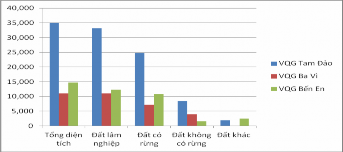
Figure 3.1. Land area of the studied national parks
Source: Ba Vi National Park Report, Tam Dao, Ben En, 2012
* Potential of forest ecosystems: The forest ecosystems of the studied national parks are very rich and diverse with many types of forests and many different species of flora and fauna. The biodiversity of the national parks is shown in Table 3.2.
Table 3.2. Number of animal and plant species in the studied national parks
Unit: species
TT
National Park Name | Animal | Bird | Amphibian | Reptile | Plants | |
1 | Ben En | 91 | 261 | 31 | 54 | 1,357 |
2 | Ba Vi | 63 | 191 | 27 | 61 | 1.201 |
3 | Tam Dao | 93 | 332 | 62 | 136 | 1,247 |
Source: Ba Vi National Park, Tam Dao, Ben En, 2012
Research results show that Ba Vi, Tam Dao, and Ben En National Parks all have high biodiversity with rich and diverse flora and fauna. In addition, each National Park has endemic species and rare wood species that are characteristic of each National Park.
* Landscape potential: In addition to the advantages of flora and fauna, national parks also have many landscape advantages for tourism development such as lake, dam, stream, waterfall systems and many other beautiful landscapes inside.
Ba Vi National Park has a small area but is quite diverse in flora and fauna, with many beautiful and attractive landscapes such as Bac waterfall, Nga stream, Yen stream, primeval forest, Suoi Hai lake, Dong Mo lake .... With many beautiful landscapes, the environment
With its fresh air, Ba Vi National Park holds great potential for research activities, forest conservation, environmental education, especially ecotourism activities.
Tam Dao National Park also has a lot of potential in terms of landscape for tourism development such as Lang Ha Lake, Xa Huong Lake, Nui Coc, Dai Lai, ... In which lakes such as Nui Coc, Dai Lai have become large and important tourist centers not only in the region but also nationwide. Besides, Tam Dao also has a system of streams and waterfalls that are well known to many people such as: Tham Thinh waterfall, Bac waterfall, Vang stream, Giai Oan stream ... creating attractive spots for tourists. Among the resources with potential for tourism development in Tam Dao, Bac waterfall has been exploited to serve tourism activities due to its quite convenient conditions, close to the tourist center.
Ben En National Park has less potential for landscape than Ba Vi and Tam Dao National Parks but has its own unique features for tourism development. Ben En National Park's landscape includes lake landscape, islands on the lake, mountain and forest landscape and cave landscape in limestone mountain ranges - the above elements create a picture that attracts tourists to Ben En. Upper Lake (May Dam) and Lower Lake (Muc Dam) have 21 islands and peninsulas surrounded by three arcs of rocky mountains, hills and forests, creating many spectacular landscapes and attracting tourists.
* Potential for human tourism resources: In addition to natural resources, Ba Vi, Tam Dao, Ben En National Parks also have human tourism resources, including both tangible and intangible resources. Human tourism resources that can be exploited are temples, pagodas, historical relics, traditional cultural features such as festivals, customs of ethnic groups,...
Ba Vi National Park has many temples, so every year it attracts a large number of spiritual tourists to the Park such as: Thuong Temple worshiping Saint Tan Vien, Trung Temple, Da Den Temple with folk legends that have gone down in history. Besides, there are many ethnic groups living here with unique customs and traditions, festivals with the characteristics of each ethnic group, and many historical relics such as French villas in the core area of the National Park. However, due to lack of investment and protection, these relics have also been lost over time.
In the Tam Dao mountain area and buffer zone, there are also many diverse and rich human tourism resources including: Ba Chua Thuong Ngan Temple, Thach Kiem Temple, Mau Temple, Duc Thanh Tran Temple, television station, .... Tam Dao National Park has relatively rich intangible resources such as customs, festivals, and poetic arts of ethnic minorities living around the National Park. Typically in Tam Dao National Park are the customs and festivals of the San Riu, Dao, Tay, San Chi ethnic groups... still preserved in villages and hamlets such as Tay Thien festival in Dai Dinh commune, Ha Village Wrestling Festival . In particular, Tam Dao still preserves a traditional folk song of the San Diu ethnic group, which is Soong Co singing.
Compared to Ba Vi and Tam Dao National Parks, Ben En National Park's human tourism resources are very few, mainly concentrated in the surrounding areas of the National Park such as Phu Na Temple in Xuan Du Commune where Ba Trieu Thi Trinh is worshiped, Khe Rong Temple in Hai Long Commune where a general of Le Loi is worshiped, also known as Duc Ong, Phu Sung Temple where Lieu Hanh Holy Mother is worshiped, etc. These are places for tourists to visit and combine spirituality. Intangible resources focus on the following categories: customs, festivals of the Thai, Muong, Tho ethnic groups still remaining in villages and hamlets such as Lung Village, Quang Village, Coc Village, Mai Village, Roc Ram Village, etc. However, to exploit and serve tourism development, it is necessary to invest in rebuilding and restoring these resources and create a connection between the tourism activities of the National Park and neighboring tourist destinations.
3.2.3. Evaluation of the results of exploiting the inherent potential for ecotourism development in Tam Dao, Ba Vi and Ben En National Parks
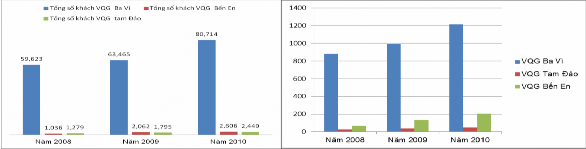
National Parks have great potential for ecotourism development through the exploitation of natural factors, biodiversity, natural landscapes and human tourism resources. With advantages in geographical location, natural resources and human tourism resources, the situation of attracting tourists has a relatively large difference between national parks (Figure 3.2).
Ba Vi National Park has more tourists coming to visit and relax than Tam Dao and Ben En National Parks and tends to increase over the years. The number of visitors to the National Parks is not yet commensurate with the existing potential due to many reasons.
different individuals. In the coming time, national parks need to have appropriate measures to increase the attraction of tourists to the national parks to both increase revenue and contribute to exploiting the advantages of the park to develop ecotourism. Revenue from ecotourism in national parks mainly comes from selling entrance tickets, due to the increase in the number of visitors, so revenue from ticket sales tends to increase sharply over the years (Figure 3.3).
Unit: Number of visitorsUnit: Million VND |
Schedule to study at the National Park
Figure 3.2. Tourist attraction situationFigure 3.3. Revenue from ticket sales at the National Park study |
Source: Report of Ba Vi National Park, Tam Dao, Ben En
The reasons for the difference in the number of visitors at the studied national parks can be considered from the following aspects:
+ Geographical location : This is considered an important factor to attract tourists to national parks. National parks with favorable locations, near large urban areas, where there is a developed transportation system such as Ba Vi or Tam Dao National Park will have more advantages in developing ecotourism than Ben En National Park. Location advantages are important factors for tourism companies to decide to invest and lease forest environments for ecotourism business.
+ Attractiveness of tourism resources : Attractiveness is the most important factor in evaluating tourism resources because it determines the attraction of tourists. Attractiveness is highly comprehensive and is often determined by the diversity of flora and fauna, the beauty of the landscape, the suitability of the climate, the uniqueness and distinctiveness of natural and human tourism resources. Attractiveness is expressed in the quantity and quality of resources, in the ability to meet many types of tourism. In the studied national parks, there is a diversity of flora and fauna and there are also endemic species associated with each national park.
+ Diversity of tourism products: Diversity of tourism products is a factor that attracts tourists and the more tourism products, the more tourists the National Park will attract. Currently, when coming to Ba Vi National Park, tourists can enjoy many types of tourism such as picnic tourism, sightseeing tourism to study ecosystems, spiritual tourism, tourism to visit historical sites, ethnic minority villages, etc. In particular, after the forest environment leasing policy was implemented in Ba Vi National Park, the number of visitors has tended to increase even more strongly because tourism companies are interested in investing in technical facilities for tourism, and tourism management is more professional. The number of visitors to Ba Vi National Park is mostly through tourism companies (mostly companies that are allowed to lease forest environments in Ba Vi National Park).
+ Local policies: Although Tam Dao National Park has a lot of potential, the number of visitors to the National Park is low due to local regulations. Tam Dao National Park is not assigned the function of tourism exploitation and management, mainly performing the function of forest protection and development, while tourist areas are managed by the District People's Committee. Therefore, tourists coming to Tam Dao mainly go to tourist areas managed by the locality such as Tay Thien, Dai Lai Lake, etc. In addition, because the province stipulates that there is no fee to enter the Park, it does not create motivation for Tam Dao National Park to exploit its advantages to develop tourism. This factor also hinders the implementation of the policy of leasing forest environment in the Park.
+ Seasonality : The seasonality of tourism activities is determined by the suitability of weather conditions for human health and the characteristics of the type of tourism. The seasonality of tourism activities directly affects the direction of tourism business investment of tourism companies in the National Park. The National Parks research tourism activities mainly in spring and summer, the remaining seasons have very few tourists coming to the park. It can be said that tourism activities in the new National Parks are concentrated at certain times of the year, with high seasonal characteristics. Ba Vi National Park mainly focuses on spring because this is the season when visitors from all over come to Ba Vi National Park to visit pagodas (Ba Vi National Park is very developed in spiritual tourism activities). As for Tam Dao and Ben En National Parks, visitors mainly come in the summer to enjoy the cool air that nature has bestowed on the National Park (mainly resort tourism). In addition, because Ben En National Park has not yet completed its development project,
developing ecotourism, there are not many tourism products so it has not attracted many visitors. Visitors to Ben En National Park often combine tourism with other places such as Sam Son beach tourism, visiting historical sites, temples and pagodas around Ben En National Park. For Ben En National Park, the largest number of visitors comes in the summer from April to September. Regarding the composition of visitors, the main groups are agencies going on vacation or traveling to other tourist destinations combined with visiting the National Park, visitors to the National Park are mainly domestic visitors more than other provinces.
Unit: Million VND Unit: Number of visitors
Figure 3.5. Number of visitors by month at Tam Dao National Park Source: Ba Vi National Park Report, Tam Dao |
+ Connectivity : The connectivity in tourism in national parks is not high, it is scattered, Ben En National Park has built tourism routes but has not exploited these routes, especially even Ba Vi National Park has not created a connection between businesses operating in the area. To develop eco-tourism, each business must find specific types of tourism, diversify tourism products but also have to have connections with each other to attract many types of tourists with different needs and demands.
3.2.4. Basic activities at the research national park
The basic activities of the National Park are preliminarily divided and grouped into four large areas: Forest protection management, Development, Exploitation and Management activities (Appendix 04) . The results show that these activities are directly or indirectly related to the implementation of the functions of the Park. In reality, the new National Parks focus on
Mainly on forest protection, forest development and management activities of a public service unit, other activities have not received attention for development.
- Forest protection and development activities: This is the main activity of the National Park and these activities are carried out relatively well, through funding from the State budget. The National Park has both a specialized force of Park Rangers and a contract for protection to local households. However, the budget is limited, so investment in forest protection and development has not achieved the desired results. In addition, the large contracted area and low funding lead to the inability to protect the forest, and the contracted households do not receive any benefits other than the contracted wages, so it does not create motivation to improve responsibility in forest protection and development. In fact, Tam Dao and Ba Vi National Parks have had to revoke the contracted contracts of many households.
- Raising awareness and attracting people to participate in forest protection: There are many activities of the National Park with the participation of people and these activities are directly or indirectly related to conservation work in the National Park such as contracting for forest protection, participating in providing traditional products for tourists, ... Currently, the National Parks have just attracted local people to participate in forest protection through the forest protection contract policy. Due to the low level of protection contracts, the number of people participating in forest protection is small, and there are not many job opportunities, so it has not attracted the enthusiastic participation of the people. Currently, in the National Parks, forest exploitation activities by communities living in the forest and on the forest edge still take place. All forest exploitation activities in the National Park are considered illegal, destroying the natural values of the forest, reducing tourism resources for eco-tourism development. In addition, in Ba Vi National Park, thanks to the implementation of the policy of leasing forest environment for ecotourism business, it has contributed to attracting a large number of people to participate directly or indirectly in tourism activities such as working at travel companies, tour guides, selling forest products or local traditional products to tourists. Allowing people to participate in exploiting the benefits of tourism has contributed to increasing people's income, reducing pressure on forests and raising people's awareness in the work of conservation and protection of environmental resources. However, some activities indirectly reduce natural resources.