
SEM testing showed that all research hypotheses were accepted. In which, the negative impact of CBDV on NTRR was the highest and the negative impact of NTRR on YĐQL was the lowest.
At the same time, chapter 4 also clarifies the moderating role of culture on the relationships in the research model. Testing has proven that culture moderates all relationships between NTRR, HPCQ and YĐQL. Thus, the research model is built with 8 hypotheses, after analysis, all 8 hypotheses are accepted. Discussing the research results through quantitative implementation confirms that the hypotheses are concluded to be appropriate and is the basis for proposing management implications in chapter 5.
CHAPTER 5: CONCLUSION AND MANAGEMENT IMPLICATIONS
Maybe you are interested!
-
 Contribution to the Research Model of Intention to Revisit Tourist Destination
 -
 Tourist Reviews on Diversity in European Tours of Viet Travel Joint Stock Company – Vietnam Travel
 -
 Tourism and travel services Factors affecting domestic tourist satisfaction at tourist destinations in An Giang province - 1
 -
 The Impact of Website Quality on Tourist Satisfaction and Purchase Intention - The Case of a Travel and Tourism Business - 14
 -
 The relationship between travel motivation, destination image and destination choice - A case study of Binh Dinh province tourism destination - 1
Introduce
The thesis is conducted to solve the research problem related to the intention to return of tourists in the research context in Vietnam. Through the qualitative and quantitative research presented, the research results are discussed. From there, managerial implications are proposed to help businesses stimulate the intention to return of international and domestic tourists. The content of the chapter will present the conclusions related to the research process and research results, focusing on managerial implications. At the same time, the limitations of the research as well as future research directions are also pointed out.
5.1 Conclusion
Based on the practical and theoretical context, the overall research objective of the thesis focuses on determining the relationship between NTRR, HPCQ and YĐQL of tourists. From that objective, the study successively addresses specific objectives through:
(1) Study the factors affecting the intention to return through an overview of theoretical foundations and previous studies. At the same time, use exploratory qualitative research by interviewing experts. The results have found research concepts and research gaps to help identify hypotheses and theoretical research models of the topic "The relationship between risk perception, subjective happiness and intention to return of tourists in Vietnam: A case study in Ho Chi Minh City". In which, the risk perception and subjective happiness factors directly affect the intention to return and the service fairness factor indirectly affects through risk perception and subjective happiness. At the same time, cultural factors play a role in moderating the level of influence of the relationships between these factors on tourists' intention to return.
Before completing the remaining objectives, the study implemented a mixed research method consisting of two types of designs that blend qualitative and quantitative research, following a specific 15-step research process. The results of the qualitative study not only help to discover the expected research model but also refine the original scale extracted from relevant empirical studies, in accordance with
more suitable to the survey subjects and research context. With 40 scales for 5 research concepts, specifically: 5 scales for the concept of service fairness, 5 scales for the concept of risk perception, 5 scales for the concept of subjective happiness, 5 scales for the concept of intention to return and 20 scales for 4 cultural groups. This is the basis for constructing a preliminary survey, which is the questionnaire used in preliminary quantitative research.
Quantitative research was conducted through two steps: preliminary research and official research. The results of testing the reliability of the scale using Cronbach's Alpha and EFA showed that 20 scales of 4 factors including service fairness, risk perception, subjective happiness and intention to return were all suitable and reliable. Therefore, the questionnaire in the official research was determined and unchanged from the preliminary research. After 6 months of surveying at 10 tourist attractions in the City, 710 qualified samples were analyzed using SPSS and AMOS tools.
(2) The results of testing the theoretical model and research hypothesis have answered the goal of determining the level of influence of factors on the intention to return. Specifically as follows:
- Service fairness negatively affects risk perception (β= -0.401; SE= 0.046; CR=-8.773; p = 0.000)
- Service fairness positively affects subjective well-being (β= 0.316; SE= 0.043; CR=7.332; p = 0.000)
- Risk perception negatively affects subjective well-being (β= -0.316; SE= 0.039; CR=-8.078; p = 0.000)
- Risk perception negatively affects revisit intention (β= -0.261; SE= 0.040; CR=-6.596; p = 0.000)
- Subjective happiness positively affects revisit intention (β= 0.304; SE= 0.043; CR=7.011; p = 0.000)
(3) The objective of determining the moderating role of culture on the relationship between factors on tourists' intention to return is answered in the part of testing the moderating role of cultural variables including four groups: individualism; pessimism; classism; egalitarianism. The test results are shown as follows:
- Culture changes the level of influence of risk perception on tourists' intention to revisit;
- Culture modifies the influence of subjective well-being on tourists' intention to revisit;
- Culture alters the extent to which risk perception affects tourists' subjective well-being;
Thus, out of the total 8 research hypotheses built, all 8 hypotheses were accepted. The research model is shown as follows:
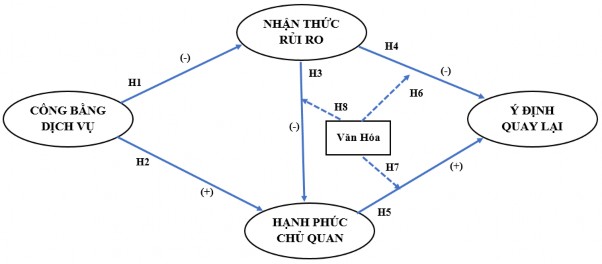
Figure 5.1: Research model
(Source: Research results)
To achieve the specific objective related to proposing managerial implications to increase tourists' intention to return, the study conducted expert interviews in explanatory qualitative research. The results of the qualitative research combined with the results of previous related research, the thesis discussed the results obtained from the official quantitative research, including some typical contents as follows:
- Regarding the influence of CBDV on NTRR, the negative relationship that the study identified can be explained by the nature of NTRR which is tourists' worries about events that may occur and leave unforeseen consequences.
- Studies around the world such as Lv and Xie (2017); Bano et al. (2019) also pointed out arguments showing similarities in conclusions about the relationship between CBDV and HPCQ. Therefore, the positive influence of CBDV on HPCQ is completely appropriate in the research context.
- For the group of customers who accept risks or control their fears, they can perform behavior according to their preferences (Holm et al., 2017) and achieve satisfaction and happiness when using the service. This view is also supported by many authors (Kim et al., 2015), so it is reasonable to affirm the relationship between risk perception and subjective happiness.
- The direct impact of NTRR on the choice of tourism products and future YĐQL has been confirmed by many studies such as An et al. (2010); Artuger (2015); Cetinsoz and Ege (2013). Savas Artuger (2015) also believes that NTRR of tourists when choosing a destination has a great influence on YĐQL and high NTRR can make tourists postpone their purchase intention or give up completely.
- The results of the relationship between HPCQ affecting tourists' YĐQL are similar to the study of Kim et al. (2015). At the same time, experts in qualitative research also believe that this result is not far from reality. Most tourists, when feeling happy, tend to have the intention to return, if their happiness is maintained, the intention can move to the stage of implementing the plan to return to the destination.
Thus, most of the analytical results from quantitative research are acceptable and consistent with the research context of the thesis.
5.2 Management implications
The research results have shown statistically significant evidence of the direct relationship between NTRR, HPCQ on tourist YĐQL. In particular, the NTRR factor also affects tourist YĐQL through the intermediary HPCQ. In addition, the study also confirms the mediating effect of CBDV on tourist YĐQL.
The cultural factor is included in the detailed study of the relationship between the above factors in the moderating role of this factor. Accordingly, the strength of the relationships changes based on the type of cultural influence. This is real evidence.
The empirical evidence explains why implemented solutions may be effective in one context but ineffective in another. Planners need to have different strategies aimed at each specific target group. This is the scientific basis for building related management implications for the goal of increasing tourist YĐQL.
5.2.1 Increasing revisit intentions of different tourist groups
Conducting a test of the mean difference of the return intention factor, the study demonstrated that there is a statistically significant difference in the return intention between different groups of tourists. The different groups included in the analysis include: culture, education, age, travel purpose, international/domestic tourists, gender, marital status. The difference in the mean return intention value was found in a number of different subgroups. These differences are the basis for building managerial implications, targeting each specific group of tourists to increase their return intention.
5.2.1.1 Balancing collective and individual activities in tourism products to satisfy customer groups (cultural differences in return intentions)
The study divided the survey subjects into 4 groups, each group was influenced by a different type of culture in the 4 types of culture mentioned by the split-combination theory. These types of culture include: individualism, pessimism, egalitarianism and classism. The results of the analysis of the average difference between these groups showed that the group of tourists influenced by individualism and pessimism had a higher intention to return than the group of classism and egalitarianism. Specifically, the average intention to return of the group of tourists belonging to the individual culture was 0.236 higher than that of the classism group, similarly, the pessimism group was also 0.241 higher in the average value of intention to return than that of the classism group. Meanwhile, the classism group did not have a statistically significant difference compared to the egalitarianism group.
This result also indirectly confirms that there is a difference in the intention to return of tourists between the two cultural groups in the direction of division (high and low). Accordingly, tourists in the low division group (individualism and pessimism) have the intention to return.
higher return intentions than highly divided groups (classism and feminism).
It is necessary to clarify the issue that the dimension of separation is mentioned by Douglas (1970) as a criterion to evaluate the level of individuality. This criterion refers to the rules that connect an individual with people around on the basis of the ego. From there, the social structure according to the high level of separation is based on individual roles or class division, while the low level of separation (low grid) emphasizes opportunities or equal status between individuals. Thus, it can be said that it is the high individual characteristics of the classist and egalitarian tourist group that affects their feelings about services as well as tourist destinations, thereby requiring appropriate solutions to enhance the intention to return for this group of tourists.
This group of tourists with lower intention to return tend to be highly individualistic in their views, and their behavior and perception of travel-related issues will be oriented towards products and services with highly individualistic characteristics. This group of customers will be less comfortable with group activities. Thus, if tourism products are provided to customers purely with group and team activities without interspersing individual and private activities, it will be difficult to satisfy this group of customers.
Therefore, tourism businesses need to diversify their products and personalize their products in the direction of increasing product choice and customization. Each customer group can adjust and choose the tourism products that best suit them.
On the other hand, it is also necessary to interweave activities during the trip. Travel companies need to combine group activities, interweave with leisure activities and certain free time to balance all aspects of tourists' needs during the trip. Thus, businesses can satisfy both the needs of high and low individuality customers, and more importantly, improve the return intention of this high individuality group.
From this research, we can see that
5.2.1.2 Exploiting well the tourist groups combined with different goals to create a stable source of customers for the business
There is also a difference in the intention to return of tourists between the pure tourism group and the group of tourists combined with business. According to the test results, the group of tourists combined with business has a higher intention to return than the group of pure tourists. This difference is relatively large, up to 1.162, showing that this is an important aspect that tourism planners need to pay attention to.
The large difference in intention to return between these two groups of tourists can be explained by a number of reasons such as travel costs, needs and convenience. From a cost perspective, combined business trips often save on travel costs because they are paid for or the total cost allocated to business and tourism will reduce the cost of the trip. This creates more favorable conditions for tourism, making customers feel more comfortable and increasing the intention to return. On the other hand, business trips can be repetitive in nature. In other words, for the type of tourism combined with business, the tendency to travel for business many times is also a major factor affecting whether tourists will continue to return to the destination on another business trip. In terms of convenience, business time often does not take up the entire trip. Therefore, integrating goals, specifically in the case study integrating tourism with business, will make the most of the trip time. This is also an important factor that makes the trip more suitable and satisfying.
From these issues, tourism service managers can take advantage of this type of combined tourism. Not only combining work and tourism. Other combined tourism products can also be invested in and exploited, such as tourism combined with health care. This is a useful type of tourism when combining the addition of destinations to the itinerary that are prestigious health care facilities, creating conditions for tourists to have health check-ups at facilities with the highest conditions and expertise. Tourism combined with learning is also a type of combined tourism that can be exploited. Combining with training facilities, designing learning programs that combine direct and distance teaching, concentrated and non-concentrated learning in each stage and each module can also be done. Exploiting this tourism product simultaneously meets the need to access prestigious educational institutions and the need to explore tourism for tourists.