
Tourism advertisers must make six decisions: What to offer? To whom? Where to offer? When to offer? How to offer? And with how much money? According to Philip Kotler, advertising is an investment, not an expense. Businesses that spend a lot of money on advertising will bring high profits. Advertising must be carefully calculated and analyzed, depending on the purpose of the advertising program, businesses must determine the appropriate spending, otherwise the effectiveness of advertising will not be commensurate with the amount of money spent, as well as the effectiveness of profits.
- Personal selling: is a form of using sales staff to inform and persuade potential customers to buy products to achieve the business's goals.
- Promotion: are promotional activities of enterprises to stimulate customers to buy products and increase sales in the short term by giving certain benefits to customers. According to Article 181 of the Vietnam Commercial Law, forms of promotion include: giving away samples, giving away free goods and services, selling at lower prices, participating in prize competitions, etc.
- Social relations: Social relations are a very important task for businesses, it determines the development or existence of the business, social relations always exist in any agency, organization, business or individual, social relations are expressed in 2 aspects: internal relations and external relations.
Maybe you are interested!
-
 Identify Rating Levels and Rating Scales
zt2i3t4l5ee
zt2a3gstourism,quan lan,quang ninh,ecology,ecotourism,minh chau,van don,geography,geographical basis,tourism development,science
zt2a3ge
zc2o3n4t5e6n7ts
of the islanders. Therefore, this indicator will be divided into two sub-indicators:
a1. Natural tourism attractiveness a2. Cultural tourism attractiveness
b. Tourist capacity
The two island communes in Quan Lan have different capacities to receive tourists. Minh Chau Commune is home to many standard hotels and resorts, attracting high-income domestic and international tourists. Meanwhile, Quan Lan Commune has many motels mainly built and operated by local people, so the scale and quality are not high, and will be suitable for ordinary tourists such as students.
c. Time of exploitation of Quan Lan Island Commune:
Quan Lan tourism is seasonal due to weather and climate conditions and festivals only take place on certain days of the year, specifically in spring. In Quan Lan commune, the period from April to June and from September to November is considered the best time to visit Quan Lan because the cultural tourism activities are mainly associated with festivals taking place during this time.
Minh Chau island commune:
Tourism exploitation time is all year round, because this is a place with a number of tourist attractions with diverse ecosystems such as Bai Tu Long National Park Research Center, Tram forest, Turtle Laying Beach, so besides coming to the beach for tourism and vacation in the summer, Minh Chau will attract research groups to come for tourism combined with research at other times of the year.
d. Sustainability
The sustainability of ecotourism sites in Quan Lan and Minh Chau communes depends on the sensitivity of the ecosystems to climate changes.
landscape. In general, these tourist destinations have a fairly high level of sustainability, because they are natural ecosystems, planned and protected. However, if a large number of tourists gather at certain times, it can exceed the carrying capacity and affect the sustainability of the environment (polluted beaches, damaged trees, animals moving away from their habitats, etc.), then the sustainability of the above ecosystems (natural ecosystems, human ecosystems) will also be affected and become less sustainable.
e. Location and accessibility
Both island communes have ports to take tourists to visit from Van Don wharf:
- Quan Lan – Van Don traffic route:
Phuc Thinh – Viet Anh high-speed boat and Quang Minh high-speed boat, depart at 8am and 2pm from Van Don to Quan Lan, and at 7am and 1pm from Quan Lan to Van Don. There are also wooden boats departing at 7am and 1pm.
- Van Don - Minh Chau traffic route:
Chung Huong high-speed train, Minh Chau train, morning 7:30 and afternoon 13:30 from Van Don to Minh Chau, morning 6:30 and afternoon 13:00 from Minh Chau to Van Don.
f. Infrastructure
Despite receiving investment attention, the issue of infrastructure and technical facilities for tourism on Quan Lan Island is still an issue that needs to be resolved because it has a direct impact on the implementation of ecotourism activities. The minimum conditions for serving tourists such as accommodation, electricity, water, communication, especially medical services, and security work need to be given top priority. Ecotourism spots in Minh Chau commune are assessed to have better infrastructure and technical facilities for tourism because there are quite complete and synchronous conditions for serving tourists, meeting many needs of domestic and foreign tourists.
3.2.1.4. Determine assessment levels and assessment scales
Corresponding to the levels of each criterion, the index is the score of those levels in the order of 4, 3, 2, 1 decreasing according to the standard of each level: very attractive (4), attractive (3), average (2), less attractive (1).
3.2.1.5. Determining the coefficients of the criteria
For the assessment of DLST in the two communes of Quan Lan and Minh Chau islands, the students added evaluation coefficients to show the importance of the criteria and indicators as follows:
Coefficient 3 with criteria: Attractiveness, Exploitation time. These are the 2 most important criteria for attracting tourists to tourism in general and eco-tourism in particular, so they have the highest coefficient.
Coefficient 2 with criteria: Capacity, Infrastructure, Location and accessibility . Because the assessment area is an island commune of Van Don district, the above criteria are selected by the author with appropriate coefficients at the average level.
Coefficient 1 with criteria: Sustainability. Quan Lan has natural and human-made ecotourism sites, with high biodiversity and little impact from local human factors. Most of the ecotourism sites are still wild, so they are highly sustainable.
3.2.1.6. Results of DLST assessment on Quan Lan island
a. Assessment of the potential for natural tourism development
For Minh Chau commune:
+ Natural tourism attractiveness is determined to be very attractive (4 points) and the most important coefficient (coefficient 3), so the score of the Attractiveness criterion is 4 x 3 = 12.
+ Capacity is determined as average (2 points) and the coefficient is quite important (coefficient 2), then the score of Capacity criterion is 2 x 2 = 4.
+ Exploitation time is long (4 points), the most important coefficient (coefficient 3) so the score of the Exploitation time criterion is 4 x 3 = 12.
+ Sustainability is determined as sustainable (4 points), the important coefficient is the average coefficient (coefficient 1), so the score of the Sustainability criterion is 4 x 1 = 4 points
+ Location and accessibility are determined to be quite favorable (2 points), the coefficient is quite important (coefficient 2), the criterion score is 2 x 2 = 4 points.
+ Infrastructure is assessed as good (3 points), the coefficient is quite important (coefficient 2), then the score of the Infrastructure criterion is 3 x 2 = 6 points.
The total score for evaluating DLST in Minh Chau commune according to 6 evaluation criteria is determined as: 12 + 4 + 12 + 4 + 4 + 6 = 42 points
Similar assessment for Quan Lan commune, we have the following table:
Table 3.3: Assessment of the potential for natural ecotourism development in Quan Lan and Minh Chau communes
Attractiveness of self-tourismof course
Capacity
Mining time
Sustainability
Location and accessibility
Infrastructure
Result
Point
DarkMulti
Point
DarkMulti
Point
DarkMulti
Point
DarkMulti
Point
DarkMulti
Point
DarkMulti
CommuneMinh Chau
12
12
4
8
12
12
4
4
4
8
6
8
42/52
Quan CommuneLan
6
12
6
8
9
12
4
4
4
8
4
8
33/52
b. Assessment of the potential for humanistic tourism development
For Quan Lan commune:
+ The attractiveness of human tourism is determined to be very attractive (4 points) and the most important coefficient (coefficient 3), so the score of the Attractiveness criterion is 4 x 3 = 12.
+ Capacity is determined to be large (3 points) and the coefficient is quite important (coefficient 2), then the score of the Capacity criterion is 3 x 2 = 6.
+ Mining time is average (3 points), the most important coefficient (coefficient 3) so the score of the Mining time criterion is 3 x 3 = 9.
+ Sustainability is determined as sustainable (4 points), the important coefficient is the average coefficient (coefficient 1), so the score of the Sustainability criterion is 4 x 1 = 4 points.
+ Location and accessibility are determined to be quite favorable (2 points), the coefficient is quite important (coefficient 2), the criterion score is 2 x 2 = 4 points.
+ Infrastructure is rated as average (2 points), the coefficient is quite important (coefficient 2), then the score of the Infrastructure criterion is 2 x 2 = 4 points.
The total score for evaluating DLST in Quan Lan commune according to 6 evaluation criteria is determined as: 12 + 6 + 6 + 4 + 4 + 4 = 36 points.
Similar assessment with Minh Chau commune we have the following table:
Table 3.4: Assessment of the potential for developing humanistic eco-tourism in Quan Lan and Minh Chau communes
Attractiveness of human tourismliterature
Capacity
Mining time
Sustainability
Location and accessibility
Infrastructure
Result
Point
DarkMulti
Point
DarkMulti
Point
DarkMulti
Point
DarkMulti
Point
DarkMulti
Point
DarkMulti
Quan CommuneLan
12
12
6
8
9
12
4
4
4
8
4
8
39/52
Minh CommuneChau
6
12
4
8
12
12
4
4
4
8
6
8
36/52
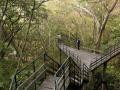
Basically, both Minh Chau and Quan Lan localities have quite favorable conditions for developing ecotourism. However, Quan Lan commune has more advantages to develop ecotourism in a humanistic direction, because this is an area with many famous historical relics such as Quan Lan Communal House, Quan Lan Pagoda, Temple worshiping the hero Tran Khanh Du, ... along with local festivals held annually such as the wind praying ceremony (March 15), Quan Lan festival (June 10-19); due to its location near the port and long exploitation time, the beaches in Quan Lan commune (especially Quan Lan beach) are no longer hygienic and clean to ensure the needs of tourists coming to relax and swim; this is also an area with many beautiful landscapes such as Got Beo wind pass, Ong Phong head, Voi Voi cave, but the ability to access these places is still very limited (dirt hill road, lots of gravel and rocks), especially during rainy and windy times; In addition, other natural resources such as mangrove forests and sea worms have not been really exploited for tourism purposes and ecotourism development. On the contrary, Minh Chau commune has more advantages in developing ecotourism in the direction of natural tourism, this is an area with diverse ecosystems such as at Rua De Beach, Bai Tu Long National Park Conservation Center...; Minh Chau beach is highly appreciated for its natural beauty and cleanliness, ranked in the top ten most beautiful beaches in Vietnam; Minh Chau commune is also home to Tram forest with a large area and a purity of up to 90%, suitable for building bridges through the forest (a very effective type of natural ecotourism currently applied by many countries) for tourists to sightsee, as well as for the purpose of studying and researching.
Figure 3.1: Thenmala Forest Bridge (India) Source: https://www.thenmalaecotourism.com/(August 21, 2019)
3.2.2. Using SWOT matrix to evaluate Quan Lan island tourism
General assessment of current tourism activities of Quan Lan island is shown through the following SWOT matrix:
Table 3.5: SWOT matrix evaluating tourism activities on Quan Lan island
Internal agent
Strengths- There is a lot of potential for tourism development, especially natural ecotourism and humanistic ecotourism.- The unskilled labor force is relatively abundant.- resource environmentunpolluted, still
Weaknesses- Poorly developed infrastructure, especially traffic routes to tourist destinations on the island.- The team of professional staff is still weak.- Tourism products in general
quite wild, originalintact
general and DLST in particularalone is monotonous.
External agents
Opportunity- Tourism is a key industry in the socio-economic development strategy of the province and Van Don economic zone.- Quan Lan was selected as a pilot area for eco-tourism development within the framework of the green growth project between Quang Ninh province and the Japanese organization JICA.- The flow of tourists and especially ecotourism in the world tends toincreasing
Challenge- Weather and climate change abnormally.- Competition in tourism products is increasingly fierce, especially with other localities in the province such as Ha Long, Mong Cai...- Awareness of tourists, especially domestic tourists, about ecotourism and nature conservation is not high.
Through summary analysis using SWOT matrix we see that:
To exploit strengths and take advantage of opportunities, it is necessary to:
- Diversify products and service types (build more tourism routes aimed at specific needs of tourists: experiential tourism immersed in nature, spiritual cultural tourism...)
- Effective exploitation of resources and differentiated products (natural resources and human resources)
div.maincontent .p { color: black; font-family:"Times New Roman", serif; font-style: normal; font-weight: normal; text-decoration: none; font-size: 14pt; margin:0pt; } div.maincontent p { color: black; font-family:"Times New Roman", serif; font-style: normal; font-weight: normal; text-decoration: none; font-size: 14pt; margin:0pt; } div.maincontent .s1 { color: black; font-family:"Times New Roman", serif; font-style: normal; font-weight: normal; text-decoration: none; font-size: 13pt; } div.maincontent .s2 { color: black; font-family:"Times New Roman", serif; font-style: normal; font-weight: normal; text-decoration: none; font-size: 13pt; } div.maincontent .s3 { color: #0D0D0D; font-family:"Times New Roman", serif; font-style: normal; font-weight: bold; text-decoration: none; font-size: 14pt; } div.maincontent .s4 { color: black; font-family:"Times New Roman", serif; font-style: italic; font-weight: normal; text-decoration: none; font-size: 14pt; } div.maincontent .s5 { color: black; font-family:"Times New Roman", serif; font-style: italic; font-weight: bold; text-decoration: none; font-size: 14pt; } div.maincontent .s6 { color: black; font-family:"Times New Roman", serif; font-style: italic; font-weight: normal; text-decoration: none; font-size: 14pt; vertical-align: -3pt; } div.maincontent .s7 { color: black; font-family:"Times New Roman", serif; font-style: italic; font-weight: normal; text-decoration: none; font-size: 14pt; vertical-align: -2pt; } div.maincontent .s8 { color: black; font-family:"Times New Roman", serif; font-style: italic; font-weight: normal; text-decoration: none; font-size: 14pt; vertical-align: -1pt; } div.maincontent .s9 { color: black; font-family:"Times New Roman", serif; font-style: normal; font-weight: normal; text-decoration: none; font-size: 14pt; } div.maincontent .s10 { color: black; font-family:"Times New Roman", serif; font-style: normal; font-weight: bold; text-decoration: none; font-size: 14pt; } div.maincontent .s11 { color: black; font-family:"Times New Roman", serif; font-style: normal; font-weight: normal; text-decoration: none; font-size: 14pt; } div.maincontent .s12 { color: black; font-family:Symbol, serif; font-style: normal; font-weight: normal; text-decoration: none; font-size: 14pt; } div.maincontent .s13 { color: black; font-family:Wingdings; font-style: normal; font-weight: normal; text-decoration: none; font-size: 14pt; } div.maincontent .s14 { color: black; font-family:"Times New Roman", serif; font-style: normal; font-weight: normal; text-decoration: none; font-size: 9pt; vertical-align: 5pt; } div.maincontent .s15 { color: black; font-family:"Times New Roman", serif; font-style: normal; font-weight: normal; text-decoration: none; font-size: 9pt; vertical-align: 5pt; } div.maincontent .s16 { color: black; font-family:Cambria, serif; font-style: italic; font-weight: normal; text-decoration: none; font-size: 14pt; } div.maincontent .s17 { color: #080808; font-family:"Times New Roman", serif; font-style: normal; font-weight: bold; text-decoration: none; font-size: 14pt; } div.maincontent .s18 { color: #080808; font-family:"Times New Roman", serif; font-style: normal; font-weight: normal; text-decoration: none; font-size: 14pt; } div.maincontent .s19 { color: black; font-family:"Times New Roman", serif; font-style: normal; font-weight: normal; text-decoration: none; font-size: 11pt; } div.maincontent .s20 { color: black; font-family:"Times New Roman", serif; font-style: normal; font-weight: normal; text-decoration: none; font-size: 10pt; } div.maincontent .s21 { color: black; font-family:"Times New Roman", serif; font-style: normal; font-weight: bold; text-decoration: none; font-size: 11pt; } div.maincontent .s22 { color: black; font-family:"Times New Roman", serif; font-style: normal; font-weight: normal; text-decoration: none; font-size: 11pt; } div.maincontent .s23 { color: black; font-family:"Times New Roman", serif; font-style: italic; font-weight: normal; text-decoration: none; font-size: 14pt; } div.maincontent .s24 { color: #212121; font-family:"Times New Roman", serif; font-style: normal; font-weight: normal; tex
Identify Rating Levels and Rating Scales
zt2i3t4l5ee
zt2a3gstourism,quan lan,quang ninh,ecology,ecotourism,minh chau,van don,geography,geographical basis,tourism development,science
zt2a3ge
zc2o3n4t5e6n7ts
of the islanders. Therefore, this indicator will be divided into two sub-indicators:
a1. Natural tourism attractiveness a2. Cultural tourism attractiveness
b. Tourist capacity
The two island communes in Quan Lan have different capacities to receive tourists. Minh Chau Commune is home to many standard hotels and resorts, attracting high-income domestic and international tourists. Meanwhile, Quan Lan Commune has many motels mainly built and operated by local people, so the scale and quality are not high, and will be suitable for ordinary tourists such as students.
c. Time of exploitation of Quan Lan Island Commune:
Quan Lan tourism is seasonal due to weather and climate conditions and festivals only take place on certain days of the year, specifically in spring. In Quan Lan commune, the period from April to June and from September to November is considered the best time to visit Quan Lan because the cultural tourism activities are mainly associated with festivals taking place during this time.
Minh Chau island commune:
Tourism exploitation time is all year round, because this is a place with a number of tourist attractions with diverse ecosystems such as Bai Tu Long National Park Research Center, Tram forest, Turtle Laying Beach, so besides coming to the beach for tourism and vacation in the summer, Minh Chau will attract research groups to come for tourism combined with research at other times of the year.
d. Sustainability
The sustainability of ecotourism sites in Quan Lan and Minh Chau communes depends on the sensitivity of the ecosystems to climate changes.
landscape. In general, these tourist destinations have a fairly high level of sustainability, because they are natural ecosystems, planned and protected. However, if a large number of tourists gather at certain times, it can exceed the carrying capacity and affect the sustainability of the environment (polluted beaches, damaged trees, animals moving away from their habitats, etc.), then the sustainability of the above ecosystems (natural ecosystems, human ecosystems) will also be affected and become less sustainable.
e. Location and accessibility
Both island communes have ports to take tourists to visit from Van Don wharf:
- Quan Lan – Van Don traffic route:
Phuc Thinh – Viet Anh high-speed boat and Quang Minh high-speed boat, depart at 8am and 2pm from Van Don to Quan Lan, and at 7am and 1pm from Quan Lan to Van Don. There are also wooden boats departing at 7am and 1pm.
- Van Don - Minh Chau traffic route:
Chung Huong high-speed train, Minh Chau train, morning 7:30 and afternoon 13:30 from Van Don to Minh Chau, morning 6:30 and afternoon 13:00 from Minh Chau to Van Don.
f. Infrastructure
Despite receiving investment attention, the issue of infrastructure and technical facilities for tourism on Quan Lan Island is still an issue that needs to be resolved because it has a direct impact on the implementation of ecotourism activities. The minimum conditions for serving tourists such as accommodation, electricity, water, communication, especially medical services, and security work need to be given top priority. Ecotourism spots in Minh Chau commune are assessed to have better infrastructure and technical facilities for tourism because there are quite complete and synchronous conditions for serving tourists, meeting many needs of domestic and foreign tourists.
3.2.1.4. Determine assessment levels and assessment scales
Corresponding to the levels of each criterion, the index is the score of those levels in the order of 4, 3, 2, 1 decreasing according to the standard of each level: very attractive (4), attractive (3), average (2), less attractive (1).
3.2.1.5. Determining the coefficients of the criteria
For the assessment of DLST in the two communes of Quan Lan and Minh Chau islands, the students added evaluation coefficients to show the importance of the criteria and indicators as follows:
Coefficient 3 with criteria: Attractiveness, Exploitation time. These are the 2 most important criteria for attracting tourists to tourism in general and eco-tourism in particular, so they have the highest coefficient.
Coefficient 2 with criteria: Capacity, Infrastructure, Location and accessibility . Because the assessment area is an island commune of Van Don district, the above criteria are selected by the author with appropriate coefficients at the average level.
Coefficient 1 with criteria: Sustainability. Quan Lan has natural and human-made ecotourism sites, with high biodiversity and little impact from local human factors. Most of the ecotourism sites are still wild, so they are highly sustainable.
3.2.1.6. Results of DLST assessment on Quan Lan island
a. Assessment of the potential for natural tourism development
For Minh Chau commune:
+ Natural tourism attractiveness is determined to be very attractive (4 points) and the most important coefficient (coefficient 3), so the score of the Attractiveness criterion is 4 x 3 = 12.
+ Capacity is determined as average (2 points) and the coefficient is quite important (coefficient 2), then the score of Capacity criterion is 2 x 2 = 4.
+ Exploitation time is long (4 points), the most important coefficient (coefficient 3) so the score of the Exploitation time criterion is 4 x 3 = 12.
+ Sustainability is determined as sustainable (4 points), the important coefficient is the average coefficient (coefficient 1), so the score of the Sustainability criterion is 4 x 1 = 4 points
+ Location and accessibility are determined to be quite favorable (2 points), the coefficient is quite important (coefficient 2), the criterion score is 2 x 2 = 4 points.
+ Infrastructure is assessed as good (3 points), the coefficient is quite important (coefficient 2), then the score of the Infrastructure criterion is 3 x 2 = 6 points.
The total score for evaluating DLST in Minh Chau commune according to 6 evaluation criteria is determined as: 12 + 4 + 12 + 4 + 4 + 6 = 42 points
Similar assessment for Quan Lan commune, we have the following table:
Table 3.3: Assessment of the potential for natural ecotourism development in Quan Lan and Minh Chau communes
Attractiveness of self-tourismof course
Capacity
Mining time
Sustainability
Location and accessibility
Infrastructure
Result
Point
DarkMulti
Point
DarkMulti
Point
DarkMulti
Point
DarkMulti
Point
DarkMulti
Point
DarkMulti
CommuneMinh Chau
12
12
4
8
12
12
4
4
4
8
6
8
42/52
Quan CommuneLan
6
12
6
8
9
12
4
4
4
8
4
8
33/52
b. Assessment of the potential for humanistic tourism development
For Quan Lan commune:
+ The attractiveness of human tourism is determined to be very attractive (4 points) and the most important coefficient (coefficient 3), so the score of the Attractiveness criterion is 4 x 3 = 12.
+ Capacity is determined to be large (3 points) and the coefficient is quite important (coefficient 2), then the score of the Capacity criterion is 3 x 2 = 6.
+ Mining time is average (3 points), the most important coefficient (coefficient 3) so the score of the Mining time criterion is 3 x 3 = 9.
+ Sustainability is determined as sustainable (4 points), the important coefficient is the average coefficient (coefficient 1), so the score of the Sustainability criterion is 4 x 1 = 4 points.
+ Location and accessibility are determined to be quite favorable (2 points), the coefficient is quite important (coefficient 2), the criterion score is 2 x 2 = 4 points.
+ Infrastructure is rated as average (2 points), the coefficient is quite important (coefficient 2), then the score of the Infrastructure criterion is 2 x 2 = 4 points.
The total score for evaluating DLST in Quan Lan commune according to 6 evaluation criteria is determined as: 12 + 6 + 6 + 4 + 4 + 4 = 36 points.
Similar assessment with Minh Chau commune we have the following table:
Table 3.4: Assessment of the potential for developing humanistic eco-tourism in Quan Lan and Minh Chau communes
Attractiveness of human tourismliterature
Capacity
Mining time
Sustainability
Location and accessibility
Infrastructure
Result
Point
DarkMulti
Point
DarkMulti
Point
DarkMulti
Point
DarkMulti
Point
DarkMulti
Point
DarkMulti
Quan CommuneLan
12
12
6
8
9
12
4
4
4
8
4
8
39/52
Minh CommuneChau
6
12
4
8
12
12
4
4
4
8
6
8
36/52
Basically, both Minh Chau and Quan Lan localities have quite favorable conditions for developing ecotourism. However, Quan Lan commune has more advantages to develop ecotourism in a humanistic direction, because this is an area with many famous historical relics such as Quan Lan Communal House, Quan Lan Pagoda, Temple worshiping the hero Tran Khanh Du, ... along with local festivals held annually such as the wind praying ceremony (March 15), Quan Lan festival (June 10-19); due to its location near the port and long exploitation time, the beaches in Quan Lan commune (especially Quan Lan beach) are no longer hygienic and clean to ensure the needs of tourists coming to relax and swim; this is also an area with many beautiful landscapes such as Got Beo wind pass, Ong Phong head, Voi Voi cave, but the ability to access these places is still very limited (dirt hill road, lots of gravel and rocks), especially during rainy and windy times; In addition, other natural resources such as mangrove forests and sea worms have not been really exploited for tourism purposes and ecotourism development. On the contrary, Minh Chau commune has more advantages in developing ecotourism in the direction of natural tourism, this is an area with diverse ecosystems such as at Rua De Beach, Bai Tu Long National Park Conservation Center...; Minh Chau beach is highly appreciated for its natural beauty and cleanliness, ranked in the top ten most beautiful beaches in Vietnam; Minh Chau commune is also home to Tram forest with a large area and a purity of up to 90%, suitable for building bridges through the forest (a very effective type of natural ecotourism currently applied by many countries) for tourists to sightsee, as well as for the purpose of studying and researching.
Figure 3.1: Thenmala Forest Bridge (India) Source: https://www.thenmalaecotourism.com/(August 21, 2019)
3.2.2. Using SWOT matrix to evaluate Quan Lan island tourism
General assessment of current tourism activities of Quan Lan island is shown through the following SWOT matrix:
Table 3.5: SWOT matrix evaluating tourism activities on Quan Lan island
Internal agent
Strengths- There is a lot of potential for tourism development, especially natural ecotourism and humanistic ecotourism.- The unskilled labor force is relatively abundant.- resource environmentunpolluted, still
Weaknesses- Poorly developed infrastructure, especially traffic routes to tourist destinations on the island.- The team of professional staff is still weak.- Tourism products in general
quite wild, originalintact
general and DLST in particularalone is monotonous.
External agents
Opportunity- Tourism is a key industry in the socio-economic development strategy of the province and Van Don economic zone.- Quan Lan was selected as a pilot area for eco-tourism development within the framework of the green growth project between Quang Ninh province and the Japanese organization JICA.- The flow of tourists and especially ecotourism in the world tends toincreasing
Challenge- Weather and climate change abnormally.- Competition in tourism products is increasingly fierce, especially with other localities in the province such as Ha Long, Mong Cai...- Awareness of tourists, especially domestic tourists, about ecotourism and nature conservation is not high.
Through summary analysis using SWOT matrix we see that:
To exploit strengths and take advantage of opportunities, it is necessary to:
- Diversify products and service types (build more tourism routes aimed at specific needs of tourists: experiential tourism immersed in nature, spiritual cultural tourism...)
- Effective exploitation of resources and differentiated products (natural resources and human resources)
div.maincontent .p { color: black; font-family:"Times New Roman", serif; font-style: normal; font-weight: normal; text-decoration: none; font-size: 14pt; margin:0pt; } div.maincontent p { color: black; font-family:"Times New Roman", serif; font-style: normal; font-weight: normal; text-decoration: none; font-size: 14pt; margin:0pt; } div.maincontent .s1 { color: black; font-family:"Times New Roman", serif; font-style: normal; font-weight: normal; text-decoration: none; font-size: 13pt; } div.maincontent .s2 { color: black; font-family:"Times New Roman", serif; font-style: normal; font-weight: normal; text-decoration: none; font-size: 13pt; } div.maincontent .s3 { color: #0D0D0D; font-family:"Times New Roman", serif; font-style: normal; font-weight: bold; text-decoration: none; font-size: 14pt; } div.maincontent .s4 { color: black; font-family:"Times New Roman", serif; font-style: italic; font-weight: normal; text-decoration: none; font-size: 14pt; } div.maincontent .s5 { color: black; font-family:"Times New Roman", serif; font-style: italic; font-weight: bold; text-decoration: none; font-size: 14pt; } div.maincontent .s6 { color: black; font-family:"Times New Roman", serif; font-style: italic; font-weight: normal; text-decoration: none; font-size: 14pt; vertical-align: -3pt; } div.maincontent .s7 { color: black; font-family:"Times New Roman", serif; font-style: italic; font-weight: normal; text-decoration: none; font-size: 14pt; vertical-align: -2pt; } div.maincontent .s8 { color: black; font-family:"Times New Roman", serif; font-style: italic; font-weight: normal; text-decoration: none; font-size: 14pt; vertical-align: -1pt; } div.maincontent .s9 { color: black; font-family:"Times New Roman", serif; font-style: normal; font-weight: normal; text-decoration: none; font-size: 14pt; } div.maincontent .s10 { color: black; font-family:"Times New Roman", serif; font-style: normal; font-weight: bold; text-decoration: none; font-size: 14pt; } div.maincontent .s11 { color: black; font-family:"Times New Roman", serif; font-style: normal; font-weight: normal; text-decoration: none; font-size: 14pt; } div.maincontent .s12 { color: black; font-family:Symbol, serif; font-style: normal; font-weight: normal; text-decoration: none; font-size: 14pt; } div.maincontent .s13 { color: black; font-family:Wingdings; font-style: normal; font-weight: normal; text-decoration: none; font-size: 14pt; } div.maincontent .s14 { color: black; font-family:"Times New Roman", serif; font-style: normal; font-weight: normal; text-decoration: none; font-size: 9pt; vertical-align: 5pt; } div.maincontent .s15 { color: black; font-family:"Times New Roman", serif; font-style: normal; font-weight: normal; text-decoration: none; font-size: 9pt; vertical-align: 5pt; } div.maincontent .s16 { color: black; font-family:Cambria, serif; font-style: italic; font-weight: normal; text-decoration: none; font-size: 14pt; } div.maincontent .s17 { color: #080808; font-family:"Times New Roman", serif; font-style: normal; font-weight: bold; text-decoration: none; font-size: 14pt; } div.maincontent .s18 { color: #080808; font-family:"Times New Roman", serif; font-style: normal; font-weight: normal; text-decoration: none; font-size: 14pt; } div.maincontent .s19 { color: black; font-family:"Times New Roman", serif; font-style: normal; font-weight: normal; text-decoration: none; font-size: 11pt; } div.maincontent .s20 { color: black; font-family:"Times New Roman", serif; font-style: normal; font-weight: normal; text-decoration: none; font-size: 10pt; } div.maincontent .s21 { color: black; font-family:"Times New Roman", serif; font-style: normal; font-weight: bold; text-decoration: none; font-size: 11pt; } div.maincontent .s22 { color: black; font-family:"Times New Roman", serif; font-style: normal; font-weight: normal; text-decoration: none; font-size: 11pt; } div.maincontent .s23 { color: black; font-family:"Times New Roman", serif; font-style: italic; font-weight: normal; text-decoration: none; font-size: 14pt; } div.maincontent .s24 { color: #212121; font-family:"Times New Roman", serif; font-style: normal; font-weight: normal; tex -
 Research on resources, current situation, and solutions to exploit the humanistic ecological tourism route in Hai Duong. Building the route Hanoi - Cam Giang - Thanh Mien - Ninh Giang - Chi Linh - Hai Duong City - 8
 -
 Strengthening Resources for Organizing Tourism Activities of Local Communities and Historical and Cultural Relic Management Units
 -
 Orientations To Preserve And Develop Humanistic Tourism Resources In Binh Duong Province To Serve Tourism
 -
 Socio-Economic Conditions and Humanistic Tourism Resources.
- Internal relations: are the relations between employees in the enterprise, company, departments in the organization and also with the company's customers. Both groups always go hand in hand with the company.
- External relations: is the external relations, communication outside the company such as customers, local public, press, government, and other organizations. In addition, in tourism, external relations must also consider joining regional, regional, and international tourism associations. Advertising in the form of public communication sometimes brings benefits that no other type of advertising can match, and this type of advertising is less costly.
1.4.2.5. People
People are one of the important factors that determine the success of tourism products. People in tourism can be tourism managers,
direct service workers in the tourism industry, tour guides, receptionists, food and beverage staff. It can also be the local population, hospitality. Thus, human resource development is of strategic significance, placed at the forefront of tourism development. Products involve human interaction and they are opportunities for errors, especially if a product is consumed over a long period of time, such as a week, and involves many different service providers. Most tourism product transformations originate from experienced human interaction, there are three types of participants for marketing purposes: visitors, employees, and host communities.
Visitors: Individual customers, products and other visitors at the same time and place. Interaction with consumers will affect individual satisfaction.
Staff: The employees of an organization can be divided into receptionists who have direct contact with customers, and those who do not have direct contact, only providing support.
Host community: residents of the destination community who may not consider themselves part of the tourism business, but who interact with tourists informally, their friendly or hostile behavior can influence the tourist experience. According to Hoffman and Bateson, 1997, interaction personnel are the face of the tourism company. Their appearance, behavior, knowledge and attitudes have a strong impact on the perceptions they represent.
1.4.2.6. Service provision process
The travel and tourism product experience includes both processes and outcomes. For the customer, outcomes are often intangible benefits, feelings of psychological and physical well-being, personal benefits such as cultural development, or positive relationships. Consumers go through a series of encounters in the travel experience. Encounters are direct consumer interactions with an employee at a company facility. Encounters can also be conducted remotely via a website, mobile phone service, or through devices such as a roadside sign or an automated check-in machine. Thus, employees and consumers are an important part of the service delivery system. In addition, service delivery must be perceived as consistent.
Like scenarios, service design must be tailored to the needs of tourists. According to Hoffman and Bateson, 1997, improvement can originate from the development of a formal service “design” or flowchart of the service delivery process.
1.4.2.7. Physical evidence and design management
Physical evidence, derived from the five senses: Sight (especially colour and aesthetics), sound, smell, touch and taste. The use of physical evidence was proposed by Hoffman and Bateson, 1997 in relation to travel and tourism. Physical evidence acts as an alternative to the use of “Packaging” for products based on physical goods. It communicates messages about location, quality and differentiation, and it helps both design and meet the expectations of the traveler. Physical evidence can be used to facilitate the service delivery process. For example, the layout of signage has an impact on customers. The power that the exterior and interior design of buildings has to influence customers and employees is increasingly recognised in all areas of travel and tourism. Its use in corporate communications, branding and product value is becoming increasingly important. Ensuring consistency and coordination between different design tools is an inherent part of planning a “complex” physical evidence system.
CHAPTER 1 SUMMARY
In chapter 1, the author presents theories and concepts related to tourism, tourism marketing and the theories presented serve as the basis for the study. Tourism products have very special characteristics, so marketing is very necessary in the tourism sector. In chapter 1, the author presents issues about tourism products, characteristics of tourism products, tourism marketing, tourism destination marketing, the role of tourism destination marketing. Activities in tourism marketing such as: market research, market segmentation and target market selection, destination positioning, local tourism marketing activities.
This is also the foundation for the author to focus on researching the current status of tourism marketing activities in Can Tho city in chapter 2, on that theoretical basis, proposing solutions to develop tourism in Can Tho city.
CHAPTER 2
CURRENT STATUS OF TOURISM MARKETING ACTIVITIES IN CAN THO CITY
2.1. Potential for tourism development in Can Tho city
Can Tho City is located in the middle of a network of rivers and canals in the Mekong Delta to the west of the Hau River, on an important waterway and road traffic axis connecting Can Tho with the provinces of the Mekong Delta, the Southeast and other regions of the country. Can Tho borders 5 provinces, of which: to the north it borders An Giang, to the south it borders Hau Giang, to the west it borders Kien Giang, to the east it borders Vinh Long and Dong Thap. Can Tho City is a centrally-governed city with a natural area of 1,389.60 km2, with an inner-city area of 53 km2. Can Tho stretches 65 km along the Mekong River with many river and canal systems such as: Hau River, Can Tho River, Xa No Canal, Cai San River... Major roads running through the city are: National Highway 1A, National Highway 80, National Highway 91, National Highway 61B
Can Tho has the simple and poetic beauty of a river village, a dense population, and prosperous villages. The unique natural and urban architecture of Can Tho is the network of canals. Canals are also "streets", it brings beauty to a large city once known as Tay Do. Can Tho also has a dense canal system that all year round deposits fertile alluvium for lush rice fields and fruit-laden gardens, forming an important traffic route that contributes to promoting tourism development in particular and the economic, cultural and social development of Can Tho in general. In general, the climate and soil of Can Tho are very favorable for the development of a multi-sector agriculture with many types of crops and livestock. This has given Can Tho great potential to develop tourism in the direction of green and ecological tourism, promoting the advantages of rivers and gardens of the Mekong Delta.
2.1.1. Natural tourism resources
Can Tho is also the cultural center of the Mekong Delta, with 4 international fairs and exhibitions and specialized markets held every year at the Can Tho International Fair and Exhibition Center, attracting a large number of visitors to visit and research. Can Tho has the potential to develop tourism in the direction of green and ecological tourism combined with visiting cultural, historical and humanistic relics, promoting the advantages of rivers and gardens of the Mekong Delta.
- Tan Loc Islet, located in the middle of Hau River, the gateway to Can Tho city from An Giang province to the city, belongs to Tan Loc ward, Thot Not district, about 40km from the center of Can Tho city. Tan Loc Islet has an area of 32.68km2, an area with fruit gardens full of fruit all year round (four seasons), cool climate, fresh ecological environment. When coming here, in addition to visiting the ecological garden, visitors can also visit the catfish (basa) rafts for export.
- Con Son is also located along the Hau River, in Bui Huu Nghia ward, Binh Thuy district, about 5km from the center of Can Tho city. Con Son has an area of 67 hectares, Con Son is a fertile land, has a very attractive position for tourism exploitation, here the economic potential is developed as a green fruit garden all year round. However, Con Son in the past time is still wild and has not been invested in, exploiting the true potential of this fertile land.
- Con Khuong is located next to Can Tho city, in Cai Khe ward, Ninh Kieu district, Can Tho city. With the planning position of a bustling villa residential area, a resort area, Con Khuong is interested in rapid investment and development, contributing to increasing the urban beauty of Can Tho city.
- Au Islet is located right at the gateway of Hau River, right next to Can Tho Bridge, in Hung Loi Ward, Cai Rang District, Can Tho City, considered the most beautiful islet in the chain of islets on Hau River. Au Islet has an area of about 130 hectares, the islet has fruit gardens and interspersed with farming areas of households, adding to the unique beauty of the Southern countryside.
- The eco-tourism area of 7 communes and towns of Phong Dien district attracts tourists by the richness and simplicity of the countryside on the outskirts of Can Tho city with vast orchards, with eco-tourism spots, eating fruit, listening to traditional music, rowing boats, visiting rice field models, ... especially being able to immerse yourself in the lives of the people, eating together, living together and working together with the people here (hoestay type) is always welcomed with enthusiasm, friendliness and hospitality.
- My Khanh tourist village, 10km from Can Tho city center, with an area of 20 hectares, is a famous eco-tourism village among Can Tho's tourist attractions. Providing tourists with many services such as: travel, accommodation, dining, karaoke, fishing, swimming pool
and the zoo has animals, craft villages, boating, folk games, souvenirs... visitors coming here will be satisfied with the service and hospitality.
- Giao Duong tourist garden, 15km from Can Tho city center, about 5ha. This is truly a garden tourist destination where visitors can integrate into the life of the garden owner's family, living naturally and comfortably. In the garden there are many fruit trees, visitors can pick the fruit themselves, enjoy the fresh, sweet fruit and enjoy a Southern garden village scene.
- Thuy Tien tourist garden (O Mon District) is a type of ecological garden tourism, 15km from the city center, area: 13ha, services provided: travel, accommodation, food, boating, zoo. It is very easy to access the garden by road because the distance from the city center is not too far, the tourist site is located on Highway 61, very convenient for visitors to visit.
- Phu Sa tourist area (Cai Rang district) is about 2km from the center of Can Tho city, from Ninh Kieu wharf you can go by water (boat or canoe). The area of 30ha has a large, cool, beautiful campus, the amount of trees here creates a lot of shade, the resting places of the trees (mango, bamboo forest) will help visitors feel more excited and satisfied. Services provided: accommodation, food, crocodile fishing, folk games, jet skiing, parachute canoe, buoy canoe, river bathing, stilt, rowing, overnight camping, souvenirs. In addition, the opening of overnight camping services with activities: campfire, barbecue (outdoor barbecue) increasingly attracts visitors to visit and extend the time at the site.
- Bang Lang Stork Garden (Thot Not District) distance from city center: 45km, area: 2ha, services provided: visiting the stork garden, eating and drinking because the Stork Garden is a very interesting type of tourism for visitors, very typical of the South, thereby attracting many tourists to visit. Bang Lang Stork Garden is a place that attracts many foreigners.
In addition to the above tourist attractions, tourists should not forget to visit river tourism: In addition to its geographical characteristics as an important traffic hub between provinces in the Mekong Delta region, Can Tho city is considered a "river city". The river system is dense, from any river wharf, we can reach the destination, from the bustling, noisy floating market in the morning to the gardens.
fruit trees, islands or farms... because of the continuous travel by water of residents in the time when there were no roads. Many canals and streams have become familiar to tourists such as: O Mon, Can Tho, Cai Rang, Rach Ngong, Rach Cai Son, Dau Sau, Long Tuyen... Each canal and stream takes us to a strange land with unique and rare ecological features. Most of the tourist gardens of Ba Lang, My Khanh, Cat Dong, Giao Duong, Phuoc Thoi, Phu An are located next to canals and streams. Coming to Can Tho, there is nothing more interesting than taking a boat trip on the Hau River, visitors can quench their thirst while listening to folk music, enjoy the blue sky, clouds, water, warm sunshine, gentle wind and watch the peaceful riverside activities at dawn and dusk on simple sampans to luxurious yachts such as: Lady Hau yacht (150 seats), Tay Do yacht (60 seats), Can Tho yacht (3 floors with a capacity of 300 guests), Ninh Kieu yacht (50 guests) or on interesting Kayaks. Especially, when arriving in Can Tho, after floating on the winding river, bustling with boats, visitors can visit floating markets such as: Cai Rang floating market, Phong Dien - a market for buying and selling on the river, a typical cultural activity of the South.
2.1.2. Human tourism resources (including historical and cultural relics)
Historical and architectural relics: When coming to Can Tho, there is a feature that will make visitors pay attention, which is the harmonious interweaving of architectural works of the Vietnamese, Khmer, and Chinese. It can be said that this city is a collection of many cultural nuances, in which each historical relic or architectural work has contributed to the complex a very unique appearance. The unique features in the village structure and the architecture of the houses have partly expressed the lifestyle, customs and thoughts of the people of the South past and present. This has added to the majestic natural picture of the Tay Do land, creating an attraction for visitors from all over. Some historical and architectural relics that often attract tourists in Can Tho are: Can Tho Museum, Binh Thuy Communal House, Binh Thuy Ancient House, Can Tho Ancient Market, Ong Pagoda, Munir Ansay Pagoda, Tomb of patriotic poet Phan Van Tri, Tomb of the First Prize Winner Bui Huu Nghia, Truc Lam Zen Monastery on the South Road, Vong Cung ...
Population, ethnicity The total population of the city is 1,137,269 people. The average population density is 812 people/km2 (in urban areas it is 1,737 people/km2 and in rural areas it is 558 people/km2). Regarding ethnicity, the Kinh people have the highest proportion (with a population of 1,102,339 people, accounting for 96.8%), in