
Tourists can participate in some tourist activities such as fishing in the pig pond, an area with many types of seafood such as cuttlefish, squid, grouper...
Cat Quy Bay Mangrove Forest: Cat Quy Bay Mangrove Forest is located in Cat Quy creek, about the middle of Ba Mun island. The mangrove forest here is 24ha wide, the structure of the tidal flat is mud and sand, the nearshore mud zone accounts for a larger proportion, the farshore sand zone accounts for a larger proportion. This is an area with the largest and most typical mangrove forest in Bai Tu Long National Park.
Minh Chau - Ngoc Vung - Quan Lan beach cluster: This is a famous beautiful beach cluster of the region, with long, smooth white sand beaches and clear water. Because the amount of silica in the sand here is very high, 90%, the sand in these areas is also used to make glass. The beach is wide, gently sloping, the bottom surface is not bumpy, and the waves are very calm in the summer because the outer islands block large waves.
Maybe you are interested!
-
 Identify Rating Levels and Rating Scales
zt2i3t4l5ee
zt2a3gstourism,quan lan,quang ninh,ecology,ecotourism,minh chau,van don,geography,geographical basis,tourism development,science
zt2a3ge
zc2o3n4t5e6n7ts
of the islanders. Therefore, this indicator will be divided into two sub-indicators:
a1. Natural tourism attractiveness a2. Cultural tourism attractiveness
b. Tourist capacity
The two island communes in Quan Lan have different capacities to receive tourists. Minh Chau Commune is home to many standard hotels and resorts, attracting high-income domestic and international tourists. Meanwhile, Quan Lan Commune has many motels mainly built and operated by local people, so the scale and quality are not high, and will be suitable for ordinary tourists such as students.
c. Time of exploitation of Quan Lan Island Commune:
Quan Lan tourism is seasonal due to weather and climate conditions and festivals only take place on certain days of the year, specifically in spring. In Quan Lan commune, the period from April to June and from September to November is considered the best time to visit Quan Lan because the cultural tourism activities are mainly associated with festivals taking place during this time.
Minh Chau island commune:
Tourism exploitation time is all year round, because this is a place with a number of tourist attractions with diverse ecosystems such as Bai Tu Long National Park Research Center, Tram forest, Turtle Laying Beach, so besides coming to the beach for tourism and vacation in the summer, Minh Chau will attract research groups to come for tourism combined with research at other times of the year.
d. Sustainability
The sustainability of ecotourism sites in Quan Lan and Minh Chau communes depends on the sensitivity of the ecosystems to climate changes.
landscape. In general, these tourist destinations have a fairly high level of sustainability, because they are natural ecosystems, planned and protected. However, if a large number of tourists gather at certain times, it can exceed the carrying capacity and affect the sustainability of the environment (polluted beaches, damaged trees, animals moving away from their habitats, etc.), then the sustainability of the above ecosystems (natural ecosystems, human ecosystems) will also be affected and become less sustainable.
e. Location and accessibility
Both island communes have ports to take tourists to visit from Van Don wharf:
- Quan Lan – Van Don traffic route:
Phuc Thinh – Viet Anh high-speed boat and Quang Minh high-speed boat, depart at 8am and 2pm from Van Don to Quan Lan, and at 7am and 1pm from Quan Lan to Van Don. There are also wooden boats departing at 7am and 1pm.
- Van Don - Minh Chau traffic route:
Chung Huong high-speed train, Minh Chau train, morning 7:30 and afternoon 13:30 from Van Don to Minh Chau, morning 6:30 and afternoon 13:00 from Minh Chau to Van Don.
f. Infrastructure
Despite receiving investment attention, the issue of infrastructure and technical facilities for tourism on Quan Lan Island is still an issue that needs to be resolved because it has a direct impact on the implementation of ecotourism activities. The minimum conditions for serving tourists such as accommodation, electricity, water, communication, especially medical services, and security work need to be given top priority. Ecotourism spots in Minh Chau commune are assessed to have better infrastructure and technical facilities for tourism because there are quite complete and synchronous conditions for serving tourists, meeting many needs of domestic and foreign tourists.
3.2.1.4. Determine assessment levels and assessment scales
Corresponding to the levels of each criterion, the index is the score of those levels in the order of 4, 3, 2, 1 decreasing according to the standard of each level: very attractive (4), attractive (3), average (2), less attractive (1).
3.2.1.5. Determining the coefficients of the criteria
For the assessment of DLST in the two communes of Quan Lan and Minh Chau islands, the students added evaluation coefficients to show the importance of the criteria and indicators as follows:
Coefficient 3 with criteria: Attractiveness, Exploitation time. These are the 2 most important criteria for attracting tourists to tourism in general and eco-tourism in particular, so they have the highest coefficient.
Coefficient 2 with criteria: Capacity, Infrastructure, Location and accessibility . Because the assessment area is an island commune of Van Don district, the above criteria are selected by the author with appropriate coefficients at the average level.
Coefficient 1 with criteria: Sustainability. Quan Lan has natural and human-made ecotourism sites, with high biodiversity and little impact from local human factors. Most of the ecotourism sites are still wild, so they are highly sustainable.
3.2.1.6. Results of DLST assessment on Quan Lan island
a. Assessment of the potential for natural tourism development
For Minh Chau commune:
+ Natural tourism attractiveness is determined to be very attractive (4 points) and the most important coefficient (coefficient 3), so the score of the Attractiveness criterion is 4 x 3 = 12.
+ Capacity is determined as average (2 points) and the coefficient is quite important (coefficient 2), then the score of Capacity criterion is 2 x 2 = 4.
+ Exploitation time is long (4 points), the most important coefficient (coefficient 3) so the score of the Exploitation time criterion is 4 x 3 = 12.
+ Sustainability is determined as sustainable (4 points), the important coefficient is the average coefficient (coefficient 1), so the score of the Sustainability criterion is 4 x 1 = 4 points
+ Location and accessibility are determined to be quite favorable (2 points), the coefficient is quite important (coefficient 2), the criterion score is 2 x 2 = 4 points.
+ Infrastructure is assessed as good (3 points), the coefficient is quite important (coefficient 2), then the score of the Infrastructure criterion is 3 x 2 = 6 points.
The total score for evaluating DLST in Minh Chau commune according to 6 evaluation criteria is determined as: 12 + 4 + 12 + 4 + 4 + 6 = 42 points
Similar assessment for Quan Lan commune, we have the following table:
Table 3.3: Assessment of the potential for natural ecotourism development in Quan Lan and Minh Chau communes
Attractiveness of self-tourismof course
Capacity
Mining time
Sustainability
Location and accessibility
Infrastructure
Result
Point
DarkMulti
Point
DarkMulti
Point
DarkMulti
Point
DarkMulti
Point
DarkMulti
Point
DarkMulti
CommuneMinh Chau
12
12
4
8
12
12
4
4
4
8
6
8
42/52
Quan CommuneLan
6
12
6
8
9
12
4
4
4
8
4
8
33/52
b. Assessment of the potential for humanistic tourism development
For Quan Lan commune:
+ The attractiveness of human tourism is determined to be very attractive (4 points) and the most important coefficient (coefficient 3), so the score of the Attractiveness criterion is 4 x 3 = 12.
+ Capacity is determined to be large (3 points) and the coefficient is quite important (coefficient 2), then the score of the Capacity criterion is 3 x 2 = 6.
+ Mining time is average (3 points), the most important coefficient (coefficient 3) so the score of the Mining time criterion is 3 x 3 = 9.
+ Sustainability is determined as sustainable (4 points), the important coefficient is the average coefficient (coefficient 1), so the score of the Sustainability criterion is 4 x 1 = 4 points.
+ Location and accessibility are determined to be quite favorable (2 points), the coefficient is quite important (coefficient 2), the criterion score is 2 x 2 = 4 points.
+ Infrastructure is rated as average (2 points), the coefficient is quite important (coefficient 2), then the score of the Infrastructure criterion is 2 x 2 = 4 points.
The total score for evaluating DLST in Quan Lan commune according to 6 evaluation criteria is determined as: 12 + 6 + 6 + 4 + 4 + 4 = 36 points.
Similar assessment with Minh Chau commune we have the following table:
Table 3.4: Assessment of the potential for developing humanistic eco-tourism in Quan Lan and Minh Chau communes
Attractiveness of human tourismliterature
Capacity
Mining time
Sustainability
Location and accessibility
Infrastructure
Result
Point
DarkMulti
Point
DarkMulti
Point
DarkMulti
Point
DarkMulti
Point
DarkMulti
Point
DarkMulti
Quan CommuneLan
12
12
6
8
9
12
4
4
4
8
4
8
39/52
Minh CommuneChau
6
12
4
8
12
12
4
4
4
8
6
8
36/52
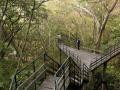
Basically, both Minh Chau and Quan Lan localities have quite favorable conditions for developing ecotourism. However, Quan Lan commune has more advantages to develop ecotourism in a humanistic direction, because this is an area with many famous historical relics such as Quan Lan Communal House, Quan Lan Pagoda, Temple worshiping the hero Tran Khanh Du, ... along with local festivals held annually such as the wind praying ceremony (March 15), Quan Lan festival (June 10-19); due to its location near the port and long exploitation time, the beaches in Quan Lan commune (especially Quan Lan beach) are no longer hygienic and clean to ensure the needs of tourists coming to relax and swim; this is also an area with many beautiful landscapes such as Got Beo wind pass, Ong Phong head, Voi Voi cave, but the ability to access these places is still very limited (dirt hill road, lots of gravel and rocks), especially during rainy and windy times; In addition, other natural resources such as mangrove forests and sea worms have not been really exploited for tourism purposes and ecotourism development. On the contrary, Minh Chau commune has more advantages in developing ecotourism in the direction of natural tourism, this is an area with diverse ecosystems such as at Rua De Beach, Bai Tu Long National Park Conservation Center...; Minh Chau beach is highly appreciated for its natural beauty and cleanliness, ranked in the top ten most beautiful beaches in Vietnam; Minh Chau commune is also home to Tram forest with a large area and a purity of up to 90%, suitable for building bridges through the forest (a very effective type of natural ecotourism currently applied by many countries) for tourists to sightsee, as well as for the purpose of studying and researching.
Figure 3.1: Thenmala Forest Bridge (India) Source: https://www.thenmalaecotourism.com/(August 21, 2019)
3.2.2. Using SWOT matrix to evaluate Quan Lan island tourism
General assessment of current tourism activities of Quan Lan island is shown through the following SWOT matrix:
Table 3.5: SWOT matrix evaluating tourism activities on Quan Lan island
Internal agent
Strengths- There is a lot of potential for tourism development, especially natural ecotourism and humanistic ecotourism.- The unskilled labor force is relatively abundant.- resource environmentunpolluted, still
Weaknesses- Poorly developed infrastructure, especially traffic routes to tourist destinations on the island.- The team of professional staff is still weak.- Tourism products in general
quite wild, originalintact
general and DLST in particularalone is monotonous.
External agents
Opportunity- Tourism is a key industry in the socio-economic development strategy of the province and Van Don economic zone.- Quan Lan was selected as a pilot area for eco-tourism development within the framework of the green growth project between Quang Ninh province and the Japanese organization JICA.- The flow of tourists and especially ecotourism in the world tends toincreasing
Challenge- Weather and climate change abnormally.- Competition in tourism products is increasingly fierce, especially with other localities in the province such as Ha Long, Mong Cai...- Awareness of tourists, especially domestic tourists, about ecotourism and nature conservation is not high.
Through summary analysis using SWOT matrix we see that:
To exploit strengths and take advantage of opportunities, it is necessary to:
- Diversify products and service types (build more tourism routes aimed at specific needs of tourists: experiential tourism immersed in nature, spiritual cultural tourism...)
- Effective exploitation of resources and differentiated products (natural resources and human resources)
div.maincontent .p { color: black; font-family:"Times New Roman", serif; font-style: normal; font-weight: normal; text-decoration: none; font-size: 14pt; margin:0pt; } div.maincontent p { color: black; font-family:"Times New Roman", serif; font-style: normal; font-weight: normal; text-decoration: none; font-size: 14pt; margin:0pt; } div.maincontent .s1 { color: black; font-family:"Times New Roman", serif; font-style: normal; font-weight: normal; text-decoration: none; font-size: 13pt; } div.maincontent .s2 { color: black; font-family:"Times New Roman", serif; font-style: normal; font-weight: normal; text-decoration: none; font-size: 13pt; } div.maincontent .s3 { color: #0D0D0D; font-family:"Times New Roman", serif; font-style: normal; font-weight: bold; text-decoration: none; font-size: 14pt; } div.maincontent .s4 { color: black; font-family:"Times New Roman", serif; font-style: italic; font-weight: normal; text-decoration: none; font-size: 14pt; } div.maincontent .s5 { color: black; font-family:"Times New Roman", serif; font-style: italic; font-weight: bold; text-decoration: none; font-size: 14pt; } div.maincontent .s6 { color: black; font-family:"Times New Roman", serif; font-style: italic; font-weight: normal; text-decoration: none; font-size: 14pt; vertical-align: -3pt; } div.maincontent .s7 { color: black; font-family:"Times New Roman", serif; font-style: italic; font-weight: normal; text-decoration: none; font-size: 14pt; vertical-align: -2pt; } div.maincontent .s8 { color: black; font-family:"Times New Roman", serif; font-style: italic; font-weight: normal; text-decoration: none; font-size: 14pt; vertical-align: -1pt; } div.maincontent .s9 { color: black; font-family:"Times New Roman", serif; font-style: normal; font-weight: normal; text-decoration: none; font-size: 14pt; } div.maincontent .s10 { color: black; font-family:"Times New Roman", serif; font-style: normal; font-weight: bold; text-decoration: none; font-size: 14pt; } div.maincontent .s11 { color: black; font-family:"Times New Roman", serif; font-style: normal; font-weight: normal; text-decoration: none; font-size: 14pt; } div.maincontent .s12 { color: black; font-family:Symbol, serif; font-style: normal; font-weight: normal; text-decoration: none; font-size: 14pt; } div.maincontent .s13 { color: black; font-family:Wingdings; font-style: normal; font-weight: normal; text-decoration: none; font-size: 14pt; } div.maincontent .s14 { color: black; font-family:"Times New Roman", serif; font-style: normal; font-weight: normal; text-decoration: none; font-size: 9pt; vertical-align: 5pt; } div.maincontent .s15 { color: black; font-family:"Times New Roman", serif; font-style: normal; font-weight: normal; text-decoration: none; font-size: 9pt; vertical-align: 5pt; } div.maincontent .s16 { color: black; font-family:Cambria, serif; font-style: italic; font-weight: normal; text-decoration: none; font-size: 14pt; } div.maincontent .s17 { color: #080808; font-family:"Times New Roman", serif; font-style: normal; font-weight: bold; text-decoration: none; font-size: 14pt; } div.maincontent .s18 { color: #080808; font-family:"Times New Roman", serif; font-style: normal; font-weight: normal; text-decoration: none; font-size: 14pt; } div.maincontent .s19 { color: black; font-family:"Times New Roman", serif; font-style: normal; font-weight: normal; text-decoration: none; font-size: 11pt; } div.maincontent .s20 { color: black; font-family:"Times New Roman", serif; font-style: normal; font-weight: normal; text-decoration: none; font-size: 10pt; } div.maincontent .s21 { color: black; font-family:"Times New Roman", serif; font-style: normal; font-weight: bold; text-decoration: none; font-size: 11pt; } div.maincontent .s22 { color: black; font-family:"Times New Roman", serif; font-style: normal; font-weight: normal; text-decoration: none; font-size: 11pt; } div.maincontent .s23 { color: black; font-family:"Times New Roman", serif; font-style: italic; font-weight: normal; text-decoration: none; font-size: 14pt; } div.maincontent .s24 { color: #212121; font-family:"Times New Roman", serif; font-style: normal; font-weight: normal; tex
Identify Rating Levels and Rating Scales
zt2i3t4l5ee
zt2a3gstourism,quan lan,quang ninh,ecology,ecotourism,minh chau,van don,geography,geographical basis,tourism development,science
zt2a3ge
zc2o3n4t5e6n7ts
of the islanders. Therefore, this indicator will be divided into two sub-indicators:
a1. Natural tourism attractiveness a2. Cultural tourism attractiveness
b. Tourist capacity
The two island communes in Quan Lan have different capacities to receive tourists. Minh Chau Commune is home to many standard hotels and resorts, attracting high-income domestic and international tourists. Meanwhile, Quan Lan Commune has many motels mainly built and operated by local people, so the scale and quality are not high, and will be suitable for ordinary tourists such as students.
c. Time of exploitation of Quan Lan Island Commune:
Quan Lan tourism is seasonal due to weather and climate conditions and festivals only take place on certain days of the year, specifically in spring. In Quan Lan commune, the period from April to June and from September to November is considered the best time to visit Quan Lan because the cultural tourism activities are mainly associated with festivals taking place during this time.
Minh Chau island commune:
Tourism exploitation time is all year round, because this is a place with a number of tourist attractions with diverse ecosystems such as Bai Tu Long National Park Research Center, Tram forest, Turtle Laying Beach, so besides coming to the beach for tourism and vacation in the summer, Minh Chau will attract research groups to come for tourism combined with research at other times of the year.
d. Sustainability
The sustainability of ecotourism sites in Quan Lan and Minh Chau communes depends on the sensitivity of the ecosystems to climate changes.
landscape. In general, these tourist destinations have a fairly high level of sustainability, because they are natural ecosystems, planned and protected. However, if a large number of tourists gather at certain times, it can exceed the carrying capacity and affect the sustainability of the environment (polluted beaches, damaged trees, animals moving away from their habitats, etc.), then the sustainability of the above ecosystems (natural ecosystems, human ecosystems) will also be affected and become less sustainable.
e. Location and accessibility
Both island communes have ports to take tourists to visit from Van Don wharf:
- Quan Lan – Van Don traffic route:
Phuc Thinh – Viet Anh high-speed boat and Quang Minh high-speed boat, depart at 8am and 2pm from Van Don to Quan Lan, and at 7am and 1pm from Quan Lan to Van Don. There are also wooden boats departing at 7am and 1pm.
- Van Don - Minh Chau traffic route:
Chung Huong high-speed train, Minh Chau train, morning 7:30 and afternoon 13:30 from Van Don to Minh Chau, morning 6:30 and afternoon 13:00 from Minh Chau to Van Don.
f. Infrastructure
Despite receiving investment attention, the issue of infrastructure and technical facilities for tourism on Quan Lan Island is still an issue that needs to be resolved because it has a direct impact on the implementation of ecotourism activities. The minimum conditions for serving tourists such as accommodation, electricity, water, communication, especially medical services, and security work need to be given top priority. Ecotourism spots in Minh Chau commune are assessed to have better infrastructure and technical facilities for tourism because there are quite complete and synchronous conditions for serving tourists, meeting many needs of domestic and foreign tourists.
3.2.1.4. Determine assessment levels and assessment scales
Corresponding to the levels of each criterion, the index is the score of those levels in the order of 4, 3, 2, 1 decreasing according to the standard of each level: very attractive (4), attractive (3), average (2), less attractive (1).
3.2.1.5. Determining the coefficients of the criteria
For the assessment of DLST in the two communes of Quan Lan and Minh Chau islands, the students added evaluation coefficients to show the importance of the criteria and indicators as follows:
Coefficient 3 with criteria: Attractiveness, Exploitation time. These are the 2 most important criteria for attracting tourists to tourism in general and eco-tourism in particular, so they have the highest coefficient.
Coefficient 2 with criteria: Capacity, Infrastructure, Location and accessibility . Because the assessment area is an island commune of Van Don district, the above criteria are selected by the author with appropriate coefficients at the average level.
Coefficient 1 with criteria: Sustainability. Quan Lan has natural and human-made ecotourism sites, with high biodiversity and little impact from local human factors. Most of the ecotourism sites are still wild, so they are highly sustainable.
3.2.1.6. Results of DLST assessment on Quan Lan island
a. Assessment of the potential for natural tourism development
For Minh Chau commune:
+ Natural tourism attractiveness is determined to be very attractive (4 points) and the most important coefficient (coefficient 3), so the score of the Attractiveness criterion is 4 x 3 = 12.
+ Capacity is determined as average (2 points) and the coefficient is quite important (coefficient 2), then the score of Capacity criterion is 2 x 2 = 4.
+ Exploitation time is long (4 points), the most important coefficient (coefficient 3) so the score of the Exploitation time criterion is 4 x 3 = 12.
+ Sustainability is determined as sustainable (4 points), the important coefficient is the average coefficient (coefficient 1), so the score of the Sustainability criterion is 4 x 1 = 4 points
+ Location and accessibility are determined to be quite favorable (2 points), the coefficient is quite important (coefficient 2), the criterion score is 2 x 2 = 4 points.
+ Infrastructure is assessed as good (3 points), the coefficient is quite important (coefficient 2), then the score of the Infrastructure criterion is 3 x 2 = 6 points.
The total score for evaluating DLST in Minh Chau commune according to 6 evaluation criteria is determined as: 12 + 4 + 12 + 4 + 4 + 6 = 42 points
Similar assessment for Quan Lan commune, we have the following table:
Table 3.3: Assessment of the potential for natural ecotourism development in Quan Lan and Minh Chau communes
Attractiveness of self-tourismof course
Capacity
Mining time
Sustainability
Location and accessibility
Infrastructure
Result
Point
DarkMulti
Point
DarkMulti
Point
DarkMulti
Point
DarkMulti
Point
DarkMulti
Point
DarkMulti
CommuneMinh Chau
12
12
4
8
12
12
4
4
4
8
6
8
42/52
Quan CommuneLan
6
12
6
8
9
12
4
4
4
8
4
8
33/52
b. Assessment of the potential for humanistic tourism development
For Quan Lan commune:
+ The attractiveness of human tourism is determined to be very attractive (4 points) and the most important coefficient (coefficient 3), so the score of the Attractiveness criterion is 4 x 3 = 12.
+ Capacity is determined to be large (3 points) and the coefficient is quite important (coefficient 2), then the score of the Capacity criterion is 3 x 2 = 6.
+ Mining time is average (3 points), the most important coefficient (coefficient 3) so the score of the Mining time criterion is 3 x 3 = 9.
+ Sustainability is determined as sustainable (4 points), the important coefficient is the average coefficient (coefficient 1), so the score of the Sustainability criterion is 4 x 1 = 4 points.
+ Location and accessibility are determined to be quite favorable (2 points), the coefficient is quite important (coefficient 2), the criterion score is 2 x 2 = 4 points.
+ Infrastructure is rated as average (2 points), the coefficient is quite important (coefficient 2), then the score of the Infrastructure criterion is 2 x 2 = 4 points.
The total score for evaluating DLST in Quan Lan commune according to 6 evaluation criteria is determined as: 12 + 6 + 6 + 4 + 4 + 4 = 36 points.
Similar assessment with Minh Chau commune we have the following table:
Table 3.4: Assessment of the potential for developing humanistic eco-tourism in Quan Lan and Minh Chau communes
Attractiveness of human tourismliterature
Capacity
Mining time
Sustainability
Location and accessibility
Infrastructure
Result
Point
DarkMulti
Point
DarkMulti
Point
DarkMulti
Point
DarkMulti
Point
DarkMulti
Point
DarkMulti
Quan CommuneLan
12
12
6
8
9
12
4
4
4
8
4
8
39/52
Minh CommuneChau
6
12
4
8
12
12
4
4
4
8
6
8
36/52
Basically, both Minh Chau and Quan Lan localities have quite favorable conditions for developing ecotourism. However, Quan Lan commune has more advantages to develop ecotourism in a humanistic direction, because this is an area with many famous historical relics such as Quan Lan Communal House, Quan Lan Pagoda, Temple worshiping the hero Tran Khanh Du, ... along with local festivals held annually such as the wind praying ceremony (March 15), Quan Lan festival (June 10-19); due to its location near the port and long exploitation time, the beaches in Quan Lan commune (especially Quan Lan beach) are no longer hygienic and clean to ensure the needs of tourists coming to relax and swim; this is also an area with many beautiful landscapes such as Got Beo wind pass, Ong Phong head, Voi Voi cave, but the ability to access these places is still very limited (dirt hill road, lots of gravel and rocks), especially during rainy and windy times; In addition, other natural resources such as mangrove forests and sea worms have not been really exploited for tourism purposes and ecotourism development. On the contrary, Minh Chau commune has more advantages in developing ecotourism in the direction of natural tourism, this is an area with diverse ecosystems such as at Rua De Beach, Bai Tu Long National Park Conservation Center...; Minh Chau beach is highly appreciated for its natural beauty and cleanliness, ranked in the top ten most beautiful beaches in Vietnam; Minh Chau commune is also home to Tram forest with a large area and a purity of up to 90%, suitable for building bridges through the forest (a very effective type of natural ecotourism currently applied by many countries) for tourists to sightsee, as well as for the purpose of studying and researching.
Figure 3.1: Thenmala Forest Bridge (India) Source: https://www.thenmalaecotourism.com/(August 21, 2019)
3.2.2. Using SWOT matrix to evaluate Quan Lan island tourism
General assessment of current tourism activities of Quan Lan island is shown through the following SWOT matrix:
Table 3.5: SWOT matrix evaluating tourism activities on Quan Lan island
Internal agent
Strengths- There is a lot of potential for tourism development, especially natural ecotourism and humanistic ecotourism.- The unskilled labor force is relatively abundant.- resource environmentunpolluted, still
Weaknesses- Poorly developed infrastructure, especially traffic routes to tourist destinations on the island.- The team of professional staff is still weak.- Tourism products in general
quite wild, originalintact
general and DLST in particularalone is monotonous.
External agents
Opportunity- Tourism is a key industry in the socio-economic development strategy of the province and Van Don economic zone.- Quan Lan was selected as a pilot area for eco-tourism development within the framework of the green growth project between Quang Ninh province and the Japanese organization JICA.- The flow of tourists and especially ecotourism in the world tends toincreasing
Challenge- Weather and climate change abnormally.- Competition in tourism products is increasingly fierce, especially with other localities in the province such as Ha Long, Mong Cai...- Awareness of tourists, especially domestic tourists, about ecotourism and nature conservation is not high.
Through summary analysis using SWOT matrix we see that:
To exploit strengths and take advantage of opportunities, it is necessary to:
- Diversify products and service types (build more tourism routes aimed at specific needs of tourists: experiential tourism immersed in nature, spiritual cultural tourism...)
- Effective exploitation of resources and differentiated products (natural resources and human resources)
div.maincontent .p { color: black; font-family:"Times New Roman", serif; font-style: normal; font-weight: normal; text-decoration: none; font-size: 14pt; margin:0pt; } div.maincontent p { color: black; font-family:"Times New Roman", serif; font-style: normal; font-weight: normal; text-decoration: none; font-size: 14pt; margin:0pt; } div.maincontent .s1 { color: black; font-family:"Times New Roman", serif; font-style: normal; font-weight: normal; text-decoration: none; font-size: 13pt; } div.maincontent .s2 { color: black; font-family:"Times New Roman", serif; font-style: normal; font-weight: normal; text-decoration: none; font-size: 13pt; } div.maincontent .s3 { color: #0D0D0D; font-family:"Times New Roman", serif; font-style: normal; font-weight: bold; text-decoration: none; font-size: 14pt; } div.maincontent .s4 { color: black; font-family:"Times New Roman", serif; font-style: italic; font-weight: normal; text-decoration: none; font-size: 14pt; } div.maincontent .s5 { color: black; font-family:"Times New Roman", serif; font-style: italic; font-weight: bold; text-decoration: none; font-size: 14pt; } div.maincontent .s6 { color: black; font-family:"Times New Roman", serif; font-style: italic; font-weight: normal; text-decoration: none; font-size: 14pt; vertical-align: -3pt; } div.maincontent .s7 { color: black; font-family:"Times New Roman", serif; font-style: italic; font-weight: normal; text-decoration: none; font-size: 14pt; vertical-align: -2pt; } div.maincontent .s8 { color: black; font-family:"Times New Roman", serif; font-style: italic; font-weight: normal; text-decoration: none; font-size: 14pt; vertical-align: -1pt; } div.maincontent .s9 { color: black; font-family:"Times New Roman", serif; font-style: normal; font-weight: normal; text-decoration: none; font-size: 14pt; } div.maincontent .s10 { color: black; font-family:"Times New Roman", serif; font-style: normal; font-weight: bold; text-decoration: none; font-size: 14pt; } div.maincontent .s11 { color: black; font-family:"Times New Roman", serif; font-style: normal; font-weight: normal; text-decoration: none; font-size: 14pt; } div.maincontent .s12 { color: black; font-family:Symbol, serif; font-style: normal; font-weight: normal; text-decoration: none; font-size: 14pt; } div.maincontent .s13 { color: black; font-family:Wingdings; font-style: normal; font-weight: normal; text-decoration: none; font-size: 14pt; } div.maincontent .s14 { color: black; font-family:"Times New Roman", serif; font-style: normal; font-weight: normal; text-decoration: none; font-size: 9pt; vertical-align: 5pt; } div.maincontent .s15 { color: black; font-family:"Times New Roman", serif; font-style: normal; font-weight: normal; text-decoration: none; font-size: 9pt; vertical-align: 5pt; } div.maincontent .s16 { color: black; font-family:Cambria, serif; font-style: italic; font-weight: normal; text-decoration: none; font-size: 14pt; } div.maincontent .s17 { color: #080808; font-family:"Times New Roman", serif; font-style: normal; font-weight: bold; text-decoration: none; font-size: 14pt; } div.maincontent .s18 { color: #080808; font-family:"Times New Roman", serif; font-style: normal; font-weight: normal; text-decoration: none; font-size: 14pt; } div.maincontent .s19 { color: black; font-family:"Times New Roman", serif; font-style: normal; font-weight: normal; text-decoration: none; font-size: 11pt; } div.maincontent .s20 { color: black; font-family:"Times New Roman", serif; font-style: normal; font-weight: normal; text-decoration: none; font-size: 10pt; } div.maincontent .s21 { color: black; font-family:"Times New Roman", serif; font-style: normal; font-weight: bold; text-decoration: none; font-size: 11pt; } div.maincontent .s22 { color: black; font-family:"Times New Roman", serif; font-style: normal; font-weight: normal; text-decoration: none; font-size: 11pt; } div.maincontent .s23 { color: black; font-family:"Times New Roman", serif; font-style: italic; font-weight: normal; text-decoration: none; font-size: 14pt; } div.maincontent .s24 { color: #212121; font-family:"Times New Roman", serif; font-style: normal; font-weight: normal; tex -
 The Role of Vinh Phuc Tourism in Local Socio-Economic Development
 -
 Natural Conditions, Socio-Economics and Resources for Tourism Development of Hai Phong
 -
 The role of tourism in the socio-economic development of Binh Thuan in the period 2001-2020 - 1
 -
 The Role of Tourism in Socio-Economic and Environmental Development
Bai Dai: Bai Dai is located on Cai Bau Island. With a natural landscape that is still quite wild, the beautiful beach stretching nearly 2 km creates an ideal beach for this tourist area. Coming here, tourists can not only enjoy the fresh, peaceful atmosphere but also visit the beautiful scenery created by human hands and what nature has bestowed on this land. At Bai Dai, tourists can both swim in the sea and watch the small islands rising above the sea, feeling the poetic and romantic scenery. In addition, tourists can go to the beach to participate in sports such as beach volleyball, swimming, jet skiing, etc.
2.3. Socio-economic conditions and human tourism resources.
2.3.1. Economic characteristics.
The outstanding feature of the economy in Van Don district is still basically the agricultural - forestry - fishery economy.
Currently, the economic structure of Van Don district has shifted towards increasing the proportion of services, tourism and fisheries, and reducing the proportion of agriculture and forestry.
– fisheries. In addition, the non-state economy grows relatively quickly compared to the state economy.
The economic proportion between sectors in the district in 2009 is as follows:
Agriculture, forestry and fishery account for 33.5%. Industry and construction account for 45.9%. Trade and services account for 20.6%.
2.3.1.1.Agricultural economic sector.
a. Aquatic products:
With a sea surface area of nearly 160 thousand hectares, adjacent to large fishing grounds, a port system and experienced professional workers, the fishery industry is truly a key economic sector in the district. In 2009, the total output was estimated at 11,650 tons, up 129.4% compared to the plan and up 33% over the same period. The total value of fishery output was estimated at 256.3 billion VND, up 163 billion VND over the same period.
However, the rapid increase in exploitation, fishing and aquaculture has created a lot of pressure on the environment. Environmental protection has not really received attention. Currently, the district is actively developing a fleet of offshore fishing vessels because it is both highly productive and protects resources in the country's inland waters, limiting environmental impacts.
b. Agricultural production:
Agriculture is still the sector with the largest number of workers, but the efficiency is not high. Regarding cultivation, in 2009, the work of converting crop structure, repairing, upgrading and building new irrigation works to ensure water sources for production was carried out. Rice productivity reached 35 tons/ha, yield reached 3,111 tons. Total food output in 2009 was 3,322 tons, reaching 97.71% of the plan.
Regarding livestock, strengthen measures to prevent and control epidemics and disinfect. 12,642 pigs, reaching 81.5% of the plan, 83,200 poultry, reaching 99% of the plan.
c. Forestry:
In 2009, 57,050 trees were planted to protect the environment, 1,292 hectares of concentrated forests, an increase of 23.6% over the same period. Forest products: planted wood (7,079m3 ) , bamboo for paper materials (881 tons).. Arrest and strictly handle 57
Forestry law violations, fire prevention and fighting, inspection of 3 types of forests to serve forest protection planning.
2.3.1.2. Industrial and handicraft economic zones.
The production value of this area in 2009 is estimated at 18 billion VND, reaching 110% of the plan. The whole district has 7 occupations, 26 traditional handicraft production units such as processing Van tea, making incense, mechanical repair, building and repairing ships... The industrial structure is still simple, including coal mining and construction materials (accounting for 67% of the production value of the industrial - construction sector), processing agriculture - forestry - fishery and seafood (accounting for 15.2%) and handicrafts (17.8%).
2.3.1.3. Commercial and service area:
In recent times, trade and services have had positive changes. Services have gradually developed with the participation of many economic sectors. The system of branches and agents of household-scale businesses has gradually formed and developed rapidly, creating convenience for consumers. Import-export activities have also contributed to the GDP growth of the district. The main export items include specialties such as shrimp, squid, blood cockles, pearls, valuable species (song, nhu, thu, de ...), forest products (turpentine, medicinal herbs, honey). Imported goods include small machinery, mechanical tools, office clothes, etc.
2.3.2. Population characteristics.
2.3.2.1. Population
Due to natural conditions, the population distribution is generally fragmented, and is naturally separated by the sea. As of December 31, 2006, the population of Van Don district was 41,081 people, 9,130 households, with 9 ethnic groups: Kinh, Tay, Nung, Dao, Muong, San Diu, Cao Lan, Hoa and Than Sin living together in harmony, of which Kinh people account for 88.6%, other ethnic groups account for 11.4%. The population is unevenly distributed over 20 islands, in 80 villages, most concentrated on Cai Bau island and Quan Lan island, population density: 75.4 people/km2 . Lower than the average of Quang Ninh province (181 people/km2 ) . The population is mainly concentrated in a number of communes (the commune with the largest population is Dong Xa commune, over 9,000 people).
people), the rest are scattered on the island communes, of which Minh Chau commune has the least with 900 people (2008 data). In the period 2001 - 2006, the average population was 4.7 people/household, the average number of workers was 2.14 workers/household, while the average of Quang Ninh province was 4.78 people/household; 2.24 workers/household. This population distribution feature greatly affects the economic and social development and organization of economic space in the district, making it very difficult to mobilize resources and access community benefits.
2.3.2.2. Labor:
As of December 2009, the number of people of working age in Van Don was 20,953, accounting for 50.3% of the district's population, 97% of the working age population had jobs.
The quality of the labor force is not high, with trained workers accounting for 6.1%. The number of laborers with university and college degrees is 500 people.
Regarding age structure: Young population under 14 years old accounts for 36.6%, from 15 to 60 years old accounts for 56.3%, over 60 years old accounts for 7.1%.
People's income is gradually improving. In 2009, GDP per capita increased to 12.45 million VND, equal to 92.67% of the national average.
The poverty rate in the whole district has gradually decreased. The poorest communes are Ban Sen, Dai Xuyen, and Van Hoa. The residents of Quan Lan and Cai Rong Ha Long have a better life.
2.3.3. Culture, health, education and national security and defense:
2.3.3.1. Culture - Sports:
With the attention of all levels and sectors, cultural and sports activities in the district are increasingly vibrant in communes near the district town such as Cai Rong Town, Ha Long, Dong Xa. In Cai Rong, there is a radio and television station broadcasting to 100% of the villages. Currently, the whole district has been recognized as having 16 cultural villages, 53 advanced residential areas and more than 6,500 cultural families.
The main traditional festivals in the district and neighboring localities are Quan Lan communal house festival and Cua Ong temple festival. In recent years, the Quan Lan communal house festival has been solemnly organized by the People's Committee of Van Don district, with the intention of
means a traditional festival, linking traditional education with tourism development in the district. This will be an important factor in the program of developing Ecotourism.
Regarding physical education and sports: The district has 1 stadium and 7 sports training grounds in the communes. The facilities are still difficult and cannot meet the needs of the people. The physical education and sports movement is organized regularly and effectively, achieving many provincial awards.
2.3.3.2. Health:
The health care network has many difficulties due to the scattered population. Currently, there is 1 district hospital (Van Don hospital in Cai Rong town) and 1 treatment center (a branch in Quan Lan commune). In addition, there are health stations in all 12 communes and towns in the district. The commune health stations are gradually increasing their efficiency thanks to improving their technical facilities to meet national standards.
Environmental sanitation conditions have been gradually improved. Population and family planning work has received attention.
2.3.3.3 Education and training:
Currently, the district has 28 educational and training facilities. These training facilities are located near residential areas, attracting a large number of children to school. The rate of children attending school at all levels is over 80%.
The quality of education is relatively good. In 1998, primary education was universalized according to standards in all communes and illiteracy was basically eliminated for people aged 15-35. However, the reality is that the district's labor force who go to university or vocational high school rarely return to their hometown to work.
2.3.3.3 . National security and defense.
As a district located at the front line of the Fatherland, the issue of national defense and security is always given attention. The district seriously carries out local defense work, organizes drills, regional defense, and regularly takes care of building and improving the combat readiness of the armed forces, reserve forces and militia.
The fight against crime and social evils is also given attention.
Thus, in general, Van Don is among the districts with a positive economic change, people's lives are improving, and the poverty rate is gradually decreasing. The labor force in the agriculture - forestry - fishery sector is large but the output value is low. This is an unfavorable factor for the conservation of natural resources and the stabilization of people's lives.
2.3.4. Human tourism resources.
Coming to Van Don, combined with visiting natural tourist attractions, visitors have the opportunity to revisit the ancient trading port of Van Don, which was prosperous and bustling since ancient times. As an area with a system of rocky island wonders connected to the Ha Long area, it has long been a famous scenic area of the country associated with the tradition of Ha Long and Bai Tu Long. Van Don has more than 600 large and small islands interwoven into walls, which is the country's fence, the first bustling trading port of our country since the Ly-Tran period (11th-12th century).
Van Don is an open-air geological museum. According to the historical records of the 19th year of Thien Hung, the Tran Dynasty established Van Don town (with Binh Hai Quan). Records related to the place name Van Don such as "Dai Viet Dia Du Toan Bien" citing the book "Thien Ha Quan Quoc Loi Benh Thu" stated that "in the fifth year of Vinh Lac (1407), Van Don was one of the eight districts of Vinh An district. Regarding Van Don mountain, it is written that "Van Don mountain is located in the northeast of Giao Chau prefecture, Van Don district is in the great sea, the two mountains face each other. A stream flows through the middle, merchant ships of the vassal states mostly meet here".
This is also the cradle of Ha Long culture, which is Soi Nhu culture. From Soi Nhu culture to Cai Beo culture, Thoi Gieng site developed into a Ha Long culture. Ha Long cultural value (including Van Don and Ha Long areas) is all the spiritual and material values that generations of Van Don - Ha Long people created since prehistoric times. From the traces of large monkeys in some caves in Soi Nhu area, we have clarified the history of Soi Nhu culture, a culture with its own characteristics. Next to Soi Nhu culture is the culture
The middle Neolithic period of Cai Beo. Progressed to the early type of Ha Long culture, Thoi Gieng, and then developed into a brilliant Ha Long culture. The imprints of Ha Long culture are spread everywhere in the midlands and northern delta.
Cultural and historical relics.
Quan Lan Communal House : is an ancient architectural work with one of the largest scales currently in Quang Ninh. The communal house was built during the Le Dynasty at Cai Lang Wharf, an ancient commercial port center of Van Don, consisting of 9 compartments. During the Nguyen Dynasty, when people moved to Quan Lan to live, the communal house was also moved and reduced to 7 compartments. At first, the communal house was built in the shape of the letter "khau", then it was modified in the shape of the letter "cong", including 5 compartments with 2 left front halls, 3 tube compartments and 1 compartment with 2 wings for the back palace. Later, it was moved to Thai Hoa hamlet, then Nam hamlet, and finally moved to Doai hamlet and was reduced to its current size. The entire architecture of the communal house, although massive and imposing, the curved dragon-shaped ends of the roof have given the communal house a graceful curve. The roof is covered with fish-tail tiles, on the ridge of the roof are embossed two dragons facing the moon, the system of wooden columns and trusses is in the style of a gong rack overlapping beams. The carvings here are elaborately, meticulously, sharply carved by artisans and reach the pinnacle of art. The main decorative motifs are dragons, phoenixes and flowers and leaves, expressed in different shades on each scroll, beam, eaves, lintel, and arched door, bearing the bold style of the Le Dynasty. The entire wooden column system is made of Man Lai wood - the best type of wood and stronger than Lim wood, growing from the rocky mountains on Ba Mun Island (Van Don).
Quan Lan Communal House was built to worship the village's Thanh Hoang and the ancestors who had the merit of establishing the hamlet and establishing today's Quan Lan commune, and Tran Khanh Du, who had great merit in commanding the battle to defeat Truong Van Ho's army in Van Don, Cua Luc, making an important contribution to the great victory of Bach Dang in 1288, so he was worshiped by the people as the village's Thanh Hoang. Currently, what is still preserved at the top is the statue of Tran Khanh Du, 18 royal decrees of the Nguyen Dynasty conferring on Tran Khanh Du, the throne, the altar, the gate, the horizontal lacquered board, and the parallel sentences.
Quan Lan Pagoda: Located right to the left of Quan Lan communal house, the name is Van Quan, the name Van Quan shows the relationship between Van Don trading port and the commune.
Quan Lan today. The pagoda has a "dinh"-shaped architecture consisting of 3 compartments, 2 front rooms and 3 back rooms, roofed with fish-tail tiles, in front of the pagoda is the three-door bell tower. The system of wooden columns and trusses is in the style of a gong frame with overlapping beams, the beams and the first beams are all carved with the images of vines, spiral leaf flowers and fully blooming chrysanthemums. In addition to worshiping Buddha, Quan Lan pagoda also worships Mother Lieu Hanh, a local belief and worships Mr. Hau (a person who contributed to the villagers). Currently, the pagoda still preserves valuable Buddha statues of the Nguyen Dynasty, horizontal lacquered boards, parallel sentences, the royal decree of King Thanh Thai (1889) conferred on Mother Lieu Hanh and many other valuable bronze and wooden objects.
Lam Pagoda: located on the western slope opposite five ancient boat docks at the foot of Cong Dong Island. The pagoda was built in the Ba Be basin surrounded by high mountains, the pagoda gate faces the vast sea, with a white sand beach stretching several hundred meters. Buddha is the most important architecture of Lam Pagoda. The pagoda's foundation has two levels, the first level is nearly square, the second level is smaller, both levels are solidly paved with stone. On the second level there are also 16 stone pillars, in the middle of the 4 pillars there is a 3-storey stone lotus pedestal. All 3 levels are beautifully carved, the soft lotus petals gradually shrink from bottom to top, from outside to inside, like a blooming lotus bud. The ancestral house is quite massive with an upper and lower row of houses. The walls are made of stacked stones, without a trace of mortar, still not skewed, the wall surface is still flat even after 60 or 70 years have passed.
Terracotta Tower: built to the north of Cong Tay Island on a flat land with a fairly high hill. The tower is built entirely of baked bricks, the outside of the tower is decorated with dragons, phoenixes, flowers and leaves with graceful and lively movements.
On each boat dock there is a fresh water well, that is Hieu well (or fairy well) on Cai Lang wharf which is full of cool water all year round. In addition, there is also Golden Turtle well on Con Quy, Dinh well on Cai Cong wharf. Each well is associated with a legend, and each well is clear, sweet and full of water all around.